How to resolve AdBlock issue?
Refresh this page
Lake County News,California
  • Home
    • Registration Form
  • News
    • Education
    • Veterans
    • Community
      • Obituaries
      • Letters
      • Commentary
    • Police Logs
    • Business
    • Recreation
    • Health
    • Religion
    • Legals
    • Arts & Life
    • Regional
  • Calendar
  • Contact us
    • FAQs
    • Phones, E-Mail
    • Subscribe
  • Advertise Here
  • Login
How to resolve AdBlock issue?
Refresh this page

News

Data centers consume massive amounts of water – companies rarely tell the public exactly how much

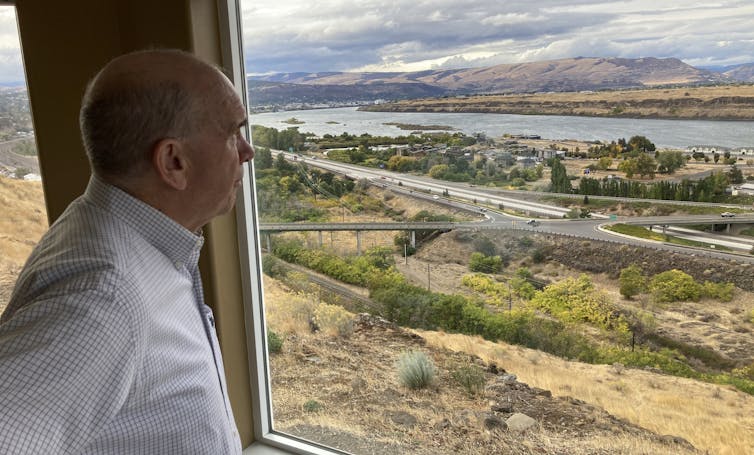
The Columbia River running through The Dalles, Oregon, supplies water to cool data centers. AP Photo/Andrew Selsky

As demand for artificial intelligence technology boosts construction and proposed construction of data centers around the world, those computers require not just electricity and land, but also a significant amount of water. Data centers use water directly, with cooling water pumped through pipes in and around the computer equipment. They also use water indirectly, through the water required to produce the electricity to power the facility. The amount of water used to produce electricity increases dramatically when the source is fossil fuels compared with solar or wind.

A 2024 report from the Lawrence Berkeley National Laboratory estimated that in 2023, U.S. data centers consumed 17 billion gallons (64 billion liters) of water directly through cooling, and projects that by 2028, those figures could double – or even quadruple. The same report estimated that in 2023, U.S. data centers consumed an additional 211 billion gallons (800 billion liters) of water indirectly through the electricity that powers them. But that is just an estimate in a fast-changing industry.

We are researchers in water law and policy based on the shores of Lake Michigan. Technology companies are eyeing the Great Lakes region to host data centers, including one proposed for Port Washington, Wisconsin, which could be one of the largest in the country. The Great Lakes region offers a relatively cool climate and an abundance of water, making the region an attractive location for hot and thirsty data centers.

The Great Lakes are an important, binational resource that more than 40 million people depend on for their drinking water and supports a US$6 trillion regional economy. Data centers compete with these existing uses and may deplete local groundwater aquifers.

Our analysis of public records, government documents and sustainability reports compiled by top data center companies has found that technology companies don’t always reveal how much water their data centers use. In a forthcoming Rutgers Computer and Technology Law Journal article, we walk through our methods and findings using these resources to uncover the water demands of data centers.

In general, corporate sustainability reports offered the most access and detail – including that in 2024, one data center in Iowa consumed 1 billion (3.8 billion liters) gallons of water – enough to supply all of Iowa’s residential water for five days.

The computer processors in data centers generate lots of heat while doing their work.

How do data centers use water?

The servers and routers in data centers work hard and generate a lot of heat. To cool them down, data centers use large amounts of water – in some cases over 25% of local community water supplies. In 2023, Google reported consuming over 6 billion gallons of water (nearly 23 billion liters) to cool all its data centers.

In some data centers, the water is used up in the cooling process. In an evaporative cooling system, pumps push cold water through pipes in the data center. The cold water absorbs the heat produced by the data center servers, turning into steam that is vented out of the facility. This system requires a constant supply of cold water.

In closed-loop cooling systems, the cooling process is similar, but rather than venting steam to the air, air-cooled chillers cool down the hot water. The cooled water is then recirculated to cool the facility again. This does not require constant addition of large volumes of water, but it uses a lot more energy to run the chillers. The actual numbers showing those differences, which likely vary by the facility, are not publicly available.

One key way to evaluate water use is the amount of water that is considered “consumed,” meaning it is withdrawn from the local water supply and used up – for instance, evaporated as steam – and not returned to its source.

For information, we first looked to government data, such as that kept by municipal water systems, but the process of getting all the necessary data can be onerous and time-consuming, with some denying data access due to confidentiality concerns. So we turned to other sources to uncover data center water use.

Sustainability reports provide insight

Many companies, especially those that prioritize sustainability, release publicly available reports about their environmental and sustainability practices, including water use. We focused on six top tech companies with data centers: Amazon, Google, Microsoft, Meta, Digital Realty and Equinix. Our findings revealed significant variability in both how much water the companies’ data centers used, and how much specific information the companies’ reports actually provided.

Sustainability reports offer a valuable glimpse into data center water use. But because the reports are voluntary, different companies report different statistics in ways that make them hard to combine or compare. Importantly, these disclosures do not consistently include the indirect water consumption from their electricity use, which the Lawrence Berkeley Lab estimated was 12 times greater than the direct use for cooling in 2023. Our estimates highlighting specific water consumption reports are all related to cooling.

Amazon releases annual sustainability reports, but those documents do not disclose how much water the company uses. Microsoft provides data on its water demands for its overall operations, but does not break down water use for its data centers. Meta does that breakdown, but only in a companywide aggregate figure. Google provides individual figures for each data center.

In general, the five companies we analyzed that do disclose water usage show a general trend of increasing direct water use each year. Researchers attribute this trend to data centers.

A closer look at Google and Meta

To take a deeper look, we focused on Google and Meta, as they provide some of the most detailed reports of data center water use.

Data centers make up significant proportions of both companies’ water use. In 2023, Meta consumed 813 million gallons of water globally (3.1 billion liters) – 95% of which, 776 million gallons (2.9 billion liters), was used by data centers.

For Google, the picture is similar, but with higher numbers. In 2023, Google operations worldwide consumed 6.4 billion gallons of water (24.2 billion liters), with 95%, 6.1 billion gallons (23.1 billion liters), used by data centers.

Google reports that in 2024, the company’s data center in Council Bluffs, Iowa, consumed 1 billion gallons of water (3.8 billion liters), the most of any of its data centers.

The Google data center using the least that year was in Pflugerville, Texas, which consumed 10,000 gallons (38,000 liters) – about as much as one Texas home would use in two months. That data center is air-cooled, not water-cooled, and consumes significantly less water than the 1.5 million gallons (5.7 million liters) at an air-cooled Google data center in Storey County, Nevada. Because Google’s disclosures do not pair water consumption data with the size of centers, technology used or indirect water consumption from power, these are simply partial views, with the big picture obscured.

Given society’s growing interest in AI, the data center industry will likely continue its rapid expansion. But without a consistent and transparent way to track water consumption over time, the public and government officials will be making decisions about locations, regulations and sustainability without complete information on how these massive companies’ hot and thirsty buildings will affect their communities and their environments.The Conversation

Peyton McCauley, Water Policy Specialist, Sea Grant UW Water Science-Policy Fellow, University of Wisconsin-Milwaukee and Melissa Scanlan, Professor and Director of the Center for Water Policy, School of Freshwater Sciences, University of Wisconsin-Milwaukee

This article is republished from The Conversation under a Creative Commons license. Read the original article.

End-of-week heat advisory issued; temperatures expected to top century mark

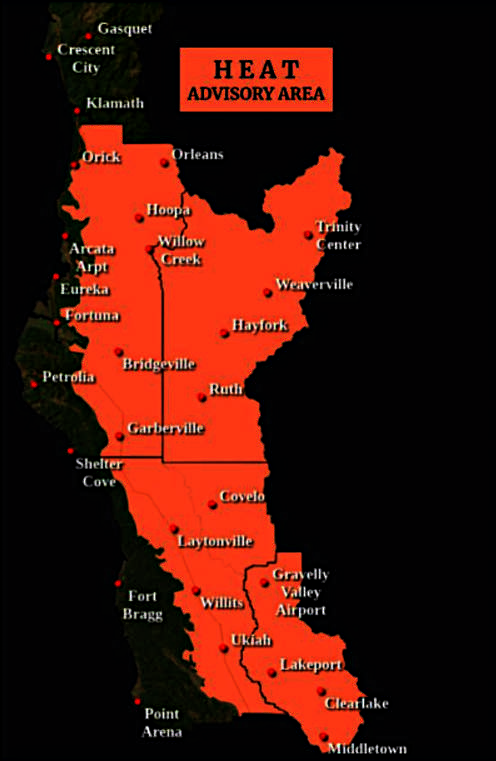
The heat advisory area. Image courtesy of the National Weather Service.


LAKE COUNTY, Calif. — The National Weather Service has issued a heat advisory due to high temperatures over the century mark over the next several days.

The advisory will be in effect from 11 a.m. Thursday to 11 p.m. Saturday. 

Along with Lake County, Trinity and parts of Humboldt and Mendocino counties are included in the advisory.

Temperatures could be the hottest in Clearlake, where forecasters predict it could reach 102 degrees on Thursday, 104 degrees on Friday and 103 degrees on Saturday.

Nighttime temperatures are expected to hover in the low 70s, according to the forecast.

Lake County residents are urged to take extra precautions when outside, to limit strenuous activities to early morning, and schedule frequent rest breaks in shaded or air conditioned
environments during outdoor work to avoid heat-related illness.

By Sunday, temperatures are expected to begin to decrease, reaching the 80s by the middle of next week. 

Email Elizabeth Larson at This email address is being protected from spambots. You need JavaScript enabled to view it.. Follow her on Twitter, @ERLarson, and on Bluesky, @erlarson.bsky.social. Find Lake County News on the following platforms: Facebook, @LakeCoNews; X, @LakeCoNews; Threads, @lakeconews, and on Bluesky, @lakeconews.bsky.social. 

Sheriff’s office investigates disappearance of Clearlake Park man

Damion Reynolds. Courtesy photo. 


LAKE COUNTY, Calif. — The Lake County Sheriff’s Office is asking for the public’s help locating a missing Clearlake Park man.

Damion Reynolds, 51, of Clearlake Park was last seen on Aug. 20 around 7 a.m. at his home on Crestview Drive.

His clothing at the time is unknown, and there is no known direction of travel.

Reynolds is 5 feet 8 inches tall and weighs 120 pounds. He has short brown hair and brown eyes, and may have a mustache and goatee.

The sheriff’s office is investigating the circumstances surrounding his disappearance.

If you have seen Reynolds or have information about his whereabouts, please call 707-263-2690.

Clearlake Animal Control: ‘Ziggy’ and the dogs

“Ziggy.” Photo courtesy of Clearlake Animal Control.


CLEARLAKE, Calif. — Clearlake Animal Control has dozens of dogs waiting for their new homes.

The shelter has 48 adoptable dogs listed on its website.

This week’s dogs include “Ziggy,” an 8-month-old male border collie mix puppy. He has a black coat with white markings.

The shelter is located at 6820 Old Highway 53. It’s open from 9 a.m. to 6 p.m. Tuesday through Saturday. 

For more information, call the shelter at 707-762-6227, email This email address is being protected from spambots. You need JavaScript enabled to view it., visit Clearlake Animal Control on Facebook or on the city’s website.

This week’s adoptable dogs are featured below.

Email Elizabeth Larson at This email address is being protected from spambots. You need JavaScript enabled to view it.. Follow her on Twitter, @ERLarson, and on Bluesky, @erlarson.bsky.social. Find Lake County News on the following platforms: Facebook, @LakeCoNews; X, @LakeCoNews; Threads, @lakeconews, and on Bluesky, @lakeconews.bsky.social. 

Pediatricians’ association recommends COVID-19 vaccines for toddlers and some older children, breaking with CDC guidance

The AAP’s guidance on COVID-19 vaccines differs substantially from that of the CDC. Images By Tang Ming Tung/DigitalVision via Getty Images

For 30 years, vaccine recommendations from the Centers for Disease Control and Prevention have aligned closely with those from the American Academy of Pediatrics, or AAP. But on Aug. 19, 2025, the AAP published new vaccine recommendations that diverge from those of the CDC.

The pediatrician association’s move comes on the heels of unprecedented changes made earlier this year by Robert F. Kennedy Jr., as head of the Department of Health and Human Services, in how the government approves and issues guidance on vaccines.

The biggest difference is in the AAP’s guidance around COVID-19 vaccines for children. This new guidance comes as COVID-19 cases are once again rising across the U.S. and many parents and providers are confused by unclear guidance from federal health authorities about whether children should be vaccinated.

In a Q&A with The Conversation U.S., David Higgins, a pediatrician, preventive medicine physician and vaccine delivery researcher from the University of Colorado Anschutz Medical Campus, explains the new guidance and what it means for parents. Higgins is also a member of the American Academy of Pediatrics.

What are the AAP’s new vaccine recommendations?

The AAP recommends that all children 6 to 23 months old receive a complete COVID-19 vaccine series, consistent with recommendations for this age group in previous years.

For children and adolescents ages 2 to 18, the AAP now advises a single dose if they are at higher risk, a change from previous years, when vaccination was recommended for all in this age group. Children at higher risk include those who have certain chronic medical conditions, who live in long-term care or group settings, who have never been vaccinated, or who live with family members at high risk.

The AAP also recommends that COVID-19 vaccines remain available for any child or adolescent whose parent wants them to be protected, regardless of risk status. In all cases, the most updated version of the vaccine should be used.

How do these recommendations differ from CDC guidance?

The difference is substantial. The CDC currently advises what it calls “shared clinical decision-making” for children ages 6 months to 17 years who are not moderately or severely immunocompromised. This means the decision is left up to individual discussions between families and their health care providers, but the vaccine is not treated as a routine recommendation. These current guidelines were made after Kennedy bypassed the agency’s normal independent review process.

That framework can be confusing for families and difficult for providers to implement. By contrast, the AAP recommendations identify the ages and conditions where the risk is highest while also supporting vaccine availability for any families who want it.

Toddlers engaged in an activity at a wooden table in a classroom.
It’s not clear whether families will be able to access routine COVID-19 vaccines for children this fall. Pancake Pictures/Connect Images via Getty Images

Why are they diverging?

The AAP has been publishing vaccine guidance since the 1930s, long before the CDC or the Advisory Committee on Immunization Practices, an independent panel of experts that advises the CDC, existed.

Since 1995, the two groups have generally issued essentially identical vaccine guidance. But this year, the federal government dismissed the advisory committee’s panel of independent scientists and immunization experts, raising questions about the credibility of CDC guidance. At the same time, misinformation about vaccines continues to spread.

In response, the AAP decided to publish independent recommendations based on its own review of the latest evidence. That review showed that although the risks for healthy older children have declined compared with the early years of the pandemic, young children and those with specific conditions remain especially vulnerable. Additionally, a review of evidence by an independent expert group called the Vaccine Integrity Project, also released on Aug. 19, 2025, confirmed that there are no new safety concerns and no decline in the effectiveness of COVID-19 vaccines.

COVID-19 continues to cause hospitalizations and deaths in children and remains a leading cause of serious respiratory illness.

Will parents be able to follow these recommendations?

This is still unclear. The AAP recommendations do not automatically guarantee insurance coverage.

By law, insurance plans and the federal Vaccines for Children program, which provides vaccines for eligible children who might not otherwise be vaccinated due to cost or lack of insurance, are tied to Advisory Committee on Immunization Practices recommendations. Unless insurers and policymakers act to align with the AAP recommendations, there is a risk that parents would be forced to pay the costs out of pocket.

Vaccine supply may also be an issue. Currently, only two COVID-19 vaccines are available for children under 12. Moderna’s vaccine is approved only for children with at least one high-risk condition, while Pfizer’s authorization for younger children may not be renewed. If that happens, any remaining Pfizer doses for this age group may be unusable, leaving a shortfall in available vaccines for children.

Finally, implementation may differ depending on the type of provider. Some vaccine providers, such as pharmacists, operate under policies tied strictly to CDC recommendations, which may make it harder to follow AAP’s schedule unless rules are updated.

What happens next?

Parents and providers are likely to face continued confusion, just as COVID-19 cases rise as children return to school. Much will depend on whether the Advisory Committee on Immunization Practices updates its own recommendations at its upcoming meeting, expected in September, and whether pediatric COVID-19 vaccines remain available.

Until then, parents can speak with their pediatricians to understand the best protection for their children.The Conversation

David Higgins, Assistant Professor of Pediatrics, University of Colorado Anschutz Medical Campus

This article is republished from The Conversation under a Creative Commons license. Read the original article.

Preliminary hearing set for Clearlake Oaks man charged with kidnap, rape

LAKEPORT, Calif. — A Clearlake Oaks man arrested last week for a kidnap and rape case along with a separate case in which he committed an assault was back in court on Tuesday.

Clifford Merle Cutrell, 54, also known as “Cliff Hanger,” appeared before Judge J. David Markham in Lake County Superior Court’s Department 2 early Tuesday morning for the appearance of his legal counsel and plea entry.

Cutrell was arrested on Tuesday, Aug. 12, for a kidnap and rape authorities said he committed that day and a felony assault case from April 10, as Lake County News has reported.

He is a registered sex offender with a lengthy criminal record and a risk assessment score conducted by the state that puts him in the “high” category for reoffending.

During the brief Tuesday morning court appearance, Chief Deputy District Attorney Rich Watson submitted to the court an amended complaint that added a 10th felony charge — sexual battery — to the rape and kidnap case, and changed previous counts of sodomy and sexual penetration by force to oral copulation by force.

Cutrell is now facing charges of kidnapping to commit robbery or rape; assault with intent to commit a felony; four charges of oral copulation by force or fear of injury; rape by force, violence, duress or menace; burglary; threats to commit a crime resulting in death; and sexual battery.

He has pleaded not guilty to all of the charges, said his public defender, Farris Purviance. 

Deputy Public Defender Jennifer Ramon had reportedly filed a motion for bail review for Cutrell, but Purviance, the public defender who didn’t make the initial appearance as Cutrell's attorney but has since taken over handling the case, withdrew that bail review motion on Tuesday.

In order to protect the right to a speedy trial, in felony cases state law sets a 60 calendar day time limit between arraignment and the preliminary hearing unless the defendant waives that time limit. 

Markham asked Cutrell if he was willing to waive the time limit and he said yes.

The judge then set Cutrell’s preliminary hearing for both the rape and kidnap case and the April assault for Sept. 25 in Department 3.

While the bail review motion had been withdrawn, Watson asked that the bail matter be addressed. 

Cutrell’s bail initially was set at $1 million. Watson asked for it to be set at no bail. 

Markham agreed, with Cutrell to be held without bail in both cases pending a future bail hearing.

Email Elizabeth Larson at This email address is being protected from spambots. You need JavaScript enabled to view it.. Follow her on Twitter, @ERLarson, and on Bluesky, @erlarson.bsky.social. Find Lake County News on the following platforms: Facebook, @LakeCoNews; X, @LakeCoNews; Threads, @lakeconews, and on Bluesky, @lakeconews.bsky.social. 

  • 165
  • 166
  • 167
  • 168
  • 169
  • 170
  • 171
  • 172
  • 173
  • 174

Community

  • Sheriff’s Activities League and Clearlake Bassmasters offer youth fishing clinic

  • City Nature Challenge takes place April 24 to 27

Public Safety

  • Lakeport Police logs: Wednesday, Feb. 11

  • Lakeport Police logs: Tuesday, Feb. 10

Education

  • Ramos measure requiring school officer training in use of anti-opioid drug moves forward

  • Lake County Chapter of CWA announces annual scholarships 

Health

  • California ranks 24th in America’s Health Rankings Annual Report from United Health Foundation

  • Healthy blood donors especially vital during active flu season

Business

  • Employment law summit takes place March 9

  • Two Lake County Mediacom employees earn company’s top service awards

Obituaries

  • Terry Knight

  • Ellen Thomas

Opinion & Letters

  • Who should pay for AI’s power? Not California ratepayers

  • Crandell: Supporting nephew for reelection in supervisorial race

Veterans

  • State honors fallen chief warrant officer killed in conflict in Iran

  • CalVet and CSU Long Beach team up to improve data collection related to veteran suicides

Recreation

  • April Audubon program will show how volunteers can help monitor local osprey nests

  • First guided nature walk of spring at Anderson Marsh State Historic Park April 11

  • Second Saturday guided nature walks continue at Anderson Marsh State Historic Park

  • Wet weather trail closure in effect on Upper Lake Ranger District

Religion

  • Kelseyville Presbyterian Church plans Easter service

  • Easter ‘Sonrise’ Service returns to Xabatin Community Park

Arts & Life

  • ‘CIA’ delves into the shadowy world of an espionage thriller

  • ‘War Machine’ shifts the battlefield into uncharted territory

Government & Politics

  • Lake County Democratic Central Committee endorses Falkenberg

  • Crandell launches reelection campaign plans March 15 event

Legals

  • April 23 hearing on Lake Coco Farms Major Use Permit

  • NOTICE OF 30-DAY PUBLIC COMMENT PERIOD & NOTICE OF PUBLIC HEARING

How to resolve AdBlock issue?
Refresh this page