How to resolve AdBlock issue?
Refresh this page
How to resolve AdBlock issue?
Refresh this page
Lake County News,California
  • Home
    • Registration Form
  • News
    • Community
      • Obituaries
      • Letters
      • Commentary
    • Education
    • Veterans
    • Police Logs
    • Business
    • Recreation
    • Health
    • Religion
    • Legals
    • Arts & Life
    • Regional
  • Calendar
  • Contact us
    • FAQs
    • Phones, E-Mail
    • Subscribe
  • Advertise Here
  • Login

Charges filed against three men in connection to Northshore shooting

Editor’s note: The story has been updated regarding the attempted murder charge.

LAKE COUNTY, Calif. — Three men have been charged in connection to a driveby shooting that injured a teenager last week.

The Lake County District Attorney’s Office has filed charges against Logan Dante Marschall, 19, of Lakeport, Ronald David Isiah Medina, 20, of Lucerne, and Eddie Franklin Knight III related to the May 9 shooting of Damian Wurm, 18, in Nice.

On Monday, detectives from the Lake County Sheriff’s Office Major Crimes Unit served two search warrants in Lucerne and Lakeport, with Marschall and Medina both arrested later that day.

In a charging document filed with the Lake County Superior Court on Wednesday, authorities said at that point that Medina was in custody, Marschall was no longer in custody and Knight had not been arrested.

Medina and Knight are charged with attempted murder. 

In addition, Medina, identified as the shooter, is charged with felonies including assault with a firearm; shooting a 9 millimeter handgun at an occupied vehicle on Lakeview Drive and Buckingham Way in Nice; committing a driveby shooting by shooting at Wurm, who was not in a vehicle; a special allegation of use of a firearm and inflicting great bodily injury on Wurm; and a special allegation of aggravating factors including the crime involving great violence, use of a weapon, a particularly vulnerable victim, the crime involved planning and sophistication and conduct indicating danger to society.

Medina also is charged with two misdemeanors for unlawfully transferring/selling a firearm without involving a licensed dealer.

Knight was charged with a felony for knowingly permitting another to discharge a firearm from a vehicle he drove.

Knight and Marschall also are charged with misdemeanors for harboring Medina in order for him to evade arrest.

At a Wednesday court appearance, the District Attorney’s Office argued for Medina to remain in custody with no bail.

However, Chief Deputy District Attorney Rich Watson said the court analyzed the case based on current law and released Medina on his own recognizance.

Watson said the terms of that release include Medina being placed on home detention and having an ankle monitor that is monitored by the Probation Department.

“He is subject to search and seizure and cannot be in possession of any firearms. A full no contact criminal protective order was issued protecting the named victim,” Watson said.

Correction: A previous version of the story incorrectly stated that Marschall also had been charged with attempted murder. Lake County News regrets the error.

Email Elizabeth Larson at This email address is being protected from spambots. You need JavaScript enabled to view it.. Follow her on Twitter, @ERLarson, and on Bluesky, @erlarson.bsky.social. Find Lake County News on the following platforms: Facebook, @LakeCoNews; X, @LakeCoNews; Threads, @lakeconews, and on Bluesky, @lakeconews.bsky.social.
Details
Written by: Elizabeth Larson
Published: 16 May 2025

Clearlake Animal Control: ‘Clutchy’ and the dogs

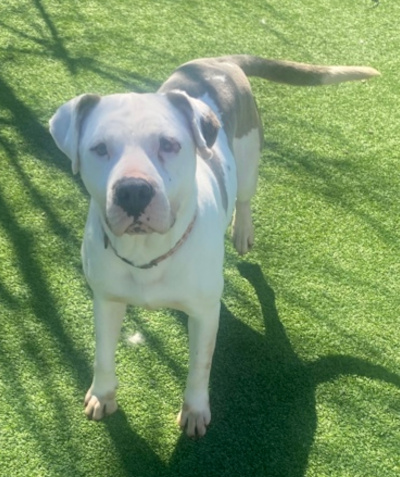
“Clutchy.” Photo courtesy of Clearlake Animal Control.

CLEARLAKE, Calif. — Clearlake Animal Control has a selection of friendly dogs waiting for new homes.

The shelter has 51 adoptable dogs listed on its website.

This week’s dogs include “Clutchy,” a loveable 5 and a half year old pit bull.

Staff says he “brings joy and playfulness to every moment. With his gentle nature and sweet disposition, he's the perfect companion for those looking for a friend. Clutchy enjoys his walks and is a pro on the leash, making outings a breeze. While he enjoys the company of some dogs, he's still figuring out his social skills. This playful pup is always ready for an adventure, a cuddle, or a game of fetch!”

The shelter is located at 6820 Old Highway 53. It’s open from 9 a.m. to 6 p.m. Tuesday through Saturday.

For more information, call the shelter at 707-762-6227, email This email address is being protected from spambots. You need JavaScript enabled to view it., visit Clearlake Animal Control on Facebook or on the city’s website.

This week’s adoptable dogs are featured below.

Email Elizabeth Larson at This email address is being protected from spambots. You need JavaScript enabled to view it.. Follow her on Twitter, @ERLarson, and on Bluesky, @erlarson.bsky.social. Find Lake County News on the following platforms: Facebook, @LakeCoNews; X, @LakeCoNews; Threads, @lakeconews, and on Bluesky, @lakeconews.bsky.social.


Details
Written by: Elizabeth Larson
Published: 16 May 2025

Why protecting wildland is crucial to American freedom and identity


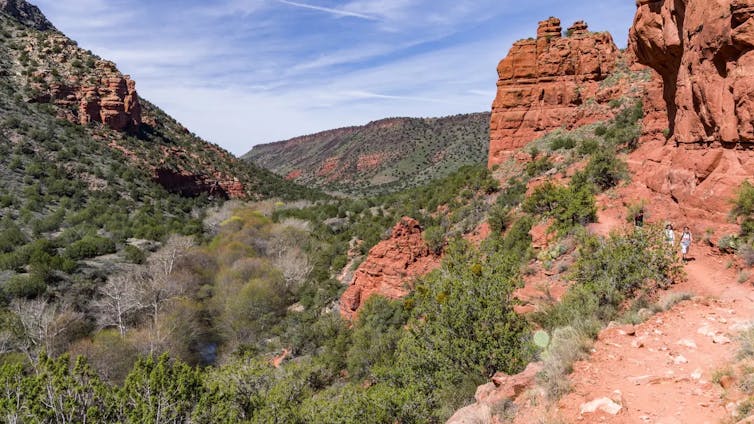
The Wet Beaver Wilderness in Coconino National Forest in Arizona is one of many designated wilderness areas in the U.S. Deborah Lee Soltesz

As summer approaches, millions of Americans begin planning or taking trips to state and national parks, seeking to explore the wide range of outdoor recreational opportunities across the nation. A lot of them will head toward the nation’s wilderness areas – 110 million acres, mostly in the West, that are protected by the strictest federal conservation rules.

When Congress passed the Wilderness Act in 1964, it described wilderness areas as places that evoked mystery and wonder, “where the earth and its community of life are untrammeled by man, where man himself is a visitor who does not remain.” These are wild landscapes that present nature in its rawest form.

The law requires the federal government to protect these areas “for the permanent good of the whole people.” Wilderness areas are found in national parks, conservation land overseen by the U.S. Bureau of Land Management, national forests and U.S. Fish and Wildlife refuges.

In early May 2025, the U.S. House of Representatives began to consider allowing the sale of federal lands in six counties in Nevada and Utah, five of which contain wilderness areas. Ostensibly, these sales are to promote affordable housing, but the reality is that the proposal, introduced by U.S. Rep. Mark Amodei, a Nevada Republican, is a departure from the standard process of federal land exchanges that accommodate development in some places but protect wilderness in others.

Regardless of whether Americans visit their public lands or know when they have crossed a wilderness boundary, as environmental historians we believe that everyone still benefits from the existence and protection of these precious places.

This belief is an idea eloquently articulated and popularized 65 years ago by the noted Western writer Wallace Stegner. His eloquence helped launch the modern environmental movement and gave power to the idea that the nation’s public lands are a fundamental part of the United States’ national identity and a cornerstone of American freedom.

Humble origins

In 1958, Congress established the Outdoor Recreation Resources Review Commission to examine outdoor recreation in the U.S. in order to determine not only what Americans wanted from the outdoors, but to consider how those needs and desires might change decades into the future.

One of the commission’s members was David E. Pesonen, who worked at the Wildland Research Center at the University of California at Berkeley. He was asked to examine wilderness and its relationship to outdoor recreation. Pesonen later became a notable environmental lawyer and leader of the Sierra Club. But at the time, Pesonen had no idea what to say about wilderness.

However, he knew someone who did. Pesonen had been impressed by the wild landscapes of the American West in Stegner’s 1954 history “Beyond the Hundredth Meridian: John Wesley Powell and the Second Opening of the West.” So he wrote to Stegner, who at the time was at Stanford University, asking for help in articulating the wilderness idea.

Stegner’s response, which he said later was written in a single afternoon, was an off-the-cuff riff on why he cared about preserving wildlands. This letter became known as the Wilderness Letter and marked a turning point in American political and conservation history.

Pesonen shared the letter with the rest of the commission, which also shared it with newly installed Secretary of the Interior Stewart Udall. Udall found its prose to be so profound, he read it at the seventh Wilderness Conference in 1961 in San Francisco, a speech broadcast by KCBS, the local FM radio station. The Sierra Club published the letter in the record of the conference’s proceedings later that year.

But it was not until its publication in The Washington Post on June 17, 1962, that the letter reached a national audience and captured the imagination of generations of Americans.

A child, a woman and a man sit on rocks in front of a rugged rocky landscape.
Wallace Stegner, right, knew the power of American wilderness landscapes. In this photo, probably from the 1950s, he pauses with his son Page and wife, Mary, on a Yosemite National Park hiking trail. Multimedia Archives, Special Collections, J. Willard Marriott Library, University of Utah

An eloquent appeal

In the letter, Stegner connected the idea of wilderness to a fundamental part of American identity. He called wilderness “something that has helped form our character and that has certainly shaped our history as a people … the challenge against which our character as a people was formed … (and) the thing that has helped to make an American different from and, until we forget it in the roar of our industrial cities, more fortunate than other men.”

Without wild places, he argued, the U.S. would be just like every other overindustrialized place in the world.

In the letter, Stegner expressed little concern with how wilderness might support outdoor recreation on public lands. He didn’t care whether wilderness areas had once featured roads, trails, homesteads or even natural resource extraction. What he cared about was Americans’ freedom to protect and enjoy these places. Stegner recognized that the freedom to protect, to restrain ourselves from consuming, was just as important as the freedom to consume.

Perhaps most importantly, he wrote, wilderness was “an intangible and spiritual resource,” a place that gave the nation “our hope and our excitement,” landscapes that were “good for our spiritual health even if we never once in ten years set foot in it.”

Without it, Stegner lamented, “never again will Americans be free in their own country from the noise, the exhausts, the stinks of human and automotive waste.” To him, the nation’s natural cathedrals and the vaulted ceiling of the pure blue sky are Americans’ sacred spaces as much as the structures in which they worship on the weekends.

Stegner penned the letter during a national debate about the value of preserving wild places in the face of future development. “Something will have gone out of us as a people,” he wrote, “if we ever let the remaining wilderness be destroyed.” If not protected, Stegner believed these wildlands that had helped shape American identity would fall to what he viewed as the same exploitative forces of unrestrained capitalism that had industrialized the nation for the past century. Every generation since has an obligation to protect these wild places.

Stegner’s Wilderness Letter became a rallying cry to pass the Wilderness Act. The closing sentences of the letter are Stegner’s best: “We simply need that wild country available to us, even if we never do more than drive to its edge and look in. For it can be a means of reassuring ourselves of our sanity as creatures, a part of the geography of hope.”

This phrase, “the geography of hope,” is Stegner’s most famous line. It has become shorthand for what wilderness means: the wildlands that defined American character on the Western frontier, the wild spaces that Americans have had the freedom to protect, and the natural places that give Americans hope for the future of this planet.

A person with a backpack and hiking poles walks through an open landscape with mountains in the distance.
Death Valley National Park in California contains one of the largest protected wilderness areas in the United States. National Park Service/E. Letterman

America’s ‘best idea’

Stegner returned to themes outlined in the Wilderness Letter again two decades later in his essay “The Best Idea We Ever Had: An Overview,” published in Wilderness magazine in spring 1983.

Writing in response to the Reagan administration’s efforts to reduce protection of the National Park System, Stegner declared that the parks were “Absolutely American, absolutely democratic.” He said they reflect us as a nation, at our best rather than our worst, and without them, millions of Americans’ lives, his included, would have been poorer.

Public lands are more than just wilderness or national parks. They are places for work and play. They provide natural resources, wildlife habitat, clean air, clean water and recreational opportunities to small towns and sprawling metro areas alike. They are, as Stegner said, cures for cynicism and places of shared hope.

Stegner’s words still resonate as Americans head for their public lands and enjoy the beauty of the wild places protected by wilderness legislation this summer. With visitor numbers increasing annually and agency budgets at historic lows, we believe it is useful to remember how precious these places are for all Americans. And we agree with Stegner that wilderness, public lands writ large, are more valuable to Americans’ collective identity and expression of freedom than they are as real estate that can be sold or commodities that can be extracted.The Conversation

Leisl Carr Childers, Associate Professor of History, Colorado State University and Michael Childers, Associate Professor of History, Colorado State University

This article is republished from The Conversation under a Creative Commons license. Read the original article.

Details
Written by: Leisl Carr Childers, Colorado State University and Michael Childers, Colorado State University
Published: 16 May 2025

Final Klaus Park concept site design to be featured in May 22 meeting

CLEARLAKE OAKS, Calif. — The county of Lake is inviting community members to check out the latest stage in the work to design a new park on the Northshore.

The John T. Klaus Park, located on donated land east of Clearlake Oaks, will be the focus of a special drop-in meeting on Thursday, May 22, from 3 to 6 p.m.

It will be held in the Nylander Building, located at 12586 Acorn Str. next to the playground at Nylander Park and behind the Red & White grocery store in Clearlake Oaks.

The 570-acre park which will be located near the roundabout at Highway 20 and Highway 53.

In November 2022, the Board of Supervisors accepted the donation of the property, as well as funds to develop the park, from the John T. Klaus Trust.

The park design is now in the final concept site design phase, Public Services reported.

Community members will get an informal look at the designs, which so far includes trails, dog parks, native garden, cultural center, frisbee golf and more.

Public Services Director Lars Ewing, along with the landscape architect and environmental lead consultant, will be present to answer questions and take community members’ comments.

For more information call the Lake County Public Services Department at 707-262-1618 from 8 a.m. to 5 p.m. Monday through Friday or email This email address is being protected from spambots. You need JavaScript enabled to view it..

Email Elizabeth Larson at This email address is being protected from spambots. You need JavaScript enabled to view it.. Follow her on Twitter, @ERLarson, and on Bluesky, @erlarson.bsky.social. Find Lake County News on the following platforms: Facebook, @LakeCoNews; X, @LakeCoNews; Threads, @lakeconews, and on Bluesky, @lakeconews.bsky.social.
Details
Written by: Elizabeth Larson
Published: 15 May 2025
  • 274
  • 275
  • 276
  • 277
  • 278
  • 279
  • 280
  • 281
  • 282
  • 283

Public Safety

  • Lakeport Police logs: Saturday, Jan. 10

  • Lakeport Police logs: Friday, Jan. 9

  • Lakeport Police logs: Thursday, Jan. 8

Community

  • Wine & Beer makers, vendors sought for Symphony Winefest 2026

  • Golden State Water provides donation to support homeless community in Clearlake

  • Valentine See's Candies sales benefit community needs

Community & Business

  • Two Lake County Mediacom employees earn company’s top service awards

  • California ranks 24th in America’s Health Rankings Annual Report from United Health Foundation

  • Woodland Community College receives maximum eight-year reaffirmation of accreditation from ACCJC

  • Healthy blood donors especially vital during active flu season

  • SNHU announces Fall 2025 President's List

  • Sherick named to the Dean's List at Bob Jones University

How to resolve AdBlock issue?
Refresh this page