How to resolve AdBlock issue?

The burgeoning space industry and the technologies society increasingly relies on – electric grids, aviation and telecommunications – are all vulnerable to the same threat: space weather.
Space weather encompasses any variations in the space environment between the Sun and Earth. One common type of space weather event is called an interplanetary coronal mass ejection.
These ejections are bundles of magnetic fields and particles that originate from the Sun. They can travel at speeds up to 1,242 miles per second (2,000 kilometers per second) and may cause geomagnetic storms.
They create beautiful aurora displays – like the northern lights you can sometimes see in the skies – but can also disrupt satellite operations, shut down the electric grid and expose astronauts aboard future crewed missions to the Moon and Mars to lethal doses of radiation.
I’m a heliophysicist and space weather expert, and my team is leading the development of a next-generation satellite constellation called SWIFT, which is designed to predict potentially dangerous space weather events in advance. Our goal is to forecast extreme space weather more accurately and earlier.
The dangers of space weather
Commercial interests now make up a big part of space exploration, focusing on space tourism, building satellite networks, and working toward extracting resources from the Moon and nearby asteroids.
Space is also a critical domain for military operations. Satellites provide essential capabilities for military communication, surveillance, navigation and intelligence.
As countries such as the U.S. grow to depend on infrastructure in space, extreme space weather events pose a greater threat. Today, space weather threatens up to US$2.7 trillion in assets globally.
In September 1859, the most powerful recorded space weather event, known as the Carrington event, caused fires in North America and Europe by supercharging telegraph lines. In August 1972, another Carrington-like event nearly struck the astronauts orbiting the Moon. The radiation dose could have been fatal. More recently, in February 2022, SpaceX lost 39 of its 49 newly launched Starlink satellites because of a moderate space weather event.
Today’s space weather monitors
Space weather services heavily rely on satellites that monitor the solar wind, which is made up of magnetic field lines and particles coming from the Sun, and communicate their observations back to Earth. Scientists can then compare those observations with historical records to predict space weather and explore how the Earth may respond to the observed changes in the solar wind.
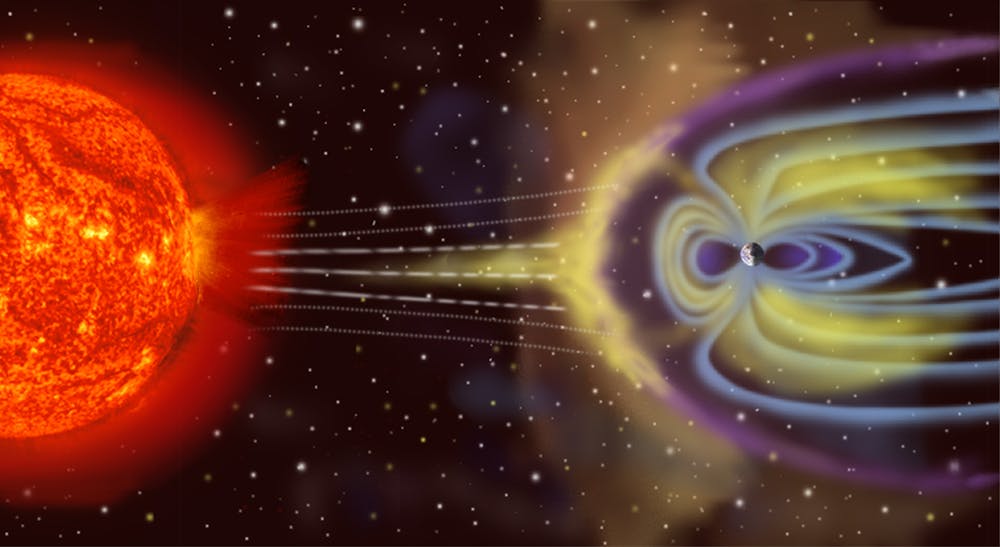
Earth’s magnetic field naturally protects living things and Earth-orbiting satellites from most adverse effects of space weather. However, extreme space weather events may compress – or in some cases, peel back – the Earth’s magnetic shield.
This process allows solar wind particles to make it into our protected environment – the magnetosphere – exposing satellites and astronauts onboard space stations to harsh conditions.
Most satellites that continuously monitor Earth-bound space weather orbit relatively close to the planet. Some satellites are positioned in low Earth orbit, about 100 miles (161 kilometers) above Earth’s surface, while others are in geosynchronous orbit, approximately 25,000 miles (40,000 km) away.
At these distances, the satellites remain within Earth’s protective magnetic shield and can reliably measure the planet’s response to space weather conditions. However, to more directly study incoming solar wind, researchers use additional satellites located farther upstream – hundreds of thousands of miles from Earth.
The U.S., the European Space Agency and India all operate space weather monitoring satellites positioned around the L1 Lagrange point – nearly 900,000 miles (1,450,000 km) from Earth – where the gravitational forces of the Sun and Earth balance. From this vantage point, space weather monitors can provide up to 40 minutes of advance warning for incoming solar events.

Advance warning for space weather
Increasing the warning time beyond 40 minutes – the current warning time – would help satellite operators, electric grid planners, flight directors, astronauts and Space Force officers better prepare for extreme space weather events.
For instance, during geomagnetic storms, the atmosphere heats up and expands, increasing drag on satellites in low Earth orbit. With enough advance warning, operators can update their drag calculations to prevent satellites from descending and burning up during these events. With the updated drag calculations, satellite operators could use the satellites’ propulsion systems to maneuver them higher up in orbit.
Airlines could change their routes to avoid exposing passengers and staff to high radiation doses during geomagnetic storms. And future astronauts on the way to or working on the Moon or Mars, which lack protection from these particles, could be alerted in advance to take cover.
Aurora lovers would also appreciate having more time to get to their favorite viewing destinations.
The Space Weather Investigation Frontier
My team and I have been developing a new space weather satellite constellation, named the Space Weather Investigation Frontier. SWIFT will, for the first time, place a space weather monitor beyond the L1 point, at 1.3 million miles (2.1 million kilometers) from Earth. This distance would allow scientists to inform decision-makers of any Earth-bound space weather events up to nearly 60 minutes before arrival.
Satellites with traditional chemical and electric propulsion systems cannot maintain an orbit at that location – farther from Earth and closer to the Sun – for long. This is because they would need to continuously burn fuel to counteract the Sun’s gravitational pull.
To address this issue, our team has spent decades designing and developing a new propulsion system. Our solution is designed to affordably reach a distance that is closer to the Sun than the traditional L1 point, and to operate there reliably for more than a decade by harnessing an abundant and reliable resource – sunlight.
SWIFT would use a fuelless propulsion system called a solar sail to reach its orbit. A solar sail is a hair-thin reflective surface – simulating a very thin mirror – that spans about a third of a football field. It balances the force of light particles coming from the Sun, which pushes it away, with the Sun’s gravity, which pulls it inward.
While a sailboat harnesses the lift created by wind flowing over its curved sails to move across water, a solar sail uses the momentum of photons from sunlight, reflected off its large, shiny sail, to propel a spacecraft through space. Both the sailboat and solar sail exploit the transfer of energy from their respective environments to drive motion without relying on traditional propellants.
A solar sail could enable SWIFT to enter an otherwise unstable sub-L1 orbit without the risk of running out of fuel.
NASA successfully launched its first solar sail in 2010. This in-space demonstration, named NanoSail-D2, featured a 107-square-foot (10 m2 ) sail and was placed in low Earth orbit. That same year, the Japanese Space Agency launched a larger solar sail mission, IKAROS, which deployed a 2,110 ft2 (196 m2 ) sail in the solar wind and successfully orbited Venus.

The Planetary Society and NASA followed up by launching two sails in low Earth orbit: LightSail, with an area of 344 ft2 (32 m2 ), and the advanced composite solar sail system, with an area of 860 ft2 (80 m2 ).
The SWIFT team’s solar sail demonstration mission, Solar Cruiser, will be equipped with a much larger sail – it will have area of 17,793 ft2 (1,653 m2 ) and launch as early as 2029. We successfully deployed a quadrant of the sail on Earth early last year.
To transport it to space, the team will meticulously fold and tightly pack the sail inside a small canister. The biggest challenge to overcome will be deploying the sail once in space and using it to guide the satellite along its orbital path.
If successful, Solar Cruiser will pave the way for SWIFT’s constellation of four satellites. The constellation would include one satellite equipped with sail propulsion, set to be placed in an orbit beyond L1, and three smaller satellites with chemical propulsion in orbit at the L1 Lagrange point.
The satellites will be indefinitely parked at and beyond L1, collecting data in the solar wind without interruption. Each of the four satellites can observe the solar wind from different locations, helping scientists better predict how it may evolve before reaching Earth.
As modern life depends more on space infrastructure, continuing to invest in space weather prediction can protect both space- and ground-based technologies.
Mojtaba Akhavan-Tafti, Associate Research Scientist, University of Michigan
This article is republished from The Conversation under a Creative Commons license. Read the original article.