How to resolve AdBlock issue?
Refresh this page
Lake County News,California
  • Home
    • Registration Form
  • News
    • Education
    • Veterans
    • Community
      • Obituaries
      • Letters
      • Commentary
    • Police Logs
    • Business
    • Recreation
    • Health
    • Religion
    • Legals
    • Arts & Life
    • Regional
  • Calendar
  • Contact us
    • FAQs
    • Phones, E-Mail
    • Subscribe
  • Advertise Here
  • Login
How to resolve AdBlock issue?
Refresh this page

News

Controlled burns reduce wildfire risk, but they require trained staff and funding − this could be a rough year


Prescribed burns like this one are intentional, controlled fires used to clear out dry grass and underbrush that could fuel more destructive wildfires. Ethan Swope/Getty Images

Red skies in August, longer fire seasons and checking air quality before taking my toddler to the park. This has become the new norm in the western United States as wildfires become more frequent, larger and more catastrophic.

As an ecologist at the University of Colorado Boulder, I know that fires are part of the natural processes that forests need to stay healthy. But the combined effects of a warmer and drier climate, more people living in fire-prone areas and vegetation and debris built up over years of fire suppression are leading to more severe fires that spread faster. And that’s putting humans, ecosystems and economies at risk.

To help prevent catastrophic fires, the U.S. Forest Service issued a 10-year strategy in 2022 that includes scaling up the use of controlled burns and other techniques to remove excess plant growth and dry, dead materials that fuel wildfires.

However, the Forest Service’s wildfire management activities have been thrown into turmoil in 2025 with funding cuts and disruptions and uncertainty from the federal government.

The planet just saw its hottest year on record. If spring and summer 2025 are also dry and hot, conditions could be prime for severe fires again.

More severe fires harm forest recovery and people

Today’s severe wildfires have been pushing societies, emergency response systems and forests beyond what they have evolved to handle.

Extreme fires have burned into cities, including destroying thousands of homes in the Los Angeles area in 2025 and near Boulder, Colorado, in 2021. They threaten downstream public drinking water by increasing sediments and contaminants in water supplies, as well as infrastructure, air quality and rural economies. They also increase the risk of flooding and mudslides from soil erosion. And they undermine efforts to mitigate climate change by releasing carbon stored in these ecosystems.

In some cases, fires burned so hot and deep into the soil that the forests are not growing back.

While many species are adapted to survive low-level fires, severe blazes can damage the seeds and cones needed for forests to regrow. My team has seen this trend outside of Fort Collins, Colorado, where four years after the Cameron Peak fire, forests have still not come back the way ecologists would expect them to under past, less severe fires. Returning to a strategy of fire suppression − or trying to “go toe-to-toe with every fire” − will make these cases more common.
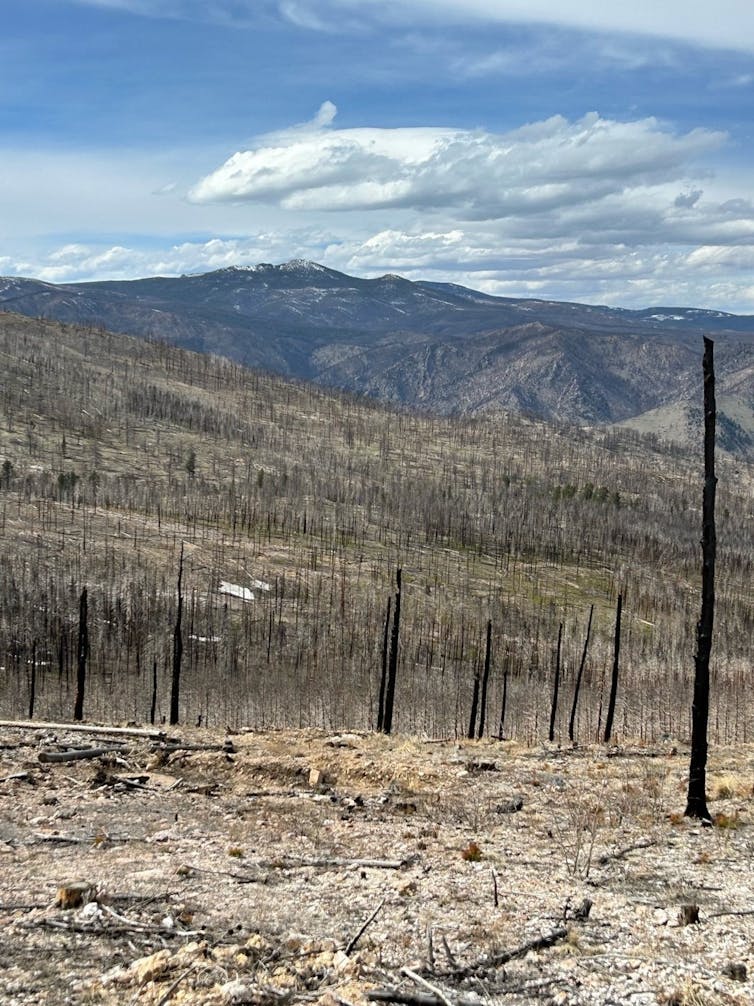
A burned landscape with black tree trunks, no canopy and little to no new growth on the ground.
Parts of Cameron Peak, burned in a severe fire in 2020, still showed little evidence of recovery in 2024. Efforts have been underway to try to replant parts of the burned areas by hand. Bella Oleksy/University of Colorado

Proactive wildfire management can help reduce the risk to forests and property.

Measures such as prescribed burns have proven to be effective for maintaining healthy forests and reducing the severity of subsequent wildfires. A recent review found that selective thinning followed by prescribed fire reduced subsequent fire severity by 72% on average, and prescribed fire on its own reduced severity by 62%.
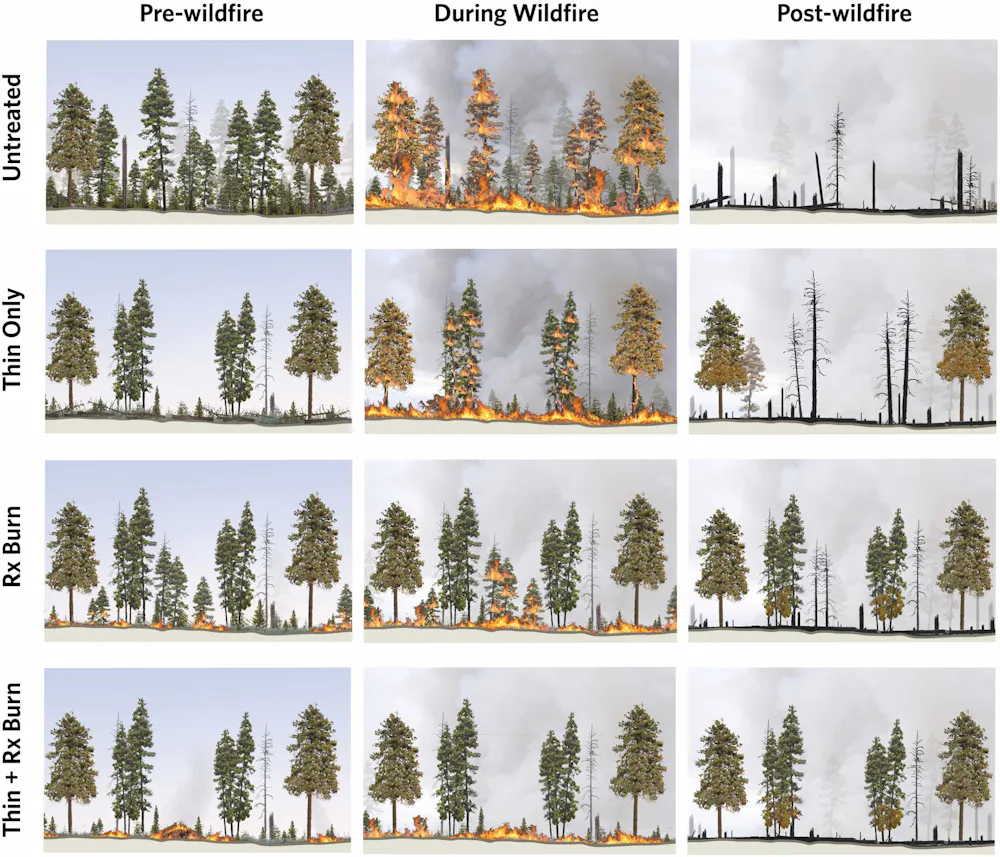
Four sets of illustrations. The most severe fires happened with no treatment. Thinning helps some. Prescribed burning keeps fires burning lower at the forest floor.
Prescribed burns and forest thinning tend to reduce the risk of extremely destructive wildfires. Kimberley T. Davis, et al., Forest Ecology and Management, 2024, CC BY

But managing forests well requires knowing how forests are changing, where trees are dying and where undergrowth has built up and increased fire hazards. And, for federal lands, these are some of the jobs that are being targeted by the Trump administration.

Some of the Forest Service staff who were fired or put in limbo by the Trump administration are those who do research or collect and communicate critical data about forests and fire risk. Other fired staff provided support so crews could clear flammable debris and carry out fuel treatments such as prescribed burns, thinning forests and building fire breaks.

Losing people in these roles is like firing all primary care doctors and leaving only EMTs. Both are clearly needed. As many people know from emergency room bills, preventing emergencies is less costly than dealing with the damage later.

Logging is not a long-term fire solution

The Trump administration cited “wildfire risk reduction” when it issued an emergency order to increase logging in national forests by 25%.

But private − unregulated − forest management looks a lot different than managing forests to prevent destructive fires.

Logging, depending on the practice, can involve clear-cutting trees and other techniques that compromise soils. Exposing a forest’s soils and dead vegetation to more sunlight also dries them out, which can increase fire risk in the near term.
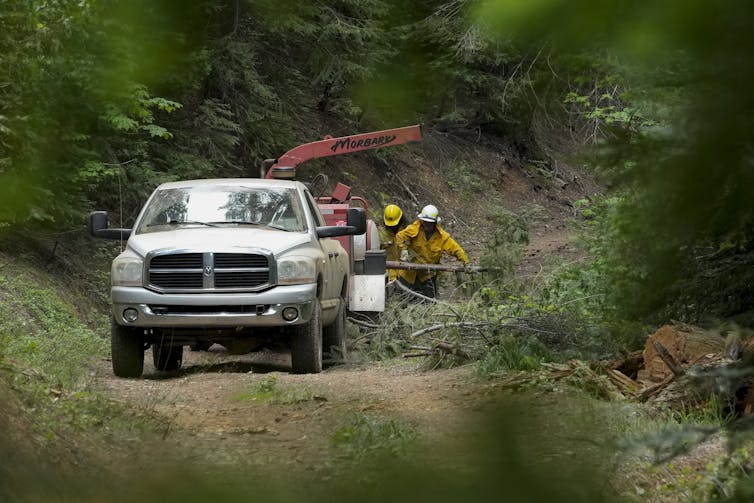
Forest Service crew members put tree branches into a wood chipper as they prepare the area for a prescribed burn in the Tahoe National Forest, June 6, 2023.
Forest-thinning operations involve carefully removing young trees and brush that could easily burn, with a goal of creating conditions less likely to send fire into the crowns of trees. AP Photo/Godofredo A. Vásquez

In general, logging that focuses on extracting the highest-value trees leaves thinner trees that are more vulnerable to fires. A study in the Pacific Northwest found that replanting logged land with the same age and size of trees can lead to more severe fires in the future.

Research and data are essential

For many people in the western U.S., these risks hit close to home.

I’ve seen neighborhoods burn and friends and family displaced, and I have contended with regular air quality warnings and red flag days signaling a high fire risk. I’ve also seen beloved landscapes, such as those on Cameron Peak, transform when conifers that once made up the forest have not regrown.

Burned trees and weeds in the ground below.
Recovery has been slow on Cameron Peak after a severe fire in 2020. This photo was taken in 2024. Bella Oleksy/University of Colorado

My scientific research group and collaborations with other scientists have been helping to identify cost-effective solutions. That includes which fuel-treatment methods are most effective, which types of forests and conditions they work best in and how often they are needed. We’re also planning research projects to better understand which forests are at greatest risk of not recovering after fires.

This sort of research is what robust, cost-effective land management is based on.

When careful, evidence-based forest management is replaced with a heavy emphasis on suppressing every fire or clear-cutting forests, I worry that human lives, property and economies, as well as the natural legacy of public lands left to every American, are at risk.The Conversation

Laura Dee, Associate Professor of Ecology, University of Colorado Boulder

This article is republished from The Conversation under a Creative Commons license. Read the original article.

Lake County returns to the top 25 cleanest counties in the nation for air quality

LAKE COUNTY, Calif. — Lake County has received some good news from the American Lung Association.

The American Lung Association has released its annual State of the Air 2025 Report.

Air quality is graded on an A through F scale by comparing local ozone and small-particulate concentrations with the federal air quality standards.

Although many areas, especially within California, were given failing grades, Lake County returned to the top 25.

Lake County received an “A” grade for Ozone, a “B” grade for short term particulate pollution, and is ranked the 23rd Cleanest County in the Nation for annual particulate average concentrations.

Lake County dropped off the top 25 cleanest counties ranking due to the impacts of the Valley fire, Rocky fire, Jerusalem fire, Clayton fire, Sulphur Fire, the Tubbs Fire, and other major fires in the region.

With fewer wildfire impacts over the past four years, Lake County’s ranking has improved.

Out of California’s 58 counties, Lake County is one of only 13 counties in California that did not have any days of ozone exceeds from 2021 through 2023.

The report presents data showing what the residents of Lake County are actually breathing on a daily basis.

This report does not exclude wildfire impacts or other natural events that are excluded when determining our attainment status.

The “B” grade for short term particulate pollution is the result of impacts from wildfires.

This report shows that despite the wildfires and permitted prescribed fires in the region, the residents of Lake County still enjoy some of the cleanest air in the nation.

The American Lung Association grades are the latest recognition of a long history of air quality accomplishments in Lake County.

The Lake County Air Quality Management District said strong local support for clean air measures has enabled the county to comply in full with not only the Federal Clean Air Standards, but also with the more rigorous California Standards for ozone and other air pollutants for the past 35 consecutive years.

No other air district in California can match that record, the air district reported.

“The success of the program is a result of the strong community support for maintaining clean, healthful air, cooperation of local government, fire protection districts, calfire, agricultural community, industry, district board of directors, and the dedication and hard work of AQMD [Air Quality Management District staff,” the district reported.

The report can be found by following the link at www.LCAQMD.net.

Woman sustains major injuries in crash with fuel tanker truck

LAKE COUNTY, Calif. — An early Saturday morning wreck involving a fuel tanker and a car on Highway 29 left a local woman with major injuries.

The California Highway Patrol’s Clear Lake Area office identified the woman who was injured as Brenda Lee Sandage, 64.

At 3:55 a.m., the CHP responded to a call of a head-on traffic crash involving a fuel tanker truck and a sedan on Highway 29 north of Hofacker Lane near Lower Lake.

The CHP said responding units determined that Sandage was driving north on Highway 29 and entered into the oncoming traffic lane directly ahead of the fuel tanker truck.

Sandage was transported via air ambulance to Kaiser Vacaville for treatment of major injuries sustained, the CHP said.

THe CHP said the driver of the fuel tanker truck was uninjured.

The cause of the crash is under investigation, and it is unknown at this time if alcohol or drugs were a contributing factor.

Officer Luis Estrada is the investigating officer. Persons with information or knowledge of the incident are asked to contact the Clear Lake CHP Office at 707-279-5200.

Helping Paws: New dogs needing homes

LAKE COUNTY, Calif. — Lake County Animal Care and Control has a new group of dogs this week waiting for their forever homes.

The dogs available for adoption this week include mixes of Catahoula leopard dog, cattle dog, German shepherd, husky, Labrador Retriever, pit bull terrier, sharpei and terrier.

Dogs that are adopted from Lake County Animal Care and Control are either neutered or spayed, microchipped and, if old enough, given a rabies shot and county license before being released to their new owner. License fees do not apply to residents of the cities of Lakeport or Clearlake.

Those dogs and the others shown on this page at the Lake County Animal Care and Control shelter have been cleared for adoption.

Call Lake County Animal Care and Control at 707-263-0278 or visit the shelter online for information on visiting or adopting.

The shelter is located at 4949 Helbush in Lakeport.

Email Elizabeth Larson at This email address is being protected from spambots. You need JavaScript enabled to view it.. Follow her on Twitter, @ERLarson, and on Bluesky, @erlarson.bsky.social. Find Lake County News on the following platforms: Facebook, @LakeCoNews; X, @LakeCoNews; Threads, @lakeconews, and on Bluesky, @lakeconews.bsky.social.


Oliver's preview photo
Oliver

Toby's preview photo
Toby

Mister's preview photo
Mister

O'Reiley's preview photo
O'Reiley

Billy's preview photo
Billy

Lady's preview photo
Lady

Hershey's preview photo
Hershey

Argo's preview photo
Argo

Sadie's preview photo
Sadie

Marjorie's preview photo
Marjorie

Lisa's preview photo
Lisa

Maggie's preview photo
Maggie

Talley's preview photo
Talley

Winnie's preview photo
Winnie

Zena's preview photo
Zena

Nova's preview photo
Nova

Leo's preview photo
Leo

Kennel#24's preview photo
Kennel#24
 
Kennel#3's preview photo
Kennel#3

 
Kennel#6's preview photo
Kennel#6

Kennel#18's preview photo
Kennel#18


Kennel #9's preview photo
Kennel #9

Kennel #10's preview photo
Kennel #10

Space News: ‘Extraordinary claims require extraordinary evidence’ − an astronomer explains how much evidence scientists need to claim discoveries like extraterrestrial life


The universe is filled with countless galaxies, stars and planets. Astronomers may find life one day, but they will need extraordinary proof. ESA/Euclid/Euclid Consortium/NASA, image processing by J.-C. Cuillandre (CEA Paris-Saclay), G. Anselmi

The detection of life beyond Earth would be one of the most profound discoveries in the history of science. The Milky Way galaxy alone hosts hundreds of millions of potentially habitable planets. Astronomers are using powerful space telescopes to look for molecular indicators of biology in the atmospheres of the most Earth-like of these planets.

But so far, no solid evidence of life has ever been found beyond the Earth. A paper published in April 2025 claimed to detect a signature of life in the atmosphere of the planet K2-18b. And while this discovery is intriguing, most astronomers – including the paper’s authors – aren’t ready to claim that it means extraterrestrial life exists. A detection of life would be a remarkable development.

The astronomer Carl Sagan used the phrase, “Extraordinary claims require extraordinary evidence,” in regard to searching for alien life. It conveys the idea that there should be a high bar for evidence to support a remarkable claim.

I’m an astronomer who has written a book about astrobiology. Over my career, I’ve seen some compelling scientific discoveries. But to reach this threshold of finding life beyond Earth, a result needs to fit several important criteria.

When is a result important and reliable?

There are three criteria for a scientific result to represent a true discovery and not be subject to uncertainty and doubt. How does the claim of life on K2-18b measure up?

First, the experiment needs to measure a meaningful and important quantity. Researchers observed K2-18b’s atmosphere with the James Webb Space Telescope and saw a spectral feature that they identified as dimethyl sulfide.

On Earth, dimethyl sulfide is associated with biology, in particular bacteria and plankton in the oceans. However, it can also arise by other means, so this single molecule is not conclusive proof of life.

Second, the detection needs to be strong. Every detector has some noise from the random motion of electrons. The signal should be strong enough to have a low probability of arising by chance from this noise.

The K2-18b detection has a significance of 3-sigma, which means it has a 0.3% probability of arising by chance.

That sounds low, but most scientists would consider that a weak detection. There are many molecules that could create a feature in the same spectral range.

The “gold standard” for scientific detection is 5-sigma, which means the probability of the finding happening by chance is less than 0.00006%. For example, physicists at CERN gathered data patiently for two years until they had a 5-sigma detection of the Higgs boson particle, leading to a Nobel Prize one year later in 2013.

The announcement of the discovery of the Higgs boson took decades from the time Peter Higgs first predicted the existence of the particle. Scientists, such as Joe Incandela shown here, waited until they’d reached that 5-sigma level to say, ‘I think we have it.’

Third, a result needs to be repeatable. Results are considered reliable when they’ve been repeated – ideally corroborated by other investigators or confirmed using a different instrument. For K2-18b, this might mean detecting other molecules that indicate biology, such as oxygen in the planet’s atmosphere. Without more and better data, most researchers are viewing the claim of life on K2-18b with skepticism.

Claims of life on Mars

In the past, some scientists have claimed to have found life much closer to home, on the planet Mars.

Over a century ago, retired Boston merchant turned astronomer Percival Lowell claimed that linear features he saw on the surface of Mars were canals, constructed by a dying civilization to transport water from the poles to the equator. Artificial waterways on Mars would certainly have been a major discovery, but this example failed the other two criteria: strong evidence and repeatability.

Lowell was misled by his visual observations, and he was engaging in wishful thinking. No other astronomers could confirm his findings.

An image of Mars in space
Mars, as taken by the OSIRIS instrument on the ESA Rosetta spacecraft during its February 2007 flyby of the planet and adjusted to show color. ESA & MPS for OSIRIS Team MPS/UPD/LAM/IAA/RSSD/INTA/UPM/DASP/IDA, CC BY-SA

In 1996, NASA held a press conference where a team of scientists presented evidence for biology in the Martian meteorite ALH 84001. Their evidence included an evocative image that seemed to show microfossils in the meteorite.

However, scientists have come up with explanations for the meteorite’s unusual features that do not involve biology. That extraordinary claim has dissipated.

More recently, astronomers detected low levels of methane in the atmosphere of Mars. Like dimethyl sulfide and oxygen, methane on Earth is made primarily – but not exclusively – by life. Different spacecraft and rovers on the Martian surface have returned conflicting results, where a detection with one spacecraft was not confirmed by another.

The low level and variability of methane on Mars is still a mystery. And in the absence of definitive evidence that this very low level of methane has a biological origin, nobody is claiming definitive evidence of life on Mars.

Claims of advanced civilizations

Detecting microbial life on Mars or an exoplanet would be dramatic, but the discovery of extraterrestrial civilizations would be truly spectacular.

The search for extraterrestrial intelligence, or SETI, has been underway for 75 years. No messages have ever been received, but in 1977 a radio telescope in Ohio detected a strong signal that lasted only for a minute.

This signal was so unusual that an astronomer working at the telescope wrote “Wow!” on the printout, giving the signal its name. Unfortunately, nothing like it has since been detected from that region of the sky, so the Wow! Signal fails the test of repeatability.

An illustration of a long, thin rock flying through space.
‘Oumuamua is the first object passing through the solar system that astronomers have identified as having interstellar origins. European Southern Observatory/M. Kornmesser

In 2017, a rocky, cigar-shaped object called ‘Oumuamua was the first known interstellar object to visit the solar system. ‘Oumuamua’s strange shape and trajectory led Harvard astronomer Avi Loeb to argue that it was an alien artifact. However, the object has already left the solar system, so there’s no chance for astronomers to observe it again. And some researchers have gathered evidence suggesting that it’s just a comet.

While many scientists think we aren’t alone, given the enormous amount of habitable real estate beyond Earth, no detection has cleared the threshold enunciated by Carl Sagan.

Claims about the universe

These same criteria apply to research about the entire universe. One particular concern in cosmology is the fact that, unlike the case of planets, there is only one universe to study.

A cautionary tale comes from attempts to show that the universe went through a period of extremely rapid expansion a fraction of a second after the Big Bang. Cosmologists call this event inflation, and it is invoked to explain why the universe is now smooth and flat.

In 2014, astronomers claimed to have found evidence for inflation in a subtle signal from microwaves left over after the Big Bang. Within a year, however, the team retracted the result because the signal had a mundane explanation: They had confused dust in our galaxy with a signature of inflation.

On the other hand, the discovery of the universe’s acceleration shows the success of the scientific method. In 1929, astronomer Edwin Hubble found that the universe was expanding. Then, in 1998, evidence emerged that this cosmic expansion is accelerating. Physicists were startled by this result.

Two research groups used supernovae to separately trace the expansion. In a friendly rivalry, they used different sets of supernovae but got the same result. Independent corroboration increased their confidence that the universe was accelerating. They called the force behind this accelerating expansion dark energy and received a Nobel Prize in 2011 for its discovery.

On scales large and small, astronomers try to set a high bar of evidence before claiming a discovery.The Conversation

Chris Impey, University Distinguished Professor of Astronomy, University of Arizona

This article is republished from The Conversation under a Creative Commons license. Read the original article.

Seaplanes, pilots and enthusiasts ‘splash’ in

It was the first time seeing the seaplanes for Brandon Bartko of Lakeport, California, during the annual Clear Lake Splash-In in Lakeport on Friday, April 25, 2025. Photo by Lingzi Chen/Lake County News.

LAKEPORT, Calif. — The annual Clear Lake Splash-In took off Friday under cloudy skies.

As seaplanes soared over mountains and skimmed onto the Lakeport shoreline, industry professionals, aviation enthusiasts and visitors of all ages gathered along the waterfront.

Spanning from Friday through Sunday, the annual event features seminars on seaplane operations, youth programs, innovative aircraft demonstrations, and discussions on developing Clear Lake’s seaplane infrastructure with professionals and local officials.

While seminars took place at the Lakeport Yacht Club, located at the 5th Street boat ramp, pilots who had flown in parked their aircraft on the lawn behind Skylark Shores Resort for spectators to view.

The seaplane viewing got off to a slow start, as thick clouds lingered overhead.

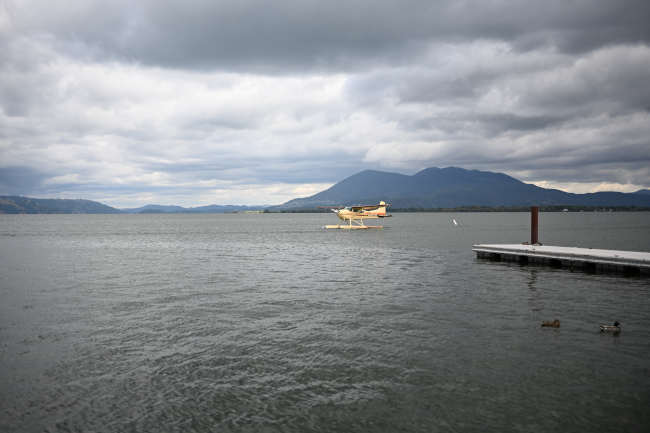
Around 2 p.m., three planes were parked at the lawn of Skylark and two docked in the water just behind the hotel, drifting quietly, looking out over the open lake. Ducks and geese swam into the shadows cast by the seaplane wings, seeking shelter from the glare, while visitors remained few and far between.

Overcast skies greeted the seaplanes arriving for the annual Clear Lake Splash-In in Lakeport, California, on Friday, April 25, 2025. Photo by Lingzi Chen/Lake County News.

“It’s pretty quiet today,” said Redwood Valley resident Jeff Blank who walked up to examine the red-wing seaplane — the largest of the three on the lawn at that time.

Blank said that he has attended Splash-In as a visitor multiple times in the past. “There used to be a lot of people with like 20 to 30 planes,” Blank said. He figured the smaller seaplane turnout this year was due to the weather.

For John Elbert, a volunteer assisting with incoming landing, the lower viewer turnout near the planes was because “everyone is over there in the seminar!”

Still, more spectators gradually arrived as scattered beams of sunlight occasionally broke through the clouds.

Some wandered among the planes on the lawn, while others lined the shore to watch the ones floating in the lake. Parents strolled with their babies, and pet owners walked with their dogs on leashes.

Lakeport Councilmember Brandon Disney made a brief stop on the lawn, asking for directions to the seminar to discuss Clear Lake “dock options” for seaplanes. He was then directed to the other event site, the Yacht Club.

A seaplane rolls up the ramp for the annual Clear Lake Splash-In in Lakeport, California, on Friday, April 25, 2025. Photo by Lingzi Chen/Lake County News.

Seaplanes touch down for the weekend

The favorite “show” for the visitors at Skylark, of course, was to watch a seaplane glide in from the distant sky and land with a splash on the lake, just yards away.

Together with other visitors, seasoned pilot Phyllis Manning-Lee who is also a seaplane instructor was waiting for her friend to land.

She drove from her home in Napa to participate and said she couldn’t get a room at Skylark. “It’s fully booked!” she exclaimed. She planned to stay at a friend’s place in Lakeport over the weekend.

Manning-Lee told Lake County News that Clear Lake is a popular destination for seaplanes. It’s not only an open lake but also has beautiful views when looking from above, she explained.

As she sat at the bench by the shore, Manning-Lee constantly checked the aviation information app on her phone, tracking the location, height, speed and landing time of her friend, Alberto Rossi, who disembarked from Hayward, East Bay.

She pointed to the clouds and mountains afar, and said that’s where Rossi would be coming.

As a pilot, Manning-Lee said she always knows the direction even without navigation tools.

The app showed that Rossi would land at 4:03 p.m..

By 3:40 p.m., everyone nearby had gathered at the shore, including those who had been examining the planes on the lawn. They looked up, stretching their sight toward the distance, scanning the sky—each hoping to be the first to spot the approaching aircraft.

The plane appeared as small as a bird when it first pierced through the shadowing clouds. Spectators pointed and called out, helping each other locate the tiny speck—and correcting those who mistook actual birds for the plane.

The Clear Lake Splash-In in Lakeport, California, attracts both residents and visitors, including pilot Phyllis Manning-Lee, center. Photo by Lingzi Chen/Lake County News.

The first time seeing the seaplanes

Among the enthusiastic viewers was 7-year-old Brandon Bartko of Lakeport — the only one who had walked out onto the dock, standing closest to the water, and of course, the landing.

He stood straight, still and quiet, eyes fixed on the approaching plane as it circled, searching for a place to touch down. Then it burst into a splash in the lake and taxied gracefully right in front of him.

This was Brandon’s first time to see a seaplane and he told Lake County News he liked it.

He was asked about what he was thinking on the dock.

Brandon looked over to the lake, contemplated, and said, “How cool it would be to be in a plane just soaring over the lake.”

Do you want to be a pilot? he was asked.

“No,” he responded, a little quicker this time — apparently he had thought about his future seriously. “I want to be a diesel mechanic.”

He was then asked if he would want to go for a ride in the seaplane?

A longer-than-usual pause ensued as Brandon clearly entered his typical deep thinking mode.

“Hmm, maybe,” he finally gave a well-considered response.

Asked about what he was thinking, he responded, “Sometimes I get scared on planes, and I don’t like being scared. And another reason, and the ‘yes’ reason, is that I know it’s not gonna crash at all.”

When asked if he was coming back on Saturday, the child finally looked up to his grandfather Bill Beedle and asked, “Are we?”

Beedle is a 40-year Lakeport resident who also attended Splash-In for the first time on Friday.

He gave a wide grin and said, “We'll come back tomorrow and look at some more planes. You bet.”

Email staff reporter Lingzi Chen at This email address is being protected from spambots. You need JavaScript enabled to view it.. 


The seaplanes that are featured at the Clear Lake Splash-In attracted visitors in Lakeport, California, on Friday, April 25, 2025. Photo by Lingzi Chen/Lake County News.
  • 246
  • 247
  • 248
  • 249
  • 250
  • 251
  • 252
  • 253
  • 254
  • 255

Community

  • Sheriff’s Activities League and Clearlake Bassmasters offer youth fishing clinic

  • City Nature Challenge takes place April 24 to 27

Public Safety

  • Lakeport Police logs: Wednesday, Feb. 11

  • Lakeport Police logs: Tuesday, Feb. 10

Education

  • Ramos measure requiring school officer training in use of anti-opioid drug moves forward

  • Lake County Chapter of CWA announces annual scholarships 

Health

  • California ranks 24th in America’s Health Rankings Annual Report from United Health Foundation

  • Healthy blood donors especially vital during active flu season

Business

  • Employment law summit takes place March 9

  • Two Lake County Mediacom employees earn company’s top service awards

Obituaries

  • Terry Knight

  • Ellen Thomas

Opinion & Letters

  • Who should pay for AI’s power? Not California ratepayers

  • Crandell: Supporting nephew for reelection in supervisorial race

Veterans

  • State honors fallen chief warrant officer killed in conflict in Iran

  • CalVet and CSU Long Beach team up to improve data collection related to veteran suicides

Recreation

  • April Audubon program will show how volunteers can help monitor local osprey nests

  • First guided nature walk of spring at Anderson Marsh State Historic Park April 11

  • Second Saturday guided nature walks continue at Anderson Marsh State Historic Park

  • Wet weather trail closure in effect on Upper Lake Ranger District

Religion

  • Kelseyville Presbyterian Church plans Easter service

  • Easter ‘Sonrise’ Service returns to Xabatin Community Park

Arts & Life

  • ‘CIA’ delves into the shadowy world of an espionage thriller

  • ‘War Machine’ shifts the battlefield into uncharted territory

Government & Politics

  • Lake County Democratic Central Committee endorses Falkenberg

  • Crandell launches reelection campaign plans March 15 event

Legals

  • April 23 hearing on Lake Coco Farms Major Use Permit

  • NOTICE OF 30-DAY PUBLIC COMMENT PERIOD & NOTICE OF PUBLIC HEARING

How to resolve AdBlock issue?
Refresh this page