How to resolve AdBlock issue?
Refresh this page
Lake County News,California
  • Home
    • Registration Form
  • News
    • Education
    • Veterans
    • Community
      • Obituaries
      • Letters
      • Commentary
    • Police Logs
    • Business
    • Recreation
    • Health
    • Religion
    • Legals
    • Arts & Life
    • Regional
  • Calendar
  • Contact us
    • FAQs
    • Phones, E-Mail
    • Subscribe
  • Advertise Here
  • Login
How to resolve AdBlock issue?
Refresh this page

News

Lake County librarian discusses funding situation for library system

LAKE COUNTY, Calif. — Cuts and staff freezes at the Institute of Museum and Library Services and the freezing of millions in grant funding to the California State Library have raised concerns about what’s in store for Lake County’s libraries.

Those concerns are of particular interest during California Library Week, April 6 though 12.

On Monday, acting Gov. Eleni Kounalakis issued a proclamation declaring California Library Week, as Lake County News has reported.

However, on the local level at least, there is reason for hope that the libraries will not be seriously impacted as a result of the actions taken by the federal government.

Last week, the California State Library said it had been notified by the federal Institute of Museum and Library Services that, effective April 1, the 2024-25 federal grant awarded under the Library Services and Technology Act has been terminated.

Officials reported that the State Library received $15,705,702 in funding to assist local California libraries provide programs and services, as well as supporting the services provided by the State Library to state government, policymakers and the public — with more than 21 percent of that funding not having been sent to California yet.

In addition, national news reports have stated that the Institute of Museum and Library Services, or IMLS, has put its entire staff on administrative leave.

Regarding the possible impacts of these developments on the local level, Lake County News reached out to Christopher Veach, Lake County’s librarian since 2013.

Veach had some reassuring news for those concerned about the Lake County Library.

“Right now we weren't slated to receive any grants directly from the IMLS in the next budget year. The library is primarily funded by a dedicated local property tax, as well as a contribution from the County general fund. Most of our grant funded programs, such as the Adult Literacy Program, are funded by the California State Library with state dollars,” Veach said in an email.

“In the next budget year the only federal funds I'm anticipating receiving are from the E-Rate program through the Federal Communications Commission. This provides reimbursement for the cost of our broadband internet,” Veach said.

Veach added, “While I don't anticipate immediate or direct impacts, federal funding is important for libraries in general.”

In the past, Veach said the Lake County Library has received federal funding from the Institute of Museum and Library Services to start its hotspot lending program and our Books by Mail program, both of which are now funded with local dollars.

“Federal funding through the American Rescue Plan Act during the Biden Presidency helped purchase the Bookmobile, alongside a grant from the State,” Veach said.

He said the Institute of Museum and Library Services budget “is a very small fraction of the federal budget, but it provides funding for State Library agencies who then fund local library programs.”

Regarding how the Lake County Library is funded, Veach said that use of dedicated property tax dates back to the founding of the County Library system in 1974 and has been in place for a long time.

“My strategy has always been to supplement that funding as efficiently as possible, often by pursuing local opportunities within the county or grants from the California State Library. My goal has been to boost our reserves to help mitigate economic uncertainty while still providing the maximum amount of relevant service to our community,” Veach said.

As to who the system serves, Veach said the 2022–23 statistical report to the State Library showed that the Lake County LIbrary has 27,524 registered users.

“We strive to serve the entire county, which is reflected in our programs and services,” Veach said. “This includes Storytime for young children and families, events like Wild Thing and ongoing Dungeons & Dragons groups for older children and teens, and interest-based clubs like the Cookbook Club and crafting groups for adults. Our Adult Literacy program, now including an English as a Second Language component, supports those with low literacy.”

Guided by the Collection Development Policy, Veach said he aims “to build a diverse collection that reflects our community and offers something for everyone — picture books, fiction, Spanish-language materials, ebooks, large print, and audiobooks.”

Veach said circulation trends show the county library’s collection is used by both younger and older patrons with a wide range of interests.

“We also see checkouts from every zip code in the County, and our bookmobile is visiting areas that are furthest from our established library branches,” said Veach.

Visit the Lake County Library at https://www.lakecountyca.gov/597/Library. 

Email Elizabeth Larson at This email address is being protected from spambots. You need JavaScript enabled to view it.. Follow her on Twitter, @ERLarson, and on Bluesky, @erlarson.bsky.social. Find Lake County News on the following platforms: Facebook, @LakeCoNews; X, @LakeCoNews; Threads, @lakeconews, and on Bluesky, @lakeconews.bsky.social.

Sheriff’s traffic stop leads to major methamphetamine seizure in Hidden Valley Lake

HIDDEN VALLEY LAKE, Calif. — A routine traffic stop by a Lake County Sheriff’s deputy in Hidden Valley Lake over the weekend quickly turned into a significant drug seizure.

The Lake County Sheriff’s Office said the stop on Sunday, April 6, led to the arrest of a Clearlake Oaks man and the seizure of a large amount of methamphetamine.

The sheriff’s office said the deputy was following a vehicle that made an abrupt turn without signaling, nearly causing an accident. The deputy turned around to conduct a traffic stop for the violation.

As the deputy pulled up to where the vehicle had stopped on a side road, he noticed the driver — identified as Nino Davis, 49 — outside his vehicle, kneeling down and glancing around.

When approached by the deputy, Davis disclosed that he was on probation and subject to an active search clause.

After confirming this information, the deputy conducted a search of both Davis and his vehicle, uncovering four one-pound packages of methamphetamine Davis had attempted to conceal underneath the vehicle.

Davis admitted to receiving the drugs outside of the county, with instructions to deliver them to an unknown location in Clearlake.

Davis was arrested on felony charges related to possessing a controlled substance for sale and transporting a controlled substance within and between counties. The sheriff’s office said he was transported to the Hill Road Correctional Facility, where he was booked on the above charges.

The seized narcotics totaled more than 1,800 grams — an amount equivalent to roughly 18,000 doses and an estimated 128,000 hours of drug influence removed from our streets, the sheriff’s office reported.

“We commend our deputy for his vigilance, professionalism, and dedication to protecting our community. His quick thinking and proactive efforts are a testament to the vital work our deputies do each day,” the sheriff’s office said.

While this seizure is a major step in removing drugs from the community, the sheriff’s office said it recognizes that the fight against drugs in our communities is far from over. “Together, with continued effort and community support, we can strive toward a safer, healthier and drug-free Lake County.”

Assembly Education Committee approves bill to strengthen Native American student rights to wear tribal regalia at graduation ceremonies

Schools would be prohibited from creating any process that would discourage or prevent Native American students from displaying any tribal adornment or ceremonial regalia at graduation ceremonies under a bill approved unanimously today by the Assembly Education Committee.

Assemblymember James C. Ramos (D-San Bernardino) introduced the bill, AB 1369.

“Despite existing legislation and constitutional protections to allow students to wear traditional tribal regalia at graduation ceremonies, Native American youth and their families continue to face obstacles and challenges. Graduation ceremonies are a time for young people, their families and tribal communities to share pride and joy in a major accomplishment. AB 1369 adds clarity to current law so that students’ and families’ celebration is not marred by unnecessary turmoil,” Ramos said.

He noted that regalia might include items such as eagle feathers or beading.

In 2018, the Legislature took action to protect student rights by passing AB 1248 (Chapter 804, Statutes of 2018). That bill stated, “A pupil may wear traditional tribal regalia or recognized objects of religious or cultural significance as an adornment at school graduation ceremonies.”

Despite this language, school districts continue to tell Native American students they cannot wear tribal regalia.

In 2021, the legislature passed Ramos’s AB 945 (Chapter 285, Statutes of 2021) which established a task force that would provide education leaders with policy, procedure, and best practices recommendations for the implementation of AB 1284.

California Indian Legal Services and the Tule River Indian Tribe are the AB 1369 sponsors, and it is also supported by the Fresno Unified School District, ACLU California Action, Habematolel Pomo of Upper Lake and Indigenous Justice.

AB 1369 will next go to the Assembly Judiciary Committee.

What causes the powerful winds that fuel dust storms, wildfires and blizzards? A weather scientist explains


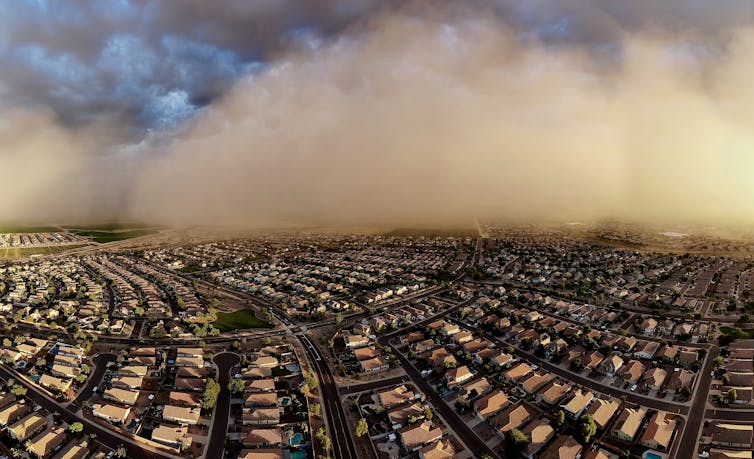
When huge dust storms like this one in the Phoenix suburbs in 2022 hit, it’s easy to see the power of the wind. Christopher Harris/iStock Images via Getty Plus

Windstorms can seem like they come out of nowhere, hitting with a sudden blast. They might be hundreds of miles long, stretching over several states, or just in your neighborhood.

But they all have one thing in common: a change in air pressure.

Just like air rushing out of your car tire when the valve is open, air in the atmosphere is forced from areas of high pressure to areas of low pressure.

The stronger the difference in pressure, the stronger the winds that will ultimately result.
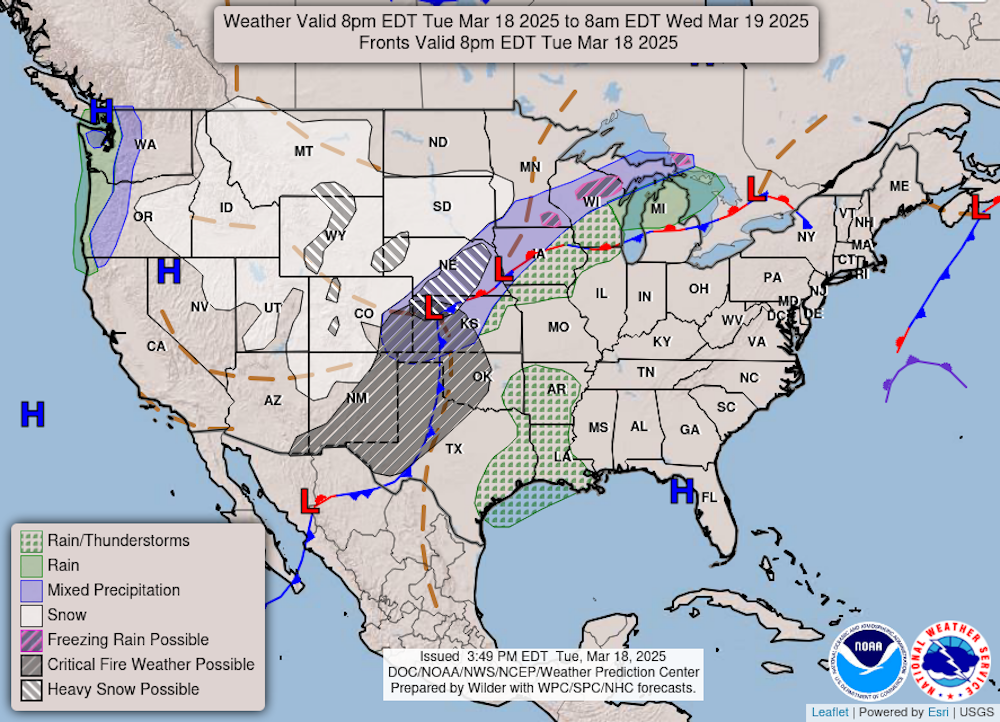
A weather map with a line between high and low pressure stretching across the U.S.
On this forecast for March 18, 2025, from the National Oceanic and Atmospheric Administration, ‘L’ represents low-pressure systems. The shaded area over New Mexico and west Texas represents strong winds and low humidity that combine to raise the risk of wildfires. NOAA Weather Prediction Center

Other forces related to the Earth’s rotation, friction and gravity can also alter the speed and direction of winds. But it all starts with this change in pressure over a distance – what meteorologists like me call a pressure gradient.

So how do we get pressure gradients?

Strong pressure gradients ultimately owe their existence to the simple fact that the Earth is round and rotates.

Because the Earth is round, the sun is more directly overhead during the day at the equator than at the poles. This means more energy reaches the surface of the Earth near the equator. And that causes the lower part of the atmosphere, where weather occurs, to be both warmer and have higher pressure on average than the poles.

Nature doesn’t like imbalances. As a result of this temperature difference, strong winds develop at high altitudes over midlatitude locations, like the continental U.S. This is the jet stream, and even though it’s several miles up in the atmosphere, it has a big impact on the winds we feel at the surface.
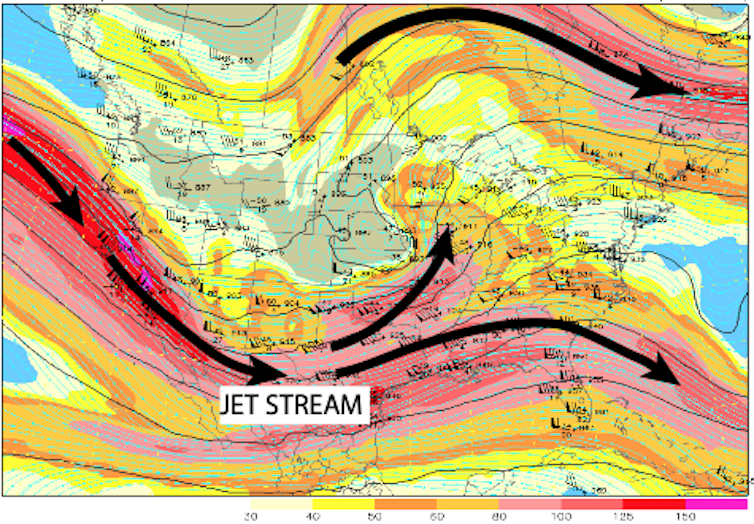
Wind speed and direction in the upper atmosphere on March 14, 2025, show waves in the jet stream. Downstream of a trough in this wave, winds diverge and low pressure can form near the surface. NCAR

Because Earth rotates, these upper-altitude winds blow from west to east. Waves in the jet stream – a consequence of Earth’s rotation and variations in the surface land, terrain and oceans – can cause air to diverge, or spread out, at certain points. As the air spreads out, the number of air molecules in a column decreases, ultimately reducing the air pressure at Earth’s surface.

The pressure can drop quite dramatically over a few days or even just a few hours, leading to the birth of a low-pressure system – what meteorologists call an extratropical cyclone.

The opposite chain of events, with air converging at other locations, can form high pressure at the surface.

In between these low-pressure and high-pressure systems is a strong change in pressure over a distance – a pressure gradient. And that pressure gradient leads to strong winds. Earth’s rotation causes these winds to spiral around areas of high and low pressure. These highs and lows are like large circular mixers, with air blowing clockwise around high pressure and counterclockwise around low pressure. This flow pattern blows warm air northward toward the poles east of lows and cool air southward toward the equator west of lows.

A maps shows pressure changes don't follow a straight line.
A map illustrates lines of surface pressure, called isobars, with areas of high and low pressure marked for March 14, 2025. Winds are strongest when isobars are packed most closely together. Plymouth State University, CC BY-NC-SA

As the waves in the jet stream migrate from west to east, so do the surface lows and highs, and with them, the corridors of strong winds.

That’s what the U.S. experienced when a strong extratropical cyclone caused winds stretching thousands of miles that whipped up dust storms and spread wildfires, and even caused tornadoes and blizzards in the central and southern U.S. in March 2025.

Whipping up dust storms and spreading fires

The jet stream over the U.S. is strongest and often the most “wavy” in the springtime, when the south-to-north difference in temperature is often the strongest.

Winds associated with large-scale pressure systems can become quite strong in areas where there is limited friction at the ground, like the flat, less forested terrain of the Great Plains. One of the biggest risks is dust storms in arid regions of west Texas or eastern New Mexico, exacerbated by drought in these areas.

Downtown is barely visible through a haze of dust.
A dust storm hit Albuquerque, N.M., on March 18, 2025. Another dust storm a few dats earlier in Kansas caused a deadly pileup involving dozens of vehices on I-70. AP Photo/Roberto E. Rosales

When the ground and vegetation are dry and the air has low relative humidity, high winds can also spread wildfires out of control.

Even more intense winds can occur when the pressure gradient interacts with terrain. Winds can sometimes rush faster downslope, as happens in the Rockies or with the Santa Ana winds that fueled devastating wildfires in the Los Angeles area in January.

Violent tornadoes and storms

Of course, winds can become even stronger and more violent on local scales associated with thunderstorms.

When thunderstorms form, hail and precipitation in them can cause the air to rapidly fall in a downdraft, causing very high pressure under these storms. That pressure forces the air to spread out horizontally when it reaches the ground. Meteorologists call these straight line winds, and the process that forms them is a downburst. Large thunderstorms or chains of them moving across a region can cause large swaths of strong wind over 60 mph, called a derecho.

Finally, some of nature’s strongest winds occur inside tornadoes. They form when the winds surrounding a thunderstorm change speed and direction with height. This can cause part of the storm to rotate, setting off a chain of events that may lead to a tornado and winds as strong as 300 mph in the most violent tornadoes.

How a tornado forms. Source: NOAA.

Tornado winds are also associated with an intense pressure gradient. The pressure inside the center of a tornado is often very low and varies considerably over a very small distance.

It’s no coincidence that localized violent winds from thunderstorm downbursts and tornadoes often occur amid large-scale windstorms. Extratropical cyclones often draw warm, moist air northward on strong winds from the south, which is a key ingredient for thunderstorms. Storms also become more severe and may produce tornadoes when the jet stream is in close proximity to these low-pressure centers. In the winter and early spring, cold air funneling south on the northwest side of strong extratropical cyclones can even lead to blizzards.

So, the same wave in the jet stream can lead to strong winds, blowing dust and fire danger in one region, while simultaneously triggering a tornado outbreak and a blizzard in other regions.The Conversation

Chris Nowotarski, Associate Professor of Atmospheric Science, Texas A&M University

This article is republished from The Conversation under a Creative Commons license. Read the original article.


Lake County Library Literacy Program provides important training

LAKE COUNTY, Calif. — As California Library Week is marked this week, the Lake County Library is preparing to train a new group of volunteers in its Literacy Program.

The Lake County Library Literacy Program will host a springtime new tutor training on Wednesday, April 16, at the Redbud Library, located at 14785 Burns Valley Road in Clearlake.

The training is free and will take place from 10 a.m. to 4 p.m.

Light snacks and refreshments will be provided, along with training materials at no cost.

Tutors are in high demand at the Library Literacy Program, with more volunteer tutors needed in the Clearlake area, bilingual tutors for the English as a Second Language Program, and tutors available and willing to tutor at the Lake County Jail.

A recent survey of adult skills indicated 26% of Lake County adults have literacy skills at level one or below.

Many adults want to improve their reading and writing skills so they can access better jobs, further their own education, advocate for their children, and overall improve their way of life.

Through hard work and perseverance, adult learners can change their own, and their family’s lives, for the better. Becoming a tutor can help someone to a better future.

No experience is needed, and ongoing support and workshops are provided for tutors. Upon completion of the training, tutors will be matched with adult learners in a variety of settings around the county.

Those who would like to help adults improve their literacy skills are encouraged to attend.

Hosted by Literacy Program Coordinator Georgina Marie Guardado and facilitated by Lake County Literacy Coalition Board Member Pam Klier, participants will learn useful techniques for teaching adults to read and write.

Learn more about the Literacy Program online at https://www.lakecountyca.gov/836/Literacy-Program. 

For more information or to register for tutor training, please call 707-263-7633 or email This email address is being protected from spambots. You need JavaScript enabled to view it..

Middletown Area Town Hall to discuss Valley Fire anniversary, hold election for alternates

MIDDLETOWN, Calif. — The Middletown Area Town Hall, or MATH, will meet this week to discuss plans for the Valley Fire anniversary, hear project updates and hold an election.

MATH will meet at 7 p.m. Thursday, April 10, in the Middletown Community Meeting Room/Library at 21256 Washington St., Middletown. The meeting is open to the public.

Zoom will not be available. Viewers can participate via PEG TV at www.youtube.com/LakeCountyPegTV. 

On the agenda is a discussion about plans for the 10th anniversary of the Valley Fire in September.

There also will be updates on Middletown area projects such as the NinaStar cannabis project, proposed campgrounds, the Guenoc Maha project and the Middletown Area Plan Update.

Action items include an election for alternates for the MATH Board, a bylaws revision and correspondence.

MATH also will discuss downtown a Caltrans safety improvement project, a possible time change for the meetings and a firewise community designation.

MATH — established by resolution of the Lake County Board of Supervisors on Dec. 12, 2006 — is a municipal advisory council serving the residents of Anderson Springs, Cobb, Coyote Valley (including Hidden Valley Lake), Long Valley and Middletown.

For more information email This email address is being protected from spambots. You need JavaScript enabled to view it.. 

Email Elizabeth Larson at This email address is being protected from spambots. You need JavaScript enabled to view it.. Follow her on Twitter, @ERLarson, and on Bluesky, @erlarson.bsky.social. Find Lake County News on the following platforms: Facebook, @LakeCoNews; X, @LakeCoNews; Threads, @lakeconews, and on Bluesky, @lakeconews.bsky.social.
  • 258
  • 259
  • 260
  • 261
  • 262
  • 263
  • 264
  • 265
  • 266
  • 267

Community

  • Sheriff’s Activities League and Clearlake Bassmasters offer youth fishing clinic

  • City Nature Challenge takes place April 24 to 27

Public Safety

  • Lakeport Police logs: Wednesday, Feb. 11

  • Lakeport Police logs: Tuesday, Feb. 10

Education

  • Ramos measure requiring school officer training in use of anti-opioid drug moves forward

  • Lake County Chapter of CWA announces annual scholarships 

Health

  • California ranks 24th in America’s Health Rankings Annual Report from United Health Foundation

  • Healthy blood donors especially vital during active flu season

Business

  • Employment law summit takes place March 9

  • Two Lake County Mediacom employees earn company’s top service awards

Obituaries

  • Terry Knight

  • Ellen Thomas

Opinion & Letters

  • Who should pay for AI’s power? Not California ratepayers

  • Crandell: Supporting nephew for reelection in supervisorial race

Veterans

  • State honors fallen chief warrant officer killed in conflict in Iran

  • CalVet and CSU Long Beach team up to improve data collection related to veteran suicides

Recreation

  • April Audubon program will show how volunteers can help monitor local osprey nests

  • First guided nature walk of spring at Anderson Marsh State Historic Park April 11

  • Second Saturday guided nature walks continue at Anderson Marsh State Historic Park

  • Wet weather trail closure in effect on Upper Lake Ranger District

Religion

  • Kelseyville Presbyterian Church plans Easter service

  • Easter ‘Sonrise’ Service returns to Xabatin Community Park

Arts & Life

  • ‘CIA’ delves into the shadowy world of an espionage thriller

  • ‘War Machine’ shifts the battlefield into uncharted territory

Government & Politics

  • Lake County Democratic Central Committee endorses Falkenberg

  • Crandell launches reelection campaign plans March 15 event

Legals

  • April 23 hearing on Lake Coco Farms Major Use Permit

  • NOTICE OF 30-DAY PUBLIC COMMENT PERIOD & NOTICE OF PUBLIC HEARING

How to resolve AdBlock issue?
Refresh this page