How to resolve AdBlock issue?
Refresh this page
Lake County News,California
  • Home
    • Registration Form
  • News
    • Education
    • Veterans
    • Community
      • Obituaries
      • Letters
      • Commentary
    • Police Logs
    • Business
    • Recreation
    • Health
    • Religion
    • Legals
    • Arts & Life
    • Regional
  • Calendar
  • Contact us
    • FAQs
    • Phones, E-Mail
    • Subscribe
  • Advertise Here
  • Login
How to resolve AdBlock issue?
Refresh this page

News

125 new officers join the ranks of the California Highway Patrol

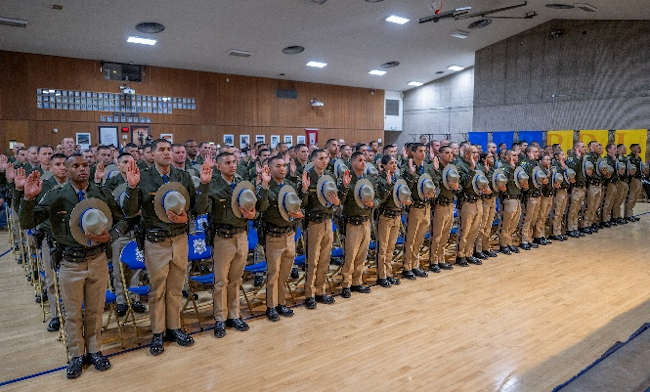
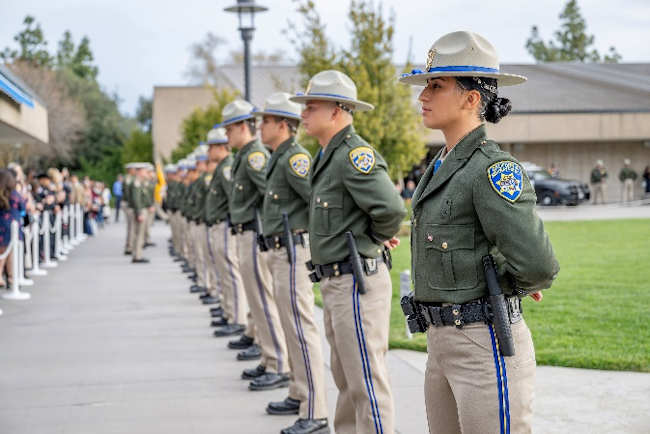
Graduating cadets at the California Highway Patrol’s Academy on Friday, March 21, 2025. Photo courtesy of the CHP.

The California Highway Patrol has announced the promotion of 125 cadets to the rank of officer.

The Friday graduation ceremony marks the successful completion of a 26-week intensive training schedule at the CHP Academy in West Sacramento.

The new officers will now report to one of the CHP’s 102 area offices throughout the state to begin their careers in public service.

The cadets being assigned to Northern Division, the region which includes Lake County, are Dylan Logelin of Auburn, assigned to duty at the CHP’s Quincy Area office; Robert Ruiz of Norwalk, assigned to the CHP’s Garberville, Laytonville Resident Post Area office; Moises Suarez Arredondo of Oakland, Calif., who is assigned to the CHP’s Trinity River Area office; Nikolas Welch of Sonora, assigned to the CHP’s Trinity River Area office; and Nolan Williams of Redding, assigned to duty at the CHP’s Mount Shasta Area office.

“Today, we celebrate the dedication and perseverance of our newly promoted officers,” said CHP Commissioner Sean Duryee on Friday. “Their commitment to integrity, service, and the safety of our communities embodies the core values of the CHP. As these officers begin their new role, they will carry the trust of those they serve — and with that, the ability to make a lasting impact.”

This is the largest graduating class since June 2022, when 128 officers were sworn in.

Nearly 300 cadets remain in training at the CHP Academy, with another 160 cadets scheduled to arrive on April 7 in preparation to serve the people of California.

During their CHP Academy training, cadets receive comprehensive instruction in critical areas, including traffic enforcement, collision investigation, defensive tactics, firearms proficiency, emergency vehicle operations, and community policing.

Training also includes a focus on legal responsibilities, communication skills, ethical conduct, and cultural diversity awareness, ensuring that cadets are equipped with the knowledge and skills necessary to protect and serve California’s communities effectively.

As part of California’s efforts to improve public safety, in June 2022, the state funded a multi-year CHP recruitment campaign aimed at filling 1,000 officer positions by hiring qualified individuals. In November 2024, the CHP met and surpassed the administration’s ambitious hiring goal.

The CHP is actively recruiting dedicated individuals to make a difference in communities throughout California.

As a CHP officer, you can make a meaningful impact by enhancing road safety, enforcing traffic laws, and responding to emergencies. With comprehensive training, competitive benefits, and opportunities for career advancement, the CHP offers a rewarding and fulfilling career path for individuals committed to upholding the highest standards of service and professionalism.

To learn more about joining the CHP, please visit its website.

Graduating cadets at the California Highway Patrol’s Academy on Friday, March 21, 2025. Photo courtesy of the CHP.

5 years on, true counts of COVID-19 deaths remain elusive − and research is hobbled by lack of data


National COVID-19 memorial wall for the five-year anniversary on March 11, 2025, in London, England. Andrew Aitchison/In Pictures via Getty Images
Dylan Thomas Doyle, University of Colorado Boulder

In the early days of the COVID-19 pandemic, researchers struggled to grasp the rate of the virus’s spread and the number of related deaths. While hospitals tracked cases and deaths within their walls, the broader picture of mortality across communities remained frustratingly incomplete.

Policymakers and researchers quickly discovered a troubling pattern: Many deaths linked to the virus were never officially counted. A study analyzing data from over 3,000 U.S. counties between March 2020 and August 2022 found nearly 163,000 excess deaths from natural causes that were missing from official mortality records.

Excess deaths, meaning those that exceed the number expected based on historical trends, serve as a key indicator of underreported deaths during health crises. Many of these uncounted deaths were later tied to COVID-19 through reviews of medical records, death certificates and statistical modeling.

In addition, lack of real-time tracking for medical interventions during those early days slowed vaccine development by delaying insights into which treatments worked and how people were responding to newly circulating variants.

Five years since the beginning of COVID-19, new epidemics such as bird flu are emerging worldwide, and researchers are still finding it difficult to access the data about people’s deaths that they need to develop lifesaving interventions.

How can the U.S. mortality data system improve? I’m a technology infrastructure researcher, and my team and I design policy and technical systems to reduce inefficiency in health care and government organizations. By analyzing the flow of mortality data in the U.S., we found several areas of the system that could use updating.

Critical need for real-time data

A death record includes key details beyond just the fact of death, such as the cause, contributing conditions, demographics, place of death and sometimes medical history. This information is crucial for researchers to be able to analyze trends, identify disparities and drive medical advances.

Approximately 2.8 million death records are added to the U.S. mortality data system each year. But in 2022 – the most recent official count available – when the world was still in the throes of the pandemic, 3,279,857 deaths were recorded in the federal system. Still, this figure is widely considered to be a major undercount of true excess deaths from COVID-19.

In addition, real-time tracking of COVID-19 mortality data was severely lacking. This process involves the continuous collection, analysis and reporting of deaths from hospitals, health agencies and government databases by integrating electronic health records, lab reports and public health surveillance systems. Ideally, it provides up-to-date insights for decision-making, but during the COVID-19 pandemic, these tracking systems lagged and failed to generate comprehensive data.

Two health care workers in full PPE attending to a patient lying on hospital bed
Getting real-time COVID-19 data from hospitals and other agencies into the hands of researchers proved difficult. Gerald Herbert/AP Photo

Without comprehensive data on prior COVID-19 infections, antibody responses and adverse events, researchers faced challenges designing clinical trials to predict how long immunity would last and optimize booster schedules.

Such data is essential in vaccine development because it helps identify who is most at risk, which variants and treatments affect survival rates, and how vaccines should be designed and distributed. And as part of the broader U.S. vital records system, mortality data is essential for medical research, including evaluating public health programs, identifying health disparities and monitoring disease.

At the heart of the problem is the inefficiency of government policy, particularly outdated public health reporting systems and slow data modernization efforts that hinder timely decision-making. These long-standing policies, such as reliance on paper-based death certificates and disjointed state-level reporting, have failed to keep pace with real-time data needs during crises such as COVID-19.

These policy shortcomings lead to delays in reporting and lack of coordination between hospital organizations, state government vital records offices and federal government agencies in collecting, standardizing and sharing death records.

History of US mortality data

The U.S. mortality data system has been cobbled together through a disparate patchwork of state and local governments, federal agencies and public health organizations over the course of more than a century and a half. It has been shaped by advances in public health, medical record-keeping and technology. From its inception to the present day, the mortality data system has been plagued by inconsistencies, inefficiencies and tensions between medical professionals, state governments and the federal government.

The first national efforts to track information about deaths began in the 1850s when the U.S. Census Bureau started collecting mortality data as part of the decennial census. However, these early efforts were inconsistent, as death registration was largely voluntary and varied widely across states.

In the early 20th century, the establishment of the National Vital Statistics System brought greater standardization to mortality data. For example, the system required all U.S. states and territories to standardize their death certificate format. It also consolidated mortality data at the federal level, whereas mortality data was previously stored at the state level.

However, state and federal reporting remained fragmented. For example, states had no unifom timeline for submitting mortality data, resulting in some states taking months or even years to finalize and release death records. Local or state-level paperwork processing practices also remained varied and at times contradictory.

Close-up of blank form titled CERTIFICATE OF DEATH
Death record processing varies by state. eric1513/iStock via Getty Images Plus

To begin to close gaps in reporting timelines to aid medical researchers, in 1981 the National Center for Health Statistics – a division of the Centers for Disease Control and Prevention – introduced the National Death Index. This is a centralized database of death records collected from state vital statistics offices, making it easier to access death data for health and medical research. The system was originally paper-based, with the aim of allowing researchers to track the deaths of study participants without navigating complex bureaucracies.

As time has passed, the National Death Index and state databases have become increasingly digital. The rise of electronic death registration systems in recent decades has improved processing speed when it comes to researchers accessing mortality data from the National Death Index. However, while the index has solved some issues related to gaps between state and federal data, other issues, such as high fees and inconsistency in state reporting times, still plague it.

Accessing the data that matters most

With the Trump administration’s increasing removal of CDC public health datasets, it is unclear whether policy reform for mortality data will be addressed anytime soon.

Experts fear that the removal of CDC datasets has now set precedent for the Trump administration to cross further lines in its attempts to influence the research and data published by the CDC. The longer-term impact of the current administration’s public health policy on mortality data and disease response are not yet clear.

What is clear is that five years since COVID-19, the U.S. mortality tracking system remains unequipped to meet emerging public health crises. Without addressing these challenges, the U.S. may not be able to respond quickly enough to public health crises threatening American lives.The Conversation

Dylan Thomas Doyle, Ph.D. Candidate in Information Science, University of Colorado Boulder

This article is republished from The Conversation under a Creative Commons license. Read the original article.

Public Health officer resigns, Board of Supervisors approves interim hire

LAKE COUNTY, Calif. — With Lake County’s latest Public Health officer resigning, the Board of Supervisors has approved a contract with a physician to cover the job on a temporary basis.

Lake County Public Health Officer Dr. Noemi Doohan has resigned, effective March 31. The Board of Supervisors unanimously approved a temporary replacement on Tuesday.

Doohan has served as Lake County’s Public Health officer since September 2023.

She was the first non-temporary Public Health officer appointee since the resignation of her predecessor, Dr. Erik McLaughlin, in June 2022.

California state law requires counties to have Public Health officers to enforce local health orders and ordinances, as well as state regulations and statutes.

Following Doohan’s resignation, Health Services Director Anthony Arton cited the need for an interim officer to prevent service disruptions, while looking for a full-time, permanent health officer.

“Appointing a contracted temporary Public Health Officer will ensure continuity and effectiveness of LCHS operations and will avoid a lapse of coverage and services to our community,” Arton wrote in a memo to the Board of Supervisors.

“Without the appointment of a Public Health Officer, vital records and immunization services will be immediately impacted, among other services,” Arton wrote in his memo.

After a search, Arton proposed hiring Anju Goel, MD, MPH, for a temporary six-month term, from April 1 to Sep. 30.

“Dr. Goel is very qualified for this role. She brings extensive experience as an Interim Health Officer in California and has served as an independent medical doctor for the CDC,” Arton wrote in the memo, citing Goel’s “deep expertise” in public health.

Arton explained that three candidates declined the interim position due to conflicting obligations or pay concerns, while two others gave “mixed responses” before Goel was recommended to him.

“Dr. Goel was recommended by Dr. Doohan as a temporary fill-in while we conduct a search for a longer-term solution,” Health Services wrote in an email to Lake County News about the contact with Geol.

“At this time, we do not have prior experience working with Dr. Goel. However, her qualifications and expertise make her a strong candidate during this interim period,” the agency noted in the email.

Prior to this new job, Goel has worked as the interim health officer for the city of Berkeley in September 2023 for a term of 18 months through 2025, according to Berkeleyside. While she did not live in Berkeley, the hybrid role allowed in-person and remote work.

Medical Board of California records show that Goel graduated from the Stanford University School of Medicine in 1999, four years earlier than Doohan who went to the same medical school.

As Goel prepares to step in temporarily for Lake County, Doohan departs for Berkeley.

“Dr. Doohan has accepted a position as the Health Officer for the City of Berkeley, which led to her resignation from Lake County Health Services,” Health Services wrote in the email response to Lake County News’ inquiries. “We wish her the best of success in her new role.”

However, Health Services declined Lake County News’ request to see Doohan’s resignation letter: “Because this is a confidential personnel matter, no further information will be released.”

They acknowledged that “transitions in leadership can have an impact,” but noted that Arton “continues to oversee the day-to-day operations of the department and hold all administrative authority.”

While all the current and former public health officers, permanent or interim, have been reporting to the Board of Supervisors, Goel however “reports administratively to the Health Services Director,” the contract stated.

The current job post for the full-time Public Health officer does not specify if the role will be reporting to the department director or the Board of Supervisors.

It is uncertain if the reporting structure has changed temporarily or permanently.

The cost of having a Public Health officer

The county’s Health Services has reached an agreement with Dr. Goel on compensation.

Goel will be paid $165 for every hour of her service, and $10.50 an hour for on-call, Arton reported at Tuesday’s Board of Supervisors’ meeting.

A Berkeleyside 2023 report said that Goel’s hourly pay as city of Berkeley’s interim health officer was $131.86 to $149.79 at that time.

“We took about four to five weeks to reach reasonable terms with her,” Arton said during the board meeting. “That will allow us to have full coverage in the absence of a full time employee health officer.”

The contract states that in the event of a Board of Supervisors declaring an emergency that requires Goel to be present in-person, the county will reimburse mileage at $0.71 per mile and lodging at $110 per day.

The total combined compensation within a year — or in this case six months — shall not exceed $49,860, according to the contract.

Health Services confirmed with Lake County News that over the six-month period, Dr. Goel’s total hours would be approximately 302 hours, averaging around 50 hours per month.

They also said that they found 50 hours per month is sufficient for the temporary appointment, “given the nature of the work and Dr. Goel’s experience.”

“And perhaps less given the on-call pay we actually project about a 12–15-week projection and will use this time to find longer term solutions,” their email said.

“We will use that time to recruit a full-time health officer as an employee or reach terms with a longer term health officer,” said Arton during the supervisors’ meeting. “I do have a candidate in waiting that I'm very excited about.”

The job posting for a full-time health officer remains active, with a listed salary range of $199,824 to $242,880.

When Doohan was hired in 2023, county documents indicated she was offered an annually renewable contract not to exceed $290,000, along with a $20,000 hiring incentive.

At that time, the listed salary was $265,000 — $22,000 more than the top end of the current listed range.

Health officer turnover continues in Lake County

Since Dr. Karen Tait resigned in 2017 after nine years in the role, no Public Health officer has held the position for more than 20 months.

The longest term since Tait has been that of Dr. Gary Pace, whose service began in August 2019 and continued through the beginning of the COVID-19 pandemic to April 2021.

The next full-time officer after Pace was Dr. McLaughlin. He was appointed in March 2022 and quickly resigned in June.

In fact, McLaughlin's three-and-a-half month tenure has been the shortest of any permanently appointed Public Health officer in Lake County in over 20 years.

With an urgent need to cover the Public Health officer’s duty during the pandemic, the Board of Supervisors approved rehiring Pace, McLaughlin’s predecessor, as an interim officer.

For the temporary appointment, Pace received a rate of $150 per hour for his work not to exceed $4,000 per month, with a flat rate of $500 per week for on-call. His total combined compensation shall not exceed $6,000 per month.

In the same meeting, supervisors also approved a contract that would pay up to $29,000 to Mosaic Public Partners, a recruitment consulting firm, to search for a permanent Public Health officer for Lake County.

Recruiting a full-time Public Health officer had been challenging for Lake and other counties “due to the repercussions of the COVID-10 health pandemic and the shortage of available health professionals,” County Administrative Officer Susan Parker's memo with the contract explained.

Less than three months later, on Sept. 13, 2022, the supervisors appointed Dr. Karl A. Sporer as interim officer for a six-month term, with an amount not to exceed $6,000 a month.

Still in 2022, at a Nov. 8 meeting, the Board of Supervisors unanimously approved a contract with Doohan for a Public Health officer “mentor program,” in response to having had few candidates for the position out of 110 potential candidates identified across the state by its recruitment contractor Mosaic Public Partners.

That mentor program contract said the county would pay Doohan a consulting rate of $250 per hour for three to six months, with a total compensation cap of $25,000.

Then in February 2023, Sporer’s interim contract was renewed for another six months, as the county still had not secured a permanent hire.

In August 2023, Doohan accepted the job as a full-time Public Health officer of Lake County and started in September.

Doohan’s 19-month tenure is close to Pace’s 20 months, but continued the pattern of short-lived appointments.

Email staff reporter Lingzi Chen at This email address is being protected from spambots. You need JavaScript enabled to view it.. 

Thompson, Pelosi, Bay Area members, physicians and patients warn of devastating health care cuts


On Tuesday, Rep. Mike Thompson (CA-04), Speaker Emerita Nancy Pelosi, Senator Adam Schiff (D-CA), Rep. Kevin Mullin (CA-15), Rep. Lateefah Simon (CA-12), Dr. Amy Herold, and patient and physician advocates participated in a press conference at University of San Francisco’s Wayne and Gladys Valley Center for Vision.

The speakers warned that Congressional Republicans’ plan to cut $880 billion from the budget that funds Medicaid in order to fund tax cuts for the ultra-rich will devastate local access to care for everyone.

“Congressional Republicans have mandated an $880 billion budget cut, something that can’t be done without destroying Medicaid. And the destruction of Medicaid will hurt everyone,” said Thompson. “One-third of health care in California comes from Medicaid. Without this funding, hospitals and health centers in our community will be forced to slash services or shut down altogether. That means everyone loses access to care. All of this is for one purpose: to facilitate a tax cut for the richest people in our country.”

“Republicans want to cut $880 billion or more in Medicaid so they can give a tax cut to the wealthiest people in America. Republicans are choosing to protect the wealthy while ripping away health care from millions of Americans, closing hospitals and nursing homes, and diminishing the quality of care. Here in San Francisco, 100,000 people, including 21,000 children on Medicaid, are at risk of losing their health care — but Democrats stand united against the cruel Republican scheme,” said Pelosi.

Members were joined by physicians and patients, including Dr. Amy Herold, OB-GYN and Chief Administrative Office and Chief Medical Officer for Providence Queen of the Valley Medical Center in Napa.

Dr. Herold spoke on the impacts Medicaid cuts will have on rural hospitals like hers.

“When we look at these proposed cuts, they would be devastating for my hospital. If we lose government funding, we will have to close services,” Herold said. “We are the only hospital in Napa County that has a trauma center. We are the only hospital in the county that has a labor and delivery unit. If these services close, there will be a health care desert. So not only do the people who are on Medi-Cal not have access to care, but anyone, regardless of insurance status, will not have access to care if we have to close our programs. This is what keeps me up at night.”

In February, Congressional Republicans passed a partisan budget bill that instructs the House Energy and Commerce Committee, which has jurisdiction over Medicare and Medicaid, to cut its spending by $880 billion.

The nonpartisan Congressional Budget Office has since analyzed the budget and confirmed that the committee cannot meet Congressional Republicans’ mandated level of spending cuts without deep cuts to Medicaid.

Millions of people would lose coverage entirely, and those who remain covered would see reduced benefits and fewer available providers.

Congressional Republicans’ proposed cuts to health care and nutrition programs in their budget bill add up to nearly the exact amount of savings the party needs in order to implement their tax bill delivering massive tax cuts for corporations and those making over $743,000 per year.

Fires, wars and bureaucracy: The tumultuous journey to establish the US National Archives


The 1952 procession to deliver the Declaration of Independence and Constitution from the Library of Congress to the National Archives included military guards and a tank. National Archives
Elizabeth Call, Rochester Institute of Technology

Some of the United States’ most important historical documents, including the Declaration of Independence, the Constitution, the Bill of Rights and the Emancipation Proclamation, are housed in the U.S. National Archives. Beyond these high-profile items, it also preserves lesser-known but no less vital records, such as national park master plans, polar exploration documents and the records of all U.S. veterans. Together, these materials stand as a testament to the country’s commitment to preserving its history.

While these crucial documents in U.S. history now have a home in the National Archives, the road to establishing this institution was paved with catastrophic losses and bureaucratic inertia.

Creating the National Archives required decades of advocacy by historians, politicians and government officials. The National Archives was not simply an administrative convenience – it was a necessity born from repeated disasters that underscored the fragility of government records. And with President Donald Trump’s firing of the head archivist in February 2025, as well as the loss of several high-level archives staff members, the organization faces a new era of uncertainty.

Documentary heritage – the recorded memory of a nation that preserves its cultural, historical and legal legacy – is essential for a country as it safeguards its identity, informs its governance and ensures that future generations can understand and learn from the past.

I am a university archivist with two decades of experience in the library and archives field. I oversee the preservation and accessibility of historical records at Rochester Institute of Technology, advocate for inclusivity, and engage in national conversations on the evolving role of archives in the digital age.

Understanding the precarious nature of historical records, it’s clear to me that maintaining, staffing and funding the National Archives is a necessary safeguard against the destruction of the nation’s documentary heritage.

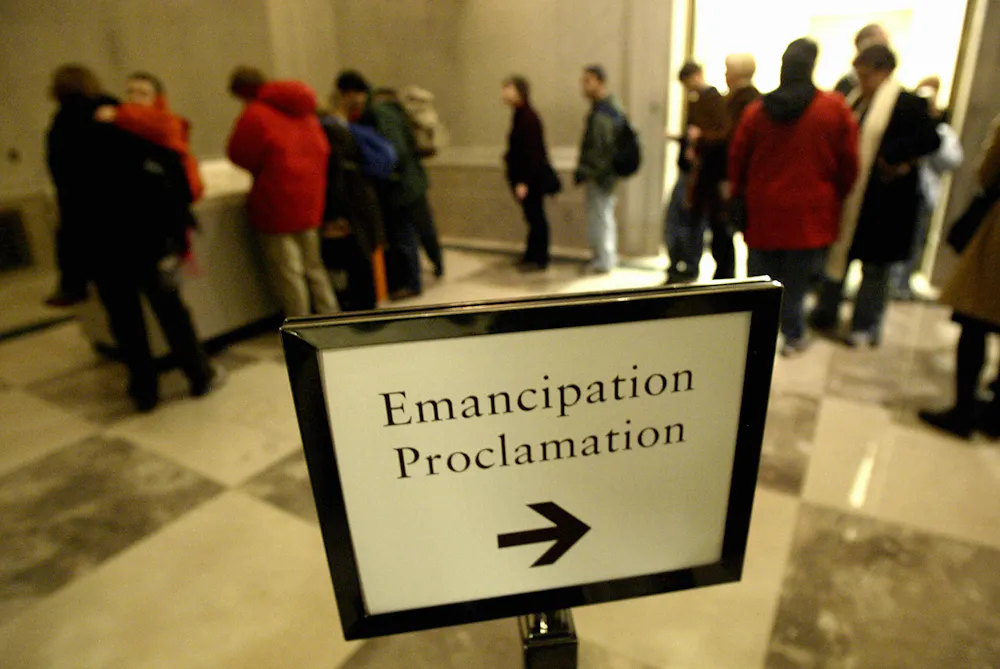
A line stands behind a direction sign that says 'Emancipation Proclamation' on it.
People line up to view the original Emancipation Proclamation on Martin Luther King Jr. Day, Jan. 19, 2004, at the National Archives building in Washington, D.C. Tim Sloan/AFP-Getty Images

Destroyed by fire

The idea of preserving the government’s records dates back to the country’s founding. Charles Thomson, secretary of the Continental Congress during the American Revolution and then secretary of Congress under the Articles of Confederation, recognized the need for proper storage of the Congress’ records.

But the young nation lacked the money and infrastructure to act. Many of the Continental Congress’ records were kept by Thomson himself for years, and while some were later transferred to the Department of State, others were lost.

Throughout the 19th and early 20th centuries, fires repeatedly ravaged federal records. Fires were very common in the 19th century due to a combination of highly flammable building materials, open frames used for lighting and heating, and the lack of modern fire safety measures such as sprinklers and fire-resistant construction.

In 1800, a blaze destroyed the War Department’s archives, a loss that severely hampered government operations. In 1810, Congress authorized better housing for government records, but the law was never fully executed. Instead, different parts of the government, from the Department of State to the Department of Treasury, continued maintaining their own records.

The Treasury Department suffered fires in 1801 and again in 1833, further erasing crucial financial records. The Patent Office, home to invaluable documentation of American innovation, burned in 1877, having already been damaged by an 1836 fire.

A messy room with furniture and documents stacked haphazardly.
Storage at the federal Office of Indian Affairs in 1935. National Archives Foundation

One of the most devastating losses occurred in 1921 when a fire at the Department of Commerce destroyed nearly all records from the 1890 federal census. This loss had far-reaching consequences, particularly for genealogical and demographic research.

Fires weren’t the only threat to the government’s records.

“It is a matter of common report that during the civil war, great quantities of documents stored in the Capitol were thrown away to make quarters for soldiers,” Historian and founding member of the American Historical Association J. Franklin Jameson noted in a 1911 Washington Post article.

“At a later date,” he added, “the archives of the House of Representatives were systematically looted for papers having a market value because of their autographs.”

Jameson spent decades lobbying Congress for a centralized repository. His persistence, coupled with the advocacy of key officials, laid the groundwork for future action.

A dark colored book with 'George Washington' stamped on the cover above 'Original Manuscript Account of Expenses while Commander in Chief of the Continental Army'
A bound copy of George Washington’s account of expenses while commander in chief of the Continental Army. National Archives and Records Administration

These repeated disasters illuminated a glaring issue: The federal government lacked a centralized, protected repository to safeguard its records.

Finding a home

Momentum for a dedicated archives building gained traction in the late 19th century. In 1903, a bipartisan bill passed Congress giving the OK to purchase land in Washington, D.C., for a Hall of Records.

But the legislation didn’t lead to any action. Government records remained scattered, vulnerable and neglected. That same year, Congress authorized that any records not needed for daily business be transferred to the Library of Congress.

In 1912, President William H. Taft issued executive order 1499, aptly named Disposal of Useless Papers, requiring agencies to consult the librarian of Congress before disposing of documents.

This established a formal review process for government document disposal, but agencies still discarded records, often haphazardly, until stricter records management laws were enacted.

In 1926, Congress passed the Public Buildings Act, authorizing construction of an archives facility in Washington, D.C. Departing president Herbert Hoover laid the cornerstone of the new building on Feb. 20, 1933. He then deposited facsimiles of the Declaration of Independence and the Constitution, an American flag and daily newspapers from that day underneath the cornerstone.

Growth and standardization

President Franklin D. Roosevelt, who took office two weeks later, was himself a meticulous record-keeper. He understood the importance of historical preservation. Roosevelt kept all of his personal and presidential records and books in a fire-safe space he built on his Hyde Park, New York, property, which he donated to the government after he died. This building and the materials inside became part of the National Archives as the first U.S. presidential library.

The National Archives, an independent agency, was officially established under Roosevelt in the 1934 National Archives Act. The head archivist was to be appointed by the president. The first archivist, Robert D.W. Connor, took office that year with a mandate to organize, preserve and make accessible the nation’s records.

Initially, the National Archives was simply a building – an impressive neoclassical structure in Washington, D.C., that opened in 1935. The very first records deposited there came from three World War I-era regulatory agencies – the U.S. Food Administration, the Sugar Equalization Board and the U.S. Grain Corporation.

Initially, the Archives lacked a formalized records management program. There were no clear guidelines on what to keep and what to discard, so agencies made their own decisions. This led to inconsistent preservation.

The creation of the first federal records administration program in 1941, together with the 1943 Records Disposal Act, codified things. These policies granted the National Archives authority to establish a structured approach to determining which records held historical value and should be preserved, while allowing for the responsible disposal of other documents.

A 1950 law gave the National Archives more power to decide what should be kept and what could be discarded, creating a more organized and accountable system for preserving the nation’s history.

As the volume of records increased and their formats changed, the archives adapted. By 2014, amendments to the Federal Records Act explicitly included electronic records, recognizing the shift toward digital documentation.

A woman in a dark dress standing in front of a huge cabinet of stacked drawers.
Stacks at the National Archives in Washington in 1950, where rare photographs and national records are ordered and stored. Three Lions/Getty Images

Ensuring accountability

Beyond mere storage, the National Archives plays a vital role in upholding democracy.

It ensures transparency by preserving government accountability, preventing manipulation or loss of records that could distort historical truth. The National Archives also provides public access to documents that shape civic awareness and historical knowledge, from the Declaration of Independence to declassified government files.

In an era of digital misinformation and contested narratives, the National Archives stands as a guardian of primary sources. Its existence reminds the nation that history is not a matter of convenience, but a cornerstone of informed governance.The Conversation

Elizabeth Call, University Archivist, RIT Libraries and Archives, Rochester Institute of Technology

This article is republished from The Conversation under a Creative Commons license. Read the original article.

Helping Paws: Cattle dogs and shepherds

LAKE COUNTY, Calif. — Lake County Animal Care and Control’s shelter is filled with dogs eager to get out and join new families.

The dogs available for adoption this week include mixes of Akita, American blue heeler, Australian shepherd, Belgian malinois, border collie, cattle dog, German shepherd, husky, Labrador Retriever, pit bull terrier, Rottweiler and Siberian husky.

Dogs that are adopted from Lake County Animal Care and Control are either neutered or spayed, microchipped and, if old enough, given a rabies shot and county license before being released to their new owner. License fees do not apply to residents of the cities of Lakeport or Clearlake.

Those dogs and the others shown on this page at the Lake County Animal Care and Control shelter have been cleared for adoption.

Call Lake County Animal Care and Control at 707-263-0278 or visit the shelter online for information on visiting or adopting.

The shelter is located at 4949 Helbush in Lakeport.

Email Elizabeth Larson at This email address is being protected from spambots. You need JavaScript enabled to view it.. Follow her on Twitter, @ERLarson, and on Bluesky, @erlarson.bsky.social. Find Lake County News on the following platforms: Facebook, @LakeCoNews; X, @LakeCoNews; Threads, @lakeconews, and on Bluesky, @lakeconews.bsky.social.

 
Jet's preview photo
Jet

Bear-Bear's preview photo
Bear-Bear

Hamilton's preview photo
Hamilton

Scout's preview photo
Scout

Sable's preview photo
Sable

Shepp's preview photo
Shepp

Chia's preview photo
Chia

Oscar(Brutus)'s preview photo
Oscar(Brutus)

Dolly's preview photo
Dolly

Buck's preview photo
Buck

Benny 's preview photo
Benny

Fred's preview photo
Fred

Annie 's preview photo
Annie

Sephire's preview photo
Sephire

Oliver's preview photo
Oliver

Rocco's preview photo
Rocco

Honey's preview photo
Honey

Aria's preview photo
Aria

 
Alma 's preview photo
Alma

Makita's preview photo
Makita

Hariett's preview photo
Hariett

Mila's preview photo
Mila

Beau's preview photo
Beau

Queenie's preview photo
Queenie

Odie's preview photo
Odie

Kennel#5b's preview photo
Kennel#5b

Kennel#5a's preview photo
Kennel#5a

Kennel#2b's preview photo
Kennel#2b

Kennel#2a's preview photo
Kennel#2a

Kennel#8's preview photo
Kennel#8


  • 270
  • 271
  • 272
  • 273
  • 274
  • 275
  • 276
  • 277
  • 278
  • 279

Community

  • Sheriff’s Activities League and Clearlake Bassmasters offer youth fishing clinic

  • City Nature Challenge takes place April 24 to 27

Public Safety

  • Lakeport Police logs: Wednesday, Feb. 11

  • Lakeport Police logs: Tuesday, Feb. 10

Education

  • Ramos measure requiring school officer training in use of anti-opioid drug moves forward

  • Lake County Chapter of CWA announces annual scholarships 

Health

  • California ranks 24th in America’s Health Rankings Annual Report from United Health Foundation

  • Healthy blood donors especially vital during active flu season

Business

  • Employment law summit takes place March 9

  • Two Lake County Mediacom employees earn company’s top service awards

Obituaries

  • Terry Knight

  • Ellen Thomas

Opinion & Letters

  • Who should pay for AI’s power? Not California ratepayers

  • Crandell: Supporting nephew for reelection in supervisorial race

Veterans

  • State honors fallen chief warrant officer killed in conflict in Iran

  • CalVet and CSU Long Beach team up to improve data collection related to veteran suicides

Recreation

  • April Audubon program will show how volunteers can help monitor local osprey nests

  • First guided nature walk of spring at Anderson Marsh State Historic Park April 11

  • Second Saturday guided nature walks continue at Anderson Marsh State Historic Park

  • Wet weather trail closure in effect on Upper Lake Ranger District

Religion

  • Kelseyville Presbyterian Church plans Easter service

  • Easter ‘Sonrise’ Service returns to Xabatin Community Park

Arts & Life

  • ‘CIA’ delves into the shadowy world of an espionage thriller

  • ‘War Machine’ shifts the battlefield into uncharted territory

Government & Politics

  • Lake County Democratic Central Committee endorses Falkenberg

  • Crandell launches reelection campaign plans March 15 event

Legals

  • April 23 hearing on Lake Coco Farms Major Use Permit

  • NOTICE OF 30-DAY PUBLIC COMMENT PERIOD & NOTICE OF PUBLIC HEARING

How to resolve AdBlock issue?
Refresh this page