How to resolve AdBlock issue?
Refresh this page
Lake County News,California
  • Home
    • Registration Form
  • News
    • Education
    • Veterans
    • Community
      • Obituaries
      • Letters
      • Commentary
    • Police Logs
    • Business
    • Recreation
    • Health
    • Religion
    • Legals
    • Arts & Life
    • Regional
  • Calendar
  • Contact us
    • FAQs
    • Phones, E-Mail
    • Subscribe
  • Advertise Here
  • Login
How to resolve AdBlock issue?
Refresh this page

News

Upper Lake’s Tallman Hotel and Blue Wing Saloon sold

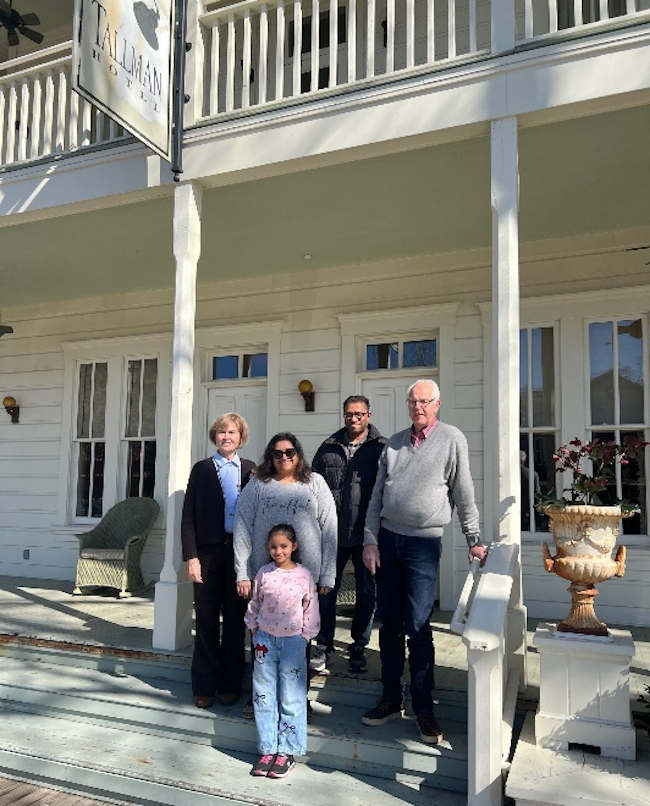
From left to right, Lynne Butcher, Rajvi Alapati and daughter Azaira, Amar Alapati and Bernie Butcher. Courtesy photo.

UPPER LAKE, Calif. — After two decades of being at the heart of renewal and redevelopment in downtown Upper Lake, the Tallman Hotel and Blue Wing Saloon restaurant have been sold.

Bernie and Lynne Butcher, who renovated the historic hotel and built the restaurant next door, said they have sold the two businesses to Amar and Rajvi Alapati. The sale closed Thursday.

“We’re proud of what we’ve been able to build here in Upper Lake over the past twenty years with the help of a first-rate, professional staff,” said Lynne Butcher. “In looking for new owners, it was important to us to find people with both the experience and the dedication to take the business to the next level.”

The Alapatis own eight other boutique hotels, most under the umbrella of Serenite Hotels. Their other properties include the Amador Hotel in Pioneer, located in the Gold Country; the Groveland Hotel and Narrow Gauge Inn, both located close to Yosemite National Park; and the Shaver Lake Village Hotel.

“Rajvi and I are delighted to add the Tallman and Blue Wing to our portfolio,” said Amar Alapati. “We were impressed from day one with the quality of the physical facilities here as well as the reputation that has been developed as the premier hotel and one of the top dining facilities in Lake County.”

He said they have rehired all of the existing staff, “and we’re committed to enhancing profitability while preserving the current high level of personal service.”

Rajvi Alapati noted the attention to detail the Butchers put into all aspects of the property and the five-star ratings she’s seen online for both the hotel and restaurant.

“We hope to leverage the economies of scale we can achieve with our other hotels and to find ways to bring even more people to experience the attractions of Lake County,” she said.

The Tallman Hotel in Upper Lake, California, when the Butchers purchased it in 2003. Courtesy photo.

History and redevelopment

Rufus and Mary Tallman originally built a stage stop hotel and saloon on the site in the early 1870s. The Tallman House Hotel burned down in October 1895. It was rebuilt and called the Riffe’s Hotel when the Tallmans’ daughter, Winnyford, and her husband, Hank Riffe, took over the business in 1906.

A history of the site said the Tallmans also operated the original Blue Wing Saloon next door to the hotel. However, during Prohibition in the 1920s, the Riffes tore down the saloon.

After her husband’s death in 1937, Winnyford Riffe ran the hotel as a boarding house, and it was a retirement home in the 1940s and into the 1950s.

The hotel remained in place but was largely abandoned by 1962. For 40 years, the building was left in a declining state, looking like a backdrop from a western movie set.

In 2003, the Butchers purchased the building — then in the county’s Northshore redevelopment area — and set about a complete rebuild and expansion of the hotel that included green technology such as a geo-exchange cooling system while paying attention to the property’s history.

As part of the project, they built the new restaurant. The redeveloped property also includes the Riffe’s Meeting House, named for the hotel’s second owners.

The Butchers opened the Blue Wing in 2005 and the 17-room Tallman Hotel in 2006.

The Tallman Hotel was added as a point of historical interest in the California Register of Historical Resources in 2008.

Since then, the hotel and restaurant have won accolades for service and for their environmentally friendly operations, drawn visitors from around the region and beyond, been a hub of activity in downtown Upper Lake, and a popular spot for live music, events and meetings. The Butchers also developed the annual Blue Wing Blues Festival.

“We’re impressed with the special events hosted by the Tallman and the local music program in the Blue Wing. We’re looking forward to hosting the 18th annual Blue Wing Blues Festival over Labor Day weekend,” Amar Alapati said.

The Alapatis will be able to call on the Butchers as they get settled into the ownership of the Tallman and Blue Wing.

“We’ll be here to help them in the transition,” Bernie Butcher said. “I expect they’ll do whatever they can to preserve the essence of what we’ve built here while putting their own stamp on the business over time.”

The Butchers thanked the Lake County community for all the support they have received over the years.

They said they plan to remain active in many areas of local interest.

Email Elizabeth Larson at This email address is being protected from spambots. You need JavaScript enabled to view it.. Follow her on Twitter, @ERLarson, and on Bluesky, @erlarson.bsky.social. Find Lake County News on the following platforms: Facebook, @LakeCoNews; X, @LakeCoNews; Threads, @lakeconews, and on Bluesky, @lakeconews.bsky.social.

The Tallman Hotel in Upper Lake, California. Courtesy photo.

California invests $11 million to expand career opportunities for farmworkers

LAKE COUNTY, Calif. — The California Employment Development Department said Thursday that it has awarded $10 million as part of the Farmworker Advancement Program to 12 California based organizations — including one that serves Lake County — for creating programs that help farmworkers adjust to the ever-changing demands of the farming industry.

An additional $1 million has been awarded to Jobs for the Future to assist these organizations in the development and rollout of their programs.

The Thursday announcement comes just ahead of Cesar Chavez Day, which will be marked on March 31, in honor of Chavez’s work and legacy of supporting farm workers.

“We’re helping to increase equity and improve outcomes for farmworkers in a rapidly changing industry,” said Employment Development Director Nancy Farias. “This investment builds the necessary skills to prepare farmworkers for upward mobility and higher wages.”

Among the awardees is North Bay Jobs with Justice, which serves Lake, Napa and Sonoma counties.

The organization — which explains on its website that it’s a grassroots coalition of more than 30 labor and community organizations — will receive $985,200.

The Farmworker Advancement Program is a California Jobs First initiative. In partnership with its 13 economic regions, the state is investing in job creation, industrial strategy, and economic development initiatives to create a greener and more equitable economy that works for everyone.

The awarded organizations will develop programs that address farmworkers’ unique needs while adapting to ongoing changes in the agriculture industry.

These programs will provide hands-on training in industry-specific skills, including climate-smart technologies and techniques that leave our land, waters, and climate in better shape for the future. Participants will also receive essential training in English, math, and digital literacy.

By equipping workers with these skills, the programs aim to enhance job stability through career advancement, which can empower farmworkers and strengthen California’s agricultural workforce.

An additional $1 million has been awarded to Jobs for the Future to strengthen collaboration among the 12 awardees, share best practices, and support program development and implementation.

This added layer of support will help ensure programs are effective, sustainable, and aligned with industry needs — ultimately improving outcomes for farmworkers and their communities.

“This work supports grantees to provide critical skills training to farmworkers through innovative programming,” said Stewart Knox, secretary of the California Labor & Workforce Development Agency. “Agriculture is essential to California’s economy and is evolving in response to climate change and technological advancements. We are investing to build pathways for the current workforce to fill the jobs of tomorrow whether in agriculture or other industries.”

These grants are 100 percent federally funded by two separate grant awards totaling $9,999,054.89 and $1 million, respectively, from the U.S. Department of Labor.

In addition to North Bay Jobs with Justice, 2024-25 Farmworker Advancement Program grant recipients include the following:

• Caravanserai Project; Riverside County; $984,532.03.

• Center for Employment Training; Imperial, Monterey, San Diego, Santa Cruz, Riverside and Ventura counties; $985,200.

• Central Valley Opportunity Center Inc.; Madera, Merced and Stanislaus counties; $985,200.

• Equitable Food Initiative; Fresno, Santa Barbara, Monterey and Santa Cruz counties; $490,112.37.

• Five Keys Schools and Programs; Riverside County; $448,248.27.

• Fresno Building Healthy Communities; Fresno and Madera counties; $985,200.

• Kern/Inyo/Mono Consortium Workforce Development Area — Kern County Employer's Training Resource; Kern County; $985,200.

• Mixteco Indigena Community Organizing Project; Ventura County; $482,881.99.

• Sonoma County Fundación de la Voz de los Viñedos; Sonoma County; $712,756.73.

• University of California Riverside; Imperial, Riverside, San Diego, Santa Barbara and Ventura counties; $980,407.

• West Hills Community College District; Fresno and Kings counties; $974,116.50.

In addition, Jobs for the Future, which offers services statewide, received $1 million through the Farmworker Advancement Program Technical Assistance and Developmental Evaluation 2024-25 Program.

Federal judge upholds California’s age-based firearms restrictions

On Wednesday, the U.S. District Court for the Southern District of California held that California’s age-based restrictions on sales and transfers of firearms are constitutional.

The case, Chavez v. Bonta, was a Second Amendment challenge to California's law prohibiting licensed firearms dealers from selling, supplying, delivering, or giving possession or control of handguns or semiautomatic centerfire rifles to 18- to 20-year-olds who are not active members of law enforcement or the military.

The plaintiffs also challenged the law’s requirement that 18- to 20-year-olds must first pass a training course and obtain a hunting license before being able to purchase other long guns from licensed dealers.

“We applaud the court’s decision and celebrate this important victory in the fight against gun violence,” said California Attorney Rob General Bonta. “This commonsense regulation will continue to protect our young and vulnerable communities from preventable gun violence. I am proud of the countless hours my team has put in to defend this law and we know the fight is not over. We will continue to lead efforts to defend commonsense gun-safety laws and protect our communities from senseless violence.”

In 2018, the California Legislature enacted Senate Bill 1100 in response to the mass shooting by 19-year-old Nikolas Cruz at Marjory Stoneman Douglas High School in Parkland, Florida.

Among other provisions, SB 1100 restricts the sale, rental, delivery or transfer of long guns by firearms dealers to any person under the age of 21 unless the individual has a valid, unexpired hunting license issued by the Department of Fish and Wildlife, is an active-duty police officer or member of the Armed Forces or is an honorably discharged member of the Armed Forces.

In 2019, the Legislature passed Senate Bill 61, which limited the sale of semiautomatic centerfire rifles by firearms dealers to individuals under 21 with exceptions for certain active duty or reserve law enforcement officers and Armed Forces members.

A copy of the court order is published below.

2025.03.26 Dkt 159 Order Granting Ds MSJ Denying Ps MSJ by LakeCoNews on Scribd

Losing your job is bad for your health, but there are things you can do to minimize the harm


Losing your job can hurt you in many ways. Maskot/Getty Images
Jeffrey Anvari-Clark, University of North Dakota

The Trump administration’s firing and furloughing of tens of thousands of federal workers and contractors have obviously caused economic hardship for Americans employed in national parks, research labs and dozens of government agencies.

As a professor of social work who studies how people’s finances affect their physical and mental well-being, I’m concerned about the health hazards they’ll face too.

My research shows that losing your job can seriously harm your physical and mental health, especially when you see the situation as a catastrophe rather than a temporary setback.

Power of financial perception

When people lose their jobs, they do have real problems. Typically, for example, their income and savings decline. They might struggle to keep up on their rent or mortgage payments and might not be able to afford to maintain the same standard of living they had beforehand.

However, research shows that your perspective regarding your financial situation can do more harm to your health than your actual financial circumstances – even as your savings dwindle.

Someone might view losing their job as a temporary setback and remain relatively calm, while another person might experience the same circumstances as a disaster, triggering intense stress that cascades into serious health problems, such as depression and substance abuse. This difference in perspective often determines whether somebody will suffer significant health problems when they lose their job or experience a similar financial setback.

In a study I published in 2023 with social work scholar Theda Rose, we found that how a person felt about a decline in income mattered 20 times more than the actual financial change itself.

This finding comes from our analysis of data from the 2018 National Financial Capability Study, which surveyed more than 27,000 American adults. We used advanced statistical methods to examine how different financial factors affected people’s health and financial decision-making, looking specifically at financial strain, confidence in managing money and overall financial satisfaction.

The study confirmed earlier work about the vastly different psychological and physical responses two people can have when their income falls by the same amount, based on how they perceive this change.

Pathway to illness

Previous research has typically viewed what’s known as “financial precarity” – not having enough money to get by – in either purely technical terms, such as being able to come up with US$400 in an emergency, or in terms related to your feelings about that situation, such as persistent worrying about your finances.

However, we found that both aspects of financial precarity can influence health and behavior.

Among the many variables we explored, a decline in income surprisingly contributed much more in terms of worry than just not being able to pay the bills.

This distress caused by economic hardship isn’t just a psychological problem – it can produce physical changes that may have long-term health implications, such as high blood pressure.

Two women hold a meeting in a big conference room.
A fired IRS employee, right, talks to a recruiter during a jobs fair for laid-off federal workers on March 15, 2025, in Kansas City, Mo. AP Photo/Charlie Riedel

Mental health suffers

There’s also a toll on your mental health.

Losing a job can lead to anxiety, depression and lower self-esteem.

Interestingly, people who face ongoing financial challenges but don’t get stressed about their situation aren’t more likely to develop depression symptoms than people without any financial stress.

A systematic review of 65 studies found clear connections between debt and mental health problems, depression and even suicide attempts.

Physical health troubles

Losing your job can harm your body in two main ways.

First, the stress from financial worries can affect people’s bodies directly – for example, by increasing blood pressure. Being in debt is associated with other ailments, including back pain and obesity.

Second, when money is tight, people often try to save money by skipping doctor visits or forgoing prescription drugs. Even with health insurance, high deductibles can mean paying thousands of dollars out of pocket before insurance helps. When choosing between paying for rent, food and health care, people often put their medical needs last.

Unhealthy coping methods

Some people turn to alcohol, tobacco or other substances to cope with the loss of their jobs. These habits are bad for your health and may empty your wallet, adding to the financial strain.

Others turn to gambling or excessive shopping to cope, which can also make money problems even worse.

Marriage and other relationships may fray amid financial stress too. Borrowing money excessively from friends and family or snapping at your loved ones when you feel stressed out can weaken ties with those closest to you.

Moving on in healthy ways

To be sure, some people become more resilient after losing their job by adopting positive coping strategies.

Whenever you lose a job, try reaching out. Your friends and loved ones can help protect your health while you move on.

In addition to applying for new positions, spend time networking. Reach out to former colleagues, join professional groups and attend events related to your career.

Try to volunteer. It will help you sharpen or expand your skills while expanding your networks and perhaps lead you to a new job.

And consider starting or expanding a side hustle. It will generate some income, give you a greater sense of control over your life and keep you feeling productive during the monotony of sending out applications.

It’s also essential to stick to self-care basics: Regular exercise reduces stress hormones. Getting enough sleep improves cognitive function, and maintaining a busy social life provides emotional support.

Keeping healthy habits is always important. But they could protect your mental and physical health during challenging times. Losing a paycheck is hard enough. Losing your health over it is even worse.The Conversation

Jeffrey Anvari-Clark, Assistant Professor of Social Work, University of North Dakota

This article is republished from The Conversation under a Creative Commons license. Read the original article.


Preliminary hearing for man accused of January murder in Lakeport postponed

LAKEPORT, Calif. — The preliminary hearing for the man charged with committing a fatal shooting in downtown Lakeport in January has been postponed until June.

Joshua Jacob Tovar, 33, was originally scheduled to appear in Lake County Superior Court on Wednesday morning.

He is charged with the Jan. 31 shooting death of 32-year-old Vicente Zeta Colacion.

However, the Public Defender’s Office, which is representing Tovar, filed a motion to continue the hearing, which was granted.

The hearing has been rescheduled to June 11.

Chief Deputy District Attorney Rich Watson said the defense sought the continuance due to outstanding discovery — information and evidence — and the need to have digital discovery analyzed.

Tovar — who has previous felony convictions for assault and weapons charges — is charged with homicide, assault with a firearm, in this case, a handgun; felon in possession of a firearm; felon in possession of ammunition; and special allegations that include personal and intentional use of a firearm and inflicting great bodily injury.

The District Attorney’s Office also has charged him with drugs and weapons charges, and for violating the terms of his post release community supervision, which is given to inmates released from state prison.

Tovar has remained in the Lake County Jail since his arrest on Feb. 2.

Email Elizabeth Larson at This email address is being protected from spambots. You need JavaScript enabled to view it.. Follow her on Twitter, @ERLarson, and on Bluesky, @erlarson.bsky.social. Find Lake County News on the following platforms: Facebook, @LakeCoNews; X, @LakeCoNews; Threads, @lakeconews, and on Bluesky, @lakeconews.bsky.social.

Lake County News selected to participate in journalism funding program

Local Media Association, or LMA, is pleased to announce 46 newsrooms selected to participate in three state cohorts of the LMA Lab for Journalism Funding in 2025.

These newsrooms in California, Illinois and New Mexico will engage in a six-month cohort learning program to develop fundraising strategies to help sustain their essential local journalism.

Among the California cohort members is Lake County News.

“We’re excited to work with the lab and other member publications to bring best practices for fundraising and community engagement to Lake County, with a view to learning new and successful strategies for conversing with community members to find out what coverage is critical to them,” said Lake County News Editor and Publisher Elizabeth Larson. “Our hope is that, from this experience, we will create avenues for fundraising that will strengthen our publication’s resources and enhance our ability to carry out the journalism that’s important to Lake County, both now and in the future.”

Since its launch in September 2020, the LMA Lab for Journalism Funding has trained 148 newsrooms in five national and two state cohorts on fundraising best practices.

Collectively, those newsrooms have raised more than $28 million to support their journalism. Training for newsrooms in the lab is made possible through sustained support from Google News Initiative.

This expansion will bring the lab’s proven training and fundraising to 19 news outlets in California, 13 news outlets in Illinois and 14 news outlets in New Mexico, enabling them to support their civic journalism in part through philanthropy.

“We are excited to expand the proven practices of the Lab for Journalism Funding to these three new states,” said Frank Mungeam, who leads the lab as LMA chief innovation officer. “These newsrooms have a deep commitment to community service journalism, and we look forward to helping them grow local support for their essential reporting.”

“The Google News Initiative has been a long-standing partner of the Lab for Journalism Funding,” said Lauren Ashcraft, news partner manager at Google. “It was exciting to see the success of the new state cohorts of the lab from last year and we’re thrilled to support an expansion of the program in these important states. We look forward to our continued partnership with LMA and its members.”

The state cohorts will be led by Mungeam and Liz White Notarangelo, LMA’s co-CEO, along with a team of best-in-class coaches including Joaquin Alvarado, who has been instrumental in the development of philanthropic funding at The Seattle Times and other local newsrooms; Jennifer Preston, formerly vice president of journalism at Knight Foundation; executive coach Joanne Heyman; and Judi Terzotis who as CEO has helped dramatically grow philanthropic support for journalism at Georges Media Group.

Each publisher in the state cohorts will set a fundraising goal, receive one-on-one customized coaching, and create and pitch a journalism project to be funded through philanthropy. Newsrooms will also gather for an in-person training and convening and have the chance to compete for stipends to kick-start their projects.

In 2025, in addition to these three new state cohorts, LMA will once again offer a national cohort of the Lab for Journalism Funding with new support from John S. and James L. Knight Foundation. LMA has also published two industry reports, Pathways to Philanthropy and Sustaining Philanthropy for Journalism, available as free downloads to help all local newsrooms learn and apply fundraising best practices.

Six-month program to focus on fundraising practices

Local Media Association said the news organizations selected to participate in the California cohort of the Lab for Journalism Funding will take part in an intensive, six-month program that brings the lab’s proven fundraising practices to independent news organizations across the state.

The 19 organizations selected for the 2025 Lab for Journalism Funding California cohort represent local newsrooms big and small, serving diverse communities across the state of California, all united in their focus on civic journalism.

The news organizations selected are:

Beyond Borders Gazette
California Health Report
Community Alliance Newspaper
Fountain Valley Living and Huntington Beach Living Magazines
Indigenous Network
inewsource
La Opinión
Lake County News
Mission Local
Monterey County Weekly (Monterey County Now)
Post News Group
Santa Cruz Local
Street Spirit
Tahoe Daily Tribune
The Mendocino Voice (Bay City News Foundation)
The San Diego Voice & Viewpoint Newspaper
The San Fernando Valley Sun/el Sol del Valle de San Fernando
The Trinity Journal
Vida Newspaper

The California cohort of the Lab for Journalism Funding is made possible with support from Google News Initiative. The lab will help these local news organizations develop and execute comprehensive programs to secure philanthropic support for their essential local journalism that is responsive to community priorities.

The lab runs from April through September 2025.
  • 267
  • 268
  • 269
  • 270
  • 271
  • 272
  • 273
  • 274
  • 275
  • 276

Community

  • Sheriff’s Activities League and Clearlake Bassmasters offer youth fishing clinic

  • City Nature Challenge takes place April 24 to 27

Public Safety

  • Lakeport Police logs: Wednesday, Feb. 11

  • Lakeport Police logs: Tuesday, Feb. 10

Education

  • Ramos measure requiring school officer training in use of anti-opioid drug moves forward

  • Lake County Chapter of CWA announces annual scholarships 

Health

  • California ranks 24th in America’s Health Rankings Annual Report from United Health Foundation

  • Healthy blood donors especially vital during active flu season

Business

  • Employment law summit takes place March 9

  • Two Lake County Mediacom employees earn company’s top service awards

Obituaries

  • Terry Knight

  • Ellen Thomas

Opinion & Letters

  • Who should pay for AI’s power? Not California ratepayers

  • Crandell: Supporting nephew for reelection in supervisorial race

Veterans

  • State honors fallen chief warrant officer killed in conflict in Iran

  • CalVet and CSU Long Beach team up to improve data collection related to veteran suicides

Recreation

  • April Audubon program will show how volunteers can help monitor local osprey nests

  • First guided nature walk of spring at Anderson Marsh State Historic Park April 11

  • Second Saturday guided nature walks continue at Anderson Marsh State Historic Park

  • Wet weather trail closure in effect on Upper Lake Ranger District

Religion

  • Kelseyville Presbyterian Church plans Easter service

  • Easter ‘Sonrise’ Service returns to Xabatin Community Park

Arts & Life

  • ‘CIA’ delves into the shadowy world of an espionage thriller

  • ‘War Machine’ shifts the battlefield into uncharted territory

Government & Politics

  • Lake County Democratic Central Committee endorses Falkenberg

  • Crandell launches reelection campaign plans March 15 event

Legals

  • April 23 hearing on Lake Coco Farms Major Use Permit

  • NOTICE OF 30-DAY PUBLIC COMMENT PERIOD & NOTICE OF PUBLIC HEARING

How to resolve AdBlock issue?
Refresh this page