How to resolve AdBlock issue?
Refresh this page
Lake County News,California
  • Home
    • Registration Form
  • News
    • Education
    • Veterans
    • Community
      • Obituaries
      • Letters
      • Commentary
    • Police Logs
    • Business
    • Recreation
    • Health
    • Religion
    • Legals
    • Arts & Life
    • Regional
  • Calendar
  • Contact us
    • FAQs
    • Phones, E-Mail
    • Subscribe
  • Advertise Here
  • Login
How to resolve AdBlock issue?
Refresh this page

News

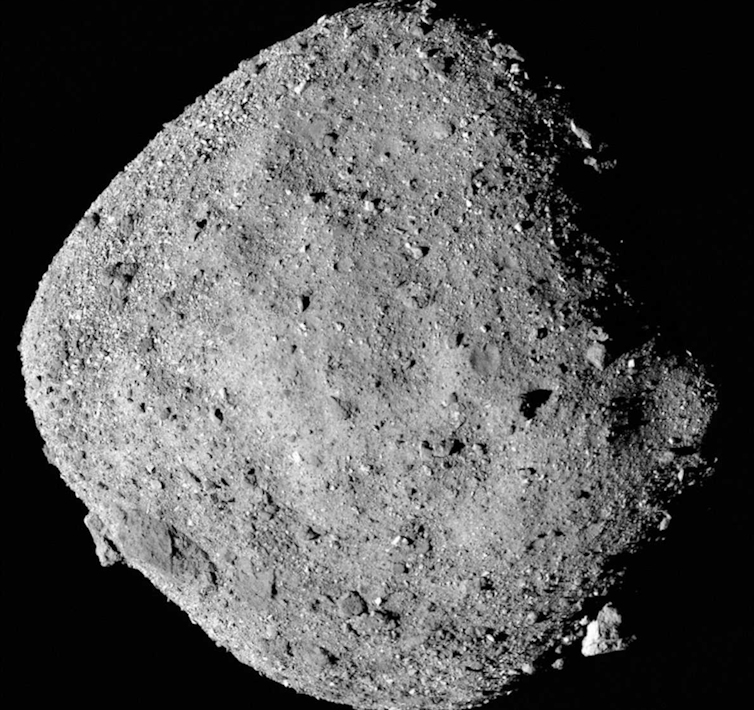
Space News: Bennu asteroid reveals its contents to scientists − and clues to how the building blocks of life on Earth may have been seeded


This photo of asteroid Bennu is composed of 12 Polycam images collected on Dec. 2, 2024, by the OSIRIS-REx spacecraft. NASA
Timothy J McCoy, Smithsonian Institution and Sara Russell, Natural History Museum

A bright fireball streaked across the sky above mountains, glaciers and spruce forest near the town of Revelstoke in British Columbia, Canada, on the evening of March 31, 1965. Fragments of this meteorite, discovered by beaver trappers, fell over a lake. A layer of ice saved them from the depths and allowed scientists a peek into the birth of the solar system.

Nearly 60 years later, NASA’s OSIRIS-REx mission returned from space with a sample of an asteroid named Bennu, similar to the one that rained rocks over Revelstoke. Our research team has published a chemical analysis of those samples, providing insight into how some of the ingredients for life may have first arrived on Earth.

Born in the years bracketing the Revelstoke meteorite’s fall, the two of us have spent our careers in the meteorite collections of the Smithsonian Institution in Washington, D.C., and the Natural History Museum in London. We’ve dreamed of studying samples from a Revelstoke-like asteroid collected by a spacecraft.

Then, nearly two decades ago, we began turning those dreams into reality. We joined NASA’s OSIRIS-REx mission team, which aimed to send a spacecraft to collect and return an asteroid sample to Earth. After those samples arrived on Sept. 24, 2023, we got to dive into a tale of rock, ice and water that hints at how life could have formed on Earth.

An illustration of a small spacecraft with solar panels and an extending arm hovers above an asteroid's rocky surface in space.
In this illustration, NASA’s OSIRIS-REx spacecraft collects a sample from the asteroid Bennu. NASA/Goddard/University of Arizona

The CI chondrites and asteroid Bennu

To learn about an asteroid – a rocky or metallic object in orbit around the Sun – we started with a study of meteorites.

Asteroids like Bennu are rocky or metallic objects in orbit around the Sun. Meteorites are the pieces of asteroids and other natural extraterrestrial objects that survive the fiery plunge to the Earth’s surface.

We really wanted to study an asteroid similar to a set of meteorites called chondrites, whose components formed in a cloud of gas and dust at the dawn of the solar system billions of years ago.

The Revelstoke meteorite is in a group called CI chondrites. Laboratory-measured compositions of CI chondrites are essentially identical, minus hydrogen and helium, to the composition of elements carried by convection from the interior of the Sun and measured in the outermost layer of the Sun. Since their components formed billions of years ago, they’re like chemically unchanged time capsules for the early solar system.

So, geologists use the chemical compositions of CI chondrites as the ultimate reference standard for geochemistry. They can compare the compositions of everything from other chondrites to Earth rocks. Any differences from the CI chondrite composition would have happened through the same processes that formed asteroids and planets.

CI chondrites are rich in clay and formed when ice melted in an ancient asteroid, altering the rock. They are also rich in prebiotic organic molecules. Some of these types of molecules are the building blocks for life.

This combination of rock, water and organics is one reason OSIRIS-REx chose to sample the organic-rich asteroid Bennu, where water and organic compounds essential to the origin of life could be found.

Evaporites − the legacy of an ancient brine

Ever since the Bennu samples returned to Earth on Sept. 24, 2023, we and our colleagues on four continents have spent hundreds of hours studying them.

The instruments on the OSIRIS-REx spacecraft made observations of reflected light that revealed the most abundant minerals and organics when it was near asteroid Bennu. Our analyses in the laboratory found that the compositions of these samples lined up with those observations.

The samples are mostly water-rich clay, with sulfide, carbonate and iron oxide minerals. These are the same minerals found in CI chondrites like Revelstoke. The discovery of rare minerals within the Bennu samples, however, surprised both of us. Despite our decades of experience studying meteorites, we have never seen many of these minerals.

We found minerals dominated by sodium, including carbonates, sulfates, chlorides and fluorides, as well as potassium chloride and magnesium phosphate. These minerals don’t form just when water and rock react. They form when water evaporates.

We’ve never seen most of these sodium-rich minerals in meteorites, but they’re sometimes found in dried-up lake beds on Earth, like Searles Lake in California.

Bennu’s rocks formed 4.5 billion years ago on a larger parent asteroid. That asteroid was wet and muddy. Under the surface, pockets of water perhaps only a few feet across were evaporating, leaving the evaporite minerals we found in the sample. That same evaporation process also formed the ancient lake beds we’ve seen these minerals in on Earth.

Bennu’s parent asteroid likely broke apart 1 to 2 billion years ago, and some of the fragments came together to form the rubble pile we know as Bennu.

These minerals are also found on icy bodies in the outer solar system. Bright deposits on the dwarf planet Ceres, the largest body in the asteroid belt, contain sodium carbonate. The Cassini mission measured the same mineral in plumes on Saturn’s moon Enceladus.

We also learned that these minerals, formed when water evaporates, disappear when exposed to water once again – even with the tiny amount of water found in air. After studying some of the Bennu samples and their minerals, researchers stored the samples in air. That’s what we do with meteorites.

Unfortunately, we lost these minerals as moisture in the air on Earth caused them to dissolve. But that explains why we can’t find these minerals in meteorites that have been on Earth for decades to centuries.

Fortunately, most of the samples have been stored and transported in nitrogen, protected from traces of water in the air.

Until scientists were able to conduct a controlled sample return with a spacecraft and carefully curate and store the samples in nitrogen, we had never seen this set of minerals in a meteorite.

An unexpected discovery

Before returning the samples, the OSIRIS-REx spacecraft spent over two years making observations around Bennu. From that two years of work, researchers learned that the surface of the asteroid is covered in rocky boulders.

We could see that the asteroid is rich in carbon and water-bearing clays, and we saw veins of white carbonate a few feet long deposited by ancient liquid water. But what we couldn’t see from these observations were the rarer minerals.

We used an array of techniques to go through the returned sample one tiny grain at a time. These included CT scanning, electron microscopy and X-ray diffraction, each of which allowed us to look at the rock at a scale not possible on the asteroid.

Cooking up the ingredients for life

From the salts we identified, we could infer the composition of the briny water from which they formed and see how it changed over time, becoming more sodium-rich.

This briny water would have been an ideal place for new chemical reactions to take place and for organic molecules to form.

While our team characterized salts, our organic chemist colleagues were busy identifying the carbon-based molecules present in Bennu. They found unexpectedly high levels of ammonia, an essential building block of the amino acids that form proteins in living matter. They also found all five of the nucleobases that make up part of DNA and RNA.

Based on these results, we’d venture to guess that these briny pods of fluid would have been the perfect environments for increasingly complicated organic molecules to form, such as the kinds that make up life on Earth.

When asteroids like Bennu hit the young Earth, they could have provided a complete package of complex molecules and the ingredients essential to life, such as water, phosphate and ammonia. Together, these components could have seeded Earth’s initially barren landscape to produce a habitable world.

Without this early bombardment, perhaps when the pieces of the Revelstoke meteorite landed several billion years later, these fragments from outer space would not have arrived into a landscape punctuated with glaciers and trees.The Conversation

Timothy J McCoy, Supervisory Research Geologist, Smithsonian Institution and Sara Russell, Professor of Planetary Sciences, Natural History Museum

This article is republished from The Conversation under a Creative Commons license. Read the original article.


CPUC awards $15 million to three Lake County broadband infrastructure projects

LAKE COUNTY, Calif. — On Thursday, the California Public Utilities Commission approved $48 million for eight broadband infrastructure projects — including three in Lake County — as part of the multi-year $2 billion Last Mile Federal Funding Account grant program, which expands broadband internet access for underserved and unserved communities across California.

The CPUC said the Last Mile Federal Funding Account “highlights the state’s commitment to bridging the digital divide through Broadband For All.”

The proposed projects will serve predominantly disadvantaged and low-income communities across the state.

The Last Mile Federal Funding Account broadband infrastructure grants the CPUC awarded on Thursday include $15 million for three projects in Lake County, benefitting 7,000 residents; $17 million for three projects in Fresno County, benefiting approximately 13,000 individuals; and $17 million for two projects in Sonoma County, benefiting approximately 2,100 Californians.

In Lake County, two of the projects are proposed by AT&T around Hidden Valley Lake and Mount Hannah in the south county, and the third by Mediacom, which will have sites near Clearlake, Clearlake Oaks, Kelseyville and Lakeport, according to the grant documents.

The companies submitted the grant applications in September of 2023.

The commission is awarding $2,218,869, or 68% of the cost, for AT&T’s Lake-1 project, which will serve 620 unserved locations and offer service to a total population of 3,073. It will provide up to 5,000/5,000 Mbps service to consumers and include the deployment of 103 miles of last-mile fiber. The project’s network infrastructure will be 12% underground and 88% aerial.

AT&T’s second project, Lake-1E, will receive up to $4 million of the total project cost of $5,906,345. It will serve 504 unserved locations and benefit an estimated population of 1,671. The project also will provide up to 5,000/5,000 Mbps service to consumers. It will include the deployment of 60 miles of last-mile fiber, with 20 percent of the infrastructure underground and 80 percent aerial.

The third grant award of up to $8,429,712 goes to Mediacom’s Lake County Grant Build project, which proposes to serve an estimated 1,037 unserved locations and benefit up to 2,249 residents. It will provide up to 2,000/1,000 Mbps service to consumers and deploy approximately 50 miles of last-mile fiber and 35 miles of middle mile fiber. The network infrastructure will be 14 percent underground and 86 percent aerial.

“We are putting these funds to work, generating quality jobs, bolstering our economy, and building fast, reliable, and affordable broadband infrastructure,” said CPUC President Alice Reynolds.

“Due to historical underinvestment, many communities across California lack access to fast, reliable, and reasonably priced broadband service, which is now a necessity to fully participate in work, school, and daily life,” said Commissioner Darcie L. Houck. “These Federal Funding Account grants represent another step in alleviating this historical disparity by closing the digital divide and providing Broadband for All Californians. I look forward to seeing the benefits of these investments that will provide opportunities for many generations to come in Sonoma, Fresno, and Lake counties.”

Currently, the total amount in Federal Funding Account grants awarded is over $1 billion for projects in 51 counties, with $550 million set to be appropriated to the Last Mile program in the 2027-28 state budget.

The CPUC did not say if the funding is in any jeopardy due to actions by the Trump Administration.

Established under Senate Bill 156 (2021), the CPUC said its Last Mile Federal Funding Account is fueling economic growth across rural, tribal, and urban communities statewide.

Thursday’s approval is part of a process to award last mile broadband grants to projects in every region in the state to established internet service providers, small providers, local governments, tribes and special districts.

Email Elizabeth Larson at This email address is being protected from spambots. You need JavaScript enabled to view it.. Follow her on Twitter, @ERLarson, and on Bluesky, @erlarson.bsky.social. Find Lake County News on the following platforms: Facebook, @LakeCoNews; X, @LakeCoNews; Threads, @lakeconews, and on Bluesky, @lakeconews.bsky.social.

California readies for incoming winter storm; governor pre-deploys resources to protect communities

With an atmospheric river expected to arrive in Northern California this weekend, California is pre-deploying resources — including thousands of personnel — to help protect communities from storm impacts.

Gov. Gavin Newsom has directed the Governor’s Office of Emergency Services, or Cal OES, to coordinate state and local partners to deploy emergency resources to support impacted communities. State officials are urging people to take precautions now before the storm arrives.

National Weather Service Sacramento is forecasting a moderate to strong atmospheric river to begin Friday and continue into next week. Prolonged periods of rain and mountain snow are expected, with the potential for flash flooding and rising creeks, rivers, and streams.

“We know from experience that these storms can pack a punch,” said Gov. Gavin Newsom. “California is pre-deploying resources and thousands of boots on the ground throughout Northern California so we can be ready at a moment’s notice to protect people. The best thing people can do now is to prepare and stay alert.”

Cal OES is monitoring weather impacts and working closely with local areas that are forecasted to be affected. In particular, the state is closely monitoring recent burn scar areas that pose the threat of mudslides and debris flows. Together, the state is preparing:

• The State-Federal Flood Operations Center is monitoring forecasts and coordinating with partners.

• In collaboration with the California-Nevada River Forecast Center (CNRFC), DWR engineers and CNRFC hydrologists are conducting river forecasts up to four times a day.

• DWR has pre-positioned flood fight materials in Northern and Central California including over 3.7 million burlap sandbags and 162 flood fight material containers across 25 counties.

• The flood control system is working as intended with flood space available throughout the system. Water can move throughout California’s flood control system including natural weirs overtopping, water in the region’s bypasses, and potential use of spillways at reservoirs.

• Caltrans has 2,500 personnel and 1,253 pieces of storm equipment including snowplows, backhoes, and storm drain clearing equipment.

• 133 CAL FIRE engines and 7 CAL FIRE hand crews staffed across the northern region that are ready to respond.

An atmospheric river could bring an increased risk of power outages, flooding in small streams and low-lying areas, and debris, rocks and mudslides on roadways.

Cal OES is encouraging residents to reduce injury risks from falling limbs and trees by staying inside, not driving through flooded roadways and preparing in advance for power outages.

Residents in the affected counties are urged to stay informed and listen to local authorities about actions they should take including evacuation orders or safety recommendations. In burn scar areas, officials recommend preparing for possible sudden debris flows by having a go-bag packed and knowing evacuation routes.

Go to ready.ca.gov for tips to prepare for the incoming storm.

California Farm Bureau stands with agricultural workers and farmers, calls for workforce stability amid reported concerns

The California Farm Bureau is weighing in on growing concerns about immigration that could have an impact on farmers across the state.

While there have been news reports of unease among some farm employees, the California Farm Bureau said it has been in contact with numerous farmers across the state and has not heard of any widespread workforce disruption.

Bryan Little, senior director of policy advocacy at the California Farm Bureau, which represents more than 26,000 farm and ranch families in the state, clarified that while concerns exist, farmers are continuing operations.

While it’s unclear if all farms are fully operational, Farm Bureau has not received reports indicating otherwise, and efforts are always underway to ensure workforce stability.

“We recognize that some workers may feel uncertain right now, and we want to be very clear: California agriculture depends on and values its workforce,” Little said. “Farm employees are not just workers — they are partners in this industry. They are people with families, dreams and an incredible work ethic that keeps food on tables across America. We understand the uncertainty some might feel right now, and we want to be absolutely clear: California’s farmers stand with you. We respect you. We value you. And we will do everything in our power to ensure that agriculture remains a place where you are safe and supported.”

With one-third of the nation’s agricultural workforce located in California, farm employees play an indispensable role in food production. These skilled workers plant, cultivate and harvest the crops that make California the leading producer of fruits, vegetables and nuts in the United States.

“Without these employees, crops would go unharvested, rural businesses would suffer and food prices could rise for families across the country,” Little said. “This is not just a farm issue — it’s a food security issue, an economic issue and a community issue.”

The interdependence of agriculture and rural economies is without question, according to Little. Thousands of employees in ag-adjacent industries — including food processing, transportation and equipment suppliers — depend on the steady flow of agricultural work to sustain their livelihoods.

Little addressed the urgent need for immigration policy reform, noting that California’s agricultural workforce challenges are not new.

“Farmers and ranchers have struggled with chronic labor shortages for years, and uncertainty surrounding immigration policy only exacerbates the problem,” he said. “California’s farmers and ranchers are ready to work with the administration and Congress to advance real, bipartisan workforce reforms this year,“ Little said. “This isn’t just about filling jobs — it’s about ensuring security and stability for the agricultural workforce and the farmers who depend on them.”

To provide a long-term solution, Little outlined three key priorities for workforce reform:

• Modernizing the H-2A agricultural visa program to make it more flexible and responsive to the labor needs of farmers and ranchers.
• Providing earned legal status for current agricultural workers, recognizing their longstanding contributions to U.S. food production.
• Crafting immigration policies that reflect the reality of agriculture in a diverse state like California, where workforce stability is essential to feeding the nation.

While supporting lawful immigration policies, the Farm Bureau cautioned against indiscriminate enforcement actions that do not account for workforce stability.

“We need policies that offer real solutions, rather than uncertainty,” Little said. “It’s like pulling the foundation out from under a house. If we want a strong agricultural economy and a secure food supply, we need solutions that reflect the reality of farming — not blanket enforcement measures that put the entire agricultural system at risk.”

Little said the California Farm Bureau remains in close contact with worker advocates, policymakers and agricultural leaders to monitor any reports of workforce disruption and to help ensure that California’s farms continue to function smoothly during all of California’s upcoming harvest periods.

“California Farm Bureau will continue to advocate for practical, compassionate solutions that protect our workforce, stabilize our industry and secure America’s food supply,” Little said. “California agriculture is strong, and our message to farm employees is simple. You are essential. You are valued. And farmers will continue to stand with you. As harvest season approaches in key growing areas, we will do everything in our power to ensure a stable and secure workforce, a dependable food supply and a strong agricultural economy for the future.”

The California Farm Bureau works to protect family farms and ranches on behalf of more than 26,000 members statewide and as part of a nationwide network of 5.8 million Farm Bureau members.

Clearlake Animal Control: ‘Dodge’ and the dogs

“Dodge.” Photo courtesy of Clearlake Animal Control.

CLEARLAKE, Calif. — Clearlake Animal Control has more new dogs ready to be adopted this week.

The shelter has 48 adoptable dogs listed on its website.

This week’s dogs include “Dodge,” a male short coat Chihuahua.

The shelter is located at 6820 Old Highway 53. It’s open from 9 a.m. to 6 p.m. Tuesday through Saturday.

For more information, call the shelter at 707-762-6227, email This email address is being protected from spambots. You need JavaScript enabled to view it., visit Clearlake Animal Control on Facebook or on the city’s website.

This week’s adoptable dogs are featured below.

Email Elizabeth Larson at This email address is being protected from spambots. You need JavaScript enabled to view it.. Follow her on Twitter, @ERLarson, and on Bluesky, @erlarson.bsky.social. Find Lake County News on the following platforms: Facebook, @LakeCoNews; X, @LakeCoNews; Threads, @lakeconews, and on Bluesky, @lakeconews.bsky.social.


Authorities investigate fatal High Valley Road crash

LAKE COUNTY, Calif. — The California Highway Patrol is investigating a Wednesday crash that resulted in one fatality near Clearlake Oaks.

So far, the identity of the crash victim has not been released by authorities.

Sheriff’s spokesperson Lauren Berlinn told Lake County News Thursday afternoon that they are still working on next of kin notification.

The CHP’s Clear Lake Area office said their officers were dispatched to assist the sheriff’s office with a fatality traffic collision at 3:11 p.m. Wednesday.

The CHP said the sheriff’s office was investigating a missing persons case and, with the assistance of California Department of Fish and Wildlife, located a vehicle down a steep embankment on High Valley Road, near Valley Oak Drive.

The investigating officers and deputies found the missing person dead near the vehicle.

The CHP is investigating this incident.

Anyone with information or knowledge of the incident is asked to contact the Clear Lake CHP Office, at 707-279-0103.

Email Elizabeth Larson at This email address is being protected from spambots. You need JavaScript enabled to view it.. Follow her on Twitter, @ERLarson, and on Bluesky, @erlarson.bsky.social. Find Lake County News on the following platforms: Facebook, @LakeCoNews; X, @LakeCoNews; Threads, @lakeconews, and on Bluesky, @lakeconews.bsky.social.
  • 307
  • 308
  • 309
  • 310
  • 311
  • 312
  • 313
  • 314
  • 315
  • 316

Community

  • Sheriff’s Activities League and Clearlake Bassmasters offer youth fishing clinic

  • City Nature Challenge takes place April 24 to 27

Public Safety

  • Lakeport Police logs: Wednesday, Feb. 11

  • Lakeport Police logs: Tuesday, Feb. 10

Education

  • Ramos measure requiring school officer training in use of anti-opioid drug moves forward

  • Lake County Chapter of CWA announces annual scholarships 

Health

  • California ranks 24th in America’s Health Rankings Annual Report from United Health Foundation

  • Healthy blood donors especially vital during active flu season

Business

  • Employment law summit takes place March 9

  • Two Lake County Mediacom employees earn company’s top service awards

Obituaries

  • Terry Knight

  • Ellen Thomas

Opinion & Letters

  • Who should pay for AI’s power? Not California ratepayers

  • Crandell: Supporting nephew for reelection in supervisorial race

Veterans

  • State honors fallen chief warrant officer killed in conflict in Iran

  • CalVet and CSU Long Beach team up to improve data collection related to veteran suicides

Recreation

  • April Audubon program will show how volunteers can help monitor local osprey nests

  • First guided nature walk of spring at Anderson Marsh State Historic Park April 11

  • Second Saturday guided nature walks continue at Anderson Marsh State Historic Park

  • Wet weather trail closure in effect on Upper Lake Ranger District

Religion

  • Kelseyville Presbyterian Church plans Easter service

  • Easter ‘Sonrise’ Service returns to Xabatin Community Park

Arts & Life

  • ‘CIA’ delves into the shadowy world of an espionage thriller

  • ‘War Machine’ shifts the battlefield into uncharted territory

Government & Politics

  • Lake County Democratic Central Committee endorses Falkenberg

  • Crandell launches reelection campaign plans March 15 event

Legals

  • April 23 hearing on Lake Coco Farms Major Use Permit

  • NOTICE OF 30-DAY PUBLIC COMMENT PERIOD & NOTICE OF PUBLIC HEARING

How to resolve AdBlock issue?
Refresh this page