How to resolve AdBlock issue?
Refresh this page
Lake County News,California
  • Home
    • Registration Form
  • News
    • Education
    • Veterans
    • Community
      • Obituaries
      • Letters
      • Commentary
    • Police Logs
    • Business
    • Recreation
    • Health
    • Religion
    • Legals
    • Arts & Life
    • Regional
  • Calendar
  • Contact us
    • FAQs
    • Phones, E-Mail
    • Subscribe
  • Advertise Here
  • Login
How to resolve AdBlock issue?
Refresh this page

News

Supervisors to hold annual governance workshop

LAKE COUNTY, Calif. — The Board of Supervisors will meet this week to hold the annual governance workshop with department heads.

The‌ ‌board will meet beginning ‌at‌ ‌9‌ ‌a.m. Tuesday, Jan. 28, in the board chambers on the first floor of the Lake County Courthouse, 255 N. Forbes St., Lakeport.

The‌ ‌meeting‌ ‌can‌ ‌be‌ ‌watched‌ ‌live‌ ‌on‌ ‌Channel‌ ‌8, ‌online‌ ‌at‌ ‌https://countyoflake.legistar.com/Calendar.aspx‌‌ and‌ ‌on‌ ‌the‌ ‌county’s‌ ‌Facebook‌ ‌page. ‌Accompanying‌ ‌board‌ ‌documents, ‌the‌ ‌agenda‌ ‌and‌ ‌archived‌ ‌board‌ ‌meeting‌ ‌videos‌ ‌also‌ ‌are‌ ‌available‌ ‌at‌ ‌that‌ ‌link. ‌ ‌

To‌ ‌participate‌ ‌in‌ ‌real-time, ‌join‌ ‌the‌ ‌Zoom‌ ‌meeting‌ ‌by‌ ‌clicking‌ ‌this‌ ‌link‌. ‌ ‌

The‌ ‌meeting‌ ‌ID‌ ‌is‌ 865 3354 4962, ‌pass code 726865.‌ ‌The meeting also can be accessed via one tap mobile at +16694449171,,86533544962#,,,,*726865#. The meeting can also be accessed via phone at 669 900 6833.

The meeting’s main item will be presentations from department heads, who will present their 2024 accomplishments, data points and diversity metrics.

Also on Tuesday, the board will consider appointments to the Central Region Town Hall and Eastern Region Town Hall, and a proposed agreement between the county of Lake and Workday Inc. for finance and human capital management enterprise resource planning software in the amount of $4,192,452 for January 2026 to January 2035.

Email Elizabeth Larson at This email address is being protected from spambots. You need JavaScript enabled to view it.. Follow her on Twitter, @ERLarson, and on Bluesky, @erlarson.bsky.social. Find Lake County News on the following platforms: Facebook, @LakeCoNews; X, @LakeCoNews; Threads, @lakeconews, and on Bluesky, @lakeconews.bsky.social.

Homeward bound: More people moved back home at height of pandemic


People move all the time but at the height of the COVID-19 pandemic, a growing share of movers returned to their state of birth, a shift that began before the pandemic and gained even more traction at its peak.

From 2019 to 2022, the share of “return-home” movers — a subset of movers who resided outside their state of birth the previous year and have since returned — increased from 4.2% to 5.0%, according to the American Community Survey (ACS) 1-year data.

The ACS offers a unique view of the changes in national migration patterns by providing information about the type and geographic scope of moves in the United States. Subject table S0601 and the B06 detailed table series offer insight into place of birth and current residence, while migration flows show where people move between geographies.

We focus on cross-state “return-home” movers that show people moving back to their state of birth.

Several trends emerge from 2019 to 2022:

• Return-home moves for those under 18 years of age increased from 4.8% to 6.4%.
• The return-home mover rate for those ages 25 to 44 increased from 4.1% to 4.7%.
• Among those ages 65 years and older, return-home moves declined between 2018 and 2019 but increased from 2019 to 2021, and again from 2021 to 2022.


Movers in the United States

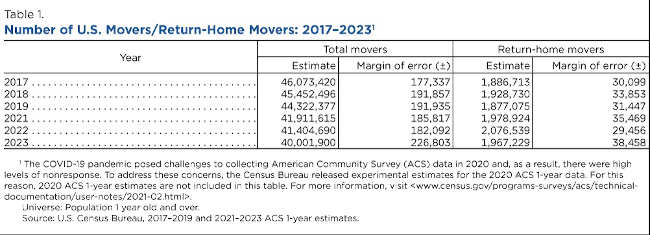
The number of U.S. movers declined between 2006 and 2019 and continued to decline into 2021. Table 1 shows estimates for total movers and return-home movers between 2017 and 2023.

Return-home moves increased from 2017 to 2018, declined between 2018 and 2019, then increased again each year between 2019 and 2022.

Return-home movers

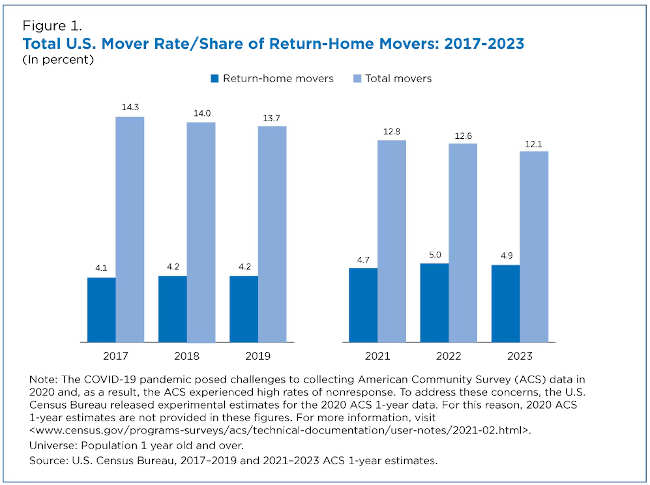
Despite declines in the total mover rates between 2017 and 2023, return-home moves increased during certain intervals throughout this period (Figure 1).

• The percentage of movers 1 year and over who moved back to their state of birth increased from 4.1% to 4.2% between 2017 and 2018.
• The percentage of return-home movers did not change significantly between 2018 and 2019, the year before the COVID-19 pandemic.
• The largest percentage change of movers returning home was from 2019 (4.2%) to 2021 (4.7%).
• Relative to 2021, the percentage of return-home movers continued to increase to 5.0% in 2022 and did not change significantly in 2023 (4.9%).


Age and return-home movers

Moving patterns tend to change as people age. We look at return-home mover rates for five age groups: under age 18; 18 to 24; 25 to 44; 45 to 64; and 65 and over:

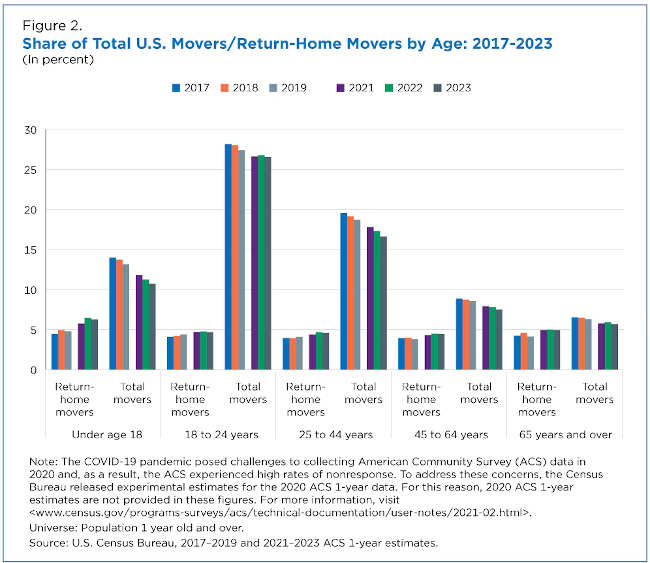
• Those under 18 had the highest percentage of return-home movers of all age groups (Figure 2), rising from 4.5% in 2017 to 4.9% in 2018, then remaining stable from 2018 to 2019 (4.8%). It increased again to 5.7% in 2021 and to 6.4% in 2022.
• Those between ages 18 and 24, or “college-age,” showed relative stability in their return-home mover rates in this period, except for an increase between 2019 (4.4%) and 2021 (4.7%).
• The 25 to 44 age range saw consistent increases in rates of return-home movers from 2017 to 2022. In 2017, 3.9% of movers returned home. By 2022, that share increased to 4.7%.
• Those between ages 45 and 64 saw relative stability in return-home mover rates, except for a drop between 2018 (4.0%) and 2019 (3.8%), and an increase between 2019 (3.8%) and 2021 (4.3%).
• The return-home mover rates for those 65 or older, or in “retirement age,” rose from 2017 (4.2%) to 2018 (4.6%), only to decline in 2019 (4.1%). In 2021, the rate was 4.9% and was not significantly different in 2022 and 2023.

Justin V. Palarino is a survey statistician in the Census Bureau’s Social, Economic, and Housing Statistics Division. L. Slagan Locklear is a survey statistician in the Census Bureau’s Social, Economic, and Housing Statistics Division.

2024 was the world’s warmest year on record

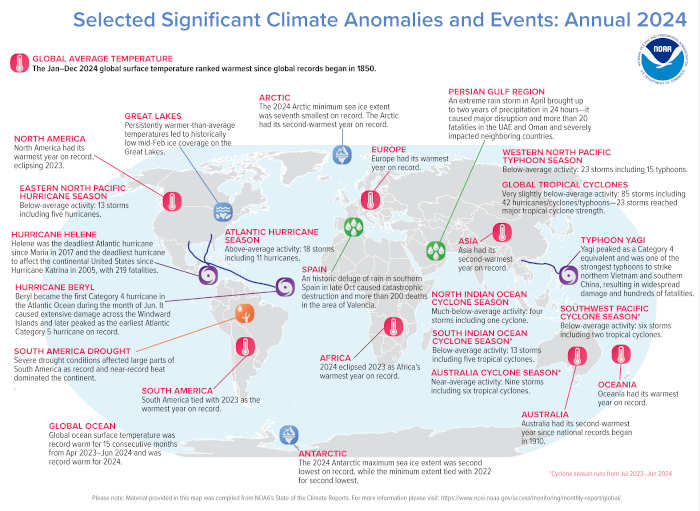
An annotated map of the world plotted with the year's most significant climate events. See the story below as well as the report summary from NOAA NCEI at http://bit.ly/Global202413offsite link. (Image credit: NOAA/NCEI).

It’s official: 2024 was the planet’s warmest year on record, according to an analysis by scientists from NOAA’s National Centers for Environmental Information, or NCEI.

Along with historic heat, Antarctic sea ice coverage dropped to its second-lowest extent (coverage) on record.

Below are highlights from NOAA’s 2024 annual global climate report:

Climate by the numbers

Earth’s average land and ocean surface temperature in 2024 was 2.32 degrees F (1.29 degrees C) above the 20th-century average — the highest global temperature among all years in NOAA’s 1850-2024 climate record. It was 0.18 of a degree F (0.10 of a degree C) warmer than 2023, which was previously the warmest year on record.

Regionally, Africa, Europe, North America, Oceania and South America (tied with 2023) had their warmest year on record. Asia and the Arctic had their second-warmest year on record.

The planet’s 10 warmest years since 1850 have all occurred in the past decade. In 2024, global temperature exceeded the pre-industrial (1850–1900) average by 2.63 degrees F (1.46 degrees C).

Other scientific organizations, including NASA, the Copernicus Climate Change and the UK Met Office have conducted separate but similar analyses that also rank 2024 as the warmest year on record.

Other notable climate findings and events

• Antarctic sea ice ran near record lows: Antarctic sea ice extent (coverage) averaged 4.00 million square miles in 2024, second lowest on record. The maximum extent in September was 6.59 million square miles, which ranked second lowest, and the minimum extent in February was 830,000 square miles, which also ranked second lowest. Arctic sea ice extent averaged 4.03 million square miles in 2024, seventh lowest on record. The maximum extent in March was 5.74 million square miles, which ranked 15th lowest, while the minimum extent in September was 1.69 million square miles, which ranked sixth lowest.
• Upper ocean heat content set record high: The 2024 upper ocean heat content, which is the amount of heat stored in the upper 2,000 meters of the ocean, was the highest on record. Ocean heat content is a key climate indicator because the ocean stores 90% of the excess heat in the Earth system. The indicator has been tracked globally since 1958, and the five highest values have all occurred in the last five years.
• Global tropical cyclone activity was near average: Eighty-five named storms occurred across the globe in 2024, which was near the 1991–2020 average of 88. Forty-two of those reached tropical cyclone strength (sustained winds of 74 mph or higher), and 23 reached major tropical cyclone strength (sustained winds of 111 mph or higher). These also included four storms that reached Category 5 (sustained winds of 157 mph or higher) on the Saffir-Simpson hurricane wind scale. The global accumulated cyclone energy (ACE) was about 21% below the 1991–2020 average.

The technology that runs Congress lags so far behind the modern world that its flag-tracking system just caught up to 2017-era Pizza Hut


Tracking one of these items to your door has been possible since 2017 – tracking the other is all new. FTiare/iStock / Getty Images Plus

On a typical day, you can’t turn on the news without hearing someone say that Congress is broken. The implication is that this dereliction explains why the institution is inert and unresponsive to the American people.

There’s one element often missing from that discussion: Congress is confounding in large part because its members can’t hear the American people, or even each other. I mean that literally. Congressional staff serve in thousands of district offices across the nation, and their communications technology doesn’t match that of most businesses and even many homes.

Members’ district offices only got connected to secure Wi-Fi internet service in 2023. Discussions among members and congressional staff were at times cut short at 40 minutes because some government workers were relying on the free version of Zoom, according to congressional testimony in March 2024.

Congressional testimony discusses meetings being cut off at 40 minutes.

The information systems Congress uses have existed largely unchanged for decades, while the world has experienced an information revolution, integrating smartphones and the internet into people’s daily personal and professional lives. The technologies that have transformed modern life and political campaigning are not yet available to improve the ability of members of Congress to govern once they win office.

Slow to adapt

Like many institutions, Congress resists change; only the COVID-19 pandemic pushed it to allow online hearings and bill introductions. Before 2020, whiteboards, sticky notes and interns with clipboards dominated the halls of Congress.

Electronic signatures arrived on Capitol Hill in 2021 – more than two decades after Congress passed the ESIGN Act to allow electronic signatures and records in commerce.

The nation spends about US$10 million a year on technology innovation in the House of Representatives – the institution that declares war and pays all the federal government’s bills. That’s just 1% of the amount theater fans have spent to see ‶Hamilton“ on Broadway since 2015.

It seems the story of American democracy is attractive to the public, but investing in making it work is less so for Congress itself.

The chief administrative office in Congress, a nonlegislative staff that helps run the operations of Congress, decides what types of technology can be used by members. These internal rules exist to protect Congress and national security, but that caution can also inhibit new ways to use technology to better serve the public.

Finding a happy medium between innovation and caution can result in a livelier public discourse.

A group of people sit around a desk facing a television monitor, and with cameras facing them.
The pandemic compelled Congress to allow witnesses to testify before committees by videoconference. Stefani Reynolds-Pool/Getty Images

A modernization effort

Congress has been working to modernize itself, including experimenting with new ways to hear local voices in their districts, including gathering constituent feedback in a standardized way that can be easily processed by computers.

The House Natural Resources Committee was also an early adopter of technology for collaborative lawmaking. In 2020, members and committee staff used a platform called Madison to collaboratively write and edit proposed environmental justice legislation with communities across the country that had been affected by pollution.

House leaders are also looking at what is called deliberative technology, which uses specially designed websites to facilitate digital participation by pairing collective human intelligence with artificial intelligence. People post their ideas online and respond to others’ posts. Then the systems can screen and summarize posts so users better understand each other’s perspectives.

These systems can even handle massive group discussions involving large numbers of people who hold a wide range of positions on a vast set of issues and interests. In general, these technologies make it easier for people to find consensus and have their voices heard by policymakers in ways the policymakers can understand and respond to.

Governments in Finland, the U.K., Canada and Brazil are already piloting deliberative technologies. In Finland, roughly one-third of young people between 12 and 17 participate in setting budget priorities for the city of Helsinki.

In May 2024, 45 U.S.-based nonprofit organizations signed a letter to Congress asking that deliberative technology platforms be included in the approved tools for civic engagement.

In the meantime, Congress is looking at ways to use artificial intelligence as part of a more integrated digital strategy based on lessons from other democratic legislatures.

A panel discussion of various ideas for modernizing how Congress hears from the American people.

Finding benefits

Modernization efforts have opened connections within Congress and with the public. For example, hearings held by video conference during the pandemic enabled witnesses to share expertise with Congress from a distance and open up a process that is notoriously unrepresentative. I was home in rural New Mexico during the pandemic and know three people who remotely testified on tribal education, methane pollution and environmental harms from abandoned oil wells.

New House Rules passed on Jan. 3, 2025, encourage the use of artificial intelligence in day-to-day operations and allow for remote witness testimony.

Other efforts that are new to Congress but long established in business and personal settings include the ability to track changes in legislation and a scheduling feature that reduces overlaps in meetings. Members are regularly scheduled to be two places at once.

Another effort in development is an internal digital staff directory that replaces expensive directories compiled by private companies assembling contact information for congressional staff.

The road ahead

In 2022, what is now called ”member-directed spending“ returned to Congress with some digital improvements. Formerly known as "earmarks,” this is the practice of allowing members of Congress to handpick specific projects in their home districts to receive federal money. Earmarks were abolished in 2011 amid concerns of abuse and opposition by fiscal hardliners. Their 2022 return and rebranding introduced publicly available project lists, ethics rules and a search engine to track the spending as efforts to provide public transparency about earmarks.

Additional reforms could make the federal government even more responsive to the American people.

Some recent improvements are already familiar. Just as customers can follow their pizza delivery from the oven to the doorstep, Congress in late 2024 created a flag-tracking app that has dramatically improved a program that allows constituents to receive a flag that has flown over the U.S. Capitol. Before, different procedures in the House and Senate caused time-consuming snags in this delivery system.

At last, the world’s most powerful legislature caught up with Pizza Hut, which rolled out this technology in 2017 to track customers’ pizzas from the store to the delivery driver to their front door.The Conversation

Lorelei Kelly, Research Lead, Modernizing Congress, McCourt School of Public Policy, Georgetown University

This article is republished from The Conversation under a Creative Commons license. Read the original article.


Authorities investigate Friday night stabbing; suspect arrested

KELSEYVILLE, Calif. — The Lake County Sheriff’s Office said it has made one arrest in a Friday night stabbing in Kelseyville.

The agency said Anthony Lee Black, 40, of Kelseyville was taken into custody for the assault.

On Friday at approximately 7:30 p.m., deputies responded to the Kelseyville Fire Protection District’s Station 55 in downtown Kelseyville for a report of a person who walked in for medical treatment due to being stabbed, the sheriff’s office reported.

The sheriff’s office said deputies spoke with the victim, who said they were stabbed at Pioneer Park in Kelseyville following a verbal argument.

The victim was transported to an out-of-county hospital and was last reported to be in stable condition. Authorities have so far not identified the individuals.

After further investigation, the suspect was determined to be Black, the sheriff’s office said.

Black was arrested shortly before 9 p.m. Friday on charges of attempted murder, assault with a deadly weapon and resisting arrest, according to the sheriff’s report.

Black was transported to the Hill Road Correctional Facility, where he was booked. Jail records show he is being held on bail totaling $246,000.

If anyone has any information related to this investigation, please call the Major Crimes Unit Tip Line at 707-262-4088.

Lake County Symphony Association to hold Feb. 2 audition event

KELSEYVILLE, Calif. — The Lake County Symphony Association is holding an audition event for their newly organized Lake County Adult & Youth Concert Orchestra on Sunday, Feb. 2.

It will take place beginning at 4 p.m. in the Friendship Hall at Kelseyville Presbyterian Church, 4021 Church St.

This invitational performance group is for intermediate to advanced musicians of all ages from Lake County and the surrounding areas.

Membership in this elite ensemble is determined through audition and/or by recommendation.

Adult and youth musicians who have demonstrable intermediate to advanced skills on an orchestral instrument are encouraged to audition.

Adult musicians with a music degree or college-level music studies and performance experience may bypass the audition process and are asked to participate in the Feb. 2 audition event to determine placement in the orchestra.

Youth musicians may bypass the audition process if they have a recommendation from a school music teacher or a recognized private music instructor affirming their intermediate to advanced skill level. Instead, recommended youth are asked to participate in the Feb. 2 audition event to determine placement in the orchestra.

By playing in an orchestral setting, participation in this group can serve as an enhancement to a student's musical experience alongside their regular musical activities.

Dedicated youth members of the Concert Orchestra can become eligible for scholarships for future studies of any collegiate subject from both the Lake County Symphony Association and the Allegro Scholarship Program.

The Lake County Adult & Youth Concert Orchestra performs at least four times a year, both opening for the Lake County Symphony during their regular season and in exclusive concerts.

The orchestra's next concert is at 2 p.m. Sunday, March 23, at the Soper Reese Theatre in Lakeport.

Please visit the orchestra's website www.lakecountyayco.org for more information.
  • 310
  • 311
  • 312
  • 313
  • 314
  • 315
  • 316
  • 317
  • 318
  • 319

Community

  • Sheriff’s Activities League and Clearlake Bassmasters offer youth fishing clinic

  • City Nature Challenge takes place April 24 to 27

Public Safety

  • Lakeport Police logs: Wednesday, Feb. 11

  • Lakeport Police logs: Tuesday, Feb. 10

Education

  • Ramos measure requiring school officer training in use of anti-opioid drug moves forward

  • Lake County Chapter of CWA announces annual scholarships 

Health

  • California ranks 24th in America’s Health Rankings Annual Report from United Health Foundation

  • Healthy blood donors especially vital during active flu season

Business

  • Employment law summit takes place March 9

  • Two Lake County Mediacom employees earn company’s top service awards

Obituaries

  • Terry Knight

  • Ellen Thomas

Opinion & Letters

  • Who should pay for AI’s power? Not California ratepayers

  • Crandell: Supporting nephew for reelection in supervisorial race

Veterans

  • State honors fallen chief warrant officer killed in conflict in Iran

  • CalVet and CSU Long Beach team up to improve data collection related to veteran suicides

Recreation

  • April Audubon program will show how volunteers can help monitor local osprey nests

  • First guided nature walk of spring at Anderson Marsh State Historic Park April 11

  • Second Saturday guided nature walks continue at Anderson Marsh State Historic Park

  • Wet weather trail closure in effect on Upper Lake Ranger District

Religion

  • Kelseyville Presbyterian Church plans Easter service

  • Easter ‘Sonrise’ Service returns to Xabatin Community Park

Arts & Life

  • ‘CIA’ delves into the shadowy world of an espionage thriller

  • ‘War Machine’ shifts the battlefield into uncharted territory

Government & Politics

  • Lake County Democratic Central Committee endorses Falkenberg

  • Crandell launches reelection campaign plans March 15 event

Legals

  • April 23 hearing on Lake Coco Farms Major Use Permit

  • NOTICE OF 30-DAY PUBLIC COMMENT PERIOD & NOTICE OF PUBLIC HEARING

How to resolve AdBlock issue?
Refresh this page