How to resolve AdBlock issue?
Refresh this page
Lake County News,California
  • Home
    • Registration Form
  • News
    • Education
    • Veterans
    • Community
      • Obituaries
      • Letters
      • Commentary
    • Police Logs
    • Business
    • Recreation
    • Health
    • Religion
    • Legals
    • Arts & Life
    • Regional
  • Calendar
  • Contact us
    • FAQs
    • Phones, E-Mail
    • Subscribe
  • Advertise Here
  • Login
How to resolve AdBlock issue?
Refresh this page

News

Thompson supports legislation to prevent government shutdown

On Friday, Rep. Mike Thompson (CA-04) said he joined a majority of members of the House of Representatives in supporting the passage of a continuing resolution to avoid a government shutdown.

“Tonight, I voted to avoid a potentially disastrous government shutdown ahead of the holidays,” Thompson said.

“Since October, Democrats and Republicans negotiated in good faith to develop a bipartisan bill to fund our government. Republicans set the total amount of funding in the bill. Yet hours before we were set to pass that bill, Elon Musk and President-elect Trump intervened to kill it,” Thompson continued.

“I am disappointed that the Continuing Resolution passed tonight was not the negotiated Republican bill that Democrats agreed to support,” Thompson said. “However, I am pleased that the Continuing resolution Democrats helped pass includes critical disaster funding and funding for lifesaving fire breaks in our state.

“The resolution also includes my bill to extend telehealth coverage benefits so that all Medicare beneficiaries retain access to critical services. Since my days in the California State Senate, I’ve been a big believer in telehealth’s ability to save money, time, and lives, and today’s telehealth extension ensures continued access to care for millions of Americans,” he said.

“As important, this bill did not extend a $4 trillion line of credit to President-elect Trump and Elon Musk so they could extend tax cuts to billionaires at the expense of Social Security and Medicare,” Thompson concluded.

Thompson represents California’s Fourth Congressional District, which includes all or part of Lake, Napa, Solano, Sonoma and Yolo counties.

Tribal housing program expansion benefits Lake County tribe

LAKE COUNTY, Calif. — The Federal Home Loan Bank of San Francisco announced this week that it added $1.8 million to its Tribal Nations Program that it first launched earlier in the year.

This additional allocation brings the 2024 program total to $2.8 million, directed towards developing essential infrastructure and expanding the supply of affordable housing for Native American communities.

The funding expansion’s beneficiaries include the Big Valley Band of Pomo Indians in Lakeport, which will receive $400,000 via Legacy Bank for new housing construction.

“FHLBank San Francisco is proud to increase the funding for our Tribal Nations Program and support the development of safe and affordable housing units on tribal land,” said Alanna McCargo, president and CEO of FHLBank San Francisco. “As all of America grapples with a severe housing crisis, Native American communities are disproportionately affected. Making these additional funds available through our Tribal Nations Program is a critical step for increasing the supply of affordable housing for Native American communities in Arizona, California and Nevada.”

According to the Department of Housing and Urban Development, approximately 15% of Native populations live with overcrowding, compared with the national average of 2%.

Emphasizing the need for more affordable housing, HUD research estimates 68,000 additional units are needed to replace severely inadequate units and eliminate overcrowding on Native American Tribal lands.

In January 2024, the Bank launched its Tribal Nations Program with $1 million in grant funding to provide critically necessary infrastructure funding to increase the supply of affordable housing for Native American communities.

The announcement of an additional $1.8 million will fund housing construction, rehabilitation and infrastructure development for three Native American and American Indian grant recipients, which, along with Big Valley, include Native American Outreach Ministries Inc. and the NAOMI House in Joseph City, Arizona, which will receive $600,000 via Clearinghouse CDFI for infrastructure building and housing rehabilitation, and the Washoe Housing Authority in Gardnerville, Nevada will receive $800,000 via Clearinghouse CDFI to bolster housing infrastructure.

“Legacy Bank is proud to work with FHLBank San Francisco on their Tribal Nations Program, supporting the development of Native-led, Native-serving affordable housing,” said James D. Hicken, president and CEO of Legacy Bank. “It is our mission to support the growth and economic strength of tribal communities, and the development of safe, secure housing is vital for advancing prosperity of these communities.”

“AHP grants from FHLBank San Francisco have proven to be an important resource in helping us reach the construction goals of the Washoe Housing Authority’s development of the Stewart Community in Carson City, Nevada,” said Martin Montgomery, executive director of Washoe Housing Authority. “A small piece of tribal land will be transformed from desert to 20 new affordable housing units, complete with modern amenities such as central heat and air, high efficiency water heaters, solar panels and ENERGY STAR® appliances. The Stewart Community will provide housing security for many tribal families, giving them a new place to call home thanks in-part to funding from FHLBank San Francisco.”

This $2.8 million in funding for the 2024 Tribal Nations Program builds on FHLBank San Francisco’s ongoing support for affordable housing and economic development projects benefiting Native American communities, including, to date, over $25 million in grants from AHP projects that have created more than 1,700 affordable housing units for tribal communities and more than $2 million in AHEAD grants awarded to over 40 economic development projects.

The Tribal Nations Program is also an important component of an initiative to voluntarily increase FHLBank San Francisco’s annual commitment to community programs.

In 2023, the Bank’s board of directors voted to allocate up to an additional 5% of the Bank’s annual net income for funding economic development and housing grant programs that enrich people’s lives and revitalize communities.

Additional programs implemented or enhanced in 2023 include a Middle-Income Downpayment Assistance pilot program, the Bank’s annual AHEAD economic development program, and the Empowering Black Homeownership matching grant program, which supports the work of Housing Counseling Agencies in underserved communities of color.

For more information about the Tribal Nations Program and other community programs, visit the Bank’s website at fhlbsf.com.

Supporting a grieving loved one on holidays and special occasions: Practical tips from a clinical psychologist


The holidays can be an especially difficult time for those grieving a loss. Dimensions/E+ via GettyImages

Nearly 95% of people who have experienced loss report dealing with at least one symptom of physical or mental distress. Approximately 10% of them develop prolonged grief disorder, a persistent and debilitating form of grief that does not ease with time.

Often, this grief is due to the death of a loved one, but it may also be caused by the loss of a friendship, a divorce or even a job loss.

Grief affects not only mental health but also physical well-being, and it can increase the risk of heart disease, immune dysfunction and even death.

Holidays and special occasions, which often include family gatherings, traditions and reminders of what’s missing, can amplify this pain, leaving those grieving feeling isolated and overwhelmed.

As a clinical psychologist and professor of psychiatry and neurobehavioral sciences working with cancer patients and their families, I see the profound toll grief takes on people. I’ve also experienced grief personally, both when my mother died suddenly at the age of 66 and when my father passed after a long illness at the age of 84.

Those experiences, combined with my research, have driven me to dedicate much of my career to understanding grief and its effects, and to finding effective ways to support those who are struggling with it.

Mourning vs. prolonged grief

Grief is a natural response to loss, encompassing emotional, cognitive, physical and social reactions. Common signs include sadness, withdrawal, difficulty concentrating, disrupted sleep and physical symptoms like fatigue or aches.

Grief is deeply personal, and while there is no “right” way to grieve, most people move through the process over time, finding a new equilibrium in their lives.

However, some people experience prolonged grief disorder, a condition newly recognized in psychiatry’s gold-standard manual, the Diagnostic and Statistical Manual of Mental Disorders, Fifth Edition, in 2022.

This condition is characterized by intense yearning, sorrow or preoccupation with the deceased that persists for 12 months or more, significantly impairing daily functioning. People experiencing this disorder often feel disconnected from life and unable to find joy or meaning.

Grief can have a profound effect on the brain.

Unlike nonpathological grief, prolonged grief disorder is associated with chronic activation of the brain’s stress response system, particularly in areas like the amygdala. The amygdala is a small, almond-shaped cluster of neurons in the brain that plays a key role in processing emotions, especially fear, stress and threat-related responses. Prolonged grief disorder is also linked to mental health conditions such as depression, anxiety and post-traumatic stress disorder, or PTSD.

As you support a friend or family member in their grief, it’s important to watch for signs of prolonged grief disorder because it requires targeted interventions. Research, including my ongoing studies on the use of psilocybin-assisted therapy for the treatment of grief, highlights the importance of innovative approaches to help those stuck in the cycle of prolonged grief.

If you suspect someone you love is struggling with prolonged grief, encouraging them to seek help and offering to support them in the process can be life-changing. Resources are available, from grief counseling to support groups. Organizations like the American Grief Foundation and local mental health services can provide further guidance for helping a loved one get the treatment they require.

Caring for our own grief on holidays and special occasions

Research supports several strategies for addressing grief, whether typical or prolonged:

  • Express emotions: Suppressing grief can exacerbate mental and physical health issues. Talking with trusted friends, journaling and joining support groups can be therapeutic.

  • Engage in rituals: Personal or cultural rituals, like lighting a candle, visiting a grave site or creating a memory book help integrate loss into one’s life.

  • Create new traditions as a way to honor your loss: If you’re mourning a death, consider integrating your loved one’s memory into the occasion by preparing their favorite dish, playing their favorite music or hanging an ornament in their honor.

  • Seek professional support: Cognitive behavioral therapy or complicated grief therapy can be effective treatments for prolonged grief disorder. Psychedelic-assisted therapy is also emerging as a promising option in clinical research.

Simply being present is one of the best ways to support a grieving loved one during the holidays. Alex Potemkin/E+ via Getty Images

Supporting someone as they grieve

For those grieving, holidays and special occasions like a birthday or Mother’s Day can be especially difficult. Here are some practical tips for supporting someone who is grieving during these times:

  • Remember that grief is not a problem to be solved, but a process to be supported.

  • Be present. A common fear is saying the wrong thing to someone who is grieving. Often, it’s not about saying the “perfect” thing, but simply showing up and listening without judgment.

  • Acknowledge the loss. Saying “I’ve been thinking about (their loved one) and how much they meant to you” or “I want you to know that I’ve been thinking about you and the significance of what you’re experiencing right now” can be more comforting than avoiding the subject.

  • Offer practical help. Grief can be debilitating and exhausting. Assisting with tasks like cooking, shopping or child care can relieve some of the burden.

  • If you don’t know what to say, it’s OK to admit it. A simple “I don’t have the right words, but I’m here for you” can mean a great deal.

  • Avoid phrases like “They’re in a better place” or “Everything happens for a reason.” While the intentions behind them are often good, these platitudes can feel dismissive.

  • Focus on empathy and validation. Saying “This must be so hard for you” or “Tell me more about what you’re feeling” opens the door to meaningful conversation and helps make space for the complex emotions that grief brings.

  • Respect the boundaries of your loved one who’s grieving. Let them honor their emotions by going at their own pace.

Navigating holidays and special occasions with those who have experienced a loss can be complicated. But your presence and compassion in these moments can support their healing.The Conversation

J. Kim Penberthy, Professor of Psychiatry and Neurobehavioral Sciences, University of Virginia

This article is republished from The Conversation under a Creative Commons license. Read the original article.

The holiday season, often considered a time of joy and togetherness, can also be one of the most challenging periods for those who are grieving a loss.

Space News: The Moon might be older than scientists previously thought − a new study shines light on its history


Rock samples from the lunar surface are important tools for scientists studying how old the Moon is. AP Photo/NASA

The three of us were all interested in the Moon, but from different perspectives: As a geophysicist, I thought about its interior; Thorsten Kleine studied its chemistry; and Alessandro Morbidelli wanted to know what the Moon’s formation could tell us about how the planets were assembled 4.5 billion years ago.

When we got together to discuss how old the Moon really was, having those multiple perspectives turned out to be crucial.

How did the Moon form?

At a conference in Hawaii in the late 1980s, a group of scientists solved the problem of how the Moon formed. Their research suggested that a Mars-size object crashed into the early Earth, jettisoning molten material into space. That glowing material coalesced into the body now called the Moon.

This story explained many things. For one, the Moon has very little material that evaporates easily, such as water, because it began life molten. It has only a tiny iron core, because it was mostly formed from the outer part of the Earth, which has very little iron. And it has a buoyant, white-colored crust made from minerals that floated to the surface as the molten Moon solidified.

The glowing, newly formed Moon was initially very close to the Earth, at roughly the distance that TV satellites orbit. The early Moon would have raised gigantic tides on the early Earth, which itself was mostly molten and spinning rapidly.

These tides took energy from the Earth’s spin and transferred some to the Moon’s orbit, slowly pushing the Moon away from the Earth and slowing the Earth’s spin as they did so. This motion continues today – the Moon still recedes from the Earth about 2 inches per year.

An illustration showing the Moon's surface, covered with volcanoes, with the Earth floating large in the background.
An artist’s impression of what the Moon looked like during the tidal heating event. There would have been intense volcanism everywhere. The early Earth would have loomed much larger in the sky because it was closer. MPS/Alexey Chizhik

As the Moon moved away, it passed through particular points where its orbit temporarily became disturbed. These orbital disturbances were an important component of its history and are a key part of our hypothesis.

When did the Moon form?

When the Moon actually formed and receded away from the Earth is a thorny issue.

Thanks to the Apollo astronauts, scientists have a collection of Moon rocks, which they can measure the age of. The oldest rocks are all about 4.35 billion years old, which is roughly 200 million years after the birth of the solar system.

Many geochemists, like my colleague Thorsten Kleine, suggested (not unreasonably) that the age of these rocks is the same as the age of the Moon.

But people like Alessandro Morbidelli, who study planet formation, didn’t like this answer very much. In their models, planets swept up most of the material floating around the early solar system long before 200 million years had elapsed. A giant, Moon-forming impact as late as the rock samples suggested seemed pretty unlikely.

What did we suggest?

This is where Kleine, Morbidelli and I came in. We followed up on a suggestion from a 2016 study that found the Moon might occasionally experience extreme heating events during its slow outward journey from Earth.

This heating happens the same way that heating does on Jupiter’s hyperactively volcanic moon Io. The smaller body’s shape gets squeezed and stretched by tides from the big body. And just like a rubber ball warms up if you squeeze it enough, so too do the rocks on Io and the Moon.

All rocks contain little internal clocks – radioactive elements that decay and allow researchers to tell how old the rock is. But here’s the key point: If the Moon warmed up enough, its clocks would lose their memory and would start recording time only once the Moon cooled down again.

So in this picture, the pileup of rocks aged around 4.35 billion years isn’t telling us when the Moon formed, but just when it went through this tidal heating event. That means the Moon’s formation must have happened earlier.

An early formation date satisfies the physicists studying planet formation, while explaining that the later dating recorded from the rocks is due to the tidal reheating.

A diagram showing the Moon's interior from molten to forming a crust, to solidifying, with a tidal heating event with made the interior partly molten again.
The Moon started out molten and then cooled down, only to be reheated roughly 100 million years later. This heating event could have reset most of the ages recorded by lunar rocks. Francis Nimmo

What next?

As often happens in science, two groups simultaneously came up with a similar idea. Our group focused on a tidal heating event that happened when the Moon was quite distant from the Earth, while research from Steve Desch at Arizona State University points to an event that happened when the Moon was closer. Sorting out which of these two hypotheses is right will take some time – and maybe neither is correct.

Testing these hypotheses will require more samples from the Moon. Fortunately, China’s Chang’e 6 mission just returned samples from the dark side of the Moon in June 2024. If these samples also show a lot of rocks all having ages of around 4.35 billion years ago, that would be consistent with our story. If the ages are much older, we’ll have to figure out a new story.

Very often in earth and planetary sciences, geochemists and geophysicists end up with different and contradictory hypotheses. This happens partly because these fields use different kinds of measurements, but also because they speak very different scientific languages. Overcoming this language barrier is hard.

Our study is an example of how – sometimes – bridging that linguistic and scientific divide can benefit researchers on both sides.The Conversation

Francis Nimmo, Professor of Earth and Planetary Sciences, University of California, Santa Cruz

This article is republished from The Conversation under a Creative Commons license. Read the original article.

A physicist, a chemist and a mathematician walk into a bar. It sounds like the start of a bad joke, but in my case, it was the start of an idea that could reshape how scientists think about the history of the Moon.

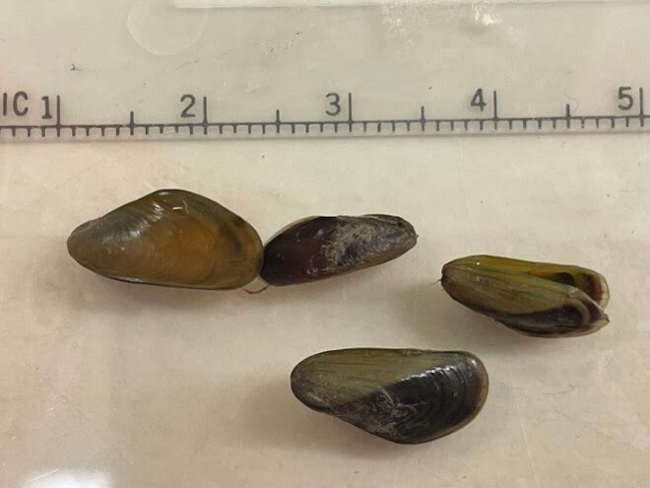
California Fish and Game Commission guards state waters against golden mussels

Golden mussels. Photo courtesy of the California Department of Fish and Wildlife.


The California Fish and Game Commission has taken emergency action to protect state waters against an invasive mussel that’s been discovered in Northern California.

The actions to address the discovery of the golden mussel came at the commission’s meeting in Sacramento on Dec. 11 and 12.

To protect California against the spread of the invasive golden mussel (Limnoperna fortunei) discovered Oct. 17 at the Port of Stockton, and in the days following as far south as San Luis Reservoir’s O'Neill Forebay, the commission added the golden mussel to the list of species restricted from live importation, transportation and possession.

This discovery is North America’s first; the golden mussel is native to China and Southeast Asia and was likely transported across the ocean on large ships.

The discovery is a concern for Lake County officials.

Angela DePalma-Dow, invasive mussel coordinator for Lake County Water Resources, told Lake County News this fall that golden mussels are similar in shape and size as quagga and zebra mussels, and have potential to cause just as much damage if introduced into freshwater lakes and streams.

DePalma-Dow updated the Lake County Board of Supervisors about the discovery of the mussels in Northern California at the board’s Dec. 10 meeting.

“Golden mussels are a bigger threat to California waters than quagga and zebra mussels because they can thrive in a wider range of water quality conditions,” said Jay Rowan, chief of the California Department of Fish and Wildlife’s Fisheries Branch. “Putting golden mussels on the restricted species list is an important first step toward containment and prevention of spread of this non-native species.”

The emergency listing will reduce the potential for people to introduce the bivalves to other waters of the state, officials said.

The species poses an immediate threat to the ecological health of the Delta — into which the waters of Clear Lake flow — and all waters of the state, water conveyance systems, infrastructure and water quality.

The commission’s action makes it illegal to be in possession or transport golden mussels in California.

Northern California pump prices stay low for holiday season; Lake County prices fall mid-range statewide

LAKE COUNTY, Calif. — Thanks to dropping gas prices, drivers in Northern California have something to be extra cheerful about this holiday season.

The average price of gasoline in the Golden State has continued to drop for a sixth straight week, according to AAA.

The average price for self-serve regular gasoline in California is $4.31, which is three cents lower than a week ago and 28 cents lower than a year ago, AAA reported.

But AAA said that trend may not stick around for long, as fuel prices are starting to rise nationally.

The average national price per gallon this week is $3.04, two cents higher than a week ago.

“Lower gas prices are great news for those planning year-end holiday travel,” said AAA Northern California spokesperson Doug Johnson. “With nearly 90 percent of travelers driving to their holiday destinations, that’s a lot of fuel — and a lot of savings.”

Here’s what the average price of self-serve regular gasoline is in each city:

San Francisco: $4.46.
Oakland: $4.30.
San Jose: $4.26.
Sacramento: $4.21.
Fresno: $4.21.
Stockton: $4.09.

AAA’s records show Lake County’s prices are falling about the middle range of prices in the state, coming in around $4.385 to $4.266 per gallon.

Meanwhile, the national average per kilowatt hour of electricity at a public EV charging station remained at 34 cents. In California, that average cost is 37 cents, AAA reported.

Drivers can find current gas and electric charging prices along their route using AAA Mobile.
  • 336
  • 337
  • 338
  • 339
  • 340
  • 341
  • 342
  • 343
  • 344
  • 345

Community

  • Sheriff’s Activities League and Clearlake Bassmasters offer youth fishing clinic

  • City Nature Challenge takes place April 24 to 27

Public Safety

  • Lakeport Police logs: Wednesday, Feb. 11

  • Lakeport Police logs: Tuesday, Feb. 10

Education

  • Ramos measure requiring school officer training in use of anti-opioid drug moves forward

  • Lake County Chapter of CWA announces annual scholarships 

Health

  • California ranks 24th in America’s Health Rankings Annual Report from United Health Foundation

  • Healthy blood donors especially vital during active flu season

Business

  • Employment law summit takes place March 9

  • Two Lake County Mediacom employees earn company’s top service awards

Obituaries

  • Terry Knight

  • Ellen Thomas

Opinion & Letters

  • Who should pay for AI’s power? Not California ratepayers

  • Crandell: Supporting nephew for reelection in supervisorial race

Veterans

  • State honors fallen chief warrant officer killed in conflict in Iran

  • CalVet and CSU Long Beach team up to improve data collection related to veteran suicides

Recreation

  • April Audubon program will show how volunteers can help monitor local osprey nests

  • First guided nature walk of spring at Anderson Marsh State Historic Park April 11

  • Second Saturday guided nature walks continue at Anderson Marsh State Historic Park

  • Wet weather trail closure in effect on Upper Lake Ranger District

Religion

  • Kelseyville Presbyterian Church plans Easter service

  • Easter ‘Sonrise’ Service returns to Xabatin Community Park

Arts & Life

  • ‘CIA’ delves into the shadowy world of an espionage thriller

  • ‘War Machine’ shifts the battlefield into uncharted territory

Government & Politics

  • Lake County Democratic Central Committee endorses Falkenberg

  • Crandell launches reelection campaign plans March 15 event

Legals

  • April 23 hearing on Lake Coco Farms Major Use Permit

  • NOTICE OF 30-DAY PUBLIC COMMENT PERIOD & NOTICE OF PUBLIC HEARING

How to resolve AdBlock issue?
Refresh this page