How to resolve AdBlock issue?
Refresh this page
Lake County News,California
  • Home
    • Registration Form
  • News
    • Education
    • Veterans
    • Community
      • Obituaries
      • Letters
      • Commentary
    • Police Logs
    • Business
    • Recreation
    • Health
    • Religion
    • Legals
    • Arts & Life
    • Regional
  • Calendar
  • Contact us
    • FAQs
    • Phones, E-Mail
    • Subscribe
  • Advertise Here
  • Login
How to resolve AdBlock issue?
Refresh this page

News

Governor commits to restarting state’s ZEV rebate program if federal tax credit is eliminated

California has surpassed 2 million zero-emission vehicles, or ZEV, sold, reaffirming California’s status as the country’s leader in clean vehicles.

This milestone comes a little over two years after California eclipsed the 1 million ZEV sales mark.

To ensure the state’s continued progress, Gov. Gavin Newsom on Monday announced that if the incoming Trump Administration eliminates a federal ZEV tax credit, he will propose creating a new version of the state’s successful Clean Vehicle Rebate Program, which was phased out in 2023.

During its lifetime, the CVRP funded more than 594,000 vehicles and saved more than 456 million gallons of fuel.

The proposed California rebates, which would include changes to promote innovation and competition in the ZEV market, could come from the Greenhouse Gas Reduction Fund, which is funded by polluters under the state’s cap-and-trade program.

"Consumers continue to prove the skeptics wrong — zero-emission vehicles are here to stay,” said Newsom. “We will intervene if the Trump Administration eliminates the federal tax credit, doubling down on our commitment to clean air and green jobs in California. We’re not turning back on a clean transportation future — we’re going to make it more affordable for people to drive vehicles that don’t pollute."

In the third quarter of 2024, Californians purchased 115,897 ZEVs, representing 26.4% of all new vehicle sales in the state. With more electric vehicles, or EVs, including plug-in hybrids, on the road every day, consumers are benefitting from the state’s work to build a bigger, better and more reliable charging network.

The nation’s leader in ZEV vehicles and infrastructure

California’s support for clean cars is unmatched. With the rise in EV and plug-in hybrid demand, the state is committed to rapidly deploying funds to develop and ensure an accessible, reliable and easy-to-use charging network. In 2024, the state has doubled down on improving the network:

150,000 public or shared private electric vehicle chargers have been installed throughout California, plus over 500,000 at-home chargers.

Awarded over $32 million in federal funds to install, operate and maintain 458 direct-current fast chargers along interstates and highways across the state thanks to the first round of funding President Biden’s Infrastructure Investment and Jobs Act. California was recently approved to spend another $81.7 million in federal funding next year.

Thousands of dollars in grants and rebates available for low-income Californians. Learn more at ClimateAction.ca.gov or ElectricForAll.org.

The work doesn’t stop with electric, hydrogen, and plug-in hybrid vehicles — the state has been hard at work to cut emissions in the freight sector and in school districts. Recent efforts include:

• $102 million to install charging stations and hydrogen fueling stations for zero-emissions trucks along Interstate 5 and other key freight corridors.

• $500 million to put another 1,000 ZEV school buses on the road.

Under President George W. Bush, the first federal EV tax credit was introduced through the U.S. Energy Policy Act of 2005.

Building a bigger, better charging network

State agencies are working to speed up charger deployment, cut through red tape, establish guidelines, plan for the expected increased grid demand, and efficiently electrify charging stations through local utilities.

This includes:

• Gathering better data on EV charger counts.

• Prioritizing shovel-ready projects for both state and federal incentives.

• Developing the Zero-Emission Vehicle Infrastructure Plan (ZIP), a comprehensive plan that lays out the overall strategy to meet California’s ZEV goals.

• Establishing reliability standards.

• Updating transportation energy forecasts.

California is spending billions to speed ZEV infrastructure deployment, tear down barriers, and deploy infrastructure in hard-to-reach and low-income areas. 30.3% of new ZEVs sold in the U.S. are sold in California, according to the California Air Resources Board.

California’s strategy for a clean transportation transition
Newsom’s office said this is a major milestone on California’s path to a clean transportation future.

In addition to advancing ZEVs, the Newsom Administration said it is prioritizing clean fuel production, public transit and rail infrastructure enhancements, and a cleaner, smarter electric grid to help power it all.

As California works toward this clean transportation future, the state is also advancing efforts to prevent gasoline price spikes.

Annual Lake County burn ban lifted

LAKE COUNTY, Calif. — The annual Lake County Burn Ban has ended for 2024.

It was lifted as of 9 a.m. Friday, Nov. 22, with Cal Fire’s declaration that fire season hazardous conditions have abated, fire season requirements have been lifted, and Cal Fire is transiting to winter preparedness.

Burn permits are required for all outdoor burning in the Lake County Air Basin. Residential and agricultural burn permits can be obtained online at www.lcaqmd.net or by appointment at the district office.

A smoke management plan burn permit is required for multi-day burns, overnight burns, standing vegetation burns, whole tree or vine removal, burns over 20 acres in one day, and any other burn where significant smoke impacts may occur or sensitive receptors may be impacted.

A smoke management plan can be obtained at the Lake County Air Quality Management District office, call 707-263-7000 to make an appointment. Bring a map showing the burn location (https://gispublic.co.lake.ca.us/portal/home/), burn site coordinates (GPS locations), parcel number or address, acres to be burned, and details of vegetation to be burned.

A fee is required for all burn permits, payable at the time the permit is issued. Smoke Management Plans, Agricultural burn permits and Residential burn permits are $34. In person payments may be made by cash, check, or money order. Online permit payment is by credit card only.

Only clean dry vegetation that was grown on the property may be burned. Residential burn permits require a one acre or larger lot of record, a burn location that is at least 100 feet from all neighbors, and at least 30 feet from any structure in order to qualify. Read your burn permit carefully and follow all the conditions.

Please be considerate of your neighbors. A permit does not allow you to create health problems for others. You can be liable for health care costs, fines, and other costs resulting from your burning.

Consider composting or using the vegetative waste pickup provided with your waste collection service as an alternative to burning leaves. Lake County’s joint fire agencies and air quality management district’s open burning program has incorporated both fire safety and air quality management since 1987.

Attendance rates improve across Lake County schools

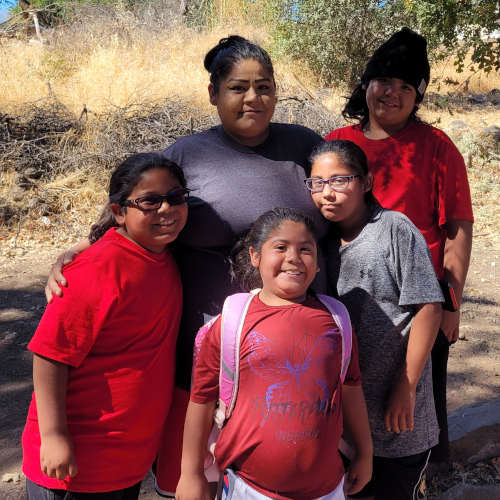
The Garcia Family improved their school attendance to 82 percent. Mom Justine Smith with her kids Kamotz Garcia, Jaden Garcia, Jada Garca and Joel Garcia. Photo courtesy of the Lake County Office of Education.

LAKE COUNTY, Calif. — There’s good news when it comes to student attendance in Lake County schools.

The California Department of Education has released the 2024 California School Dashboard, providing educators and families with insights into school and district progress.

An initial dashboard review shows that schools across Lake County have increased student attendance rates, a key factor linked to academic success.

“Getting into the habit of daily attendance is more important now than ever. When students improve their attendance rates, they improve their academic prospects and chances for graduating,” said Lake County Superintendent of Schools Brock Falkenberg.

Data for the 2023/24 school year highlights reductions in average days missed by students in every Lake County district is as follows:

• Lucerne Elementary: Reduced from 16.6 to 14.0 (15.7% improvement).

• Konocti Unified: Reduced from 24.5 to 21.8 (11.0% improvement).

• Middletown Unified: Reduced from 15.9 to 14.3 (10.1% improvement).

• Upper Lake Unified: Reduced from 18.2 to 16.2 (10.1% improvement).

• Lakeport Unified: Reduced from 18.4 to 17.4 (5.4% improvement).

• Kelseyville Unified: Reduced from 15.2 to 14.7 (3.3% improvement).

The most dramatic improvements came from Konocti Unified and Lucerne Elementary, with reductions of 2.7 and 2.6 days, respectively.

These improvements reflect a collective effort to tackle chronic absenteeism, which is defined as missing two or more days of school per month, excused or unexcused.

Amid these encouraging trends, the Garcia family from Konocti Unified School District stands out.

Facing significant challenges, the family initially reported an average attendance rate of just 25 percent.

With the dedicated support of the Healthy Start Attendance Team, the family achieved a remarkable turnaround, increasing their attendance rate to 82 percent.

This success story illustrates how targeted support and commitment to student well-being can create transformative change.

The Healthy Start Attendance Team was able to help improve attendance due to the Communities for School Success program, a partnership between the Lake County Office of Education and local school districts.

Funded by the California Department of Education, the initiative is led by Roxanne Morris, attendance supervisor for Healthy Start, who oversees a team of youth advocates.

“The program focuses on addressing barriers to consistent attendance, providing families with resources, and fostering a sense of belonging for every student,” Morris said. “I am proud of the Attendance staff and the work they have done to help Lake County students return to school.”

By working collaboratively with families, educators, and community partners, the Communities for School Success program is creating lasting change and brighter futures for Lake County students.

The release of the 2024 California School Dashboard and the progress in attendance underscore Lake County’s dedication to fostering academic success and community engagement.

For more information on the Dashboard, the Communities for School Success program, or other LCOE initiatives, visit https://www.lakecoe.org/.

Adventist Health Clear Lake medical office in Lucerne to close; services to be reallocated

LUCERNE, Calif. — Adventist Health Clear Lake reported that it is closing its Lucerne medical office.

Hospital officials said in a written statement that the decision is “part of a strategic effort to reallocate resources to areas of higher demand, ensuring the community receives the best possible care in the most impactful locations.”

The Lucerne office will officially close on Dec. 31.

“At Adventist Health Clear Lake, our mission is to provide compassionate, high-quality care for everyone we serve,” said Adventist Health Clear Lake Administrator Chuck Kassis. “This decision allows us to strengthen services in key areas, optimizing resources to benefit the greatest number of patients in our community.”

Adventist Health Clear Lake opened the medical office in Lucerne — the former Lucerne Community Clinic at 6300 East Highway 20 in Lucerne — in the spring of 2019 after acquiring it from Dr. Robert Gardner.

The decision to close the Lucerne office “follows an in-depth review of service demands and patient needs across Lake County. By concentrating resources in locations where there is higher patient volume, Adventist Health Clear Lake aims to enhance access and improve service capacity for residents,” hospital officials said.

Adventist Health Clear Lake said patients affected by the closure will be provided “with support to transition their care seamlessly to nearby Adventist Health Clear Lake facilities,” which include options in Lakeport, Kelseyville and Clearlake.

The Adventist Health Clear Lakes patient services team can assist with answering questions about care continuity or finding a new provider, officials said.

Email Elizabeth Larson at This email address is being protected from spambots. You need JavaScript enabled to view it.. Follow her on Twitter, @ERLarson, and on Bluesky, @erlarson.bsky.social. Find Lake County News on the following platforms: Facebook, @LakeCoNews; X, @LakeCoNews; Threads, @lakeconews, and on Bluesky, @lakeconews.bsky.social.

General plan meeting for agricultural community postponed

LAKE COUNTY, Calif. — A Lake County General Plan meeting focusing on the agricultural community was postponed due to inclement weather.

The meeting on Lake County 2050, the project to update Lake County’s General Plan, was set to have taken place on Thursday, Nov. 21, at the Lake County Courthouse.

County officials ask that community members stay tuned for updates on the new date and time, currently to be determined.

For updates and more information, visit lakecounty2050.org/meetings/.

For more information about the meeting and the process, contact Community Development Director Mireya Turner at telephone 707-263-2221 or email This email address is being protected from spambots. You need JavaScript enabled to view it..

Public health surveillance, from social media to sewage, spots disease outbreaks early to stop them fast


Health officials work to connect the dots during the early stages of an outbreak. Maxiphoto/iStock via Getty Images Plus

A cluster of people talking on social media about their mysterious rashes. A sudden die-off of birds at a nature preserve. A big bump in patients showing up to a city’s hospital emergency rooms.

These are the kinds of events that public health officials are constantly on the lookout for as they watch for new disease threats.

Health emergencies can range from widespread infectious disease outbreaks to natural disasters and even acts of terrorism. The scope, timing or unexpected nature of these events can overwhelm routine health care capacities.

I am a public health expert with a background in strengthening health systems, infectious disease surveillance and pandemic preparedness.

Rather than winging it when an unusual health event crops up, health officials take a systematic approach. There are structures in place to collect and analyze data to guide their response. Public health surveillance is foundational for figuring out what’s going on and hopefully squashing any outbreak before it spirals out of control.

Tracking day by day

Indicator-based surveillance is the routine, systematic collection of specific health data from established reporting systems. It monitors trends over time; the goal is to detect anomalies or patterns that may signal a widespread or emerging public health threat.

Hospitals are legally required to report data on admissions and positive test results for specific diseases, such as measles or polio, to local health departments. The local health officials then compile the pertinent data and share it with state or national public health agencies, such as the U.S. Centers for Disease Control and Prevention.

When doctors diagnose a positive case of influenza, for example, they report it through the National Respiratory and Enteric Virus Surveillance System, which tracks respiratory and gastrointestinal illnesses. A rise in the number of cases could be a warning sign of a new outbreak. Likewise, the National Syndromic Surveillance Program collects anonymized data from emergency departments about patients who report symptoms such as fever, cough or respiratory distress.

Public health officials keep an eye on wastewater as well. A variety of pathogens shed by infected people, who may be asymptomatic, can be identified in sewage. The CDC created the National Wastewater Surveillance System to help track the virus that causes COVID-19. Since the pandemic, it’s expanded in some areas to monitor additional pathogens, including influenza, respiratory syncytial virus (RSV) and norovirus. Wastewater surveillance adds another layer of data, allowing health officials to catch potential outbreaks in the community, even when many infected individuals show no symptoms and may not seek medical care.

Having these surveillance systems in place allows health experts to detect early signs of possible outbreaks and gives them time to plan and respond effectively.

lots of people wearing PPE in a hospital hallway
An extremely busy emergency room could be a signal that an outbreak is underway. Jeffrey Basinger/Newsday via Getty Images

Watching for anything outside the norm

Event-based surveillance watches in real time for anything that could indicate the start of an outbreak.

This can look like health officials tracking rumors, news articles or social media mentions of unusual illnesses or sudden deaths. Or it can be emergency room reports of unusual spikes in numbers of patients showing up with specific symptoms.

Local health care workers, community leaders and the public all support this kind of public health surveillance when they report unexpected health events through hotlines and online forms or just call, text or email their public health department. Local health workers can assess the information and escalate it to state or national authorities.

Public health officials have their ears to the ground in these various ways simultaneously. When they suspect the start of an outbreak, a number of teams spring into action, deploying different, coordinated responses.

Collecting samples for more analysis

Once event-based surveillance has picked up an unusual report or a sudden pattern of illness, health officials try to gather medical samples to get more information about what might be going on. They may focus on people, animals or specific locations, depending on the suspected source. For example, during an avian flu outbreak, officials take swabs from birds, both live and dead, and blood samples from people who have been exposed.

Health workers collect material ranging from nose or throat swabs, fecal, blood or tissue samples, and water and soil samples. Back in specialized laboratories, technicians analyze the samples, trying to identify a specific pathogen, determine whether it is contagious and evaluate how it might spread. Ultimately, scientists are trying to figure out the potential impact on public health.

Finding people who may have been exposed

Once an outbreak is detected, the priority quickly shifts to containment to prevent further spread. Public health officials turn into detectives, working to identify people who may have had direct contact with a known infected person. This process is called contact tracing.

Often, contact tracers work backward from a positive laboratory confirmation of the index case – that is, the first person known to be infected with a particular pathogen. Based on interviews with the patient and visiting places they had been, the local health department will reach out to people who may have been exposed. Health workers can then provide guidance about how to monitor potential symptoms, arrange testing or advise about isolating for a set amount of time to prevent further spread.

truck advertising 'COVID Trace' app
Many states, including Nevada, set up contact tracing apps to help people determine whether they may have been exposed to the coronavirus. Gabe Ginsberg/Experience Strategy Associates via Getty Images

Contact tracing played a pivotal role during the early days of the COVID-19 pandemic, helping health departments monitor possible cases and take immediate action to protect public health. By focusing on people who had been in close contact with a confirmed case, public health agencies could break the chain of transmission and direct critical resources to those who were affected.

Though contact tracing is labor- and resource-intensive, it is a highly effective method of stopping outbreaks before they become unmanageable. In order for contact tracing to be effective, though, the public has to cooperate and comply with public health measures.

Stopping an outbreak before it’s a pandemic

Ultimately, public health officials want to keep as many people as possible from getting sick. Strategies to try to contain an outbreak include isolating patients with confirmed cases, quarantining those who have been exposed and, if necessary, imposing travel restrictions. For cases involving animal-to-human transmission, such as bird flu, containment measures may also include strict protocols on farms to prevent further spread.

Health officials use predictive models and data analysis tools to anticipate spread patterns and allocate resources effectively. Hospitals can streamline infection control based on these forecasts, while health care workers receive timely updates and training in response protocols. This process ensures that everyone is informed and ready to act to maximize public safety.

No one knows what the next emerging disease will be. But public health workers are constantly scanning the horizon for threats and ready to jump into action.The Conversation

John Duah, Assistant Professor of Health Services Administration, Auburn University

This article is republished from The Conversation under a Creative Commons license. Read the original article.


  • 354
  • 355
  • 356
  • 357
  • 358
  • 359
  • 360
  • 361
  • 362
  • 363

Community

  • Sheriff’s Activities League and Clearlake Bassmasters offer youth fishing clinic

  • City Nature Challenge takes place April 24 to 27

Public Safety

  • Lakeport Police logs: Wednesday, Feb. 11

  • Lakeport Police logs: Tuesday, Feb. 10

Education

  • Ramos measure requiring school officer training in use of anti-opioid drug moves forward

  • Lake County Chapter of CWA announces annual scholarships 

Health

  • California ranks 24th in America’s Health Rankings Annual Report from United Health Foundation

  • Healthy blood donors especially vital during active flu season

Business

  • Employment law summit takes place March 9

  • Two Lake County Mediacom employees earn company’s top service awards

Obituaries

  • Terry Knight

  • Ellen Thomas

Opinion & Letters

  • Who should pay for AI’s power? Not California ratepayers

  • Crandell: Supporting nephew for reelection in supervisorial race

Veterans

  • State honors fallen chief warrant officer killed in conflict in Iran

  • CalVet and CSU Long Beach team up to improve data collection related to veteran suicides

Recreation

  • April Audubon program will show how volunteers can help monitor local osprey nests

  • First guided nature walk of spring at Anderson Marsh State Historic Park April 11

  • Second Saturday guided nature walks continue at Anderson Marsh State Historic Park

  • Wet weather trail closure in effect on Upper Lake Ranger District

Religion

  • Kelseyville Presbyterian Church plans Easter service

  • Easter ‘Sonrise’ Service returns to Xabatin Community Park

Arts & Life

  • ‘CIA’ delves into the shadowy world of an espionage thriller

  • ‘War Machine’ shifts the battlefield into uncharted territory

Government & Politics

  • Lake County Democratic Central Committee endorses Falkenberg

  • Crandell launches reelection campaign plans March 15 event

Legals

  • April 23 hearing on Lake Coco Farms Major Use Permit

  • NOTICE OF 30-DAY PUBLIC COMMENT PERIOD & NOTICE OF PUBLIC HEARING

How to resolve AdBlock issue?
Refresh this page