How to resolve AdBlock issue?
Refresh this page
Lake County News,California
  • Home
    • Registration Form
  • News
    • Education
    • Veterans
    • Community
      • Obituaries
      • Letters
      • Commentary
    • Police Logs
    • Business
    • Recreation
    • Health
    • Religion
    • Legals
    • Arts & Life
    • Regional
  • Calendar
  • Contact us
    • FAQs
    • Phones, E-Mail
    • Subscribe
  • Advertise Here
  • Login
How to resolve AdBlock issue?
Refresh this page

News

Tuleyome Tales: The Pacific Flyway, a natural wonder in our own backyard

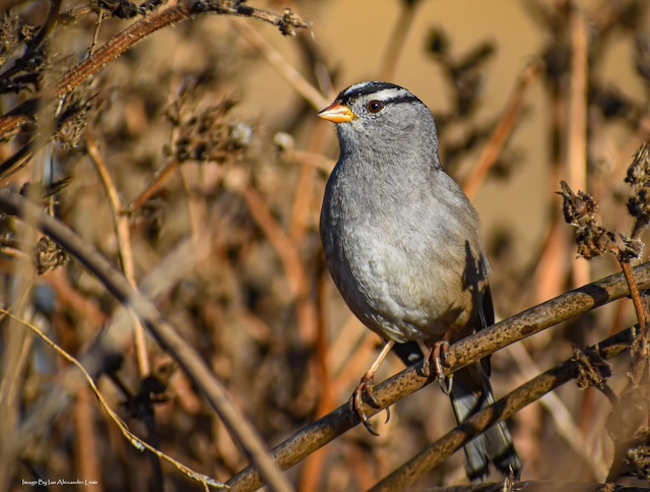
White crowned sparrows (Zonotrichis leucophrys) are regular backyard visitors. Photo by Ian Alexander Levin.

NORTHERN CALIFORNIA — Fall is my favorite season in the Berryessa Snow Mountain National Monument region, but not for the usual reasons.

It’s not the spiced lattes or the leaves changing colors, although those are nice too. The reason I love autumn so much in Northern California is because of the birds.

As temperatures finally start to cool, like clockwork, the birds come by the thousands to enjoy our comfortable and temperate winter weather.

Here in the valley, we are located along a major bird migration route called the Pacific Flyway. The Pacific Flyway spans 4,000 miles north to south from Alaska to Patagonia. More than 350 species of birds migrate every year using the Pacific Flyway.

According to the Sacramento Audubon Society, at least one billion birds migrate through the Sacramento region annually. Birds migrate south to our little corner of the Pacific Flyway from as far north as Canada and Alaska. For some birds, our valley floor is the final destination of their migratory route; for others, we are a rest stop on their way further south.

Birds begin to migrate when the days begin to shorten, and temperatures start to cool in their northern habitats. With the change in seasons, they see a reduction in the availability of their food sources, which are primarily insects, berries and aquatic plants. Migration offers a way to find more ample food and milder temperatures.

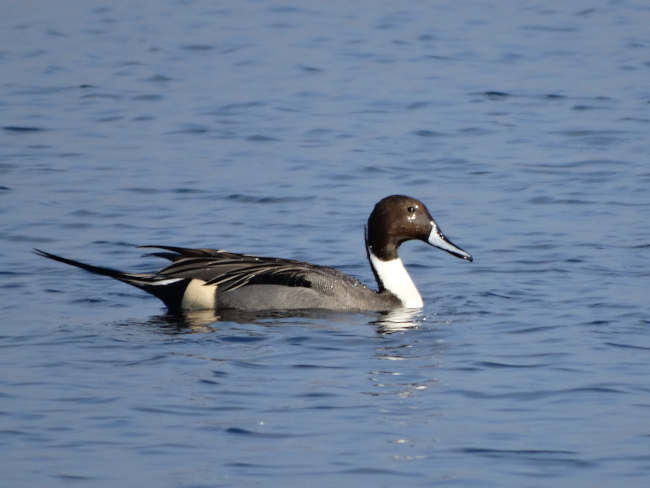
In the Sacramento Valley, the Northern Pintail (Anas acuta) is the harbinger of fall migration, arriving as early as August. Later, you may be lucky enough to hear the Sandhill Cranes (Antigone canadensis), whose loud calls can be heard up to a mile away.

During the fall, if you visit one of our area’s beautiful wetlands, you can see American Avocets, Horned Larks, Green-Winged Teals, American Widgeons, Long-Billed Curlews, and Merlins, to name just a few. In your yard you might enjoy watching White Crowned Sparrows, Hermit Thrushes, Dark Eyed Juncos, Western Tanagers, Townsend’s Warblers, and many more.

The idea of bird migration often brings to mind geese flying in V formation, which is an impressive feat. What I think is even more astounding is that tiny bird species like sparrows, warblers and hummingbirds also migrate, and compared to their size, the distances that they travel are nothing short of amazing.

Rufous hummingbirds (Selasphorus rufus) for example, which measure only about 3 inches in length, fly roughly 3,900 miles one way from Alaska to Mexico.

According to the website All About Birds, this journey is equivalent to 78 million body lengths for this tiny bird. Compare that to another impressive long-distance migrator, the 13-inch-long Arctic Tern that flies a mind boggling 11 thousand miles one way from Alaska to Antarctica, which is just 51 million of its body lengths.

Scientists still don’t fully understand how birds are able to migrate, but over the last few decades there have been some fascinating findings on the topic. Studies have shown that birds use the night sky and positioning of the stars, chiefly Polaris (the North Star) to navigate. On cloudy nights when stars are less visible, birds seem to wait for better visibility.

Many birds have a small amount of magnetite in their upper beak, a magnetic mineral that serves as a sort of internal compass.

Bird eyes contain a protein called cryptochrome that allow them to see the Earth’s magnetic field, and birds are thought to create what scientists call a mental map of the world around them.

Additionally, while historically it was thought that birds navigate solely based on instinct, recent studies have shown that juvenile birds seem to learn migration skills and routes from other birds.

Since birds tend to use the same migration route each year, ornithologists can often predict the day that a specific species will arrive in a given place along the flyway, which is great news if you enjoy watching birds.

Tools such as Birdcast can show you how many birds are expected to be migrating on a given day, including live updates. You might consider using a nature journal or a community science tool like eBird to record when your favorite species arrive in your yard, and in doing so, help scientists track this magnificent natural wonder.

While along the migratory path, birds face countless challenges. It is a dangerous and arduous journey, and many birds do not make it to their final destination due to difficult weather conditions, predation, exhaustion, or starvation along the way.

Human-related obstacles have also made this journey more difficult. These include habitat loss, inadequate food supply at resting stops, changing weather patterns, predation by house cats, hunting, and in recent years, commercial and residential light pollution and collisions with windows and tall buildings.

There are many things that you can do to help birds along their journey. Make your yard a good waystation along their travels. Leaf litter provides hiding places for insects that birds need to refuel, so “leave the leaves.” Plant native plants that provide seasonal habitat and berries for birds. Avoid using pesticides as they reduce the supply of birds’ primary food source: insects.

Turning off unnecessary lights outside can also have a big impact on birds who can be confused by artificial lighting along their migration route. Prevent window collisions by placing protective decals on the outside of your windows.

The fall bird migration serves as a reminder of the interconnectedness of our beautiful planet and the way that we are all part of a larger world. Tending gently to our little corner of the world benefits not just us, but also travelers along their epic journeys.

The most fun thing you can do to help birds is to learn about them and love them. We protect what we love. So, get out there and enjoy those fall birds!

Diana Drips is a Certified California Naturalist. Tuleyome is a 501(c)(3) nonprofit conservation organization based in Woodland, California. For more information go to www.tuleyome.org.

Northern pintails (Anas acuta) are early arrivers to the Sacramento Valley, often arriving in August. Photo by Erin Powell.

Lake County Sheriff’s Activities League begins 28th year of service to local youth


LAKE COUNTY, Calif. — For the past 27 years a group of dedicated volunteers has provided a variety of activities for local youth helping to develop their skills and their sense of accomplishment and competence.

It began in 1997 with the first board of directors, submission of articles of incorporation for nonprofit status, a small grant and a USA Boxing Program.

Over the years, the Lake County Sheriff’s Activities League, or LCSAL, has grown to include the Junior Giants Summer Baseball and Softball league, kayaking for kids and families as well as boxing.

Volunteers have provided instruction in fishing, archery, basketball, open gym sessions, sewing, quilting, rock climbing, cooking, flower arranging, tutoring, a class in manners and social skills, theater festivals for local high school students, dance instruction, theater games sessions, leadership conferences and participation in parades.

LCSAL is a 100-percent volunteer organization and is funded through local grants, donations and an annual benefit breakfast.

Lake County residents and agencies have been very generous over the years, allowing the programs to thrive.

The group invites volunteers to share their interests and hobbies with the youth of Lake County. Volunteers can sign up for Junior Giants and receive coaches training to implement the San Francisco Giants model program that uses baseball and softball as a backdrop for teaching important life skills and values.

Four Lake County students have received college scholarships ranging from $5,000 to $10,000 each from their association with Junior Giants.

A volunteer who wants to share their love for a specific hobby can stipulate the number of students, the age range of the students and how many times they want to offer their activity.

LCSAL has the resources to cover the expenses for equipment and supplies. Liability insurance is provided.

The group also will arrange for meeting space and handle student recruitment. All volunteers receive background checks at no expense to the volunteer.

These programs are offered at no cost to families and can make a difference in how a young person experiences their local community.

Please call Board President Dave Borjon if you would like to explore volunteering at 707-279-1050 or 707-245-0637.

Every effort to engage local youngsters in positive leisure time activities provides a building block toward developing young citizens who will enrich our communities in the future.

US House passes measure that could punish nonprofits Treasury Department decides are ‘terrorist’


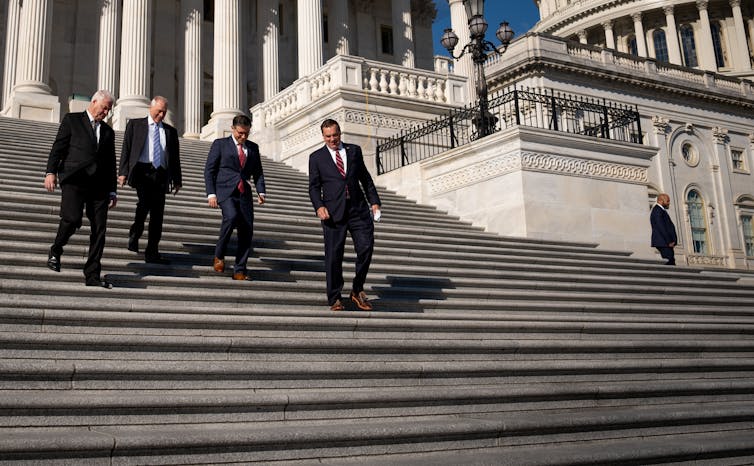
U.S. Reps. Tom Emmer, Steve Scalise, Mike Johnson and Richard Hudson, four prominent GOP lawmakers, descend the U.S. Capitol’s steps on Nov. 12, 2024. Andrew Harnik/Getty Images

The U.S. House of Representatives has passed a bill that would empower the Treasury Department to eliminate the tax-exempt status of any nonprofit it deems to be supporting terrorism. The Stop Terror-Financing and Tax Penalties on American Hostages Act was approved in a 219-184 vote, with all but one Republican backing it and only 15 Democrats voting for it, on Nov. 21, 2024.

The Conversation U.S. philanthropy and nonprofits editor Emily Schwartz Greco spoke with Beth Gazley, an Indiana University scholar of nonprofits, local governance and civil society, to better understand the outcry over this measure – which would have to pass in the Senate before a U.S. president could sign it into law. President-elect Donald Trump, who will take office in January 2025, will begin his second term with narrow majorities in both chambers of Congress. That means an identical or similar bill could come across his desk after being reintroduced in the next Congress.

Why are so many people concerned about this bill?

I believe that this is part of a strategy to preempt opposition to Republican policies and encourage self-censorship. It’s a way for the GOP to try to restrict what activists and nonprofit organizations can say or do. And, essentially, it’s a threat to political opponents of President-elect Donald Trump.

This kind of law could become a blunt sword that can be used against everybody.

I’m not the only one who feels this way. U.S. Rep. Jamie Raskin, a Democrat who previously was a constitutional law professor, called the bill “a werewolf in sheep’s clothing.” Raskin observed that “rendering support to terrorists is already a felony” and warned that this bill could end up “capsizing” all rights to due process.

Several nonpartisan groups and associations representing a wide array of nonprofits, including the Council on Foundations, Independent Sector, the National Council of Nonprofits, and United Philanthropy Forum, issued a joint statement that condemned this measure ahead of its passage in the House. The groups said they were concerned that it would provide “the executive branch with expansive new authority that could be abused.”


What do you think ‘terrorism’ means in this context?

An earlier version of this legislation was introduced in December 2023 and passed in the House in April 2024. Based on the timing, it was widely interpreted as an attempt to quell widespread protests by students and other people who were expressing their solidarity with Palestinians and their objections to Israel’s military operations in Gaza.

But this legislation could easily do far more than that because it does not distinguish between foreign and domestic terrorism – whether it’s real or imagined.

Until now, the Treasury Department has taken great care in how it defines domestic terrorism, observing on its website that the Constitution and U.S. laws “protect a wide range of expression – even expression that many might disagree with or find abhorrent, and even expression that certain foreign allies and partners of the United States prohibit and criminalize under their own laws.”

U.S. law stipulates that The Treasury Department has an obligation to remain nonpartisan in any of its interactions with tax-exempt organizations.

As a result, making it easier for federal authorities to allege that a nonprofit is “terrorist” would be a big departure from American traditions. It could be turning the term into a kind of political rhetoric that’s meant to intimidate activists, including those holding campus protests.

The lack of a clear definition in the legislation would leave room for interpretation. It’s not clear who would be held liable – it might even be the nonprofits’ donors.

Constitutional protections may protect people in the end who get caught up in these allegations, but there’s no way to know how far this could go or how much it might upend their livelihoods while they defend themselves.

What other concerns do you have?

This bill reminds me of what’s happening around the world in countries where support for democratic principles is declining and right-wing governments are restricting dissent.

I’m currently working with Jennifer Alexander, a public administration professor at the University of Texas at San Antonio, on a paper about this trend and how it’s tied to what’s already happening in many U.S. states. We’ve found this pattern most prevalent where the Republican Party has full control over the government – the GOP occupies the governor’s mansion and has a majority in both legislative chambers.

We have found that at least 22 U.S. states have either passed new laws restricting protests or tightened laws that were already on the books, increasing the severity of possible punishment. These laws restrict public advocacy and organizing.

I can see it being used to clamp down on environmental protests, like the ones held in Atlanta to object to the construction of a police training center in an urban forest, or in North Dakota, against the construction of an oil pipeline.

This kind of measure could lead to more severe crackdowns, should there be a new wave of Black Lives Matter protests, similar to the ones in 2020 that followed George Floyd’s murder. Many of those demonstrations were organized by nonprofit groups.

In Texas, state authorities have attempted to shut down charities that assist immigrants, leading to an outcry from civil rights groups.

And Indiana Attorney General Todd Rokita has launched a probe of companies and nonprofits, including the God Is Good Foundation, that have allegedly conspired to bring noncitizens to the state.

What do you think would happen if this measure were to become law?

I can see how people intending to continue with the kind of mass mobilization organized by nonprofits might decide to go underground – to avoid the repercussions of activity that I would argue is clearly protected by the U.S. Constitution.

Even without this measure becoming law, it has become possible for an organizer to be held liable in court for damage or injuries incurred during a demonstration – even if they personally did not engage in violence or destruction.

Officially labeling an organization as “terrorist” can be very powerful. If this were to start happening, some of the population would never see that group any other way again.

Many authoritarian regimes like to use this propaganda tool because it makes the public distrust those organizations. It places these organizations outside acceptable norms of civic engagement, despite nonprofits’ right to freedom of speech, assembly and petition embedded in the First Amendment to the Constitution.The Conversation

Beth Gazley, Professor of Nonprofit Management and Policy, Indiana University

This article is republished from The Conversation under a Creative Commons license. Read the original article.

Helping Paws: From pups to seniors

LAKE COUNTY, Calif. — Lake County Animal Care and Control has dogs of all ages, from puppies to seniors, waiting to be adopted.

The dogs available for adoption this week include mixes of Anatolian shepherd, boxer, bull terrier, cane corso, cattle dog, Dogo Argentino, German shepherd, Great Pyrenees, husky, Labrador Retriever, pit bull terrier and terrier.

Dogs that are adopted from Lake County Animal Care and Control are either neutered or spayed, microchipped and, if old enough, given a rabies shot and county license before being released to their new owner. License fees do not apply to residents of the cities of Lakeport or Clearlake.

Those dogs and the others shown on this page at the Lake County Animal Care and Control shelter have been cleared for adoption.

Call Lake County Animal Care and Control at 707-263-0278 or visit the shelter online for information on visiting or adopting.

The shelter is located at 4949 Helbush in Lakeport.

Email Elizabeth Larson at This email address is being protected from spambots. You need JavaScript enabled to view it.. Follow her on Twitter, @ERLarson, or Lake County News, @LakeCoNews.


Kennel#12's preview photo
Kennel#12

Kennel#5's preview photo
Kennel#5

Kennel#10's preview photo
Kennel#10

Kennel#16(Caney)'s preview photo
Kennel#16(Caney)

Kennel#20's preview photo
Kennel#20

Kennel#30's preview photo
Kennel#30

Kennel#33's preview photo
Kennel#33

Kennel#14's preview photo
Kennel#14

Kennel#26(Ben)'s preview photo
Kennel#26(Ben)

Kennel#25(Jerry)'s preview photo
Kennel#25(Jerry)

 
Kennel#34's preview photo
Kennel#34


Kennel#19's preview photo
Kennel#19

Kennel#27's preview photo
Kennel#27

Kennel#9's preview photo
Kennel#9

Kennel#6's preview photo
Kennel#6

Kennel#8(Buddy)'s preview photo
Kennel#8(Buddy)

Kennel#21's preview photo
Kennel#21

 
Kennel#22's preview photo
Kennel#22

Kennel#28's preview photo
Kennel#28

Kennel#29's preview photo
Kennel#29

Kennel#11's preview photo
Kennel#11

Kennel#2(Saint)'s preview photo
Kennel#2(Saint)

Kennel#18's preview photo
Kennel#18

 
Kennel#31's preview photo
Kennel#31

Kennel#32's preview photo
Kennel#32

Kennel#13's preview photo
Kennel#13

Kennel#15's preview photo
Kennel#15

Space News: It’s 100 years since we learned the Milky Way is not the only galaxy


Edwin Hubble’s work showed that Andromeda (pictured) was a separate galaxy outside the Milky Way. Nasa/JPL-Caltech

On Sunday November 23 1924, 100 years ago this month, readers perusing page six of the New York Times would have found an intriguing article, amid several large adverts for fur coats. The headline read: Finds Spiral Nebulae are Stellar Systems: “Dr Hubbell Confirms View That They Are ‘Island Universes’; Similar to Our Own”.

The American astronomer at the centre of the article, Dr Edwin Powell Hubble, was probably bemused by the misspelling of his name. But the story detailed a groundbreaking discovery: Hubble had found that two spiral-shaped nebulae, objects made up of gas and stars, which were previously thought to reside within our Milky Way galaxy, were located outside it.

These objects were actually the Andromeda and Messier 33 galaxies, the closest large galaxies to our Milky Way. Today, up to several trillion galaxies are estimated to fill the Universe, based on observations of tens of millions of galaxies.

Four years before Hubble’s announcement, an event called “the great debate” had taken place in Washington DC between the American astronomers Harlow Shapley and Heber Curtis. Shapley had recently shown the Milky Way to be larger than previously measured. Shapley argued that it could accommodate spiral nebulae within it. Curtis, on the other hand, advocated for the existence of galaxies beyond the Milky Way.

In hindsight, and ignoring certain details, Curtis won the debate. However, the method Shapley used to measure distances across the Milky Way was critical to Hubble’s discovery, and was inherited from the work of a pioneering US astronomer: Henrietta Swan Leavitt.

Measuring distances to stars

In 1893, a young Leavitt was hired as a “computer” to analyse images from telescope observations at Harvard College Observatory, Massachusetts. Leavitt studied photographic plates from telescope observations of another galaxy called the Small Magellanic Cloud carried out by other observatory researchers.

Leavitt was searching for stars whose brightness changed over time. From over a thousand variable (changing) stars, she identified 25 were of a type known as Cepheids, publishing the results in 1912.

The brightness of Cepheid stars changes with time, so they appear to pulse. Leavitt found a consistent relationship: Cepheids that pulsed more slowly were intrinsically brighter (more luminous) than those pulsing more quickly. This was dubbed the “period-luminosity relationship”.

Other astronomers realised the significance of Leavitt’s work: the relationship could be used to work out distances to stars. While a student at Princeton University, Shapley used the period-luminosity relationship to estimate distances to other Cepheids across the Milky Way. This is how Shapley reached his estimate for our galaxy’s size.

But, in order for astronomers to be sure about distances within our galaxy, they needed a more direct way to measure distances to Cepheids. The stellar parallax method is another way to measure cosmic distances, but it only works for nearby stars. As the Earth orbits the Sun, a nearby star appears to move relative to more distant background stars. This apparent motion is known as stellar parallax. Through the angle of this parallax, astronomers can work out a star’s distance from Earth.

The Danish researcher Ejnar Hertzsprung used stellar parallax to obtain the distances to a handful of nearby Cepheid stars, helping calibrate Leavitt’s work.

The New York Times article emphasised the “great” telescopes at the Mount Wilson Observatory near Los Angeles, where Hubble was working. Telescope size is generally assessed by the diameter of the primary mirror. With a 100-inch (2.5-metre) diameter mirror for collecting light, the Hooker telescope at Mount Wilson was the largest telescope at the time.

Large telescopes are not only more sensitive to resolving galaxies, but also create sharper images. Edwin Hubble was therefore well placed to make his discovery. When Hubble compared his photographic plates taken using the 100 inch telescope with those taken on previous nights by other astronomers, he was thrilled to see one bright star appear to change in brightness over time, as expected for a Cepheid.

Using Leavitt’s calculations, Hubble found that the distance to his Cepheid exceeded Shapley’s size for the Milky Way. Over subsequent months, Hubble examined other spiral nebulae as he searched for more Cepheids with which to measure distances. Word of Hubble’s observations was spreading among astronomers. At Harvard, Shapley received a letter from Hubble detailing the discovery. He handed it to fellow astronomer Cecilia Payne-Gaposchkin, remarking: “Here is the letter that has destroyed my universe”.

Expansion of the Universe

Besides estimating the distance to a galaxy, telescopes can also measure the speed at which a galaxy moves towards or away from Earth. In order to do this, astronomers measure a galaxy’s spectrum: the different wavelengths of light coming from it. They also calculate an effect known as the Doppler shift and apply it to that spectrum.

The Doppler shift occurs for both light and sound waves; it is responsible for the pitch of a siren increasing as an emergency vehicle approaches, then decreasing as it passes you. When a galaxy is moving away from Earth, features of the spectrum known as absorption lines have longer measured wavelengths than they would if they were not moving. This is due to the Doppler shift, and we say that these galaxies have been “redshifted”.

Beginning in 1904, the American astronomer Vesto Slipher used the Doppler technique with a 24-inch telescope at the Lowell Observatory in Flagstaff, Arizona. He found that nebulae were either redshifted (moving away) or blueshifted (travelling towards us). Slipher found that some nebulae were moving away from Earth at speeds as high as a thousand kilometres a second.

Hubble combined Slipher’s measurements with his distance estimates for each galaxy and discovered a relationship: the further a galaxy is from us, the faster it is moving away from us. This can be explained by the expansion of the Universe from a common origin, which would become known derisively as the Big Bang.

The announcement 100 years ago cemented Hubble’s place in the history of astronomy. His name would later be used for one of the most powerful scientific instruments ever created: the Hubble space telescope. It seems incredible how, over the course of just five years, our understanding of the Universe was brought into focus.The Conversation

Jeffrey Grube, Senior Lecturer in Physics Education, King's College London

This article is republished from The Conversation under a Creative Commons license. Read the original article.

Lake County Adult School celebrates inspirational graduate Tom Willis

Lake County Adult School Graduate Tom Willis with wife, Darlene and his daughter Renee, who recently graduated from the Lake County Adult School Program. Courtesy photo.

LAKE COUNTY, Calif. — The Lake County Adult School is proud to highlight the remarkable achievements of its students, including Tom Willis, who earned his high school diploma at the age of 71.

His story is a testament to the belief that it is never too late to pursue educational dreams.

Inspired by watching his daughter and granddaughter graduate last year from the Lake County Office of Education’s Lake County Adult School, Willis enrolled to achieve his own milestone.

"Everyone can learn and succeed, but not always on the same day or in the same way," said Lake County Superintendent of Schools Brock Falkenberg. "Tom's story is a shining example of what our adult education programs are all about: perseverance, growth, and new beginnings."

His hard work and dedication paid off, and his graduation brought tears of joy. "It's never too late to mark something off your bucket list," Willis said.

Looking forward, Willis plans to enroll in culinary classes at Woodland Community College, aiming to refine his baking skills.

His story exemplifies the school’s mission to provide opportunities for lifelong learning and personal growth.

“I am always amazed by the stories my students share with me, and I never get tired of listening to them,” said Lake County Adult School Teacher Jonah Wakefield about the determination of the student body. “This year, we've enrolled political refugees, single mothers, recent immigrants, and startup company COOs. It's a delightful cornucopia of people. I hope you enjoy hearing these stories as much as I do.”

Lake County Adult School, which opened in September 2023 at the Lake County Campus of Woodland Community College, offers a free, in-person high school diploma completion program for adults 18 and older.

The school has since expanded to also offer classes at the Lake County Campus of Mendocino College.

With a 130-credit graduation requirement, the program is designed to be flexible and accommodating, ensuring students can balance their education with other responsibilities.

The school has already celebrated several graduates and currently supports students from all corners of the county.

Its partnership with the local community colleges enables co-enrollment, expanding the horizons for students like Willis to pursue further education and career goals.

Since opening its doors in 2023, the Lake County Adult School has enrolled over 100 students, highlighting the strong community demand for this program.

For more information about Lake County Adult School or to enroll, visit the Lake County Office of Education website.
  • 355
  • 356
  • 357
  • 358
  • 359
  • 360
  • 361
  • 362
  • 363
  • 364

Community

  • Sheriff’s Activities League and Clearlake Bassmasters offer youth fishing clinic

  • City Nature Challenge takes place April 24 to 27

Public Safety

  • Lakeport Police logs: Wednesday, Feb. 11

  • Lakeport Police logs: Tuesday, Feb. 10

Education

  • Ramos measure requiring school officer training in use of anti-opioid drug moves forward

  • Lake County Chapter of CWA announces annual scholarships 

Health

  • California ranks 24th in America’s Health Rankings Annual Report from United Health Foundation

  • Healthy blood donors especially vital during active flu season

Business

  • Employment law summit takes place March 9

  • Two Lake County Mediacom employees earn company’s top service awards

Obituaries

  • Terry Knight

  • Ellen Thomas

Opinion & Letters

  • Who should pay for AI’s power? Not California ratepayers

  • Crandell: Supporting nephew for reelection in supervisorial race

Veterans

  • State honors fallen chief warrant officer killed in conflict in Iran

  • CalVet and CSU Long Beach team up to improve data collection related to veteran suicides

Recreation

  • April Audubon program will show how volunteers can help monitor local osprey nests

  • First guided nature walk of spring at Anderson Marsh State Historic Park April 11

  • Second Saturday guided nature walks continue at Anderson Marsh State Historic Park

  • Wet weather trail closure in effect on Upper Lake Ranger District

Religion

  • Kelseyville Presbyterian Church plans Easter service

  • Easter ‘Sonrise’ Service returns to Xabatin Community Park

Arts & Life

  • ‘CIA’ delves into the shadowy world of an espionage thriller

  • ‘War Machine’ shifts the battlefield into uncharted territory

Government & Politics

  • Lake County Democratic Central Committee endorses Falkenberg

  • Crandell launches reelection campaign plans March 15 event

Legals

  • April 23 hearing on Lake Coco Farms Major Use Permit

  • NOTICE OF 30-DAY PUBLIC COMMENT PERIOD & NOTICE OF PUBLIC HEARING

How to resolve AdBlock issue?
Refresh this page