 How to resolve AdBlock issue?
News
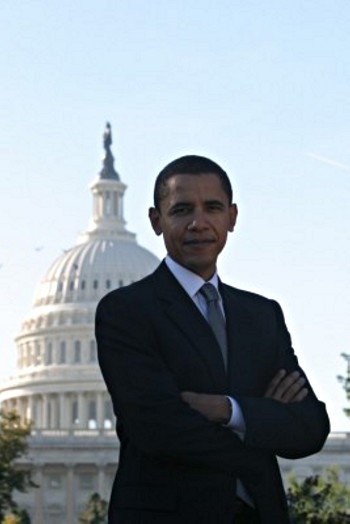
When Barack Obama stands before the nation on Tuesday to be sworn in at the 44th president of the United States, he'll be at the center of a centuries-old ceremony invested with ideals, hopes and symbols.
Presidential inaugurations have been going on since 1789, when George Washington took his oath as the nation's first president.
But the ceremony in which Washington was invested with the country's leadership has changed, evolved and been refined over the years, with each of his presidential successors adding a special touch to reflect their own vision of the country they were to lead.
Obama's inaugural event could end up being the largest, with the National Mall thrown open to the millions of people estimated to be in the nation's capitol for the event.
People from around the country – including several from Lake County – are making the trek to Washington, DC because of the desire to see the first president of African descent begin his tenure as the nation's head.
The ceremony will take place on the US Capitol Building's West Portico, facing out toward the National Mall, at noon Eastern Standard Time, and 9 a.m. on the West Coast.
So, how has the ceremony developed, and how has it changed? Let's take a brief look at the ceremony, with the help of historical documents from the Library of Congress and the Joint Congressional Committee on Inaugural Ceremonies.
Presidential inaugurals: The early days
General George Washington was said to have been offered the kingship of the fledgling United States, a country that sought to sever itself from King George III's British sovereignty.
But Washington, who had fought hard to see the new nation on its own, turned down that offer, and instead taken part in a search for a proper name for the country's new chief executive and the proper form of the accompanying ceremonies.
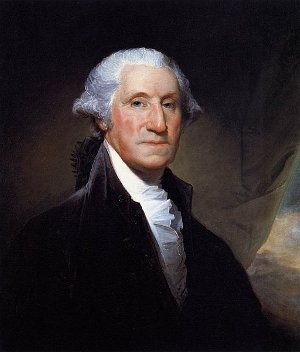
Washington's popularity was such that he was was elected to two terms, in 1789 and 1792, running unopposed both times and getting 100 percent of the Electoral College vote, the only president ever to have that distinction.
When it came time for his inauguration, it was a ceremony very different from that which will be witnessed by the world this Jan. 20.
George Washington was inaugurated on April 30, 1789, in a formal ceremony that took place at Federalist Hall before a joint session of Congress in New York City, then the nation's capitol, according to a history of the event provided by the Joint Congressional Committee on Inaugural Ceremonies.
Histories of the event say he was led into the chamber and seated in a chair that faced Congress, with the House on one side and the Senate on another, according to an account of the event provided by Eyewitness to History's Web site.
After a brief address from Vice President John Adams, the swearing-in itself took place on a balcony overlooking Wall Street, with Robert Livingston, chancellor of State of New York, administering the oath. Afterward the crowd was said to have let out three big cheers for the new president, who then went back inside to give his inaugural address.
By the time Washington was inaugurated again four years later, on March 4, 1793, the ceremony already was undergoing modifications.
For one, the ceremony moved from New York to Philadelphia, and the oath was administered by Supreme Court Associate Justice William Cushing.
Rather than an April swearing-in, the ceremony month moved to March, which would remain the time of the ceremony until Franklin Roosevelt's first swearing-in on Jan. 20, 1937. Only when presidents died did the ceremony deviate from the regular schedule.
Unique men, unique touches
When Washington's successor, John Adams, was sworn in on March 4, 1797, the ceremony remained in Philadelphia. It was an event that proved the United States' leaders would peacefully relinquish and transfer authority at the bidding of the citizens.
Adams was the first president to take the oath of office from a chief justice, in this case Oliver Ellsworth.
In 1801, Adams' successor and, at the time, bitter rival, Thomas Jefferson, also would employ the chief justice in his ceremony.
In a March 2, 1801, letter to Chief Justice John Marshall, Jefferson wrote that he intended to take the oath of office on March 4, 1801, in the senate chambers.
"May I hope the favor of your attendance to administer the oath?" he wrote in the letter, found today in the Library of Congress.
He also asked Marshall, "I would pray you in the mean time to consider whether the oath prescribed in the constitution be not the only one necessary to take? It seems to comprehend the substance of that prescribed by the act of Congress to all officers, and it may be questionable whether the legislature can require any new oath from the President."
Marshall received the letter and wrote back the same day, March 2. "I shall with much pleasure attend to administer the oath of office on the 4th, and shall make a point of being punctual."
As to the oath itself, "The records of the office of the department of state furnish no information respecting the oaths which have been heretofore taken," Marshall wrote. "That prescribed in the constitution seems to me to be the only one which is to be administered. I will however enquire what has been the practice."
Marshall would go on to administer the oath of office nine times for presidents Thomas Jefferson, James Madison, James Monroe, John Quincy Adams and Andrew Jackson – the most times a chief justice has participated in inaugurations since.
Jefferson's inaugural was the first to take place in Washington, DC, in the US Capitol's Senate chamber.
In 1809, the presidential inauguration had its first inaugural ball, on the evening of Saturday, March 4, the same day as President James Madison was sworn in. Tickets to the event, held at Long's Hotel, cost $4 each, according to the Joint Congressional Committee on Inaugural Ceremonies.
Other presidents would bring their own unique touches. President John Quincy Adams took his oath on a volume of law on Friday, March 4, 1825, the first president to wear long trousers rather than knee breeches.
For his March 4, 1837, inaugural, Martin Van Buren would ride to the US Capitol with his predecessor, Andrew Jackson, the first time outgoing and incoming presidents traveled together.
William Henry Harrison would be the first president to arrive in the capitol by train for his 1841 ceremony. The accompanying ball and parade were planned by the first citizens inaugural committee to form.
Harrison gave the longest inaugural address in history – 8,445 words, compared to the shortest, 133 words which Washington gave at his second inaugural. Harrison would die a month later of pneumonia, which historians believe came about due to his exposure to bad weather at the inaugural.
His death was the first for a sitting president. His vice president, John Tyler, would take the oath from Chief Judge of the US District Court William Cranch in a private ceremony at the Brown's Hotel on Pennsylvania Avenue.
James K. Polk's 1845 inaugural ceremony would be the first one reported over a telegraph and the first depicted in a newspaper illustration in the Illustrated London Times.
Franklin Pierce affirmed his 1853 oath but didn't swear it, and is said to have recited his 3,329-word address from memory. The 1857 ceremony of his successor, James Buchanan, was the first to be photographed.
In 1861, with the Civil War about to break out, Abraham Lincoln's inaugural was marked by a procession surrounded by armed cavalry and infantry, with riflemen perched in the US Capitol's windows.
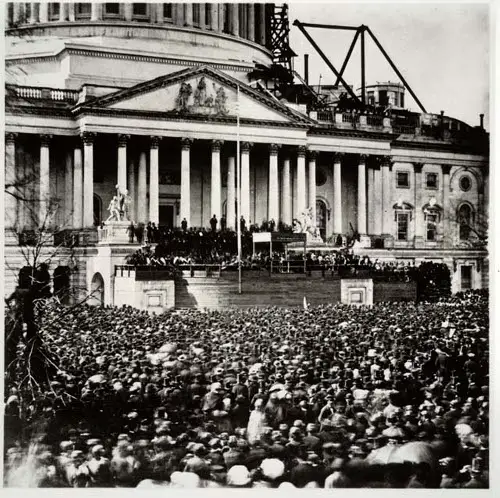
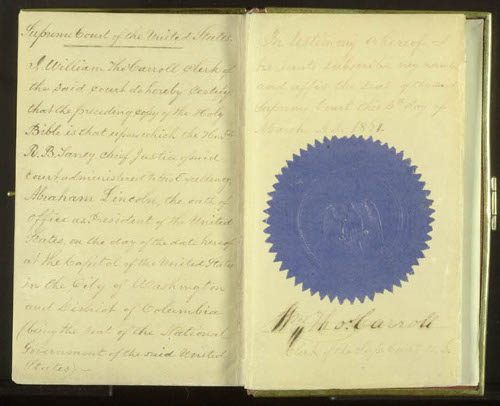
Wearing his trademark top hat, Lincoln was sworn in by Chief Justice Roger B. Taney on a Bible purchased by William Thomas Carroll, clerk to the Supreme Court. During his second inaugural four years later, blacks marched for the first time in the inaugural parade.
Moving pictures made their debut at William McKinley's 1897 inaugural, the first recorded on a movie camera. For McKinley's second inaugural, the Joint Congressional Committee on Inaugural Ceremonies was first formed to arrange the ceremonies.
Theodore Roosevelt, at 42, became the youngest president in history in September 1901 when McKinley was assassinated. Roosevelt's first swearing-in took place in Buffalo, New York, where he was said to not have used a Bible or any other book during the brief oath.
William Taft would be accompanied by his wife, Helen, on the return ride from the US Capitol to the White House after his 1909 inaugural. Following his one term as president, Taft would become chief justice of the US Supreme Court, and in that capacity would administer the oath of office to Calvin Coolidge in 1925 and Herbert Hoover in 1929.
President Woodrow Wilson's wife, Edith, rode with him to and from the US Capitol for the inaugural in 1917, a year that also marked the first time the inaugural parade included women participants.
The first president to make his way to and from his inauguration in an automobile was Warren Harding in 1921. Harding also honored Washington by using the same Bible for his swearing-in – owned by St. John's Masonic Lodge, No. 1 – as Washington used in 1789.
Calvin Coolidge's 1925 inaugural had the distinction of being the first to be nationally broadcast on the radio. For Herbert Hoover's ceremony four years later, the event was recorded by a talking newsreel.
Franklin Roosevelt and wife, Eleanor, would add attendance at a morning worship service to inauguration day solemnities in 1933.
That same year, the 20th Amendment to the US Constitution was adopted; it set the time for inaugurals at noon Eastern Standard Time, and moved the date permanently to Jan. 20. Roosevelt's second inaugural in 1937 would take place in January; that event also would be the first time that a vice president – in this case, John Nance Garner – would be sworn in at the same ceremony, a practice which continues today.
Harry Truman's 1949 inaugural was the first to be broadcast on national television.
In 1953, Dwight Eisenhower used the Bible Washington used in his first inaugural, which Harding also had used.
John F. Kennedy, the first Roman Catholic president, added poetry to the inaugural – famed poet Robert Frost read a poem for the occasion at the 1961 event.
The next swearing-in ceremony took place far from Washington, DC. On Nov. 22, 1963, Lyndon Johnson took the oath of office from the only woman ever to administer it – Sarah T. Hughes, a US district judge of the Northern District of Texas – in the conference room aboard Air Force One at Love Field, Dallas, Texas. John F. Kennedy had been fatally shot earlier that day.
Historian Michael R. Beschloss' book "Taking Charge: The Johnson White House Tapes, 1963-1964," recounts Johnson as saying he spoke with Robert F. Kennedy shortly after President Kennedy's assassination. Robert Kennedy, according to Johnson, urged him to take the oath of office immediately, an account disputed in William Manchester's book, "The Death of a President."
On Aug. 9, 1974, Gerald Ford took the oath of office in the White House after Richard Nixon became the only president to ever resign from office.
The inauguration would move to the west front of the US Capitol in 1981, with Ronald Reagan's swearing-in. Reagan would have the distinction of having the warmest and coldest inaugural days on records – 1981 and 1985 respectively.
Another innovation would be introduced to the ceremonies in 1997, when Bill Clinton's inauguration would be broadcast live on the Internet for the first time.
Obama's event has special touches of its own
Prior to Barack Obama taking the oath of office on Tuesday, his vice president, Joe Biden, will be sworn in by Supreme Court Justice John Paul Stevens.
Chief Justice John Roberts then will lead Obama through the 35-word oath, an honor chief justices have had since 1797. It will be the 69th time the oath has been given, according to Library of Congress records.
Obama will call on history in adding his own special touches to the ceremony.
He identifies strongly with Lincoln – another president from Illinois – and so will lay his hand on Lincoln's 1861 inaugural Bible as he takes the oath of office prescribed in the US Constitution's Article II, Section I: “I do solemnly swear (or affirm) that I will faithfully execute the office of President of the United States, and will to the best of my ability, preserve, protect and defend the Constitution of the United States.”
Following the swearing-in, Obama will give his much-anticipated inauguration speech, and afterward he and Biden will travel back to the White House to view the inaugural parade and begin a daylong celebration that will include inaugural balls in the evening.
The inauguration and its accompanying events officially conclude on Wednesday morning, with a national prayer service at the Washington National Cathedral.
E-mail Elizabeth Larson at
{mos_sb_discuss:3}
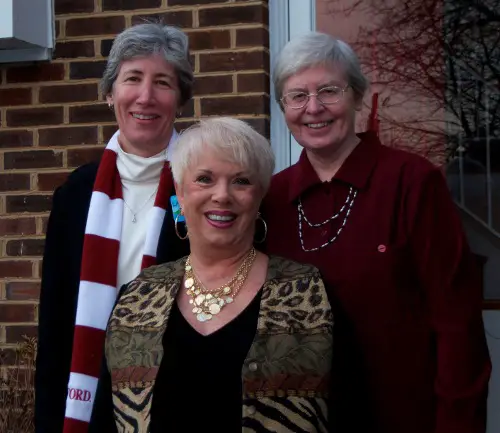
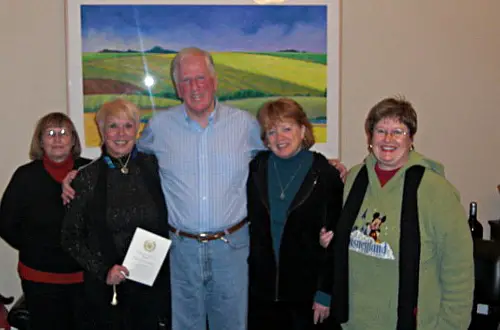
Editor's note: Supervisor Denise Rushing and several local residents are in Washington, DC this week to witness Barack Obama's inauguration. The following is an eyewitness report from the nation's capitol.
WASHINGTON, DC – Wow. That is the one word I would use to describe our first day in Washington DC.
The entire city is abuzz with the energy of this upcoming inauguration — from the airport to the downtown. I am struck by the diversity of those arriving, all races, ages ... and particularly the number of young people and families with children.
Thousands stream in, and everyone is bundled up in their winter gear – it is COLD here. Faces are absolutely beaming with the excitement of the event, mine too. Loretta and I decided that we would attend the Sunday public concert, joining thousands upon thousands in a celebration of America. This proved to be a providential decision (more on that below).
We are staying at a well-stocked condo near the pentagon, a great location—and courtesy of Wanda Harris' ingenuity, we scored a great price, too.
Our first full day in the city fell on a Sunday, so I thought that bus transportation to the Metro train into DC might prove to be tricky. Thankfully, in this area, buses run frequently on Sunday. Not only that, we are located right on the bus line and have two directions to choose from — one heads to the Pentagon Metro station and the other heads to Crystal City Station. This first venture out, we had only waited a few minutes when the first bus appeared and soon, we found ourselves at the Crystal City Metro station, buying a ticket (Metro is very similar to BART).
Our first order of business yesterday was to pick up our tickets to the inauguration Tuesday and the California Bash that evening. The Capitol South Metro station is only a few steps from the Cannon Office building, home of Congressman Mike Thompson’s office. We quickly found his office at 231 Cannon and met with Mike Thompson’s aide, Jonathan Birdsong. There, we chatted a bit about the happenings of the week in DC and what is going on in Lake County.
Next stop was the Hyatt Regency where we picked up our tickets to the California Bash at the Air and Space Museum that evening. The theme seemed appropriately named: “Flying to the Moon.”
The Hyatt experienced some trouble with its security system — alarms went off in the lobby with a female voice over the loudspeaker urged us to “Please exit the building immediately,” even as live people were announcing, “False alarm, false alarm, come back inside!” Naw. we had our tickets … enough of the Hyatt. I noticed that even with alarms — no one seemed scared even — everyone is celebrating here. Fear? Too much excitement to let fear intervene.
At this point, we embarked on our two mile walk toward the Lincoln Memorial. Each block more and more people gathered, and larger and larger numbers of street vendors appeared selling t-shirts and buttons and hats and calendars and gloves and hand warmers. The brisk walk and the jovial crowds created an atmosphere of pure celebration — all drawn to this first event. Barack Obama and his family would be there ...
We did not make it all the way to the Lincoln Memorial — though we could see the concert stage in the distance from our vantage at the base of the Washington memorial. The crowds were massive. We felt drawn to come and even more drawn to stay.
Fortunately large audio speakers and video screens gave us a view of the stage. The opening invocation by Gene Robinson had us all crying … you can view it here (it was left off of HBO “We Are One” special, too bad): www.streetprophets.com/storyonly/2009/1/19/121035/677.
Wow. Wow. Loretta and I agreed that if we saw nothing else in Washington, that experience would have been worth the trip. What an invocation … what an experience with our fellow Americans. This common experience cemented our love of democracy, our love of who we are as a people and that we are called to renew our country and our land in these difficult times.
Then, Barack Obama and his family were introduced. Amazingly, they were there and with us for the entire concert! The music, the readings … Barack and Michele and their children were not only celebrating with us, they were celebrating US! From time to time, the camera would pan over to Barack and Michele, singing the songs we all love by Garth Brooks, Stevie Wonder, John Mellencamp, Sheryl Crow, Josh Groban and so many more. The event ended with a powerful speech from Barack Obama —setting expectations for the difficult task ahead.
We all have work to do.
On the way back, I bought a red Obama 44th President ski hat to keep my ears warm on Inauguration Day. Our tickets have us in the “Blue Standing” area — that puts us to the right side facing the dais where the president will be sworn in Tuesday morning.
{mos_sb_discuss:3}
RealtyTrac, a company which tracks foreclosure rates around the United States, released its 2008 U.S. Foreclosure Market Report last week.
The news for 2008 wasn't good: RealtyTrac's report states that foreclosure activity increased 81 percent nationwide over 2007 and 225 percent from 2006.
In all, there were more than 3.1 million foreclosure filings – default notices, auction sale notices and bank repossessions – on more than 2.3 million US properties. Some properties had more than one foreclosure filing, according to the report.
RealtyTrac also reported that 1.84 percent of all U.S. housing units – amounting to one in 54 – received at least one foreclosure filing during the year, up from 1.03 percent in 2007.
In Lake County, the percentage increases are even more stark.
In 2006, Lake County had 265 foreclosure filings, and 553 foreclosures in 2007, a 108-percent increase, according to RealtyTrac records.
For 2008, foreclosure filings in Lake County ballooned to 1,176, a 112-percent increase over 2007 and 343 percent over 2006's reported numbers. That number ranked it No. 19 among California's 58 counties for the most foreclosure activity.
Looking at the states, Nevada, Florida and Arizona were the top three when it came to the largest foreclosure activity increases in 2008, RealtyTrac reported.
California came in at No. 4, with a 110 percent increase over 2007. RealtyTrac noted that the state's foreclosure activity has gone up by 498 percent since 2006.
In addition, California had a total of 523,624 properties that received a foreclosure filing in 2008, which RealtyTrac said was the nation's highest state total.
California also had the most cities in the top 10 US metro areas for foreclosures, including Stockton at No. 1; Riverside/San Bernardino, No. 3; Bakersfield, No. 4; and Sacramento, No. 9.
RealtyTrac reported that foreclosure filings were reported on 303,410 US properties in December, up 17 percent from the previous month and up nearly 41 percent from December 2007.
However, the company noted that, despite the spike in December, foreclosure activity for the fourth quarter was down nearly 4 percent from the previous quarter but still up nearly 40 percent from the fourth quarter of 2007.
"State legislation that slowed down the onset of new foreclosure activity clearly had an effect on fourth quarter numbers overall, but that effect appears to have worn off by December," said James J. Saccacio, chief executive officer of RealtyTrac.
Saccacio said the big jump in December foreclosure activity “was somewhat surprising” given the moratoria enacted by both Freddie Mac and Fannie Mae, along with programs from some of the major lenders and loan servicers aimed at delaying foreclosure actions against distressed homeowners.
California passed SB 1137, which required lenders to provide written notice of their intent to initiate foreclosure proceedings 30 days prior to issuing a notice of default (NOD), resulted in a reduction of NODs from 44,278 in August to 21,665 in September.
Notice of Default filings then surged by 122 percent, to over 42,000, in December, according to RealtyTrac, which noted that similar patterns have occurred in other states, such as Massachusetts and Maryland, where similar types of foreclosure prevention legislation has been enacted.
"Clearly the foreclosure prevention programs implemented to-date have not had any real success in slowing down this foreclosure tsunami,” said Saccacio.
Last month, Gov. Arnold Schwarzenegger announced $7.8 Million in federal grant funding to Help California homeowners who are struggling to pay their mortgages. He said those homeowners will be eligible for free counseling on how to avoid foreclosure.
The California Housing Finance Agency and HUD-approved counseling groups in partnership with the Rural Community Assistance Corporation were awarded the $7.8 million grant in addition to the previous $8 million grant awarded to California earlier in 2008, according to Schwarzenegger's office.
The grants are part of new federal program enacted in late 2007 to help homeowners avoid foreclosures, the governor's officer reported.
Counseling is available to homeowners who have defaulted on their mortgages or are in danger of defaulting on their mortgages. Homeowners in those situations can arrange counseling by contacting one of the counseling agencies in their area or by visiting www.yourhome.ca.gov.
E-mail Elizabeth Larson at
{mos_sb_discuss:2}
The meeting will begin at 9 a.m. in the board chambers at the Lake County Courthouse, 255 N. Forbes St., Lakeport. TV 8 will broadcast the meeting live.
Beginning at 10 a.m., the board will discuss the possibility of transferring Community Development Block Grant program income money from the Business Expansion and Retention Revolving
Loan Fund to finance other projects, including curb, gutter and sidewalk projects in the Northshore Redevelopment Project Area and a feasibility study for the Lucerne Hotel property.
The hotel, which has housed the Lucerne Christian Conference Center for many years, has been put up for sale by its owners after bookings for Christian retreats and camps in the coming year began to drop significantly, as Lake County News has reported.
On Jan. 13 the board discussed possibly becoming involved with buying the property to hold it for a new buyer or assisting with active marketing it to assist in a speedy sale. At that time, supervisors approved looking at using grant funds for a study to look at the building's structural integrity and also conducting an appraisal.
Other items on the board's agenda include the following.
Timed:
9:15 a.m.: Public hearing on the Planning Commission’s recommendations for approval of proposed amendments to the Lake County Zoning Ordinance pertaining to bed and breakfast inns, detached
granny units and creating a new category of off-site signage for certain shopping centers and business districts.
9:45 a.m.: Public hearing on Planning Commission's recommendation for approval of a one-year time extension of the Vintage Faire General Plan of Development for applicant De Nova Homes; project is located at 20740 and 20830 State Highway 29, Middletown.
10:30 a.m.: Appointment of District 1 Lake County Planning Commissioner and administer Oath of Office; and consideration of applications from members of the public for appointment to miscellaneous Lake County committees, commissions and advisory boards.
11 a.m.: Public hearing on Ronald Jacobs' appeal of the Planning Commission’s decision to grant the appeal of Erik Thorsen, trustee, Edgar F. Thorsen Trust, regarding the issuance of a lakebed encroachment permit and supporting California Environmental Quality Act (CEQA) Notice of
Exemption to Ronald Jacobs for the construction of pier/covered deck/gangway/suspended platform/covered electric boat lift; project is located at 1925 Westlake Drive.
Untimed items:
– Consideration of recommendation for award of bid for Fourth through Fifth Avenue Lucerne Sidewalk Improvement Project; and consideration of proposed agreement for construction
inspection services for Lucerne Sidewalk Improvement Project.
– An ordinance establishing annual payments for lakebed encroachment permits and annual lease fees – (second reading).
The board also will hold a closed session to discuss labor negotiations.
E-mail Elizabeth Larson at
{mos_sb_discuss:3}
Highlights of the Water Plan and Volume 1 – Strategic Plan are now posted at www.waterplan.water.ca.gov/cwpu2009/index.cfm.
Update 2009 outlines a new approach in how California manages its water resources. Titled “Integrated Water Management,” it is the state’s blueprint for statewide and regional integrated water management, integrated flood management, and sustainable use of this valuable resource.
Guided by a 21 state-agency steering committee, Update 2009 is a result of collaboration between government and private agencies, Native Americans, cities, farms, industry and environmental organizations.
The document addresses concerns from every arena of water use, supply, flood protection, and for the environment.
The plan includes 27 resource management strategies (Volume 2) to meet various water management goals: reduce water demand, improve operational efficiency and transfers, increase water supply, improve water quality, practice environmental stewardship, and improve flood management.
The strategic plan includes 13 objectives with more than 100 near-term and long-term actions. New analytical methods and tools will help plan for future effects of climate change, population growth, and other factors outside the water community’s control.
Volume 3 Regional Reports looks at water conditions and concerns in California’s 10 hydrologic regions and two special areas of concern: the Sacramento-San Joaquin River Delta and Mountain Counties Area in the Sierra Nevada foothills.
All drafts will be posted at www.waterplan.water.ca.gov/cwpu2009/index.cfm.
The Water Plan Highlights and Volume 1 – The Strategic Plan were posted Jan. 7; Volume 2 – Resource Management Strategies will be posted Jan. 21 and Volume 3 – Regional Reports will be available Jan. 28. Printed highlights containing a CD of the other volumes will be available in February.
Public comment workshops will be held in all regions mid-April through May. Refer to the www.waterplan.water.ca.gov/cwpu2009/index.cfm Web site for meeting dates and locations. Comments will also be posted at this location.
Comments may be sent through June 5 via:
Email:
Fax: 916-651-9289
Postal Mail: Attn: Paul Dabbs
Strategic Water Planning
Statewide Integrated Water Management
California Department of Water Resources
P.O. Box 942836
Sacramento, CA 94236-0001
{mos_sb_discuss:2}
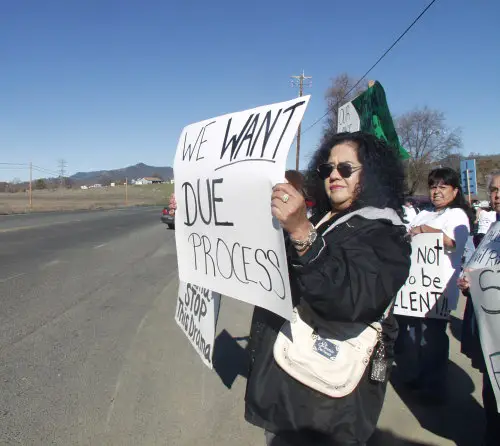
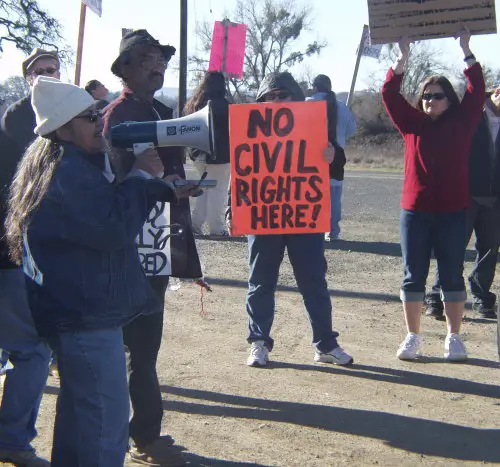
NICE – Dozens of Robinson Rancheria tribal members – those under threat of disenrollment and those who aren't – as well as nontribal members lined a short stretch of Highway 20 near the tribe's casino on Saturday, protesting the tribal council's action to remove at least 60 people from its rolls and to fire numerous people from jobs with the tribe.
The disenrollment, which took place last month as Lake County News has reported, has deepened divisions in the tribe, according to those who marched and chanted Saturday.
The Bureau of Indian Affairs must approve the action, according to the tribe's constitution. That agency has yet to do that, according to tribal members who appealed their disenrollment and await a decision.
That disenrollment action was followed earlier this month by sudden firings for disenrollees and nontribal members working at California Tribal TANF, which offers social services to Indians, and the tribe's well-respected environmental program.
Indian and non-Indians alike carried signs that read, “Corruption spoken here,” “Can you smell the greed,” “Justice for who? All,” “Did our ancestors die for injustice,” “All tribes united to fight tribal corruption,” “Honk for justice” and “Fairness and quality for all RR (Robinson Rancheria) Pomos.”
About 50 people were engaged in the protest at any one time, with many people coming and going over five and a half hours. Drivers of dozens of cars honked and waved to the group.
Clayton Duncan helped start the morning out with a brief smudging ceremony, burning sage and offering a blessing of the protest and its participants, who ranged from young children to elders.
Duncan expressed concern over what the disenrollment could mean for the tribe's future and its young people, some of whom also are proposed to be stricken from membership rolls.
“What about our children?” Duncan said. “They don't even think about our children.”
Wanda Quitiquit, one of those targeted for disenrollment and a member of the American Indian Rights and Resources Organization (AIRRO), credited AIRRO – which cosponsored the protest – with being the only group to actively fight for Indian civil rights.
“I'm not disenrolled as far as I'm concerned,” said Quitiquit, who called California “the home of disenrollment.”
She said AIRRO estimates that 3,000 California Indians have been disenrolled from their tribes. “There is something very bad going on in Indian land today.”
Wanda Quitiquit and her brother, Marion Quitiquit, have been part of AIRRO since it was founded several years ago with the help of the Foreman family of Redding Rancheria, who were themselves disenrolled.
Quitiquit said Indian gaming “is our downfall,” and said the present disenrollment crisis requires Indians to step up their political activism like they did in the 1960s, 1970s and 1980s.
Education
Health
Business
Obituaries
Opinion & Letters
Veterans
Recreation

Religion
Arts & Life
Government & Politics