How to resolve AdBlock issue?
Refresh this page
Lake County News,California
  • Home
    • Registration Form
  • News
    • Education
    • Veterans
    • Community
      • Obituaries
      • Letters
      • Commentary
    • Police Logs
    • Business
    • Recreation
    • Health
    • Religion
    • Legals
    • Arts & Life
    • Regional
  • Calendar
  • Contact us
    • FAQs
    • Phones, E-Mail
    • Subscribe
  • Advertise Here
  • Login
How to resolve AdBlock issue?
Refresh this page

News

Highway 20 upgrades among California Transportation Commission-approved projects

SPUI, Public domain, via Wikimedia Commons.


The California Transportation Commission, or CTC, this past week allocated nearly $1 billion to expand transit capabilities, add new highway safety features and boost the state’s continued climate action goals. 

The $988.7 million approved includes $184 million from the federal Infrastructure Investment and Jobs Act of 2021, or IIJA, and $336 million in support from Senate Bill 1 (SB 1), the Road Repair and Accountability Act of 2017.

The investments made by these two funding sources have created an estimated 684,000 jobs. It has helped Californians, businesses and visitors who rely on the state’s transportation network for employment and educational opportunities, access to goods and services and connection to recreational attractions.

Among the projects, approximately $1.7 million has been approved toward stormwater upgrades and roadway repairs on Route 20 from east of New Long Valley Road to east of Walker Ridge Road near Clearlake Oaks in Lake County.

“Creating a brighter future in the Golden State is about addressing big challenges with meaningful investments like those made today,” said California Transportation Secretary Toks Omishakin. “This level of support funds wide-ranging transportation upgrades that provide the backbone of California’s vibrant economy by improving goods movement, expanding transit and rail systems and making our system more bikeable and walkable. These benefits will be experienced by every region, including disadvantaged communities throughout the state.”

“The long-term investments allocated today will power our ongoing effort to provide the safest, most accessible transportation system possible for all users, while continuing to serve as responsible stewards of California’s environment,” said Caltrans Director Dina El-Tawansy. “From new sidewalks and bicycle lanes to bridge repairs and highway reconditioning, we are improving our transportation system for the benefit of all Californians and creating thousands of jobs in the process.”

“Today’s investments will improve the safety, mobility, and economic prosperity of all Californians, especially those in rural communities,” said California Transportation Commission Chair Darnell Grisby said following the Tuesday meeting. “These infrastructure improvements will better connect working families to jobs, schools, essential services, and recreational activities while simultaneously reducing out-of-pocket transportation costs. Thank you to all our partner agencies for their help in delivering these projects across California.”

The list of funded projects includes $96 million to improve travel times and enhance traffic safety between Ventura County and Goleta with high-occupancy vehicle lanes, pedestrian and bike paths and transit enhancements.

Approximately $73 million will go to improve semi-truck operations and safety on Interstate 10 in San Bernardino County, and $63 million will be used in Riverside County for a new bridge, bike lanes and wildlife crossing as part of an upgrade to the Ramona Expressway.

The commission also agreed to fund several notable transit-related projects including $60 million to help rehabilitate Union Station in the city of Los Angeles; $17 million for 20 electric buses for the city of Glendale; and $21 million for eight new light rail vehicles for Sacramento Regional Transit.

In addition, the commission allocated $18.8 million for the Wallis Annenberg Wildlife Crossing in partnership with the California Natural Resources Agency. This crossing will provide a safe wildlife passage over U.S. 101, reducing wildlife-vehicle collisions and support long-term species viability through improved movement. This will be the first of its kind in California and a globally significant model for wildlife connectivity in an urban corridor. 

In addition to the Lake County road work, projects approved in District 1 include:

Approximately $12.5 million in SB1 funding toward bridge repairs on Route 36, Route 211 and U.S. 101 in Humboldt County.

Approximately $1.4 million toward roadway repairs and realignment along with slope stabilization on Route 36 east of Bridgeville in Humboldt County.

Approximately $1.3 million in SB1 funding toward roadway, drainage and guardrail improvements on U.S. 101 near Garberville in Humboldt County.

Approximately $1.3 million in SB1 funding toward roadway and guardrail upgrades from Rockport to DeHaven on Route 1 in Mendocino County.

Approximately $1.1 million in SB1 funding toward roadway and drainage improvements on Route 271 near Leggett in Mendocino County.

California will receive nearly $54 billion in federal infrastructure funding with IIJA. This includes investments to upgrade the state’s roads, bridges, rail, public transit, airports, electric vehicle charging network, ports and waterways. IIJA funding alone has already created an estimated 269,00 jobs.

SB 1, which has provided $5 billion annually for transportation projects since 2017, provides funding annually split between the state and local agencies. Road projects progress through construction phases more quickly based on the availability of funds, including projects that are partially funded by SB 1. It has created approximately 417,000 jobs.

For more information about transportation and other infrastructure projects funded with state and federal investments, visit build.ca.gov.  

Kelseyville Pear Festival donates to Kelseyville Unified athletics 

Mt. Vista Middle School Athletic Director Allison Panella receives donation from Kelseyville Pear Festival President Cindy Bain in front of the MVMS Girls B Basketball team. Courtesy photo.


KELSEYVILLE, Calif. — The Kelseyville Unified School District reported that it has gratefully accepted the Kelseyville Pear Festival’s generous donation to fund all listed needs for student athletes at Mountain Vista Middle School and Kelseyville High School. 

“This extraordinary show of community support will have a lasting impact on more than 235 students who participate in school sports programs each year,” said Mountain Vista Middle School, or MVMS, Athletic Director Allison Panella.

The donation will allow MVMS to purchase new uniforms, essential safety equipment, and other supplies for several sports teams, including track and field, basketball, soccer, softball and golf. 

It will also allow Kelseyville High School to purchase uniforms and equipment for track and field, cross country and softball. 

At MVMS, many sports teams had been using uniforms that were five to ten years old, along with equipment that had worn down through seasons of heavy use. 

Replacing these items ensures students can compete safely, confidently, and with pride in representing their school, according to MVMS Principal Rick Kale.

MVMS wasted no time in putting the donation to good use. According to Panella, the school purchased new uniforms for Girls A and B Basketball teams, allowing athletes to begin their seasons feeling confident, prepared, and proud to represent their school.

“Wearing updated team uniforms strengthens a sense of unity and professionalism that positively affects morale and team cohesion,” she said. 

Members of the co-ed golf team will receive matching polos, marking the first time the program has had an official team uniform. 

This milestone will help build a stronger team identity and create a shared sense of belonging for students who previously competed without consistent team gear. 

These improvements have brought renewed excitement and pride to athletes, coaches and families alike.

“Getting new uniforms and equipment makes us feel proud to represent our school,” said MVMS student athlete Francisco Calvillo said. “It doesn’t matter if we play basketball, run track, or are out on the golf course, we feel like one school team. It shows that people in our community care about us and want us to do our best.”

Thanks to the Pear Festival’s generosity, MVMS basketball teams will benefit from new game uniforms, practice gear, and team bags that promote unity and organization throughout the season. 

Soccer players will receive updated uniforms and gear that strengthen team identity and school spirit. 

Softball athletes will have access to improved protective equipment, helmets, and essential gear that directly supports player safety. 

Track and field athletes will benefit from updated practice equipment, improved storage for shared gear, and supplies that enhance daily training. 

In addition, every athletic team at MVMS will be equipped with updated first-aid kits, helping to ensure coaches have the tools they need to respond quickly and appropriately to student injuries during practices and competitions.

“Athletics teaches teamwork, resilience, and confidence,” said Kale. “Now our students have the uniforms and equipment they need to participate safely and proudly. We are deeply grateful for this investment in our kids and their future.” 

The new uniforms and equipment at the middle school and high school will serve students for multiple seasons. 

Panella noted that having updated uniforms, using safe and reliable gear, and feeling supported by their community helps to build confidence, belonging, and pride in the students that extends far beyond the playing field.

Panella said the Kelseyville Pear Festival’s contribution represents a significant investment in local youth. 

“Their support strengthens school programs, promotes student well-being, and reinforces the connection between schools and the greater Kelseyville community,” Panella said. “Mt. Vista Middle School and Kelseyville High School extend their heartfelt gratitude to the Kelseyville Pear Festival for supporting local students and making it possible for young athletes to learn, grow, and succeed through sports. The positive effects of this generosity will be seen on the courts, fields, and tracks, as well as in the daily lives of our students for years to come.”

Tiny earthquakes reveal hidden faults under Northern California

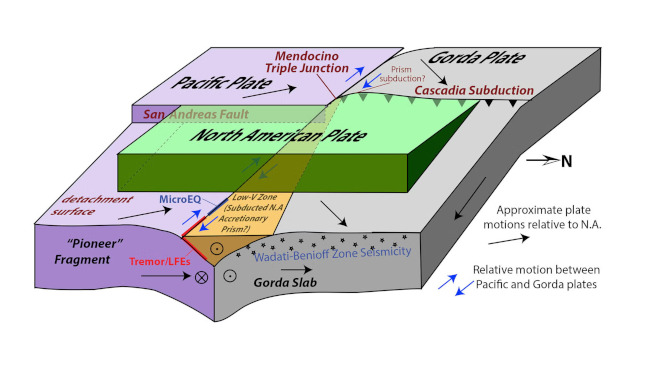
Proposed model of the Mendocino Triple Junction. The Pacific plate is dragging the Pioneer fragment under the North American plate. Credit: David Shelly, USGS.

By tracking swarms of very small earthquakes, seismologists are getting a new picture of the complex region where the San Andreas fault meets the Cascadia subduction zone, an area that could give rise to devastating major earthquakes. 

The work, by researchers at the U.S. Geological Survey, the University of California, Davis, and the University of Colorado Boulder, is published Jan. 15 in Science. 

“If we don’t understand the underlying tectonic processes, it’s hard to predict the seismic hazard,” said co-author Amanda Thomas, professor of earth and planetary sciences at UC Davis. 

Three of the great tectonic plates that make up the Earth’s crust meet at the Mendocino Triple Junction, off the Humboldt County coast. South of the junction, the Pacific plate is moving roughly northwest against the North American plate, forming the San Andreas fault. To the north, the Gorda (or Juan de Fuca) plate is moving northeast to dive under the North American plate and disappear into the Earth’s mantle, a process called subduction. 

But whatever is going on at the Mendocino Triple Junction is clearly a lot more complex than three lines on a map. For example, a large (magnitude 7.2) earthquake in 1992 occurred at a much shallower depth than expected. 

First author David Shelly of the USGS Geologic Hazards Center in Golden, Colo., compared it to studying an iceberg. 

“You can see a bit at the surface, but you have to figure out what is the configuration underneath,” Shelly said. 

Shelly, Thomas, Kathryn Materna at CU Boulder and Robert Skoumal at USGS’s Earthquake Science Center at Moffett Field, Calif., used a network of seismometers in the Pacific Northwest to measure very small, “low-frequency” earthquakes occurring where the plates rub against or over each other. These earthquakes are thousands of times less intense than any shaking we could feel at the surface. 

They confirmed their model by looking at how the plates respond to tidal forces. The gravitational forces of the Sun and Moon pull on tectonic plates just as they do on the waters of the ocean. When tidal forces align with the direction in which a plate wants to move, you should see more small earthquakes, Thomas said. 

A diagram showing the Mendocino Triple Junction, a meeting point of three plates, the Pacific Plate, the North American Plate, and the Gorda, or Juan de Fuca plate. Credit: USGS.


Five moving pieces

The new model includes five moving pieces, not just three plates — and two of them are out of sight from the Earth’s surface. 

At the southern end of the Cascadia subduction zone, a chunk has broken off the North American plate and is being pulled down with the Gorda plate as it sinks under North America, the team found.  

South of the triple junction, the Pacific plate is dragging a blob of rock called the Pioneer fragment underneath the North American plate as it moves northwards. The fault boundary between the Pioneer fragment and the North American plate is essentially horizontal and not visible from the surface at all. 

The Pioneer fragment was originally part of the Farallon plate, an ancient tectonic plate that once ran along the coast of California but is now mostly gone. 

The new model explains the shallowness of the 1992 earthquake, because the subducting surface is shallower than previously thought, Materna said. 

“It had been assumed that faults follow the leading edge of the subducting slab, but this example deviates from that,” Materna said. “The plate boundary seems not to be where we thought it was.” 

The work was supported by a grant from the National Science Foundation. 

Andy Fell writes for the University of California, Davis.

Ramos introduces bill to ensure victim notification about assailant parole conditions while avoiding revictimization

Protecting crime victims’ rights by ensuring they receive timely notifications about an offender’s release, parole hearings, escapes, or special parole conditions is the goal of newly introduced legislation.

Assemblymember James C. Ramos (D–San Bernardino) authorized AB 1681.

“Making sure that victims are kept up to date on critical notifications about an offender is crucial,” Ramos stated. “The current process is burdensome on victims because they must complete a form to receive notifications about an offender although the courts and attorneys already have the victim’s information on hand. Improving the accessibility and completion of California Department of Corrections and Rehabilitation (CDCR) Form 1707 must become an immediate priority to safeguard victims’ rights. It is a burden that should be removed from their shoulders and avoids revictimizing them.”

AB 1681 also aims to increase completion of the CDCR Form 1707. If the bill were to become law, it would require that in cases resulting in a sentence to state prison, the court and prosecuting agency shall ensure that the victim and victim’s next-of-kin contact information is provided to the CDCR at the time of sentencing for purposes of victim notification. 

Currently, about 75% of victims aren’t submitting the form, which means they may miss critical notifications about an offender. 

Even though these updates are rights guaranteed under Marsy’s Law, many victims either find the form too confusing or burdensome or wrongly assume CDCR automatically gets their contact information from the courts. 

Ramos stated the CDCR Form 1707 must be easier to understand and complete as it is an urgent step toward protecting victims’ safety and their rights.

“The rights of victims do not end with a conviction,” said Orange County District Attorney Todd Spitzer said. “No one who has had to undergo the trauma of becoming a crime victim and then the trauma of having to relive that experience during the court process should not have to shoulder the burden of filling out additional paperwork just to ensure they receive timely notifications about offender release, parole hearings, escapes, and special parole conditions. These notifications are not discretionary — they are rights guaranteed to victims under Marsy’s Law, which I helped pass in 2008 as the statewide campaign manager to ensure victims’ rights are codified in the California constitution. I am thankful for the support of Assemblymember Ramos in providing some much needed relief for victims by automating their registration with CDCR and ensuring the voices of victims will continue to be heard.”

AB 1681 is co-sponsored by the California District Attorneys Association, Orange County District Attorney’s Office and San Bernardino County District Attorney’s Office. 

Law that built the internet turns 30 – a legal expert explains what would happen if efforts to repeal Section 230 succeed

Sens. Lindsey Graham, R-S.C., and Dick Durbin, D-Ill., are vocal critics of Section 230. AP Photo/J. Scott Applewhite

Section 230 of the Communications Decency Act has become a political lightning rod in recent years. The law, part of the Telecommunications Act of 1996 signed into law on Feb. 8, 1996, shields online platforms from liability for user-generated content while allowing moderation done in good faith.

A group of bipartisan lawmakers led by Sens. Lindsey Graham, R-S.C., and Dick Durbin, D-Ill., has filed a bill to sunset Section 230 by 2027 in order to spur a renegotiation of its provisions. The bill would start a timer on reforming or replacing Section 230. If no agreement is reached by the deadline, Section 230 would cease to be law.

The debate over the law centers on balancing accountability for harmful content with the risks of censorship and stifled innovation. As a legal scholar, I see dramatic potential effects if Section 230 were to be repealed, with some platforms and websites blocking any potentially controversial content. Imagine Reddit with no critical comments or TikTok stripped of political satire.

The law that built the internet

Section 230, often described as “the 26 words that created the internet,” arose in response to a 1995 ruling penalizing platforms for moderating content. The key provision of the law, (c)(1), states that “no provider or user of an interactive computer service shall be treated as the publisher or speaker of any information provided by another information content provider.” This immunizes platforms such as Facebook and Yelp from liability for content posted by users.

Importantly, Section 230 does not offer blanket immunity. It does not shield platforms from liability related to federal criminal law, intellectual property infringement, sex trafficking or where platforms codevelop unlawful content. At the same time, Section 230 allows platform companies to moderate content as they see fit, letting them block harmful or offensive content that is permitted by the First Amendment.

Some critics argue that the algorithms social media platforms use to feed content to users are a form of content creation and should be outside the scope of Section 230 immunity. In addition, Federal Communications Commission Chairman Brendan Carr has signaled a more aggressive stance toward Big Tech, advocating for a rollback of Section 230’s protections to address what he perceives as biased content moderation and censorship.

What Section 230 does and how it came about.

Censorship and the moderation dilemma

Opponents warn that repealing Section 230 could lead to increased censorship, a flood of litigation and a chilling effect on innovation and free expression.

Section 230 grants complete immunity to platforms for third-party activities regardless of whether the challenged speech is unlawful, according to a February 2024 report from the Congressional Research Service. In contrast, immunity via the First Amendment requires an inquiry into whether the challenged speech is constitutionally protected.

Without immunity, platforms could be treated as publishers and held liable for defamatory, harmful or illegal content their users post. Platforms could adopt a more cautious approach, removing legally questionable material to avoid litigation. They could also block potentially controversial content, which could leave less space for voices of marginalized people.

MIT management professor Sinan Aral warned, “If you repeal Section 230, one of two things will happen. Either platforms will decide they don’t want to moderate anything, or platforms will moderate everything.” The overcautious approach, sometimes called “collateral censorship,” could lead platforms to remove a broader swath of speech, including lawful but controversial content, to protect against potential lawsuits. Yelp’s general counsel noted that without Section 230, platforms may feel forced to remove legitimate negative reviews, depriving users of critical information.

Corbin Barthold, a lawyer with the nonprofit advocacy organization TechFreedom, warned that some platforms might abandon content moderation to avoid liability for selective enforcement. This would result in more online spaces for misinformation and hate speech, he wrote. However, large platforms would likely not choose this route to avoid backlash from users and advertisers.

A legal minefield

Section 230(e) currently preempts most state laws that would hold platforms liable for user content. This preemption maintains a uniform legal standard at the federal level. Without it, the balance of power would shift, allowing states to regulate online platforms more aggressively.

Some states could pass laws imposing stricter content moderation standards, requiring platforms to remove certain types of content within defined time frames or mandating transparency in content moderation decisions. Conversely, some states may seek to limit moderation efforts to preserve free speech, creating conflicting obligations for platforms that operate nationally. Litigation outcomes could also become inconsistent as courts across different jurisdictions apply varying standards to determine platform liability.

The lack of uniformity would make it difficult for platforms to establish consistent content moderation practices, further complicating compliance efforts. The chilling effect on expression and innovation would be especially pronounced for new market entrants.

While major players such as Facebook and YouTube might be able to absorb the legal pressure, smaller competitors could be forced out of the market or rendered ineffective. Small or midsize businesses with a website could be targeted by frivolous lawsuits. The high cost of compliance could deter many from entering the market.

Reform without ruin

The nonprofit advocacy group Electronic Frontier Foundation warned, “The free and open internet as we know it couldn’t exist without Section 230.” The law has been instrumental in fostering the growth of the internet by enabling platforms to operate without the constant threat of lawsuits over user-generated content. Section 230 also lets platforms organize and tailor user-generated content.

The potential repeal of Section 230 would fundamentally alter this legal landscape, reshaping how platforms operate, increasing their exposure to litigation and redefining the relationship between the government and online intermediaries.

This story was updated on Feb. 4, 2026, to include the 30th anniversary of the Communications Decency Act and recent efforts to repeal Section 230.The Conversation

Daryl Lim, Professor of Law and Associate Dean for Research and Innovation, Penn State

This article is republished from The Conversation under a Creative Commons license. Read the original article.


Man charged with killing wife with hammer set for preliminary hearing

LAKE COUNTY, Calif. – A preliminary hearing has been scheduled for a Kelseyville man charged with killing his wife last month with a hammer.

Travis Ryan Bonson, 46, has been charged with first-degree murder for the death of 44-year-old Ayano Bonson, his wife of 22 years.

Lake County Sheriff’s deputies arrested Travis Bonson on the morning of Jan. 16 after receiving a call from him at his Single Spring Drive home. Bonson told authorities he had physically assaulted Ayano Bonson.

Deputies found Ayano Bonson in critical condition. She was transported to an out-of-county hospital for medical treatment. She died four days after the attack.

Senior Deputy District Attorney Nicholas Rotow, who is the prosecutor handling the case, confirmed to Lake County News that Travis Bonson used a hammer to kill his wife while she was in bed.

Based on the evidence, “I think it’s a reasonable conclusion, probably the only conclusion,” that Ayano Bonson was assaulted when she was asleep, Rotow said.

Bonson is a registered sex offender as the result of a 2012 felony conviction for committing lewd or lascivious acts on a child under age 14. Rotow said Bonson has not had any Lake County cases since completing his prior sex-related prison sentence. 

On Tuesday morning, Bonson was in Lake County Superior Court, where he entered a not guilty plea in the case before Judge J. David Markham.

He is scheduled to return to court for a preliminary hearing and bail review on March 19.

Bonson remains in custody in the Lake County Jail. He’s being held without bail.

Email Elizabeth Larson at This email address is being protected from spambots. You need JavaScript enabled to view it.. Follow her on Twitter, @ERLarson, and on Bluesky, @erlarson.bsky.social. Find Lake County News on the following platforms: Facebook, @LakeCoNews; X, @LakeCoNews; Threads, @lakeconews, and on Bluesky, @lakeconews.bsky.social. 

  • 48
  • 49
  • 50
  • 51
  • 52
  • 53
  • 54
  • 55
  • 56
  • 57

Community

  • Sheriff’s Activities League and Clearlake Bassmasters offer youth fishing clinic

  • City Nature Challenge takes place April 24 to 27

Public Safety

  • Lakeport Police logs: Wednesday, Feb. 11

  • Lakeport Police logs: Tuesday, Feb. 10

Education

  • Ramos measure requiring school officer training in use of anti-opioid drug moves forward

  • Lake County Chapter of CWA announces annual scholarships 

Health

  • California ranks 24th in America’s Health Rankings Annual Report from United Health Foundation

  • Healthy blood donors especially vital during active flu season

Business

  • Employment law summit takes place March 9

  • Two Lake County Mediacom employees earn company’s top service awards

Obituaries

  • Terry Knight

  • Ellen Thomas

Opinion & Letters

  • Who should pay for AI’s power? Not California ratepayers

  • Crandell: Supporting nephew for reelection in supervisorial race

Veterans

  • State honors fallen chief warrant officer killed in conflict in Iran

  • CalVet and CSU Long Beach team up to improve data collection related to veteran suicides

Recreation

  • April Audubon program will show how volunteers can help monitor local osprey nests

  • First guided nature walk of spring at Anderson Marsh State Historic Park April 11

  • Second Saturday guided nature walks continue at Anderson Marsh State Historic Park

  • Wet weather trail closure in effect on Upper Lake Ranger District

Religion

  • Kelseyville Presbyterian Church plans Easter service

  • Easter ‘Sonrise’ Service returns to Xabatin Community Park

Arts & Life

  • ‘CIA’ delves into the shadowy world of an espionage thriller

  • ‘War Machine’ shifts the battlefield into uncharted territory

Government & Politics

  • Lake County Democratic Central Committee endorses Falkenberg

  • Crandell launches reelection campaign plans March 15 event

Legals

  • April 23 hearing on Lake Coco Farms Major Use Permit

  • NOTICE OF 30-DAY PUBLIC COMMENT PERIOD & NOTICE OF PUBLIC HEARING

How to resolve AdBlock issue?
Refresh this page