How to resolve AdBlock issue?
Refresh this page
Lake County News,California
  • Home
    • Registration Form
  • News
    • Education
    • Veterans
    • Community
      • Obituaries
      • Letters
      • Commentary
    • Police Logs
    • Business
    • Recreation
    • Health
    • Religion
    • Legals
    • Arts & Life
    • Regional
  • Calendar
  • Contact us
    • FAQs
    • Phones, E-Mail
    • Subscribe
  • Advertise Here
  • Login
How to resolve AdBlock issue?
Refresh this page

News

California Commission on the Status of Women and Girls launches 2026 Girls Agenda

The California Commission on the Status of Women and Girls, or CCSWG, announced the release of the 2026 Girls Agenda, a comprehensive statewide policy roadmap created by the commission’s Youth Advisory Council.

Developed by 17 youth commissioners representing communities across California, the Girls Agenda outlines urgent priorities in education and workforce development, health and access, and safety and prevention. Each section is grounded in current data, lived experience and the realities girls face every day.

“The Girls Agenda is more than a report; it is a call to action,” said Chair of the CCSWG Youth Advisory Council Nicole Kim. “Girls are navigating challenges from food insecurity and mental health struggles to inequitable access to STEM education and unsafe environments. This agenda reflects our vision for a California where every girl can grow up safe, healthy, and able to pursue the education and opportunities that shape her future.”

The Girls Agenda highlights the systemic barriers that continue to affect the lives of girls statewide, including the high cost of childcare, underrepresentation in STEM fields, rising rates of depression among teen girls, food insecurity, menstrual inequity, and persistent threats to safety. 

The Girls Agenda also identifies gaps in existing policy implementation, such as uneven enforcement of menstrual equity laws and limited access to mental health resources in rural and low-income communities.

“This work is essential because the challenges facing girls today are complex and interconnected,” said Chair of the CCSWG Dr. Rita Gallardo Good. “Girls are sharing their needs with us, and The Girls Agenda ensures that their voices will guide our policy priorities. By uplifting girls’ voices, we strengthen the future of every community in California.”

Key recommendations in The Girls Agenda include:

• Expanding access to computer science and STEM courses;
• Strengthening childcare support for teen parents;
• Improving nutrition and eating disorder education in schools;
• Enforcing menstrual equity laws;
• Increasing mental health resources; and
• Enhancing Title IX protections and violence prevention education.

The Girls Agenda also calls for youth-centered approaches to digital safety, reproductive health access, and teen dating violence prevention.

“Our Youth Advisory Council has done extraordinary work,” said Executive Director of the CCSWG Darcy Totten. “Their leadership, insight, and honesty have shaped a powerful blueprint for change. The Girls Agenda is a reminder that when we listen to girls, we can help them create policies that reflect their lived realities and support our collective future. This effort continues the Commission’s commitment to ensuring girls’ voices remain central to statewide decision-making and that those most impacted by policy have a seat at the table to help design it.”

The commission will use The Girls Agenda to guide its policy advocacy and programming throughout 2026 and will partner with state agencies, legislators and community organizations to advance the recommendations.

The California Commission on the Status of Women and Girls recognizes that youth aren’t just the leaders of tomorrow — they’re powerful changemakers today. 

The commission’s Youth Advisory Council provides young Californians (ages 14–20) with a meaningful platform to engage with the commission’s legislative work and help shape and elevate policies that impact their lives. 

Through this council, youth connect with other youth across the state, develop advocacy and leadership skills, obtain hands-on experience with California’s policy process, participate in mentorship, and have transformative conversations about the needs of our state’s young people.  

For more than 50 years, the California Commission on the Status of Women and Girls has identified and worked to eliminate inequities in state laws, practices, and conditions that affect California’s women and girls. Established as a state agency with 17 appointed commissioners in 1965, the Commission regularly assesses gender equity in health, safety, employment, education, and equal representation in the military, and the media. The Commission provides leadership through research, policy and program development, education, outreach and collaboration, advocacy, and strategic partnerships. Learn more at www.women.ca.gov. 

Space News: Rural areas have darker skies but fewer resources for students interested in astronomy – telescopes in schools can help

Observing the night sky can get kids interested in astronomy and STEM careers. Jeremy Thomas/Unsplash

The night sky has long sparked wonder and curiosity. Early civilizations studied the stars and tracked celestial events, predicted eclipses and used their observations to construct calendars, develop maps and formulate religious rituals.

Scholars widely agree that astronomy is a gateway science – that it inspires a core human interest in science among people of all ages, from senior citizens to schoolchildren. Helping young people tap into their excitement about the night sky helps them build confidence and opens career pathways they may not have considered before.

Yet today the night sky is often hidden from view. Almost all Americans live under light-polluted skies, and only 1 in 5 people in North America can see the Milky Way. When people live in areas where the night sky is clearer, they tend to express a greater wonder about the universe. Altogether, this means communities with less light pollution have great potential to educate the next generation of scientists.

Rural communities have some of the darkest skies in the country, making them perfect for stargazing. Yet while students in rural areas are in the optimal physical environment to be inspired by the night sky, they are the most in need of science, technology, engineering and mathematics, or STEM, education resources to support their interests and build the confidence they need to pursue careers in science.

Stargazing, finding constellations and watching meteor showers as a kid inspired my own sense of awe around the vastness of space and possibilities in our universe. Now, I’m the executive director of the Smithsonian’s Scientists Taking Astronomy to Rural Schools, or STARS, a new program led by the Smithsonian Astrophysical Observatory, part of the Center for Astrophysics | Harvard & Smithsonian, that delivers telescopes and associated lesson plans to rural schools across the United States, free of charge. I’m working to share my excitement and wonder with students in rural areas.

The Sun, partially blocked by the Moon.
A solar eclipse, as viewed through a telescope. STARS

Why hands-on STEM learning matters

Students need direct exposure to STEM careers and hands-on experiences that help them learn the skills they will need to pursue these careers on their own. Hands-on activities ground new knowledge in ways that lectures and reading often cannot. Experiential opportunities connect what may be distant or abstract concepts to clear, tangible, real-world skills. This experiential learning improves students’ understanding of astronomy content and increases their motivation to learn.

Telescopes are important tools for astronomy that scientists use all the time. When students use telescopes as part of their learning, they are experiencing real techniques that scientists use. Using a telescope brings the viewer closer to fantastic celestial objects – allowing them to see galaxies, nebulas, planets, the Moon and the Sun, with solar filter protection, more closely or in greater detail.

A full Moon, tinged orange from sunlight, during a lunar eclipse.
Telescopes help students view astronomical objects, like the Moon, up close. STARS

There is nothing quite like seeing the soaring peaks and shadowed valleys of the Moon, or the distinct ring structure of Saturn, or endless other astronomical objects, through a telescope lens. This inspiration can motivate students to use their curiosity to explore the universe and see STEM careers as potential pathways.

Rural STEM education

The National Rural Education Association’s Why Rural Matters 2023 report estimates that there are 9.5 million students attending school in rural areas in the U.S., across more than 32,000 schools. This is more students than the student population of the 100 largest U.S. school districts combined.

While rural communities around the country all look different, they can face similar challenges: limited access to broadband internet, reduced state funding support and restricted geographical access to field trip opportunities, such as museums. Why Rural Matters found, on average, that 13.4% of rural households have a limited internet connection, and for some states this increases to 20%.

Each state distributes their education funding differently. The percentage allocated to rural schools varies from state to state, ranging from 5% to 50% of the total funding, which results in a wide range of money spent per student. Nonrural districts spend an average of US$500 more per student than rural districts. Looking state by state, however, this disparity climbs into the thousands of dollars.

Given their remote locations, rural areas host only 1 in 4 museums in the United States. Only 12% of children’s museums are in rural areas.

Educators may also consider STEM topics daunting. Many teachers do not feel adequately prepared or confident to introduce these topics to students. In other situations, there simply aren’t enough teachers to cover these topics. Shortages of STEM-focused teachers occur at some of the highest rates in rural districts, reducing rural students’ access to these subjects.

These reasons are why, through the STARS program, we give teachers access to a national community of practice that supports peer sharing and participation, alongside the telescope and science-aligned lesson plans. The lesson plans will be available online for anyone to use later this spring, whether or not they are part of the program.

STARS isn’t the only program connecting students with the night sky. Teachers, parents and students can also participate in national activities such as Observe the Moon Night and Globe at Night, and local activities, like their local amateur astronomy clubs.

A starry sky, silhouetted by trees.
Rural areas farther from cities tend to have darker skies, better for stargazing. Ryan Hutton/Unsplash

Opportunities to observe the sky with telescopes lead to an improvement in learning outcomes and STEM identity, and rural schools are uniquely situated to introduce students to the night sky. With a little extra support, through community events and educational programs, these schools have the opportunity to inspire the next generation of scientists and engineers.The Conversation

Emma Marcucci, Executive Director of STARS, Smithsonian Astrophysical Observatory, Smithsonian Institution

This article is republished from The Conversation under a Creative Commons license. Read the original article.
Sewer spill response: More tanks installed, tests completed

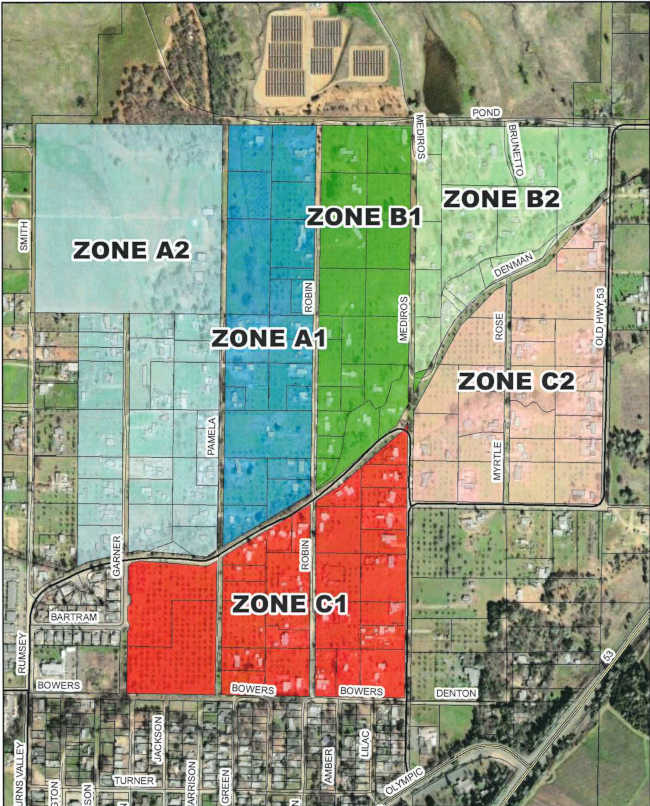
A map of the 2026 Robin Lane Sewer Spill area divided into zones. Courtesy of the city of Clearlake.


LAKE COUNTY, Calif. — Officials reported progress on Thursday in the continued water testing and tank placement in the neighborhoods impacted by a massive sewage spill that occurred earlier this month.

The city of Clearlake and the Lake County Office of Emergency Services, or Lake County OES, entered into unified command on Monday in managing the response to the Robin Lane sewer spill, which began on Jan. 11.

That management includes coordinating testing, resources and public updates as the recovery efforts continue, officials reported.

The spill, the result of a 16-inch force main rupture, lasted more than 38 hours and resulted in an estimated 2.9 million gallons of sewage being released, with impacts extending over a roughly 300-acre area. 

Public Health Officer Dr. Bob Bernstein urged residents of the spill area who rely on well water to temporarily relocate until their wells have been deemed safe following testing.

The Lake County Sanitation District, overseen by Lake County Special Districts, operates the sewer system that failed.

Initially, Special Districts was leading the response, but this week the management transitioned to the city and OES.

Officials told community members at a Wednesday night town hall that their goal is to get people back to normal as soon as possible.

The city said response efforts have moved from emergency containment to coordinated recovery and monitoring, with assessment and testing teams working across the six zones into which the spill area has been split.

“Sewer infrastructure has been stabilized, environmental assessments have been completed, and private well testing is ongoing across all zones, with each zone tested at least once and continued follow-up sampling underway,” the city reported.

The response has included providing potable water tanks, water deliveries, mobile laundry and hygiene services, and temporary shelter support to residents and animals, according to the Thursday report.

With the change in leadership, more information has become available this week, including an updated number of impacted properties — from the initial estimate of 58 to 200.

On Thursday, the city of Clearlake reported that the unified command’s teams had tested another 151 sites, bringing the total of water samples completed to 310.

To date, the total number of water tanks installed has risen to 19. Of those, 12 were installed by the incident team and the seven others were installed by a program overseen by Lake County Social Services.

The city of Clearlake’s website has a webpage dedicated to the incident. 

Additional information requests about the incident can be directed to Administrative Services Director/City Clerk Melissa Swanson, who also is acting as the incident’s public information officer, at 707-994-8201, Extension 106, or This email address is being protected from spambots. You need JavaScript enabled to view it..

Lake County Special Districts can be reached at 707-263-0119.

Email Elizabeth Larson at This email address is being protected from spambots. You need JavaScript enabled to view it.. Follow her on Twitter, @ERLarson, and on Bluesky, @erlarson.bsky.social. Find Lake County News on the following platforms: Facebook, @LakeCoNews; X, @LakeCoNews; Threads, @lakeconews, and on Bluesky, @lakeconews.bsky.social. 

Solving Long COVID: How decades of HIV research paved the way

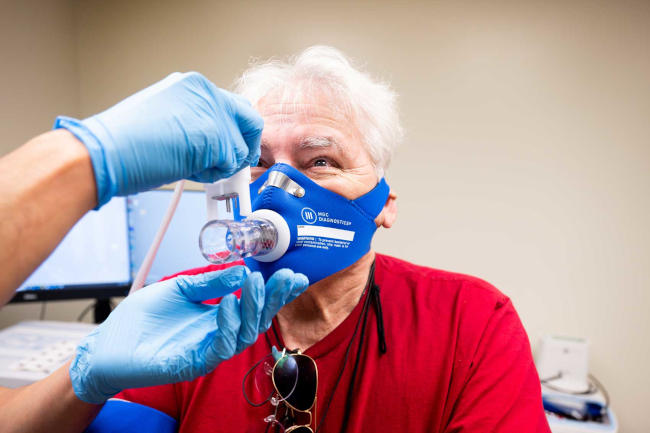
Long COVID patient Michael Dahl does a test as part of UCSF’s Long-term Impact of Infection with Novel Coronavirus (LIINC) project at Zuckerberg San Francisco General Hospital. Photo by Noah Berger.


UCSF’s rapid shift to uncover the virus’s hidden effects and seemingly unconnected symptoms put its researchers at the forefront of the field.

In the early months of the COVID-19 pandemic, UC San Francisco researchers were already seeing signs of lingering symptoms in some who had been infected. Importantly, this was when experts still viewed the illness as a transient respiratory virus and before long COVID even had a name, let alone a diagnosis.

Clinicians were hearing young, previously healthy people with no other medical problems talk about how they couldn’t shake the virus. They had bone-crushing fatigue, respiratory issues that wouldn’t go away, difficulty thinking, dizziness, and other problems that persisted well after the acute phase of the disease was over.

Many were in the prime of life but could no longer perform their jobs or function normally. Some had incapacitating symptoms and couldn’t sit upright for long periods of time or needed assistive devices to help them get around. A significant number faced skepticism from health care providers, and even their families and friends. Their symptoms were dismissed as anxiety or otherwise not taken seriously. But, at UCSF, clinicians and researchers took action and did so at a speed unmatched by any other institution.

They were able to quickly tap into decades of expertise and infrastructure built to study another complex virus, HIV. They used that advantage to pivot to COVID-19, the disease caused by the SARS-CoV-2 virus, and what eventually came to be known as long COVID.

“HIV taught us how chronic viral infections can affect the body long after the initial illness, and how important it is to involve patients in that research,” said Michael Peluso, MD, MHS, an infectious disease researcher and assistant professor of medicine at UCSF. “Applying those lessons to long COVID has helped us accelerate discovery and move closer to answers and treatments.”

In March 2020, UCSF established a program that allowed them to follow patients over years. As part of the Long-term Impact of Infection with Novel Coronavirus program, or LIINC, researchers recruited more than 1,700 participants, collected over 100,000 biospecimens, and produced many of the first and most consequential studies about the mechanisms of the disease. Within LIINC, which is directed by Peluso, researchers also built one of the premier clinical trial programs for long COVID in the world.

“By following individuals over time and studying them deeply, we began to uncover the biological drivers of long COVID, identify who was most at risk, and use that knowledge to inform better diagnostics, treatments, and prevention strategies,” Peluso said.

UCSF staff research associates work on UCSF’s Long-term Impact of Infection with Novel Coronavirus (LIINC) project. Photo by Noah Berger.

How HIV paved the way

Today, more than 20 million Americans have been diagnosed with long COVID. Yet still no diagnostic tests or therapeutics have been approved specifically for the debilitating condition, which is defined as persistent symptoms that include everything from shortness of breath to cognitive issues and cardiac problems that last more than three months after a COVID infection.

LIINC co-founder Steven Deeks, MD, started his career in the early 1990s at what is now the Priscilla Chan and Mark Zuckerberg San Francisco General Hospital and Trauma Center (ZSFG). That was just as AIDS was becoming the leading cause of death for American men between the ages of 25 and 44, but treatments were limited to single-drug therapies.

By 1996, combinations of anti-HIV drugs were introduced that suppressed the virus and dramatically improved the outlook for people living with HIV. “In the early era of HIV, we tried single-drug therapies, but nothing worked. Two drugs, that didn’t really work. Three drugs – boom,” Deeks said. “That’s the way it worked for HIV, and that may be the way it works for long COVID. We’re certainly setting up our program to begin to look at these combinations.”

At the heart of the collaboration between ZSFG and UCSF on AIDS research was what became known as the San Francisco “model of care.” This is the integrated, team-based approach to working with public health and community organizations that led to HIV testing, clinical trials to evaluate treatments, and compassionate care. This included academic institutions, public health, community advocates, political leaders, and the biotechnology industry.

The same has been true of long COVID, where partnerships are starting to produce answers that researchers have been searching for.

About a year after opening, LIINC launched the world’s first long COVID tissue bank and discovered that pieces of the virus can linger in the tissue of patients for up to two years. LIINC shares blood and tissues with researchers around the world, is involved in dozens of collaborations to identify the abnormal biology driving the disease, and has conducted seven clinical trials to correct that biology.

“Our approach to clinical trials in long COVID is quite similar to our approach to cure HIV,” Peluso explained. “We identify the pathways that we think are driving the problem. Then we take an experimental medicine approach where we use novel therapeutics to really target those pathways to see if we can alter that biology that we think is at the core of this disease.”

The LIINC team was one of the few groups worldwide capable of shifting to study long COVID so quickly, according to Amy Proal, PhD, president of the PolyBio Research Foundation, a Massachusetts-based nonprofit that supports research into the root causes of chronic disease. Which is why PolyBio is LIINC’s primary funder, she said.

“They already knew that the SARS-CoV-2 virus might persist because of their history with HIV,” Proal said of UCSF’s researchers. “The things that they chose to do right from the beginning, like collect tissue and do certain kinds of imaging, could be targeted and very specific to what a virus does in a chronic capacity.”

That foresight allowed UCSF to immediately track long COVID patients overtime and led to a number of breakthrough findings.

No longer a mystery

While the biological mechanisms behind long COVID are still not fully understood, researchers say they’ve come a long way and are getting closer to finding treatments.

They’ve been able to detect immunologic differences between people with long COVID and without. They’ve discovered abnormal physiologic responses in cardiopulmonary and vascular function tests. They’ve also found inflammation in the tissues, as well as viral persistence in the gut, bone marrow, brain, and other deeper tissues.

“I don’t think that it is fair in 2026 to say that this disease is a mystery,” Peluso said. “I think we’ve made a lot of progress in understanding objectively what might be happening.”

Still, much of the difficulty in understanding long COVID is because it’s a complex syndrome with more than 200 documented symptoms affecting the respiratory, immune, nervous, cardiovascular, gastrointestinal, and other systems.

Timothy Henrich, MD, a professor of medicine in UCSF’s Department of Experimental Medicine and a lead researcher at LIINC, runs a lab that expanded its focus from HIV to study the mechanisms by which viral infections lead to conditions like long COVID.  Not only did Henrich’s lab find viral persistence in the gut, bone marrow, brain, and other deeper tissues, they saw profound changes in immune responses and inflammation in these tissues at levels they didn’t see in standard blood tests.

One of the main things we learned is that SARS-CoV-2 is able to persist for a long period of time in various tissues across the body,” Henrich said. “This is really unusual and changed the paradigm of thinking about this as a chronic viral infection versus a transient, acute respiratory viral infection.”

To get a clearer understanding, researchers used noninvasive PET scans and revealed that T-cells, part of the immune system, were remaining active for prolonged periods of time, likely contributing to ongoing inflammation, which the immune system uses to fight illness, and other symptoms.

UCSF Clinical Research Coordinator Kathleen Bellon Pizarro (right) speaks with long COVID patient Hulda Brown (left) while working on UCSF’s Long-term Impact of Infection with Novel Coronavirus (LIINC) project. Photo by Noah Berger.

A commitment to finding answers

These discoveries get scientists closer to solutions, but researchers say the work needs more federal funding and investments from the pharmaceutical industry and private donors.

At a roundtable with long COVID experts convened last fall by U.S. Health and Human Services Secretary Robert F. Kennedy Jr., Peluso stressed the need to scale up the number of clinical trials and to implement a diagnostics program to identify who is most likely to benefit from the interventions. He emphasized that this would require investment on a faster timeline than is typical of federal programs.

“We saw for HIV how important it was in the ’90s to have pharmaceutical partners on board with developing drugs and investing tremendously ... in figuring out which treatments would work,” Peluso told the panel. “We need that level of commitment for long COVID.”

Peluso also emphasized the continued need to involve patients with the research. Hannah Davis, co-founder of the advocacy group, Patient-Led Research Collaborative, said UCSF’s researchers not only had the ability to immediately recognize that SARS-CoV-2 was causing this disorder, but they listened to patients and sought their participation in finding answers.

Davis believes LIINC’s work could eventually advance the understanding of other infection-associated chronic conditions, including myalgic encephalomyelitis/chronic fatigue syndrome (ME/CFS), and persistent Lyme disease.

“One day soon, we’ll look back on LIINC as part of the groundswell that forever changed the understanding of conditions like long COVID,” Davis said. “The competence and credibility they have brought to the field has been rivaled by very few, and I’m forever grateful to the prescience, humility, and bold dedication they have shown in approaching this condition.”

Victoria Colliver writes for UCSF.

Clearlake Animal Control: ‘Chubbiana’ and the dogs

“Chubbiana.” Photo courtesy of Clearlake Animal Control.

CLEARLAKE, Calif. — There are many dogs at Clearlake Animal Control — new ones and those that are still waiting — ready to go to their new homes.

The shelter has 56 adoptable dogs and puppies listed on its website.

This week’s dogs include “Chubbiana,” a female English bulldog mix. She has been spayed.

The shelter is located at 6820 Old Highway 53. It’s open from 9 a.m. to 6 p.m. Tuesday through Saturday. 

For more information, call the shelter at 707-762-6227, email This email address is being protected from spambots. You need JavaScript enabled to view it. or visit Clearlake’s adoptable dogs here.

This week’s adoptable dogs are featured below.

Email Elizabeth Larson at This email address is being protected from spambots. You need JavaScript enabled to view it.. Follow her on Twitter, @ERLarson, and on Bluesky, @erlarson.bsky.social. Find Lake County News on the following platforms: Facebook, @LakeCoNews; X, @LakeCoNews; Threads, @lakeconews, and on Bluesky, @lakeconews.bsky.social. 


Americans want heat pumps – but high electricity prices may get in the way

Workers install an air-source heat pump at a home in Charlotte, Vt. Robert Nickelsberg/Getty Images

Heat pumps can reduce carbon emissions associated with heating buildings, and many states have set aggressive targets to increase their use in the coming decades. But while heat pumps are often cheaper choices for new buildings, getting homeowners to install them in existing homes isn’t so easy.

Current energy prices, including the rising cost of electricity, mean that homeowners may experience higher heating bills by replacing their current heating systems with heat pumps – at least in some regions of the country.

Heat pumps, which use electricity to move heat from the outside in, are used in only 14% of U.S. households. They are common primarily in warm southern states such as Florida where winter heating needs are relatively low. In the Northeast, where winters are colder and longer, only about 5% of households use a heat pump.

In our new study, my co-author Dan Schrag and I examined how heat pump adoption would change annual heating bills for the average-size household in each county across the U.S. We wanted to understand where heat pumps may already be cost-effective and where other factors may be preventing households from making the switch.

Wide variation in home heating

Across the U.S., people heat their homes with a range of fuels, mainly because of differences in climate, pricing and infrastructure. In colder regions – northern states and states across the Rocky Mountains – most people use natural gas or propane to provide reliable winter heating. In California, most households also use natural gas for heating.

In warmer, southern states, including Florida and Texas, where electricity prices are cheaper, most households use electricity for heating – either in electric furnaces, baseboard resistance heating or to run heat pumps. In the Pacific northwest, where electricity prices are low due to abundant hydropower, electricity is also a dominant heating fuel.

The type of community also affects homes’ fuel choices. Homes in cities are more likely to use natural gas relative to rural areas, where natural gas distribution networks are not as well developed. In rural areas, homes are more likely to use heating oil and propane, which can be stored on property in tanks. Oil is also more commonly used in the Northeast, where properties are older – particularly in New England, where a third of households still rely on oil for heating.

Why heat pumps?

Instead of generating heat by burning fuels such as natural gas that directly emit carbon, heat pumps use electricity to move heat from one place to another. Air-source heat pumps extract the heat of outside air, and ground-source heat pumps, sometimes called geothermal heat pumps, extract heat stored in the ground.

Heat pump efficiency depends on the local climate: A heat pump operated in Florida will provide more heat per unit of electricity used than one in colder northern states such as Minnesota or Massachusetts.

But they are highly efficient: An air-source heat pump can reduce household heating energy use by roughly 30% to 50% relative to existing fossil-based systems and up to 75% relative to inefficient electric systems such as baseboard heaters.

Heat pumps can also reduce emissions of greenhouse gases, although that depends on how their electricity is generated – whether from fossil fuels or cleaner energy, such as wind and solar.

Heat pumps can lower heating bills

We found that for households currently using oil, propane or non-heat pump forms of electric heating – such as electric furnaces or baseboard resistive heaters – installing a heat pump would reduce heating bills across all parts of the country.

The amount a household can save on energy costs with a heat pump depends on region and heating type, averaging between $200 and $500 a year for the average-size household currently using propane or oil.

However, savings can be significantly greater: We found the greatest opportunity for savings in households using inefficient forms of electric heating in northern regions. High electricity prices in the Northeast, for example, mean that heat pumps can save consumers up to $3,000 a year over what they would pay to heat with an electric furnace or to use baseboard heating.

A challenge in converting homes using natural gas

Unfortunately for the households that use natural gas in colder, northern regions – making up around half of the country’s annual heating needs – installing a heat pump could raise their annual heating bills. Our analysis shows that bills could increase by as much as $1,200 per year in northern regions, where electricity costs are as much as five times greater than natural gas per kilowatt-hour.

Even households that install ground-source heat pumps, the most efficient type of heat pump, would still see bill increases in regions with the highest electricity prices relative to natural gas.

Installation costs

In parts of the country where households would see their energy costs drop after installing a heat pump, the savings would eventually offset the upfront costs. But those costs can be significant and discourage people from buying.

On average, it costs $17,000 to install an air-source heat pump and typically at least $30,000 to install a ground-source heat pump.

Some homes may also need upgrades to their electrical systems, which can increase the total installation price even more, by tens of thousands of dollars in some cases, if costly service upgrades are required.

In places where air conditioning is typical, homes may be able to offset some costs by using heat pumps to replace their air conditioning units as well as their heating systems. For instance, a new program in California aims to encourage homeowners who are installing central air conditioning or replacing broken AC systems to get energy-efficient heat pumps that provide both heating and cooling.

Rising costs of electricity

A main finding of our analysis was that the cost of electricity is key to encouraging people to install heat pumps.

Electricity prices have risen sharply across the U.S. in recent years, driven by factors such as extreme weather, aging infrastructure and increasing demand for electric power. New data center demand has added further pressure and raised questions about who bears these costs.

Heat pump installations will also increase electricity demand on the grid: The full electrification of home heating across the country would increase peak electricity demand by about 70%. But heat pumps – when used in concert with other technologies such as hot-water storage – can provide opportunities for grid balancing and be paired with discounted or time-of-use rate structures to reduce overall operating costs. In some states, regulators have ordered utilities to discount electricity costs for homes that use heat pumps.

But ultimately, encouraging households to embrace heat pumps and broader economy-wide electrification, including electric vehicles, will require more than just technological fixes and a lot more electricity – it will require lower power prices.The Conversation

Roxana Shafiee, Environmental Fellow, Center for the Environment, Harvard University; Harvard Kennedy School

This article is republished from The Conversation under a Creative Commons license. Read the original article.
  • 52
  • 53
  • 54
  • 55
  • 56
  • 57
  • 58
  • 59
  • 60
  • 61

Community

  • Sheriff’s Activities League and Clearlake Bassmasters offer youth fishing clinic

  • City Nature Challenge takes place April 24 to 27

Public Safety

  • Lakeport Police logs: Wednesday, Feb. 11

  • Lakeport Police logs: Tuesday, Feb. 10

Education

  • Ramos measure requiring school officer training in use of anti-opioid drug moves forward

  • Lake County Chapter of CWA announces annual scholarships 

Health

  • California ranks 24th in America’s Health Rankings Annual Report from United Health Foundation

  • Healthy blood donors especially vital during active flu season

Business

  • Employment law summit takes place March 9

  • Two Lake County Mediacom employees earn company’s top service awards

Obituaries

  • Terry Knight

  • Ellen Thomas

Opinion & Letters

  • Who should pay for AI’s power? Not California ratepayers

  • Crandell: Supporting nephew for reelection in supervisorial race

Veterans

  • State honors fallen chief warrant officer killed in conflict in Iran

  • CalVet and CSU Long Beach team up to improve data collection related to veteran suicides

Recreation

  • April Audubon program will show how volunteers can help monitor local osprey nests

  • First guided nature walk of spring at Anderson Marsh State Historic Park April 11

  • Second Saturday guided nature walks continue at Anderson Marsh State Historic Park

  • Wet weather trail closure in effect on Upper Lake Ranger District

Religion

  • Kelseyville Presbyterian Church plans Easter service

  • Easter ‘Sonrise’ Service returns to Xabatin Community Park

Arts & Life

  • ‘CIA’ delves into the shadowy world of an espionage thriller

  • ‘War Machine’ shifts the battlefield into uncharted territory

Government & Politics

  • Lake County Democratic Central Committee endorses Falkenberg

  • Crandell launches reelection campaign plans March 15 event

Legals

  • April 23 hearing on Lake Coco Farms Major Use Permit

  • NOTICE OF 30-DAY PUBLIC COMMENT PERIOD & NOTICE OF PUBLIC HEARING

How to resolve AdBlock issue?
Refresh this page