How to resolve AdBlock issue?
Refresh this page
Lake County News,California
  • Home
    • Registration Form
  • News
    • Education
    • Veterans
    • Community
      • Obituaries
      • Letters
      • Commentary
    • Police Logs
    • Business
    • Recreation
    • Health
    • Religion
    • Legals
    • Arts & Life
    • Regional
  • Calendar
  • Contact us
    • FAQs
    • Phones, E-Mail
    • Subscribe
  • Advertise Here
  • Login
How to resolve AdBlock issue?
Refresh this page

News

Lakeport protest pushes back on federal immigration actions

013126protestgroup

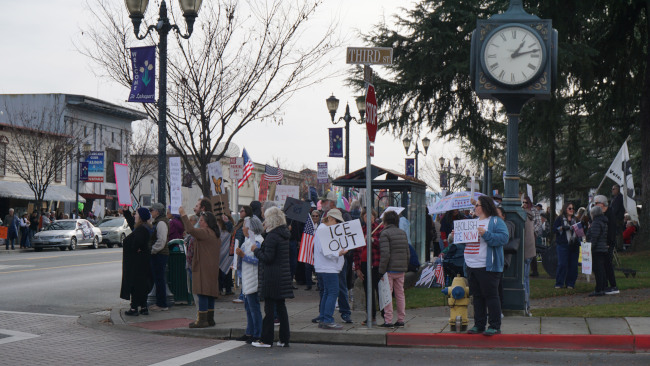
Protesters gather at Museum Square in downtown Lakeport, California, on Saturday, Jan. 31, 2026. Photo by Elizabeth Larson/Lake County News. 


LAKEPORT, Calif. — Several hundred protestors came out on the last day of January to protest the immigration crackdown that’s underway nationwide and has culminated over the past month in the shooting deaths of two people in Minneapolis.

The “ICE Out for Good” took place from noon to 2 p.m. Saturday at Museum Square in downtown Lakeport.

The protest was one among many that have taken place across the United States in recent days in response to the actions of United States Immigration and Customs Enforcement, or ICE.

The event was organized to allow community members to stand in solidarity with Minnesota. That state has been the epicenter of federal immigration action, with a heightened presence in Minneapolis, where Renee Good, a mother of three, was killed by ICE on Jan. 7 and Alex Pretti, a Department of Veteran Affairs nurse, on Jan. 24 by Border Patrol.

The scene in Lakeport on Saturday afternoon was much like it has been at the series of protests in Museum Square over the past year.

There were several hundred attendees — organizers estimated just over 600 people took part — lining a three-block area of Main Street, cheering as passing drivers honked their horns.

Also at the event was Luca Moretti, Congressman Mike Thompson’s Lake County field representative.

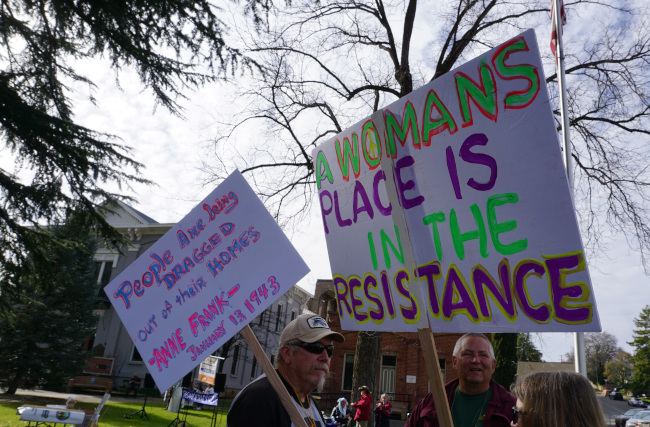
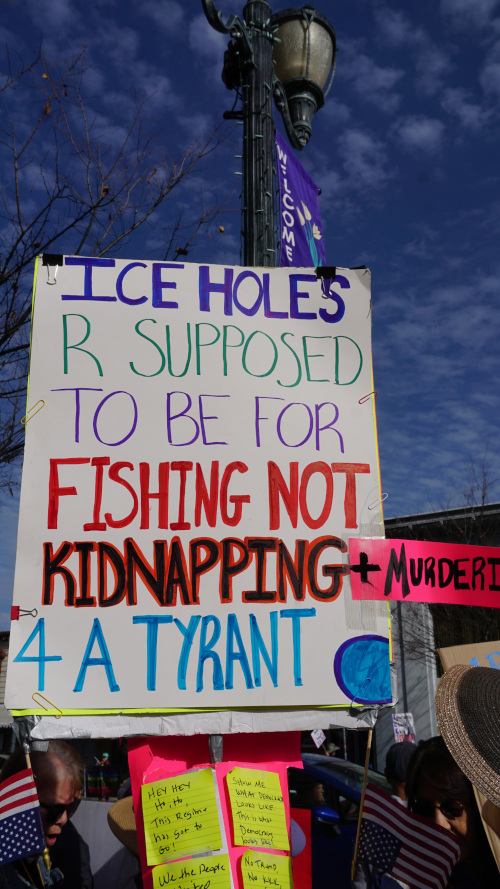
Protestors who ranged across generations, from teens to seniors, carried signs with a variety of slogans that called for Donald Trump’s impeachment, conviction and removal from the presidency. Signs read “Make America Sane Again: Fight Fascism”; “Impeach Krasnov”; “Abolish ICE now”; “A Woman’s Place is in the Resistance”; “No Kings, No Oligarchs”; “Defend Democracy”; and “ICE is Un-American, Non-Christian,” among others.

There also were signs with Good’s name and with Pretti’s. One such sign said, “Pretti good time for Congress to stop this destruction of the United States.”

The day was peaceful with one exception reported by organizers.

A group of high school girls who were standing on the corner of Third and Main streets were accosted by an aggressive male subject. The individual, described as a middle aged man, pulled up in a pickup and yelled at the teens, “I hope all of you get raped and murdered!”

That subject has so far not been identified.

At the event it was announced that more protests are expected to take place in late February and March.


013126protestwomansplace

A sign at the “ICE Out for Good” protest in Lakeport, California, on Saturday, Jan. 31, 2026. Photo by Elizabeth Larson/Lake County News.


Protests take place in other parts of the region

Congressman Mike Thompson reported on Saturday that over the past week he’d been joined by over 1,500 community members in Napa and Woodland to protest ICE’s actions in Minneapolis and call for action.

Thompson was one of the first members of Congress to sign onto articles of impeachment against Department of Homeland Security Secretary Kristi Noem earlier this month, leads legislation to prohibit agents from wearing masks and will be introducing legislation to mandate agents wear body cameras.

Thompson also voted no on funding for ICE and Border Patrol operations.

In Woodland, Thompson hosted a “Fire Noem” Day of Action on Wednesday at Heritage Plaza. More than 400 community members gathered to amplify calls for accountability in immigration enforcement and to call on Congress to act to impeach Noem. Thompson was joined by Yolo County Supervisors Angel Barajas, Lucas Frerichs, Sheila Allen and Mary Vixie Sandy; Woodland Mayor Pro Tempore Mayra Vega; and Jake Whitaker, chair of the Yolo County Democratic Party and former Woodland School Board member.

In Napa, Thompson led a “Stop ICE” Day of Action on Friday at Veterans Memorial Park, where more than 1,000 community members and local leaders gathered to express concern about aggressive federal immigration tactics. Participating leaders included State Senator Christopher Cabaldon, Napa City Councilmember Bernie Narvaez, Indivisible Napa’s Pat Reynes, Napa Valley Together’s Jenny Ocon, Rabbi Niles Goldstein of Congregation Beth Shalom and 13 year-old Edna Velazquez from Robert Louis Stevenson Middle School in St. Helena.

Thompson has hosted several “Know Your Rights” events over the past year for business owners, employees and community members to help people understand what they should do if ICE comes to their home or business.

Email Elizabeth Larson at This email address is being protected from spambots. You need JavaScript enabled to view it.. Follow her on Twitter, @ERLarson, and on Bluesky, @erlarson.bsky.social. Find Lake County News on the following platforms: Facebook, @LakeCoNews; X, @LakeCoNews; Threads, @lakeconews, and on Bluesky, @lakeconews.bsky.social.


013126protesticeholes

A sign at the “ICE Out for Good” protest in Lakeport, California, on Saturday, Jan. 31, 2026. Photo by Elizabeth Larson/Lake County News.


Testing continues in expanded sewer spill area

013026newsewerspillmap


LAKE COUNTY, Calif. — More water well tests were completed on Saturday as the recovery effort for a massive sewage spill in Clearlake continues.

The spill began three weeks ago today, when a 16-inch force main operated by the Lake County Sanitation District ruptured on Robin Lane, releasing nearly three millions gallons over a 38-hour period.

The incident led to some temporary relocations for residents who rely on well water, as dozens of wells were found to have been contaminated by the sewage.

For the past week, a joint command composed of the city of Clearlake and the Lake County Sheriff’s Office of Emergency Services has moved the incident into a recovery operation.

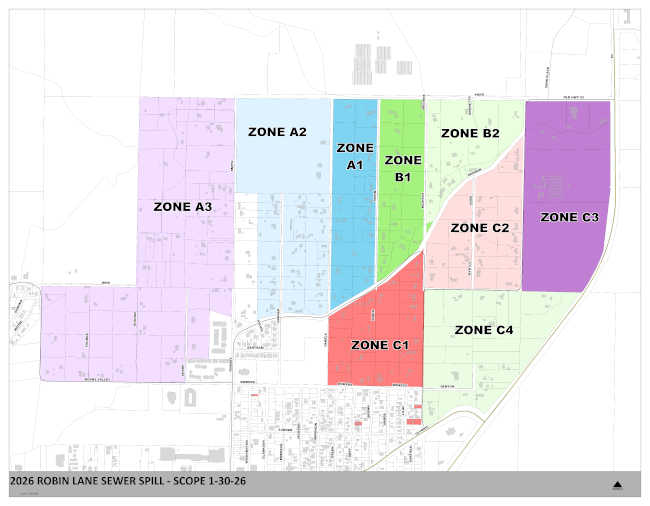
An updated map released on Friday showed nine impact zones totaling an estimated 550 acres — an increase of about 250 acres — on the northern end of Clearlake.

The expanded area includes three new incident zones covering properties north of Burns Valley Road that are east of Reid Lane and south of Pond Road, and north of Olympic Drive that are east of Old Highway 53, and west of Highway 53.

Officials have advised residents within the expanded area not to use their well water until water sampling and laboratory testing have been completed and results confirm the water is safe for use.

Groundwater testing is ongoing as officials seek to clear property owners to be able to safely use their wells again.

On Saturday, the incident management team reported that 18 more water samples had been completed, bringing the total to 394 for 151 sites tested.

The number of water tanks installed for residents remained at 25 on Saturday — 18 of them by the incident management team and seven through a program administered by Lake County Social Services.

For residents without water, the mobile laundry and hygiene service trailer is located at 2485 Old Highway 53 in Clearlake.

Residents with questions may contact Lake County Environmental Health at 707-263-1164 for well testing and the city of Clearlake at 707-994-8201 for general information.

Updates, maps, testing information and available resources are available here or at Response.LakeCountyCA.gov.

Email Elizabeth Larson at This email address is being protected from spambots. You need JavaScript enabled to view it.. Follow her on Twitter, @ERLarson, and on Bluesky, @erlarson.bsky.social. Find Lake County News on the following platforms: Facebook, @LakeCoNews; X, @LakeCoNews; Threads, @lakeconews, and on Bluesky, @lakeconews.bsky.social.

US exit from the World Health Organization marks a new era in global health policy – here’s what the US, and world, will lose

The U.S.-WHO collaboration has been critical in the country’s response to mpox, shown here, as well as Ebola, Marburg, flu and COVID-19. Uma Shankar sharma/Moment via Getty Images

The U.S. departure from the World Health Organization became official in late January 2026, according to the Trump administration – a year after President Donald Trump signed an executive order on inauguration day of his second term declaring that he was doing so. He first stated his intention to do so during his first term in 2020, early in the COVID-19 pandemic.

The U.S. severing its ties with the WHO will cause ripple effects that linger for years to come, with widespread implications for public health. The Conversation asked Jordan Miller, a public health professor at Arizona State University, to explain what the U.S. departure means in the short and long term.

Why is the US leaving the WHO?

The Trump administration says it’s unfair that the U.S. contributes more than other nations and cites this as the main reason for leaving. The White House’s official announcement gives the example of China, which – despite having a population three times the size of the U.S. – contributes 90% less than the U.S. does to the WHO.

The Trump administration has also claimed that the WHO’s response to the COVID-19 pandemic was botched and that it lacked accountability and transparency.

The WHO has pushed back on these claims, defending its pandemic response, which recommended masking and physical distancing.

The U.S. does provide a disproportionate amount of funding to the WHO. In 2023, for example, U.S. contributions almost tripled that of the European Commission’s and were roughly 50% more than the second highest donor, Germany. But health experts point out that preventing and responding quickly to public health challenges is far less expensive than dealing with those problems once they’ve taken root and spread.

However, the withdrawal process is complicated, despite the U.S. assertion that it is final. Most countries do not have the ability to withdraw, as that is the way the original agreement to join the WHO was designed. But the U.S. inserted a clause into its agreement with the WHO when it agreed to join, stipulating that the U.S. would have the ability to withdraw, as long as it provided a one-year notice and paid all remaining dues. Though the U.S. gave its notice when Trump took office a year ago, it still owes the WHO about US$260 million in fees for 2024-25. There are complicated questions of international law that remain.

The U.S. has been a dominant force in the WHO, and its absence will have direct and lasting impacts on health systems in the U.S. and other countries.

What does US withdrawal from the WHO mean in the short term?

In short, the U.S. withdrawal weakens public health abroad and at home. The WHO’s priorities include stopping the spread of infectious diseases, stemming antimicrobial resistance, mitigating natural disasters, providing medication and health services to those who need it, and even preventing chronic diseases. So public health challenges, such as infectious diseases, have to be approached at scale because experience shows that coordination across borders is important for success.

The U.S. has been the largest single funder of the WHO, with contributions in the hundreds of millions of dollars annually over the past decade, so its withdrawal will have immediate operational impacts, limiting the WHO’s ability to continue established programs.

As a result of losing such a significant share of its funding, the WHO announced in a recent memo to staff that it plans to cut roughly 2,300 jobs – a quarter of its workforce – by summer 2026. It also plans to downsize 10 of its divisions to four.

In addition to a long history of funding, U.S. experts have worked closely with the WHO to address public health challenges. Successes stemming from this partnership include effectively responding to several Ebola outbreaks, addressing mpox around the world and the Marburg virus outbreak in Rwanda and Ethiopia. Both the Marburg and Ebola viruses have a 50% fatality rate, on average, so containing these diseases before they reached pandemic-level spread was critically important.

The Infectious Diseases Society of America issued a statement in January 2026 describing the move as “a shortsighted and misguided abandonment of our global health commitments,” noting that “global cooperation and communication are critical to keep our own citizens protected because germs do not respect borders.”

Pink and purple-stained light micrograph image of liver cells infected with Ebola virus.
The US has been instrumental in the response to major Ebola outbreaks through its involvement with the WHO. Shown here, Ebola-infected liver cells. Callista Images/Connect Images via Getty Images

What are the longer-term impacts of US withdrawal?

By withdrawing from the WHO, the U.S. will no longer participate in the organization’s Global Influenza Surveillance and Response System, which has been in operation since 1952. This will seriously compromise the U.S.’s ability to plan and manufacture vaccines to match the predicted flu strains for each coming year.

Annual flu vaccines for the U.S. and globally are developed a year in advance using data that is collected around the world and then analyzed by an international team of experts to predict which strains are likely to be most widespread in the next year. The WHO convenes expert panels twice per year and then makes recommendations on which flu strains to include in each year’s vaccine manufacturing formulation.

While manufacturers will likely still be able to obtain information regarding the WHO’s conclusions, the U.S. will not contribute data in the same way, and American experts will no longer have a role in the process of data analysis. This could lead to problematic differences between WHO recommendations and those coming from U.S. authorities.

The Centers for Disease Control and Prevention estimates that each year in the U.S. millions of people get the flu, hundreds of thousands of Americans are hospitalized and tens of thousands die as a result of influenza. Diminishing the country’s ability to prepare in advance through flu shots will likely mean more hospitalizations and more deaths as a result of the flu.

This is just one example of many of how the U.S.’s departure will affect the country’s readiness to respond to disease threats.

Additionally, the reputational damage done by the U.S. departure cannot be overstated. The U.S. has developed its position as an international leader in public health over many decades as the largest developer and implementer of global health programs.

I believe surrendering this position will diminish the United States’ ability to influence public health strategies internationally, and that is important because global health affects health in the U.S. It will also make it harder to shape a multinational response in the event of another public health crisis like the COVID-19 pandemic.

Public health and policy experts predict that China will use this opportunity to strengthen its position and its global influence, stepping into the power vacuum the U.S. creates by withdrawing. China has pledged an additional US$500 million in support of the WHO over the next five years.

As a member of the WHO, the United States has had ready access to a vast amount of data collected by the WHO and its members. While most data the WHO obtains is ultimately made available to the public, member nations have greater access to detailed information about collection methods and gain access sooner, as new threats are emerging.

Delays in access to data could hamstring the country’s ability to respond in the event of the next infectious disease outbreak.

Could the US return under a new president?

In short, yes. The WHO has clearly signaled its desire to continue to engage with the U.S., saying it “regrets the U.S. decision to withdraw” and hopes the U.S. will reconsider its decision to leave.

In the meantime, individual states have the opportunity to participate. In late January, California announced it will join the WHO’s Global Outbreak Alert & Response Network, which is open to a broader array of participants than just WHO member nations. California was also a founding member of the West Coast Health Alliance, which now includes 14 U.S. states that have agreed to work together to address public health challenges.

California Gov. Gavin Newsom has also launched an initiative designed to improve public health infrastructure and build trust. He enlisted national public health leaders for this effort, including former Centers for Disease Control and Prevention leaders Susan Monarez and Deb Houry, as well as Katelyn Jetelina, who became well known as Your Local Epidemiologist during the COVID-19 pandemic.

I think we will continue to see innovative efforts like these emerging, as political and public health leaders work to fill the vacuum being created by the Trump administration’s disinvestment in public health.The Conversation

Jordan Miller, Teaching Professor of Public Health, Arizona State University

This article is republished from The Conversation under a Creative Commons license. Read the original article.
Space News: NASA’s Artemis II crewed mission to the Moon shows how US space strategy has changed since Apollo – and contrasts with China’s closed program

As part of the Artemis II mission, humans will fly around the Moon for the first time in decades. Roberto Moiola/Sysaworld via Getty Images

When Apollo 13 looped around the Moon in April 1970, more than 40 million people around the world watched the United States recover from a potential catastrophe. An oxygen tank explosion turned a planned landing into an urgent exercise in problem-solving, and the three astronauts on board used the Moon’s gravity to sling themselves safely home. It was a moment of extraordinary human drama, and a revealing geopolitical one.

The Cold War space race was a two-player contest. The Soviet Union and the United States operated in parallel, rarely cooperating, but clearly measuring themselves against one another. By 1970, the United States had already landed on the Moon, and competition centered on demonstrating technological capability, political and economic superiority and national prestige. As Apollo 13 showed, even missions that did not go as planned could reinforce a country’s leadership if they were managed effectively.

More than half a century later, NASA’s Artemis II mission will send humans around the Moon again in early 2026, this time deliberately. But the strategy going into Artemis II looks very different from that of 1970. The United States is no longer competing against a single rival in a largely symbolic race.

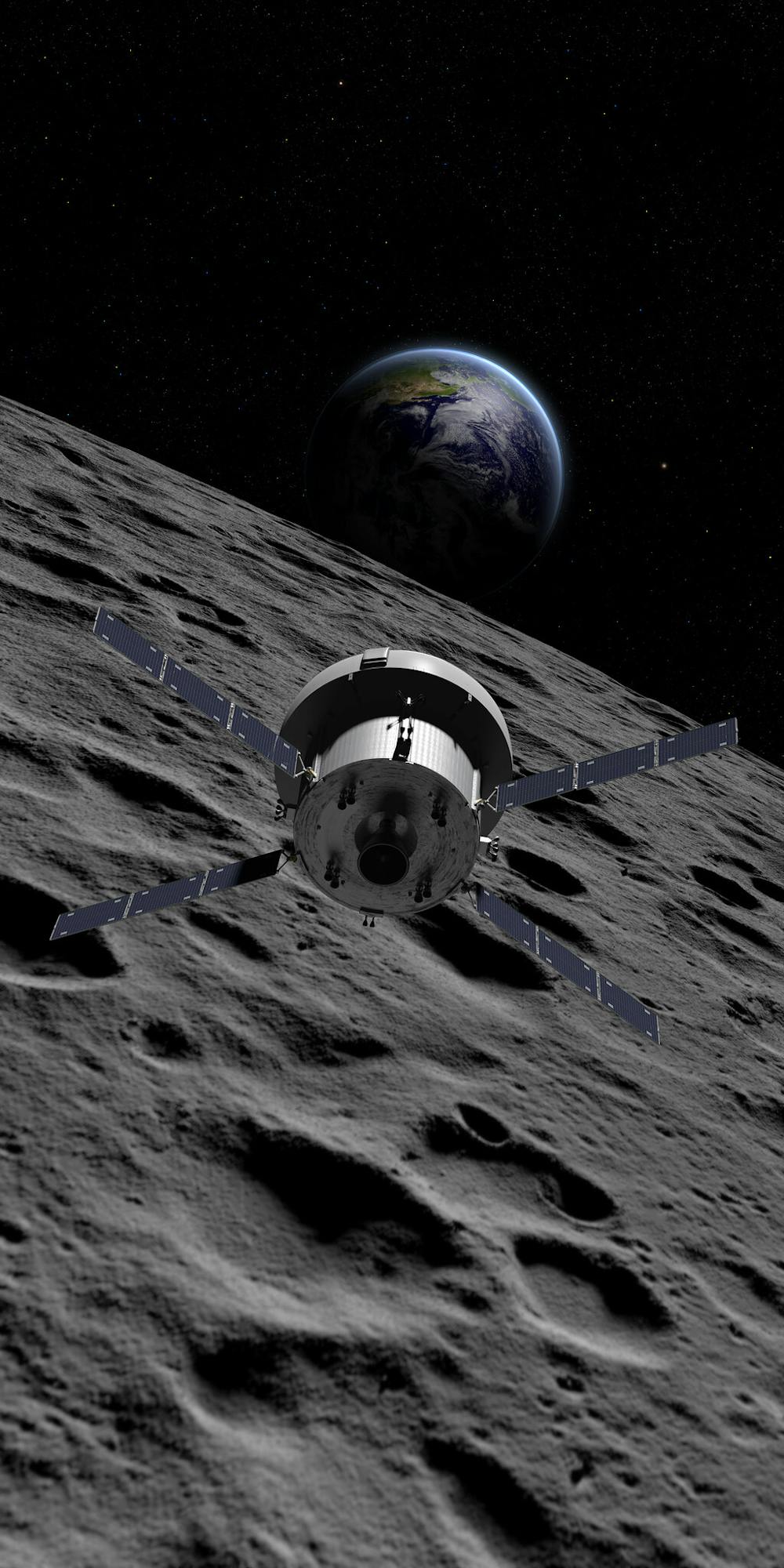
An artist's impression of a spacecraft flying over the surface of the Moon.
The crew will make a single flyby of the Moon in an Orion capsule, shown in this illustration. NASA, CC BY-NC

As a professor of air and space law, I research questions of governance and conflict avoidance beyond Earth. From a space law perspective, sustained human activity on the Moon and beyond depends on shared expectations about safety and responsible behavior. In practice, the countries that show up, operate repeatedly and demonstrate how activity on the lunar surface and in outer space can be carried out over time shape these expectations.

Artemis II matters not as nostalgia or merely a technical test flight. It is a strategic signal that the United States intends to compete in a different kind of Moon race, one defined less by singular achievements and more by sustained presence, partnerships and the ability to shape how activity on the Moon is conducted.

From a 2-player race to a crowded field

Today, more countries are competing to land on the Moon than ever before, with China emerging as a pacing competitor. While national prestige remains a factor, the stakes now extend well beyond flags and firsts.

Governments remain central actors in the race to the Moon, but they no longer operate alone. Commercial companies design and operate spacecraft, and international partnerships shape missions from the start.

China, in particular, has developed a lunar program that is deliberate, well-resourced and focused on establishing a long-term presence, including plans for a research station. Its robotic missions have landed on the Moon’s far side and returned samples to Earth, and Beijing has announced plans for a crewed landing by 2030. Together, these steps reflect a program built on incremental capability rather than symbolic milestones.

Why Artemis II matters without landing

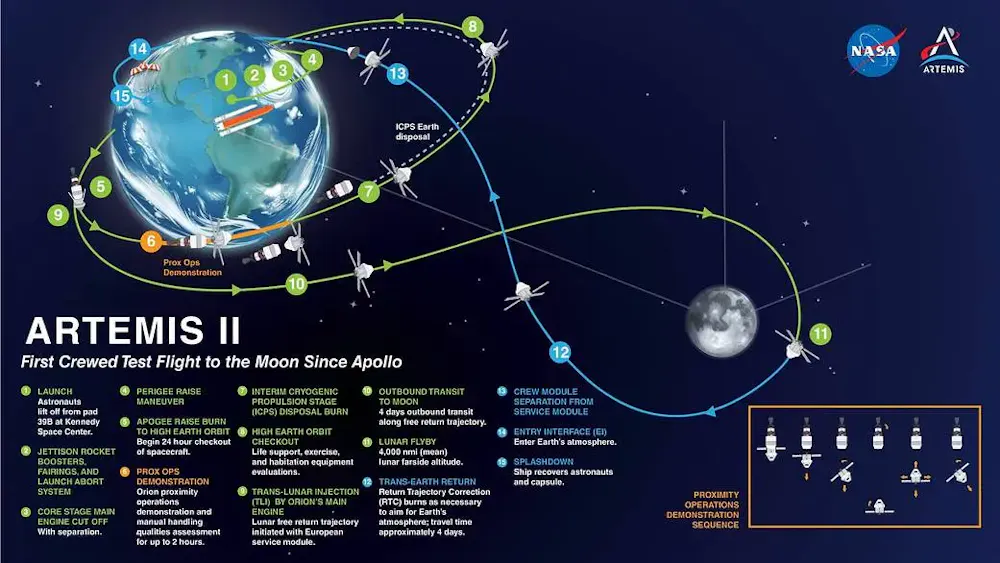
Artemis II, scheduled to launch in February 2026, will not land on the Moon. Its four-person crew will loop around the Moon’s far side, test life-support and navigation systems, and return to Earth. This mission may appear modest. Strategically, however, crewed missions carry a different weight than robotic missions.

A diagram showing the trajectory of Artemis II and major milestones, from jettisoning its rocket boosters to the crew capsule's separation.
Artemis II’s four-person crew will circle around the Earth and the Moon. NASA

Sending people beyond low Earth orbit requires sustained political commitment to spaceflight, funding stability and systems reliable enough that sovereign and commercial partners can align their own plans around them.

Artemis II also serves as a bridge to Artemis III, the mission where NASA plans to land astronauts near the Moon’s south pole, currently targeted for 2028. A credible, near-term human return signals that the U.S. is moving beyond experimentation and toward a sustained presence.

The Artemis II mission, detailed from launch to splashdown.

2 different models for going back to the Moon

The contrast between U.S. and Chinese lunar strategies is increasingly clear.

China’s program is centrally directed and tightly controlled by the state. Its partnerships are selective, and it has released few details about how activities on the Moon would be coordinated with other countries or commercial actors.

The U.S. approach, by contrast, is intentionally open. The Artemis program is designed so partners, both other countries and companies, can operate within a shared framework for exploration, resource use and surface activity.

This openness reflects a strategic choice. Coalitions among countries and companies expand their capabilities and shape expectations about how activities such as landing, operating surface equipment and using local resources are conducted.

When vague rules start to matter

International space law already contains a framework relevant to this emerging competition. Article IX of the 1967 outer space treaty requires countries to conduct their activities with “due regard” for the interests of others and to avoid harmful interference. In simple terms, this means countries are expected to avoid actions that would disrupt or impede the activities of others.

For decades, this obligation remained largely theoretical. On Earth, however, similarly open-ended rules, particularly in maritime contexts, created international conflicts as traffic on shipping lanes, resource extraction and military activity increased. Disputes intensified as some states asserted claims that extended beyond what international law recognized.

The Moon is now approaching a comparable phase.

As more actors converge on resource-rich regions, particularly near the lunar south pole, due regard becomes an immediate operational question rather than a theoretical future issue. How it is interpreted – whether it means simply staying out of each other’s way or actively coordinating activities – will shape who can operate where, and under what conditions.

Washington is naming the race − without panic

During his second Senate Commerce Committee confirmation hearing, NASA Administrator Jared Isaacman was asked directly about competition with China in lunar exploration. He emphasized the importance of keeping U.S. space efforts on track over time, linking the success of the Artemis program to long-term American leadership in space.

A similar perspective appears in a recent U.S. government assessment, the U.S.-China Economic and Security Review Commission’s 2025 annual report to Congress. Chapter 7 addresses space as a domain of strategic competition, highlighting China’s growing capabilities. The report frames human spaceflight and deep-space infrastructure – including spacecraft, lunar bases and supporting technologies – as part of broader strategic efforts. It emphasizes growing a human space program over time, rather than changing course in response to individual setbacks or the accomplishments of other countries.

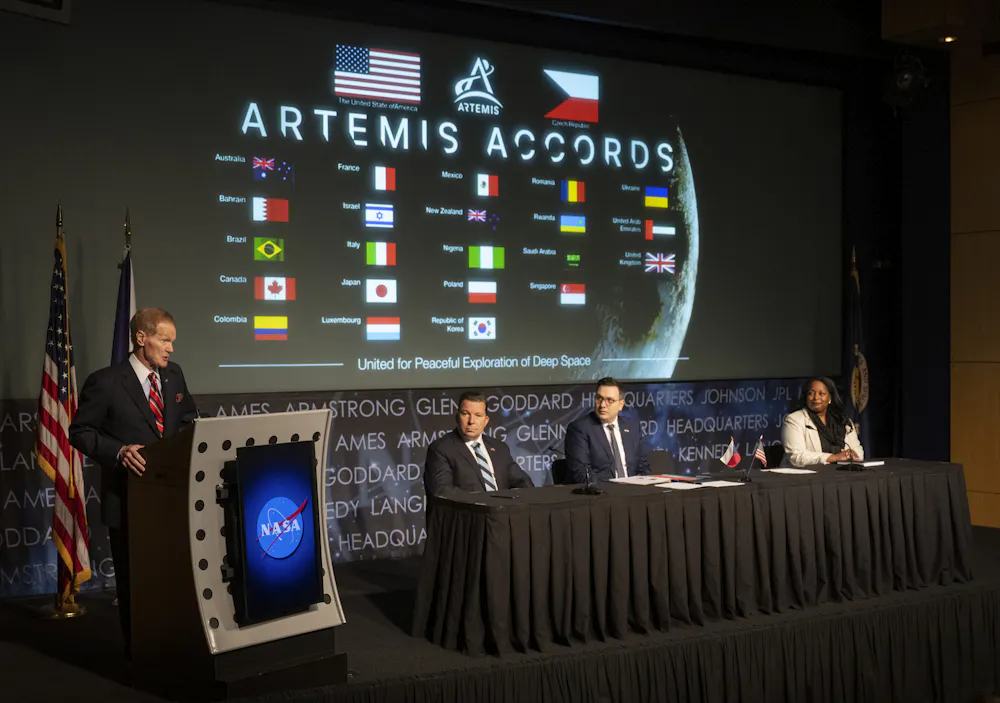
Three people sitting at a panel table and one speaking at a podium with the NASA logo. Projected behind them is a slide reading Artemis Accords, with the flags of several countries.
The U.S. approach to spaceflight is emphasizing international cooperation. Joel Kowsky/NASA via Getty Images

Recent U.S. policy reflects this emphasis on continuity. A new executive order affirms federal support for sustained lunar operations, as well as commercial participation and coordination across agencies. Rather than treating the Moon as a short-term challenge, the order anticipates long-term activity where clear rules, partnerships and predictability matter.

Artemis II aligns with this posture as one step in the U.S.’s plans for sustained activity on the Moon.

A different kind of test

As Artemis II heads toward the Moon, China will also continue to advance its lunar ambitions, and competition will shape the pace and manner of activity around the Moon. But competition alone does not determine leadership. In my view, leadership emerges when a country demonstrates that its approach reduces uncertainty, supports cooperation and translates ambition into a set of stable operating practices.

Artemis II will not settle the future of the Moon. It does, however, illustrate the American model of space activity built on coalitions, transparency and shared expectations. If sustained, that model could influence how the next era of lunar, and eventually Martian, exploration unfolds.The Conversation

Michelle L.D. Hanlon, Professor of Air and Space Law, University of Mississippi

This article is republished from The Conversation under a Creative Commons license. Read the original article.
Clearlake sewer spill area expanded; more water tanks installed

A new map of the expanded 2026 Robin Lake Sewer Spill impact area issued on Friday, Jan. 30, 2026. 


LAKE COUNTY, Calif. — Officials on Friday said they have expanded the incident area for a massive sewer spill in the northern part of Clearlake as a precautionary measure.

Sunday will mark three weeks since a Lake County Sanitation District-owned force main rupture triggered the Robin Lane sewer spill, which released nearly three million gallons of raw sewage into streets and across private properties.

On Monday, the city of Clearlake began managing the recovery phase of the incident in unified command with the Lake County Sheriff’s Office of Emergency Services.

During the week, officials expanded the number of impacted properties from 58 to 200.

By Friday, the unified command said that, based on continued evaluation of groundwater conditions related to the spill, the incident area was expanded as a precautionary measure to ensure the protection of public health.

When the sewer line break was first identified, officials said an initial impact area was established based on the information available at that time, including where groundwater from the shallow aquifer was believed to have the potential to be affected. 

“After further review and consultation with a hydrogeologist, it was determined that groundwater in the area may have moved more laterally than originally anticipated,” the Friday unified command report said.

As a result, unified command expanded the incident area to include additional residents who rely on private wells drawing from the shallow aquifer. 

Three new incident zones were created for properties north of Burns Valley Road that are east of Reid Lane and south of Pond Road, which comprise the new Zone A3, and properties north of Olympic Drive that are east of Old Highway 53, and west of Highway 53, which are included in zones C3 and C4.

Those zone changes — which bring the total number of zones to nine — resulted in the new incident area growing from about 297 acres to an estimated 550 acres, based on an analysis of the city map released by city and county officials.

“Inclusion in the expanded area does not mean contamination has been confirmed at a property. The expansion is intended to ensure that all areas that could potentially be affected receive appropriate guidance, testing and support,” officials said.

Following the recommendation of Public Health Officer Dr. Robert Bernstein, residents within the expanded area are advised not to use their well water until water sampling and laboratory testing have been completed and results confirm the water is safe for use, according to the Friday report.

Officials said Friday that additional groundwater testing and evaluation will continue as part of the ongoing response, and residents will be notified directly about testing and next steps as more information becomes available.

Friday’s recovery update also included new figures for testing, with 151 sites tested and 376 water samples completed.

Additionally, 25 water tanks have now been installed, 18 of them by the incident management team and seven through a program administered by Lake County Social Services.

For residents without water, the mobile laundry and hygiene service trailer is located at 2485 Old Highway 53 in Clearlake.

Residents with questions may contact Lake County Environmental Health at 707-263-1164 for well testing and the city of Clearlake at 707-994-8201 for general information. 

Updates, maps, testing information and available resources are available at the city of Clearlake's website or Response.LakeCountyCA.gov. 

Email Elizabeth Larson at This email address is being protected from spambots. You need JavaScript enabled to view it.. Follow her on Twitter, @ERLarson, and on Bluesky, @erlarson.bsky.social. Find Lake County News on the following platforms: Facebook, @LakeCoNews; X, @LakeCoNews; Threads, @lakeconews, and on Bluesky, @lakeconews.bsky.social. 

Authorities identify subjects killed in Jan. 23 crashes

LAKE COUNTY, Calif. — Authorities have released the names of two people who died in separate crashes last week.

The Lake County Sheriff’s Office said Richard Orvis Evens, 63, Kelseyville died in a vehicle crash on Big Valley Road in Kelseyville and Thalia Inez Ugaz, 23, Stockton was hit and killed by a vehicle while crossing Highway 29 in Nice on Friday, Jan. 23.

The two crashes occurred two hours apart.

At 5:25 p.m. Jan. 23, the California Highway Patrol’s Ukiah Dispatch Center broadcast a call of a solo vehicle crash on Big Valley Road east of Renfro Drive, the CHP reported.

Responding units determined Evens was driving a gray Honda CR-V west on Big Valley Road when, for unknown reasons, he failed to negotiate the curve of the roadway. 

The CHP said Evens drove the Honda off the road and the front of the Honda crashed into a ditch south of Big Valley Road. 

The Honda cartwheeled multiple times and came to rest on its wheels south of Big Valley Road and east of Renfro Drive facing an easterly direction, the CHP said.

The CHP said preliminary evidence suggests Evens was not wearing a seatbelt during the crash. 

He was pronounced dead at the scene, the CHP said.

The CHP said Friday that it remains unknown if drugs and/or alcohol were factors in the crash.

Just two hours after the Evens crash, the CHP responded to a call for a pedestrian hit by a vehicle on Highway 20, west of Howard Avenue in Nice.

Ugaz was found lying in the roadway, unresponsive. A CHP officer administered aid by Ugaz died of her injuries at the scene, the CHP said.

The CHP said the preliminary investigation showed that Ugaz was crossing Highway 20 from south to north, within a crosswalk at Howard Avenue, when she was hit by a gray 2012 Honda Ridgeline being driven westbound on Highway 20 by Brannon Keller, 64, of Clearlake.

Keller was not under the influence of drugs or alcohol and was released from the scene, while the CHP said it was not yet known if Ugaz was under the influence of any substance when the crash occurred.

Email Elizabeth Larson at This email address is being protected from spambots. You need JavaScript enabled to view it.. Follow her on Twitter, @ERLarson, and on Bluesky, @erlarson.bsky.social. Find Lake County News on the following platforms: Facebook, @LakeCoNews; X, @LakeCoNews; Threads, @lakeconews, and on Bluesky, @lakeconews.bsky.social. 

  • 51
  • 52
  • 53
  • 54
  • 55
  • 56
  • 57
  • 58
  • 59
  • 60

Community

  • Sheriff’s Activities League and Clearlake Bassmasters offer youth fishing clinic

  • City Nature Challenge takes place April 24 to 27

Public Safety

  • Lakeport Police logs: Wednesday, Feb. 11

  • Lakeport Police logs: Tuesday, Feb. 10

Education

  • Ramos measure requiring school officer training in use of anti-opioid drug moves forward

  • Lake County Chapter of CWA announces annual scholarships 

Health

  • California ranks 24th in America’s Health Rankings Annual Report from United Health Foundation

  • Healthy blood donors especially vital during active flu season

Business

  • Employment law summit takes place March 9

  • Two Lake County Mediacom employees earn company’s top service awards

Obituaries

  • Terry Knight

  • Ellen Thomas

Opinion & Letters

  • Who should pay for AI’s power? Not California ratepayers

  • Crandell: Supporting nephew for reelection in supervisorial race

Veterans

  • State honors fallen chief warrant officer killed in conflict in Iran

  • CalVet and CSU Long Beach team up to improve data collection related to veteran suicides

Recreation

  • April Audubon program will show how volunteers can help monitor local osprey nests

  • First guided nature walk of spring at Anderson Marsh State Historic Park April 11

  • Second Saturday guided nature walks continue at Anderson Marsh State Historic Park

  • Wet weather trail closure in effect on Upper Lake Ranger District

Religion

  • Kelseyville Presbyterian Church plans Easter service

  • Easter ‘Sonrise’ Service returns to Xabatin Community Park

Arts & Life

  • ‘CIA’ delves into the shadowy world of an espionage thriller

  • ‘War Machine’ shifts the battlefield into uncharted territory

Government & Politics

  • Lake County Democratic Central Committee endorses Falkenberg

  • Crandell launches reelection campaign plans March 15 event

Legals

  • April 23 hearing on Lake Coco Farms Major Use Permit

  • NOTICE OF 30-DAY PUBLIC COMMENT PERIOD & NOTICE OF PUBLIC HEARING

How to resolve AdBlock issue?
Refresh this page