How to resolve AdBlock issue?
Refresh this page
Lake County News,California
  • Home
    • Registration Form
  • News
    • Education
    • Veterans
    • Community
      • Obituaries
      • Letters
      • Commentary
    • Police Logs
    • Business
    • Recreation
    • Health
    • Religion
    • Legals
    • Arts & Life
    • Regional
  • Calendar
  • Contact us
    • FAQs
    • Phones, E-Mail
    • Subscribe
  • Advertise Here
  • Login
How to resolve AdBlock issue?
Refresh this page

News

Clearlake Animal Control: ‘Biggie’ and the dogs

"Biggie." Photo courtesy of Clearlake Animal Control.


CLEARLAKE, Calif. — Clearlake Animal Control has dozens of great dogs needing new homes.

The shelter has 47 adoptable dogs listed on its website.

This week’s dogs include “Biggie,” a large mixed breed dog with a tan and white coat.

Shelter staff said has a personality as big as his body. “This lovable guy is full of affection — he adores cuddles, loves his toys, and is always ready to play. With his goofy charm and gentle heart, he'll keep you smiling every day.”

They said he may do well with other dogs with proper introductions, but they are not sure about cats yet. 

“What we do know is that he's eager to find a family to love and be loved by. Come by and see if he's the right fit for your family,” shelter staff said.

The shelter is located at 6820 Old Highway 53. It’s open from 9 a.m. to 6 p.m. Tuesday through Saturday. 

For more information, call the shelter at 707-762-6227, email This email address is being protected from spambots. You need JavaScript enabled to view it., visit Clearlake Animal Control on Facebook or on the city’s website.

This week’s adoptable dogs are featured below.

Email Elizabeth Larson at This email address is being protected from spambots. You need JavaScript enabled to view it.. Follow her on Twitter, @ERLarson, and on Bluesky, @erlarson.bsky.social. Find Lake County News on the following platforms: Facebook, @LakeCoNews; X, @LakeCoNews; Threads, @lakeconews, and on Bluesky, @lakeconews.bsky.social. 

East Region Town Hall meets Oct. 1

LAKE COUNTY, Calif. — The East Region Town Hall, or ERTH, will meet on Wednesday, Oct. 1.

The meeting will begin at 4 p.m. at the Moose Lodge, located at 15900 Moose Lodge Lane in Clearlake Oaks.

The meeting will be available via Zoom. The meeting ID is 813 6295 6146, pass code is 917658.

Please note, at times Zoom has issues with sound or video. The meeting will also be live streamed on the Lake County Peg TV YouTube channel.

Guest speakers will include Shannon Walker-Smith of Lake County Community Development Department, who will give a presentation on the public draft of the climate adaptation plan and take community input.

The group also will hear from Robin Borre, administrator Lake County Special Districts, regarding a discussion on the status of the Special Lighting District in Clearlake Oaks and Spring Valley CSA No. 2 projects and issues.

Also on the agenda are updates and consideration of ERTH activities/projects, ERTH Council opening, District 3 MAC Update, discussion and consideration of a letter to submit to the Board of Supervisors regarding the Sonoma Clean Power proposal and another on the environmental process for a cell phone tower.

Standing agenda items include the commercial cannabis report and cannabis ordinance update, updates on code enforcement updates, Spring Valley, the Superfund cleanup and Klaus Park, a report from District 3 Supervisor EJ Crandell, and new business and announcements.
   
ERTH’s next meeting will take place on Nov. 5.

Members are Angela Amaral, Holly Harris, Maria Kann and Denise Loustalot.

For more information visit the group’s Facebook page.

California exceeds 200,000 EV chargers

This week, Gov. Gavin Newsom announced that there are now 201,180 fully public and shared electric vehicle, or EV, charging ports available for use throughout the state. 

This is 68% more EV charger ports than the number of gasoline nozzles statewide, according to the California Energy Commission, or CEC.

Earlier this week, the governor announced clean truck sales continued to rise in California in 2024, with zero-emission models representing nearly 1 in 4 of all new truck sales. 

“In the state of California, 94% of people now live within just 10 minutes of an EV charger. We’re proving that electric vehicles are here to stay — even as Trump sells out American innovation and jobs to China,” said Newsom.

California’s growing number of publicly available EV chargers can be found at highly accessible locations like grocery stores, parking lots, and even gas stations. Shared chargers can be found at apartment complexes, workplaces, sports facilities, and other parking areas. This statewide network of public and shared chargers is in addition to the estimated 800,000 EV chargers installed in single family homes. 

“With this expanding public network, EV chargers are becoming ubiquitous in California,” said CEC Commissioner Nancy Skinner. “Our goal is to make driving an EV a no-brainer choice for Californians. They are fun to drive, never need an oil change, don’t cause smog, and it’s getting easier to charge your vehicle with public EV infrastructure.”

Federal ZEV incentives end Sept. 30

Thanks to the Trump administration and Republicans in Congress, federal incentives are ending on September 30. 

Tax credits up to $7,500 are available until then for purchase or lease of eligible new ZEVs, which include EVs and hydrogen-fueled vehicles, and up to $4,000 for eligible used ones. 

Federal incentives for at-home charging and associated battery storage are also available, up to $1,000.  

California is charging ahead

State agencies recently published a report in response to Governor Gavin Newsom’s executive order reaffirming the state’s commitment to ZEV adoption. 

While the federal government wants to keep us hooked on gas, California is charging ahead in the fight for clean air for all.

California is tearing down barriers to ZEV adoption and providing financial and other assistance to speed up EV charger deployment including in low-income areas and rural communities.  

California state agencies continue efforts to speed up EV charger installation and plan for increasing grid demand. This includes: 

• Providing grant funds that support publicly accessible, workplace and at-home charging installations, including in multi-family complexes, throughout the state.
• Prioritizing shovel-ready fast-charging installations for the funding incentives available through the CEC’s grant solicitation programs. 
• Developing the ZEV Infrastructure Plan, a comprehensive plan that lays out the overall infrastructure strategy to meet California’s zero-emission transportation goals.  
• Establishing charger reliability standards. 

In June, the state successfully blocked the Trump Administration from unlawfully withholding billions of dollars in funding approved by bipartisan majorities in Congress for electric vehicle charging infrastructure.

California also announced that there are 20,093 charging and hydrogen fueling points for medium- and heavy-duty zero-emission vehicle vehicles across the state. This is an increase of 3,766 (23%) since the last update in February.

While trucks total just six percent of vehicles on California’s roads, they account for over 35 percent of the state’s transportation emissions and a quarter of the state’s on-road greenhouse gases. 

California’s climate leadership

Pollution is down and the economy is up. Greenhouse gas emissions in California are down 20% since 2000 — even as the state’s GDP increased 78% in that same time period all while becoming the world's fourth largest economy. 

The state also continues to set clean energy records. California was powered by two-thirds clean energy in 2023, the latest year for which data is available — the largest economy in the world to achieve this level of clean energy. The state has run on 100% clean electricity for some part of the day almost every day this year.

Since the beginning of the Newsom Administration, battery storage is up to over 15,000 megawatts — a 1,900%+ increase, and over 25,000 megawatts of new resources have been added to the electric grid. 

Middletown Middle School breaks ground on new gym

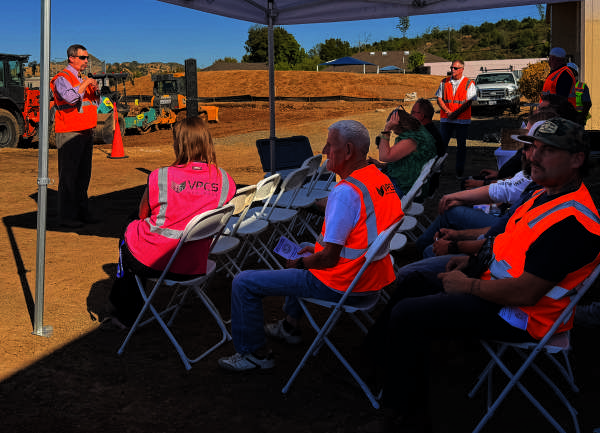
Middletown Unified School District officials participate in the groundbreaking for the new Middletown Middle School gym on Monday, Sep. 22, 2025. Photo by Lingzi Chen/Lake County News.

MIDDLETOWN, Calif. — Middletown Middle School held a groundbreaking ceremony Monday for a new $12 million gym, funded through the Measure H bond approved by voters in 2018.

The 14,000-square-foot gym will feature a basketball/volleyball court striped for pickleball with seating for 500, two locker rooms with coach offices, two classrooms, and a welcoming lobby with restrooms and a ticket booth. 

Construction began on Monday, and is estimated to take 14 months to complete. 

The project is paid for by the Measure H bond, which aims to replace outdated portables, modernize classrooms, enhance student safety and security, and improve career technical and agricultural facilities.

“The project was delayed from its original timeline while the team was able to get necessary state approvals,” Middletown Unified School District Superintendent Jeff Crane told Lake County News in an email.

A rendering of the exterior of the Middletown Middle School gym, construction on which began officially on Monday, Sep. 22, 2025. Image courtesy of Middletown Middle School.

At the groundbreaking, speakers acknowledged the long wait.

“This project has been a long time coming. And there was a lot of adversity and hurdles that threatened to kind of kill the project, ” said Ray Green, project manager for Van Pelt, the company that oversees the bond program and the project execution.

“We got through every single hurdle, and to the point today where we're actually starting to push dirt around,” Green added. 

Crane called it “very much a team project,” citing the efforts of the district, school board and the community.

“There's the community team that voted on the bond and approved the money that we are using to construct this wonderful facility,” he said.

Middletown Unified School District Superintendent Jeff Crane speaks at the groundbreaking for the new Middletown Middle School gym on Monday, Sep. 22, 2025. Photo by Lingzi Chen/Lake County News.

“The voters voted to tax themselves, essentially,” Green added. “This is going to be a huge asset to the community… centralized gathering spot for the community and the community will probably get great use of it.”

Crane later told Lake County News that the new gym will be available for use by outside organizations for a nominal fee, primarily youth sports leagues, but general public access is limited due to the gym's high demand. 

Members of the Middletown Unified Board of Trustees, the Citizens Bond Oversight Committee, Crane and Middletown Middle School Principal Erin Dorman attended the groundbreaking and took part in the ceremonial dirt turning in front of the construction site and excavators. 

A rendering of the interior of the Middletown Middle School gym, construction on which began officially on Monday, Sep. 22, 2025. Image courtesy of Middletown Middle School.

Costs and bond financing

The gym’s construction will cost about $12 million, with additional “soft costs” such as architectural fees, inspectors, project management, and audio and video systems, Green said in an interview after the event.

Arntz Builders, the construction contractor, was the only one of three bidders to come in under budget. “We also happen to like the design that Arntz Builders brought to the table — better than the other two,” Green said.

He also addressed social media criticism that the district is building a $12 million gym while facing budget challenges. Green explained that the project is funded by the Measure H bond, which by law cannot be used to balance the district’s general fund.

“They’re two completely different pots of money, and one cannot be used for the other,” he said.

Green noted that the district also qualifies for state funding to cover part of the two new classrooms. 

A consultant is preparing the application, which, once approved, will provide a 50% state match. However, he said it will take at least two years for those funds to be returned to the district, and they must also be used for facilities.

According to the district website, other Measure H projects completed in the past two years include renovations to sixth grade portables at Middletown Middle School; painting and dry rot repairs at Middletown High, Middletown Middle and Coyote Valley Elementary; a new modular building at Minnie Cannon Elementary; replacement of aging portables at Middletown High with a new three-classroom modular; a new fire alarm system and refurbished restrooms at Coyote Valley Elementary; new flooring at several sites; and envelope repairs to the Tallman Gym at Middletown High.

Email staff reporter Lingzi Chen at This email address is being protected from spambots. You need JavaScript enabled to view it.. 

A rendering of the Middletown Middle School gym complex. Construction on the gym began officially on Monday, Sep. 22, 2025. Image courtesy of Middletown Middle School.


Lake County to explore option of public power generation with Sonoma Clean Power

LAKE COUNTY, Calif. — The Board of Supervisors and the Clearlake and Lakeport city councils will convene for a special meeting next week to discuss a proposal for public power generation.

The public is invited to learn more about how Lake County could offer an alternative to Pacific Gas and Electric’s electric power sources, cut emissions and potentially trim rates while maintaining PG&E for grid maintenance. 

Attendees will learn how Mendocino and Sonoma counties have successfully replaced PG&E’s power sources with their own, and how Lake County is considering a similar action through Sonoma Clean Power.

The joint workshop of the supervisors and the two councils will take place at 5 p.m. Tuesday, Sept. 30, in the board chambers at 255 N Forbes St.

Sonoma Clean Power will make a presentation on its power sources and services. The organization will then answer questions from Lake County, Lakeport and Clearlake elected officials, as well as the public.

Earlier this year, the Lake County Board of Supervisors and the cities of Lakeport and Clearlake sent requests to Sonoma Clean Power to consider extending service into Lake County. This meeting will continue to explore that option in detail. 

The expectation is then that the Board of Supervisors will vote on the decision on Tuesday, Oct. 21, with the Clearlake City Council to vote on Thursday, Oct. 2, and the Lakeport City Council to make its decision on Tuesday, Oct. 21.

Sonoma Clean Power is a community-owned organization fighting for lower rates and more renewable energy. 

Starting in 2014, Sonoma Clean Power began replacing PG&E’s power sources for customers across Mendocino and Sonoma counties. 

Sonoma Clean Power is not a full municipal utility as it still relies on PG&E to maintain all of the poles and wires in the power grid.

The organization has trimmed power bills for its customers by over $100 million over the past decade, and built large solar, wind, and battery systems. 

Sonoma Clean Power is also leading an effort to build 600 megawatts of new geothermal power to secure affordable rates and improve our region’s energy independence. 

Today, Sonoma Clean Power generates the power for 87% of all electric customers across Sonoma and Mendocino counties

How the First Amendment protects Americans’ speech − and how it does not

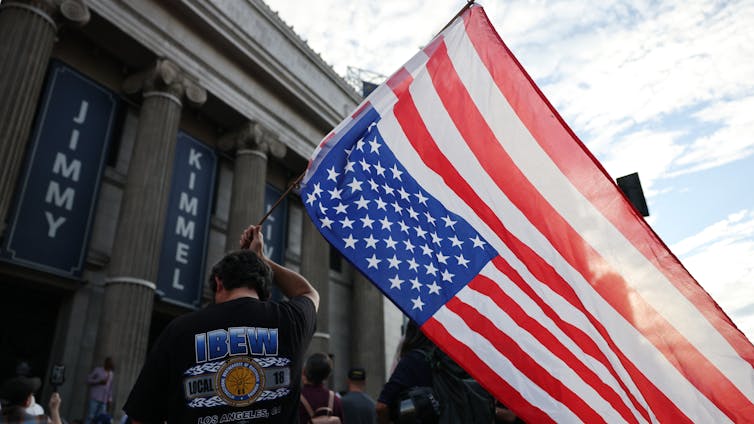
Demonstrators protest the suspension of the “Jimmy Kimmel Live!” show on Sept. 18, 2025, in Los Angeles, Calif. Photo by Mario Tama/Getty Images

Imagine a protest outside the funeral of a popular political leader, with some of the protesters celebrating the death and holding signs that say things like “God Hates the USA/Thank God for 9/11,” “America is Doomed” and “Don’t Pray for the USA.”

No matter the political leanings of that leader, most Americans would probably abhor such a protest and those signs.

What would tolerate such activities, no matter how distasteful? The First Amendment.

The situation described above is taken from an actual protest, though it did not involve the funeral of a political figure. Instead, members of the Westboro Baptist Church protested outside the funeral of Marine Lance Cpl. Matthew Snyder, a U.S. service member killed in Iraq.

Through demonstrations like this, members of this group were conveying their belief that the U.S. is overly tolerant of those they perceive as sinners, especially people from the LGBTQ community, and that the death of U.S. soldiers should be recognized as divine retribution for such sinfulness.

Snyder’s family sued for intentional infliction of emotional distress, among other claims. A jury issued a US$5 million jury award in favor of the family of the deceased service member. But in a nearly unanimous decision issued in 2011, the U.S. Supreme Court found that the First Amendment insulated the protesters from such a judgment.

This holding is particularly instructive today.

The Trump administration has vowed to crack down on what it calls hate speech. It has labeled antifa, a loosely organized anti-fascist group, a terrorist organization. And it has sought to punish figures such as TV host Jimmy Kimmel for statements perceived critical of conservative activists.

What the First Amendment makes clear is that it does not just protect the rights of speakers who say things with which Americans agree. Or, as the Supreme Court said in a separate decision it issued one year after the case involving the funeral protesters: “The Nation well knows that one of the costs of the First Amendment is that it protects the speech we detest as well as the speech we embrace.”

But free speech is not absolute. As a legal scholar who has studied political movements, free speech and privacy, I realize the government can regulate speech through what are known as “reasonable time, place, and manner” restrictions. These limits cannot depend upon the content of the speech or expressive conduct in which a speaker is engaged, however.

For example, the government can ban campfires in an area prone to wildfires. But if it banned the burning of the U.S. flag only as a form of political protest, that would be an unconstitutional restriction on speech.

Protected and unprotected speech

There are certain categories of speech that are not entitled to First Amendment protection. They include incitement to violence, obscenity, defamation and what are considered “true threats.”

When, for example, someone posts threats on social media with reckless disregard for whether they will instill legitimate fear in their target, such posts are not a protected form of speech. Similarly, burning a cross on someone’s property as a means of striking terror in them such that they fear bodily harm also represents this kind of true threat.

There are also violations of the law that are sometimes prosecuted as “hate crimes,” criminal acts driven by some discriminatory motive. In these cases, it’s generally not the perpetrator’s beliefs that are punished but the fact that they act on them and engage in some other form of criminal conduct, as when someone physically assaults their victim based on that victim’s race or religion. Such motives can increase the punishment people receive for the underlying criminal conduct.

Speech that enjoys the strongest free-speech protections is that which is critical of government policies and leaders. As the Supreme Court said in 1966, “There is practically universal agreement that a major purpose of (the First) Amendment was to protect the free discussion of governmental affairs.”

As the late Justice Antonin Scalia would explain in 2003, “The right to criticize the government” is at “the heart of what the First Amendment is meant to protect.”

Restrictions on government action

The First Amendment prevents the government from taking direct action to curtail speech by, for example, trying to prevent the publication of material critical of it. Americans witnessed this in the Pentagon Papers case, where the Supreme Court ruled that the government could not prevent newspapers from publishing a leaked – and politically damaging – study on U.S. military involvement in Vietnam.

But it also applies when the government acts in indirect ways, such as threatening to investigate a media company or cutting funding for a university based on politically disfavored action or inaction.

In 2024 the Supreme Court ruled unanimously that the state of New York’s efforts to punish companies that did business with the National Rifle Association because of the organization’s political positions violated the group’s First Amendment rights.

Similarly, in recent months, courts have ruled on First Amendment grounds against Trump administration efforts to punish law firms or to withhold funds from Harvard University.

And just last week, a federal court in Florida threw out a lawsuit filed by President Trump against The New York Times seeking $15 billion for alleged harm to the president’s investments and reputation.

Nevertheless, some people fear government retribution for criticizing the administration. And some, like the TV network ABC, have engaged in speech-restricting action on their own, such as taking Kimmel temporarily off the air for his comments critical of conservative activists in the wake of Charlie Kirk’s killing.

Before Kimmel’s suspension, Federal Communications Commission Chairman Brendan Carr described his negotiations with ABC’s parent company, Disney, to take action against him. “We could do this the easy way or the hard way,” Carr said. And Trump said that some media companies might “lose their license” for criticizing the president. It is encouraging that, in the face of these threats, ABC has reversed course and agreed to put Kimmel back on the air.

A man listens to reporters.
President Trump speaks to reporters aboard Air Force One after attending a memorial service for conservative activist Charlie Kirk in Glendale, Ariz., on Sept. 21, 2025. AP Photo/Julia Demaree Nikhinson

The First Amendment protects speech across the political spectrum, even speech Americans do not like. Both liberal comedian Jon Stewart and conservative commentator Tucker Carlson have recently agreed on this. As Carlson said recently, “If they can tell you what to say, they’re telling you what to think. … There is nothing they can’t do to you because they don’t consider you human.”

Just last year in the NRA case referenced above, the Supreme Court clearly stated that even indirect government efforts to curtail protected speech are indeed unconstitutional. In light of that ruling, efforts to limit criticism of the administration, any administration, should give all Americans, regardless of their political views, great pause.The Conversation

Ray Brescia, Associate Dean for Research and Intellectual Life, Albany Law School

This article is republished from The Conversation under a Creative Commons license. Read the original article.


  • 140
  • 141
  • 142
  • 143
  • 144
  • 145
  • 146
  • 147
  • 148
  • 149

Community

  • Sheriff’s Activities League and Clearlake Bassmasters offer youth fishing clinic

  • City Nature Challenge takes place April 24 to 27

Public Safety

  • Lakeport Police logs: Wednesday, Feb. 11

  • Lakeport Police logs: Tuesday, Feb. 10

Education

  • Ramos measure requiring school officer training in use of anti-opioid drug moves forward

  • Lake County Chapter of CWA announces annual scholarships 

Health

  • California ranks 24th in America’s Health Rankings Annual Report from United Health Foundation

  • Healthy blood donors especially vital during active flu season

Business

  • Employment law summit takes place March 9

  • Two Lake County Mediacom employees earn company’s top service awards

Obituaries

  • Terry Knight

  • Ellen Thomas

Opinion & Letters

  • Who should pay for AI’s power? Not California ratepayers

  • Crandell: Supporting nephew for reelection in supervisorial race

Veterans

  • State honors fallen chief warrant officer killed in conflict in Iran

  • CalVet and CSU Long Beach team up to improve data collection related to veteran suicides

Recreation

  • April Audubon program will show how volunteers can help monitor local osprey nests

  • First guided nature walk of spring at Anderson Marsh State Historic Park April 11

  • Second Saturday guided nature walks continue at Anderson Marsh State Historic Park

  • Wet weather trail closure in effect on Upper Lake Ranger District

Religion

  • Kelseyville Presbyterian Church plans Easter service

  • Easter ‘Sonrise’ Service returns to Xabatin Community Park

Arts & Life

  • ‘CIA’ delves into the shadowy world of an espionage thriller

  • ‘War Machine’ shifts the battlefield into uncharted territory

Government & Politics

  • Lake County Democratic Central Committee endorses Falkenberg

  • Crandell launches reelection campaign plans March 15 event

Legals

  • April 23 hearing on Lake Coco Farms Major Use Permit

  • NOTICE OF 30-DAY PUBLIC COMMENT PERIOD & NOTICE OF PUBLIC HEARING

How to resolve AdBlock issue?
Refresh this page