How to resolve AdBlock issue?
News
LAKE COUNTY, Calif. — There was another development on Monday in the county of Lake’s ongoing effort to push back against Pacific Gas and Electric’s effort to remove the dams in the Potter Valley Project, including the Scott Dam that forms Lake Pillsbury, a plan the Board of Supervisors chair called “reckless.”
County officials issued a Monday statement that challenged PG&E’s recent assertions that a reason for decommissioning and removing the project was due to seismic issues.
The Potter Valley Project, which PG&E has owned since 1930, is located in Lake and Mendocino counties.
The project consists of the Scott Dam and the Cape Horn Dam, both of which are located on the upper main stem of the Eel River, as well as the Potter Valley powerhouse, the 80,000-acre-foot Lake Pillsbury in Lake County, the Van Arsdale Reservoir, a fish passage structure and salmon and steelhead counting station at the Cape Horn Dam, and and 5,600 acres of land.
The Scott Dam diverts water from the Eel River to the Russian River, which county officials said sustains agriculture, contains critical water for fire suppression, aids local economies
and provides water supplies to property owners from Mendocino to Marin counties.
In 2017, PG&E announced it would auction off the project the following year, and since then the project has moved forward over the objections of the Lake County government and the Lake Pillsbury community.
In that time, PG&E has gathered allies for the decommissioning around the North Coast, including counties, cities and tribes in line to get water and monetary benefits from a “two basin solution,” a plan that includes adding new diversions and increasing storage elsewhere, such as at the Coyote Dam at Lake Mendocino.
PG&E’s justifications for abandoning the project have included its age and reported financial losses. More recently, the company has claimed seismic risk is a reason for walking away from the dam’s maintenance.
Lake County officials pointed out that, despite those reported drawbacks to the project, PG&E has still noted water storage and diversion benefits of the Potter Valley Project within its own company reports.
Then, on Monday, the county of Lake said that newly obtained reports from the California Department of Water Resources’ Division of Safety of Dams show the Potter Valley dams slated for removal are, “suitable for continued safe and reliable operation” — despite claims by PG&E and supporters of the decommissioning plan to the contrary.
The reports are now published on a dedicated page on the county of Lake website.
County officials said they obtained the state reports from 2023 “after repeated attempts for their public disclosure.”
The county also noted in its statement that, “For years, proponents of the dam removal effort have described the Potter Valley project as a seismic risk — citing safety concerns as justification for their removal. In the report, analysis indicates, that per ‘known information and visual inspection, the dam, reservoir and appurtenances are judged safe for continued use.’”
The county’s statement cited a study conducted by the University of California, Davis that found losing the Potter Valley Project diversion — which encompasses both Scott and Cape Horn dams — would reduce the reliability of Lake Mendocino’s water storage and would affect Lake Pillsbury.
Water from Lake Pillsbury was used to combat the 2018 Mendocino Complex fire and the 2020 August Complex fire, a point made repeatedly during a May town hall on the Potter Valley Project situation.
“For years, we’ve heard about safety issues surrounding the dam; today, armed with facts and data from the State’s dam safety authority, those allegations are in serious doubt,” said Board of Supervisors Chair Eddie Crandell. “PG&E’s decommissioning plan is reckless and puts our county at risk. We will continue to work with regional leaders and partners to reach resolution without negatively affecting our communities and residents.”
The county referenced findings in the state dam safety surveillance monitoring report and visual inspections by PG&E, the Federal Energy Regulatory Commission and the Division of Safety of Dams – Department of Water Resources that concluded that “the dam is judged to be performing satisfactorily.”
Those documents also quote an expert review by the Division of Safety of Dams that stated, “The project is suitable for continued safe and reliable operation. The dam surveillance and monitoring program is adequate.”
Earlier this year, the Board of Supervisors voted to write to state and federal officials about their concerns about the removal of the Scott Dam and Lake Pillsbury.
“PG&E’s proposed decommissioning conflicts with state and federal priorities to increase water supply and storage capacity, especially in fire-prone regions, in response to the Los Angeles fires earlier this year,” the county’s Monday statement said.
PG&E submitted its surrender application and decommissioning plan for the Potter Valley Project with the Federal Energy Regulatory Commission, or FERC, on July 25.
FERC is now in the process of reviewing the application, which can take up to two years, county officials said.
PG&E responds to county
Lake County News asked PG&E for a response to the county’s statements.
On Monday evening, PG&E offered the following:
“PG&E made the challenging and irreversible decision not to relicense the Potter Valley Project as it was uneconomic for our customers. Over time, PVP became non-economic for PG&E’s customers as the cost of generating has exceeded the cost of alternative sources of renewable power on the open market.
“Realizing that agriculture and communities had come to rely upon the water, nearly 10 years ago, PG&E reached out to stakeholders and suggested they take over the project. When no one did, PG&E issued a request for proposals from interested parties such as other hydropower producers. No one sought ownership then.
“In 2019, PG&E withdrew its application for a new FERC license. The decision to cease relicensing of the project is not one PG&E took lightly, as we recognize the important regional and state significance, particularly around water supply, recreation, and the project’s effects on the Eel and Russian Rivers.
“We have always said the dams are safe, otherwise we would not be operating them. In 2023 PG&E completed a study showing the seismic concerns at Scott Dam were greater than previously understood and required mitigation to meet PG&E’s safety standards and those of our dam safety regulators. As mitigation, PG&E kept the maximum reservoir elevation at least 10 feet below the full elevation. Well before the updated analyses, PG&E made the decision to decommission the Potter Valley Project as it is uneconomical. The updated analysis is not the driver of decommissioning, despite what some claim,” the statement said.
New comment period to be announced
On Monday, the county said that, following PG&E’s submission of its July FERC filing, FERC was expected to announce a new 30-day period allowing the public to comment on proposed action for the Potter Valley Project.
The county said that no new public comment period has so far been established.
In response, PG&E said, “FERC will announce when the public comment period will open and we do not know when that will be determined.”
The company said FERC will notify subscribers to the P-77 Docket when the public comment period opens. Subscribe here.
To be considered, comments must be submitted directly to FERC.
Email Elizabeth Larson at
LAKE COUNTY, Calif. — A shooting reported on Monday night sent two people to regional trauma centers.
The incident was first reported shortly after 8 p.m. at WestAmerica Bank, 15342 Lakeshore Drive.
Medics were cleared by Clearlake Police to enter the scene shortly after dispatch, according to radio traffic.
There were reported to be two adult patients in the bank’s back parking lot with multiple gunshot wounds to their lower extremities.
Two air ambulances were requested to respond to Adventist Health Clear Lake Hospital and to the former Pearce Field airport, where ground ambulances took the patients for transport.
No additional details were immediately available on the shooting.
Email Elizabeth Larson at
NORTH COAST, Calif. — The Sonoma County Sheriff's Office said it has arrested two suspects from Hidden Valley Lake and Santa Rosa as part of its investigation into a violent home invasion robbery in Sonoma earlier this month.
Hugo Alexander Matamoros-Acosta, 20, of Hidden Valley Lake, and Sincere Nasir Rush Tanner, 22, of Santa Rosa, were taken into custody in the case, the agency said.
Authorities said the home invasion occurred at approximately 4:14 a.m. Sept. 12 in the 3000 block of Wood Valley Road in Sonoma.
Deputies responded to reports of an armed robbery where masked subjects, armed with firearms, forcibly entered a residence and restrained three victims, two of them being elderly, officials said.
The subjects threatened the victims, demanding valuables and, during the incident, one of the robbers struck a victim over the head with a blunt object, resulting in injury. The subjects fled the scene with stolen items.
Following the incident, detectives from the Sonoma County Sheriff’s Violent Crimes Unit were dispatched to the scene and assumed responsibility for the investigation, the agency said.
Based on the information they gathered, detectives were able to track down Matamoros-Acosta and Tanner at Twin Pine Casino in Middletown, the report said.
During the execution of a search warrant, the sheriff’s office said detectives recovered a firearm in Rush Tanner's car that they suspect was used in the robbery.
Both suspects were arrested and booked into the Sonoma County Main Adult Detention Facility on multiple charges.
Rush Tanner is being held on $1 million bail for felony charges including elder abuse, kidnapping to commit robbery, vehicle theft, altering a firearm ID number, first-degree robbery, assault with a deadly weapon, possession of a large-capacity magazine and conspiracy.
Matamoros-Acosta is being held on $1,031,000 bail for felony charges including elder abuse, kidnapping to commit robbery, vehicle theft, first-degree robbery, assault with a deadly weapon and conspiracy, and a misdemeanor violation of probation.
Both remain in custody.
Court records show both Matamoros-Acosta and Rush Tanner were arraigned on Sept. 16 and are due to return to court on Oct. 7 to enter their pleas.
Detectives from the Violent Crimes Unit are actively investigating this incident to identify all those involved. Anyone with information about this incident to contact the Sonoma County Sheriff’s Office at 707-565-2185, or submit an anonymous tip through the agency’s website.
On Monday, Gov. Gavin Newsom signed legislation meant to help ensure the long-term success of California’s legal cannabis market, which is reported to be the largest in the world.
The legislation, AB 564, eliminates a 25% tax increase on California's legal cannabis industry.
“We’re rolling back this cannabis tax hike so the legal market can continue to grow, consumers can access safe products and our local communities see the benefits,” said Newsom.
"California's cannabis economy can bring enormous benefits to our state, but only if our legal industry is given a fair chance to compete against the untaxed and unregulated illegal market,” said Assemblymember Matt Haney (D–San Francisco), the bill’s author. “AB 564 helps level the playing field. It protects California jobs, keeps small businesses open, and ensures that our legal cannabis market can grow and thrive the way voters intended.”
AB 564 reverses a 25% tax increase on California's legal cannabis industry and sets the state’s cannabis excise tax rate at 15% until 2028, allowing legal businesses to remain competitive and promoting the industry’s long-term growth.
The administration recently enacted measures to bolster long-term enforcement efforts against illegal operators by dedicating cannabis tax revenue to fund civil and criminal enforcement activities. Newsom’s office said this will reduce the burden on legal businesses while ensuring sustained actions against illegal operators.
In addition, Board of State and Community Corrections grant eligibility has expanded to local jurisdictions, especially those allowing retail access, to further enhance and support local enforcement efforts against illegal cannabis activity.
A unified strategy across California
So far, the Unified Cannabis Enforcement Taskforce, or UCETF, which Newsom established in 2022, has seized and destroyed over 317 tons, or over 635,303 pounds, of illegal cannabis worth an estimated retail value of $890 million through nearly 230 multiagency operations.
UCETF has enhanced collaboration and enforcement coordination between state, local and federal partners. Partners on the task force include the Department of Cannabis Control, the Department of Pesticide Regulation, the Department of Toxic Substances Control, and the Department of Fish and Wildlife, among others.
To learn more about the legal California cannabis market, state licenses, and laws, visit cannabis.ca.gov.
LAKE COUNTY, Calif. — The Board of Supervisors this week will take up a slate of fiscal and policy matters, including adopting the final 2025-26 budget, considering $60,000 in support for business groups, increasing $350,000 for a Behavioral Health contract and imposing a temporary ban on new cannabis cultivation permits.
The board will meet beginning at 9 a.m. Tuesday, Sept. 23, in the board chambers on the first floor of the Lake County Courthouse, 255 N. Forbes St., Lakeport.
The meeting can be watched live on Channel 8, online at https://countyoflake.legistar.com/Calendar.aspx and on the county’s Facebook page. Accompanying board documents, the agenda and archived board meeting videos also are available at that link.
To participate in real-time, join the Zoom meeting by clicking this link.
The meeting ID is 865 3354 4962, pass code 726865. The meeting also can be accessed via one tap mobile at +16694449171,,86533544962#,,,,*726865#. The meeting can also be accessed via phone at 669 900 6833.
At 10:15 a.m., the board will consider a one-time combined $60,000 allocation from the county — $26,000 for the Lake County Economic Development Corp., or EDC, and $34,000 for the Lake County Chamber of Commerce — to stabilize funding while the two organizations “share an executive director” and reduce costs, according to the staff report.
The EDC has not received its usual $109,000 from the US Department of Agriculture Rural Business Development Grant, awarded since 2019. If the grant comes through, the staff report said it will repay the $26,000 to the county, and explore ways to return the full $60,000.
The allocation would come from the county’s $900,000 economic development impact fee deferral program, reducing it to $840,000.
The financial difficulty of the Lake County Chamber came up during the county’s budget hearings in June.
Supervisor Brad Rasmussen said the chamber “can’t sustain running that visitor center” since the transfer of transient occupancy tax to the Tourism Improvement District. “What’s at risk is that the visitor center may close,” Rasmussen said.
He added that an annual $50,000 allocation to the chamber will need discussion.
Supervisor Bruno Sabatier said at the same hearing, “A group to support businesses that can't run their own business and needs us to support them financially to run their business, seems a little bit on the awkward side.”
On Sept. 2, Amanda Martin, hired in December 2024 as chief executive officer of the chamber, announced her resignation after nine months in the role.
At 10:30 a.m., the board will discuss a presentation about the outcome of the 2025 Clear Lake Hitch community science spawner observation program, which trained community volunteers to observe and collect data about the hitch.
At 11 a.m., the board will consider the final recommended budget for fiscal year 2025-26.
The staff report noted adjustments to budget, project and position allocation, as the county has received new funds since the June hearings, such as $6,493,892 in Fund Balance Available and $12,506,226 in American Rescue Plan Act, also known as the State and Local Fiscal Recovery Funds.
At 1 p.m., the board will consider establishing an ad hoc committee to develop agriculture road standards.
In 2019, the board clarified that outdoor cannabis cultivation should follow agricultural rather than commercial road standards. However, broader discussion raised the need for consistent road standards across all agricultural activities such as pears, walnuts and winegrapes.
The proposed ad hoc committee would include representatives from local agriculture, fire districts, the Lake County Winegrape Association and the Farm Bureau.
Staff proposes that the committee function as a temporary working group, not subject to the Brown Act, coordinated by Community Development, and aligned with the timeline for updating cannabis regulations.
At 2 p.m., the board will consider an ordinance amendment that temporarily bans new commercial cannabis cultivation applications and halt the process of incomplete applications.
“In response to declining permitted cannabis cultivation and an increasing backlog of incomplete applications,” the staff report said, “the ordinance would temporarily prohibit the acceptance of new commercial cannabis cultivation applications and halt the process of applications not deemed complete as of the ordinance’s effective date.”
This measure, once approved, will remain in effect until Jan. 1, 2026.
“This action would allow staff to focus on processing existing complete applications while supporting the development of a comprehensive, updated cannabis ordinance,” the staff report said.
At 2:30 p.m., the board will consider impacts of recent and pending withdrawals from the county treasury pool and potential changes to county investment policy.
County fire districts have utilized the county treasurer both for treasury operations and for investment. However, the Lake County Fire Protection District Board of Directors approved on August 20 to withdraw from the county’s treasury pool to pursue independent investments, while still seeking to use some county treasurer services.
“While we recently have had a district leave the pool entirely, this is the first we have encountered a district attempting to stay partially in…” the staff report said.
The partial participation creates instability for the pool, which is structured for all participants to share risks and rewards equally, according to the staff report. The county is now evaluating protective measures to safeguard schools and other agencies dependent on the pool.
In the untimed items, the board will consider raising a Behavioral Health service contract from $25,000 to $375,000 — 15 times the original amount.
The county entered into an agreement with Redwood Community Services Inc. on July 1, to operate the Phoenix House Crisis Residential Treatment Facility. “Service demand has exceeded initial projections, requiring an increase in contract funding,” the staff report said.
Despite overseeing tens of millions in service contracts, Behavioral Health has leaned on General Fund loans, citing cash flow challenges associated with Medi-Cal reimbursement. The board last week granted the department a nine-month extension on a $2 million loan in a 4-1 vote, with Sabatier opposed.
The full agenda follows.
CONSENT AGENDA
5.1: Adopt proclamation declaring September 26, 2025, as Native American Day in Lake County.
5.2: Adopt proclamation declaring the second Monday in October as Indigenous Peoples’ Day in Lake County.
5.3: Approve second amendment of agreement between the County of Lake and 4LEAF Inc. to extend term to October 1, 2027, and increase compensation by $60,000, for a total compensation not to exceed $200,000, for building permit processing and inspection services, and authorize the chair to sign.
5.4: Adopt resolution setting rate of pay for election officers for the November 4, 2025, statewide special election.
5.5: Adopt resolution to accept the funding in the agreement between the County of Lake and the California Housing and Community Development Department.
TIMED ITEMS
6.1, 9:02 a.m.: Public input.
6.2, 9:03 a.m.: Pet of the week.
6.3, 9:05 a.m.: Presentation of proclamation declaring September 26, 2025, as Native American Day in Lake County.
6.4, 9:10 a.m.: Presentation of proclamation declaring the second Monday in October as Indigenous Peoples’ Day in Lake County.
6.5, 9:15 a.m.: UCCE Water and Climate Advisor Program update – Dr. Laura Garza Díaz.
6.6, 9:30 a.m.: Hearing, consideration of request for hearing regarding code enforcement abatement activity at 6782 and 6792 Marin Street, Nice (APNs 031-173-38 & 41); property owner and appellant: Jessica Northcutt.
6.7, 10 a.m.: Hearing, consideration of request for hearing regarding code enforcement activity at 7180 Dodge Road, Nice (APN 032-091-18); property owner: Diana Anglero.
6.7(b), 10:15 a.m.: Addendum, consideration of support in the amount of $26,000 for the Lake County Economic Development Corporation and $34,000 for the Lake County Chamber of Commerce.
6.8, 10:30 a.m.: Presentation from Lake County Watershed Protection District/Water Resources staff on the 2025 Clear Lake Hitch Community Science Spawner Observation Program – summary and outcomes.
6.9, 11 a.m.: Public hearing, consideration of the final recommended budget for fiscal year 2025-26 for the County of Lake and special districts governed by the Board of Supervisors.
6.10, 1 p.m.: Consideration of request for board direction regarding establishment of ad hoc committee for development of agriculture road standards.
6.11, 1:30 p.m.: Consideration of Western Region Town Hall presentation to the Lake County Board of Supervisors.
6.12, 2 p.m.: Public hearing, consideration of an ordinance on the processing of commercial cannabis cultivation permits within the unincorporated area of the County of Lake.
6.13, 2:30 p.m.: Consideration of impacts resulting from recent and pending withdrawals from county treasury pool and potential changes to county investment policy.
NON-TIMED ITEMS
7.1, Supervisors’ weekly calendar, travel and reports.
7.2, Consideration of response to the 2024-25 Lake County Civil Grand Jury final report.
7.3, Consideration of approval of Amendment No. 1 to the agreement between the County of Lake and Redwood Community Services, Inc. Phoenix House Crisis Residential Treatment Facility for fiscal year 2025-26.
CLOSED SESSION
8.1, Conference with legal counsel, significant exposure to litigation pursuant to Gov. Code section 54956.9(d)(2), (e)(1), one potential case.
Email staff reporter Lingzi Chen at
A new UC Berkeley-led study demonstrates how two mitigation strategies — home hardening and defensible space — can have a major impact on wildfire destructiveness.
Since January’s wildfires flattened entire neighborhoods in Los Angeles, displacing 12,900 households and causing an estimated $30 billion in losses, California’s many other fire-prone communities have been eager for solutions to better protect themselves.
A new UC Berkeley-led study provides these communities and their lawmakers with actionable data on how wildfire mitigation strategies can reduce the destructiveness of wildfires by as much as 50%.
One option to reduce wildfire damage is home hardening, which describes a variety of structural modifications that homeowners can use to make their houses less susceptible to fire.
These include using fire-resistant siding and roofing materials, covering vents to prevent embers from entering the home, and upgrading to double-paned tempered glass windows that are less likely to break in a fire.
Another strategy, defensible space, refers to a vegetation-free “buffer zone” around a home or structure. Because renovating existing homes is not always easy or cheap, data on the effectiveness of these measures is key to justifying future investment.
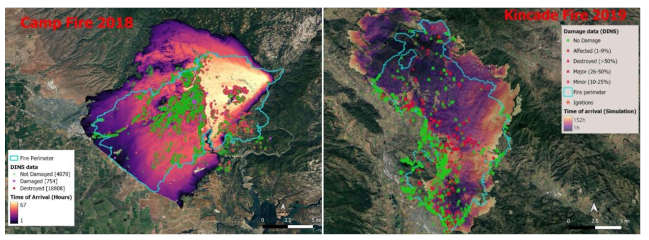
In the study, the researchers used state-of-the-art wildfire simulation tools, combined with real-world data from five of the most destructive fires that occurred in California before 2022, to quantify the impact of these strategies.
It found that home hardening and defensible space together can double the number of homes and other structures that survive a blaze. Notably, they also demonstrated that just removing the vegetation within a 5-foot perimeter of homes — the subject of California’s proposed Zone Zero regulations — could reduce structure losses by 17%.
“I view this as really powerful evidence that the mitigation measures that are available to us, hardening and defensible space, actually have some real-world effectiveness,” said study senior author Michael Gollner, associate professor of mechanical engineering at Berkeley.
These strategies may further prevent loss and death by slowing the spread of fire, giving residents more time to evacuate and emergency responders more time to arrive at the scene, Gollner said.
“We can’t always change the spacing between structures or the exposure from flames and embers,” Gollner said. “But even within those limitations, we still have the power to cut the destruction in half, if not more. That is very powerful.”
The study was published online today (Aug. 28) in the journal Nature Communications, and was supported by grants from the California Department of Forestry and Fire Protection (CAL FIRE) through the Forest Health program, the Gordon and Betty Moore Foundation and the National Science Foundation.
Investment in mitigation pays off
To measure the impact of wildfire mitigation strategies, a research team led by Gollner and Berkeley postdoctoral scholar Maryam Zamanialaei took advantage of Cal Fire’s unique damage inspection database, or DINS, which includes data from on-the-ground surveys of all structures that were damaged or destroyed in major California wildfires since 2013.
The study focused on the 2017 Tubbs and Thomas fires, 2018 Camp fire, 2019 Kincade fire and 2020 Glass fires. To build a comprehensive data set, researchers then added information from a variety of other geospatial sources to better define the spacing between each building, the construction materials used and the density of vegetation surrounding each structure.
A unique aspect of the study was the use of state-of-art simulation tools to model how wildfire might have spread through each community, allowing researchers to account for fire exposure to each structure.
By applying advanced machine learning techniques to the combined dataset, they developed a data-driven model that predicts structure survivability with 82% accuracy and disentangles how factors such as structure spacing, fire exposure, construction materials and defensible space combine to influence risk.
“We wanted to identify the risk factors that make a structure susceptible to loss,” Zamanialaei said.
“It’s possible that a well-protected home may have a low chance of survival because of everything around it,” Gollner added. “The model allows us to tune in to see the impact of each factor and how they interplay.”
Their research identified structure separation distance as the most influential factor driving structure loss, especially in densely built areas where wildfire is spread from building to building. Flame length also emerged as a critical contributor.
In addition, construction features such as exterior siding and window materials substantially contributed to the vulnerability of structures. The findings highlight how building arrangement and exposure to flames, combined with ignition resistance, all contribute to wildfire risk.
However, for mitigation strategies to work best, they need to be adopted by everyone in a fire-prone community, Gollner said. As the fierce debates over Zone Zero regulations illustrate, it can be challenging to cultivate the social and political will to implement these changes on a large scale.
“Much of what you can do to prevent these fires from spreading through the whole community happens on an individual’s property and depends on what your neighbor does,” Gollner said. “This is a really challenging social, economic and political problem that requires a lot of groups working together.”
He hopes that the study further highlights the importance — and positive impact — of this challenging work.
“We need to justify the investments we’re making in mitigation, and I was glad to see that for many of them, we do see significant payback in terms of risk reduction,” Gollner said.
Additional co-authors of the study include Daniel San Martin of the Universidad Técnica Federico Santa María; Maria Theodori and Dwi Purnomo of UC Berkeley; Ali Tohidi, Arnaud Trouvé and Yiren Qin of the University of Maryland; and Chris Lautenberger of Cloudfire.
Kara Manke writes for the UC Berkeley News Center.