How to resolve AdBlock issue?
Refresh this page
Lake County News,California
  • Home
    • Registration Form
  • News
    • Education
    • Veterans
    • Community
      • Obituaries
      • Letters
      • Commentary
    • Police Logs
    • Business
    • Recreation
    • Health
    • Religion
    • Legals
    • Arts & Life
    • Regional
  • Calendar
  • Contact us
    • FAQs
    • Phones, E-Mail
    • Subscribe
  • Advertise Here
  • Login
How to resolve AdBlock issue?
Refresh this page

News

Space News: 50 years ago, NASA sent 2 spacecraft to search for life on Mars – the Viking missions’ findings are still discussed today

NASA’s Viking landers were the first spacecraft to successfully touch down on the surface of Mars. NASA/JPL-Caltech via AP

Finding life beyond the Earth would be a major scientific discovery with significant implications for all areas of science and human thought. Yet, only one direct search for extraterrestrial life has ever been conducted.

A poster showing the Viking craft parachuting to the Martian surface.
The Viking missions landed on the Martian surface using parachutes. This diagram shows each stage the spacecraft went through as they landed. NASA

The NASA Viking spacecraft, which landed on Mars, conducted this search in the summer of 1976. Viking consisted of two twin orbiters and landers, with experimental chambers in the landers to conduct three biology experiments.

Over the past half-century, the measurements made during the Viking biology experiments have been the subject of many discussions, analyses and speculation. Today, scientists are still discussing the results of these experiments in an attempt to answer the age-old question of whether there is life beyond the Earth.

The year 2025 marks 50 years since the two spacecraft launched, three weeks apart. These landers achieved humankind’s first two successful soft landings of operational and functioning spacecraft on the surface of another planet.

I’m an atmospheric scientist who worked on the Viking missions in the 1970s at the NASA Langley Research Center, the laboratory that developed and managed the highly successful Viking missions. The Viking missions’ scientific discoveries painted a new picture of Mars’ atmosphere, surface and planetary history.

The Viking 1 lander reached the surface of Mars after being ejected from a spacecraft and deploying a parachute.

Launching and landing the Viking spacecraft

The two Viking spacecraft both consisted of an orbiter and a lander. Viking 1 entered Mars’ orbit on June 19, 1976, and successfully landed on the surface on July 20, 1976, which was also the seventh anniversary of the first human Moon landing. Viking 2 followed, landing on Sept. 3, 1976, at a site farther to the northwest.

Viking wasn’t just looking for life.

These crafts contained equipment to take pictures; map heat energy, wind and weather; study the chemical composition of the surface, dust and atmosphere; and collect and analyze soil samples.

Measurements that Viking took of the atmosphere suggested that Mars used to have a much denser atmosphere but over time lost it. It also observed that the wind picks up tiny dust particles, blowing them into the atmosphere. This process colors the planet’s sky permanently pink.

A diagram of the Viking landers, with each instrument labeled.
All the instruments found on the Viking landers. NASA

The Viking landers also discovered that at any location on Mars, the atmosphere’s surface pressure varies seasonally. The planet has frozen north and south poles, like on Earth. At the Martian poles in summer, the frozen carbon dioxide sublimates – transforming from a frozen solid to a gas – and then at the winter pole condenses back into a frozen solid.

That process, unique to Mars, affects the atmospheric pressure by changing how much carbon dioxide is in gas form instead of solid form over the planet’s surface.

Biology experiments

Each of the three Viking biology experiments brought a soil sample from the Martian surface into a sterilized test chamber and exposed the sample to a different nutrient under different atmospheric conditions.

Researchers wanted to find out whether the soil contained microorganisms, so they monitored how the atmosphere in the chamber changed. Metabolic processes – like breathing – from organisms consuming the nutrient would change the chemical composition of the chamber’s atmosphere.

Depending on the experiment, the nutrient contained either carbon, carbon dioxide or carbon monoxide – all of which were radioactive. With radioactive samples, researchers could track the level of radioactivity in the chamber to see if metabolic reactions in the soil samples were raising or lowering it.

For all three experiments, the researchers could use radio commands to heat up the test chamber, which was still inside the Viking spacecraft on Mars. This would destroy any potential microorganisms in the soil and stop the production of any gases they were creating metabolically.

In the first experiment, called the carbon assimilation experiment or the pyrolytic release experiment, the researchers simulated the Martian atmosphere in one of Viking’s test chambers. They filled the chamber with gases such as carbon dioxide and carbon monoxide and made these gases radioactive to see how the atmosphere changed from interactions with the soil sample.

In the second experiment, The labeled release experiment, researchers directly injected the soil sample with a nutrient containing radioactive carbon. They monitored the experimental chamber for radioactive carbon dioxide and measured the level of radioactive carbon dioxide after injecting the soil samples. In this experiment, the investigators saw results that could have come from a biological source.

A diagram showing the three experiments in sealed chambers.
The three biology experiments involved putting soil samples in sealed chambers with nutrients and seeing what happened to the atmosphere in each chamber. NASA

The third experiment, the gas exchange experiment, filled the chamber with helium, which doesn’t react with anything. They exposed the soil to different types of nutrients. Some had been incubating in wet conditions, others in humid conditions and others still in dry conditions.

Again they monitored the chamber for potential metabolically produced gases. When the soil samples touched the wet nutrient, the humidity immediately caused some changes in the chamber’s chemical environment. Most of these changes were just caused by the water evaporating.

In one case, superoxides in the soil, which are O₂ molecules that have taken on an extra electron, reacted with water. Other changes had to do with oxygen molecules in the soil breaking down. All of these changed the atmosphere in the chamber but likely wouldn’t have been caused by microorganisms.

The researchers repeated this experiment by resetting the chamber’s atmosphere and adding in fresh nutrients, but they didn’t change the soil sample. This time, the soil released only carbon dioxide into the chamber, which likely came from the organic materials in the nutrient they added breaking down.

The results from this third experiment led the researchers to conclude that there likely weren’t microorganisms in the soil. But together, the results from the three experiments weren’t exactly straightforward.

Only the labeled release experiment results suggested a biological source for the observed results. The carbon assimilation experiment and the gas exchange experiment suggested that nonbiological or inorganic chemical reactions caused the observed results.

Lead researchers on the project concluded that there was no unambiguous discovery of life by the Viking landers, but it cannot be completely ruled out.

The front page of the New York Times, with a headline reading 'viking robot sets down safely on Mars and sends back pictures of rocky plain' with a picture of a rocky plain.
The Viking mission was a major scientific and engineering success. On July 21, 1976, the day after the successful Viking 1 landing on the surface of Mars, The New York Times published the first photograph of Mars taken by the Viking Lander on its front page, covering all eight columns of the newspaper. The New York Times

The molecular analysis experiment

Unlike the biology experiments, which experimented on soil samples, another Viking experiment, the molecular analysis experiment, directly searched the Martian surface for organic matter. Organic materials are carbon compounds bonded with hydrogen, oxygen or nitrogen that come either directly or indirectly from living organisms.

To everyone’s surprise, this experiment did not detect any organic compounds on the surface of Mars. Researchers had known for years that meteorites containing organic materials had hit Mars repeatedly throughout its history, so to find none at all seemed strange.

Some scientists theorized that Martian soil might contain a compound that quickly converts any organic material on the surface to carbon dioxide. A compound like this would have evaporated any evidence before scientific instruments had the chance to find it.

In 2008, decades after this finding, NASA found a compound that may be doing just that. Their Phoenix lander detected high concentrations of a compound called perchlorate in the soil.

When perchlorate is heated – as it was in the Viking molecular analysis experiment – it can chemically destroy organic compounds, and scientists figured it’s the likely culprit behind the strange result from the molecular analysis experiment.

A small, low to the ground spacecraft with an antenna disk pointing upwards, resting on a rocky surface.
The Viking 1 lander, pictured in a Mars simulation laboratory. AP Photo

A new model for life on Mars

Scientists are still using the findings from these experiments today. Recently, Steven A. Benner, the director of the Foundation for Applied Molecular Evolution, developed a new model for present-day life on Mars based on the three Viking biology experiments’ measurements.

His model predicts that microorganisms could have used the radioactive carbon nutrient in the experiment chamber to create their own food, releasing radioactive carbon dioxide in the process. It also suggests that at night, microorganisms could be absorbing oxygen and expelling carbon dioxide. That could explain the oxygen released from the Mars soil sample when moistened.

The Benner model suggests that there could be living microorganisms on the surface of Mars, but future research and measurements will need to confirm this very intriguing possibility.The Conversation

Joel S. Levine, Research Professor of Applied Science, William & Mary

This article is republished from The Conversation under a Creative Commons license. Read the original article.


Lake County Continuum of Care to host community conversation on local unhoused crisis Sept. 24

LAKE COUNTY, Calif. — The Lake County Continuum of Care will host a public town hall meeting on the ongoing unhoused crisis in Lake County next week.

The town hall will take place from 5:30 to 7:30 p.m. Wednesday, Sept. 24, at the Soper Reese Theater, 275 S. Main St. in Lakeport.

It also can be viewed here.

The event will offer residents an opportunity to hear updates, ask questions and engage in meaningful solutions-based dialogue.

“The unhoused crisis touches every part of our small community. It will take all of us working together to respond with compassion, creativity, and resolve,” said District 2 Supervisor Bruno Sabatier. “This community conversation provides us all a chance to share updates, listen to concerns, and foster community-driven action for the good of us all.”

Topics for this conversation will include:

• Funding and ongoing organizational efforts.
• Updates on shelter and housing initiatives.
• Services provided for the unhoused.
• Current challenges facing unhoused residents.
• Lived experience.
• Up-to-date data.
• Opportunities for public engagement, volunteerism, and advocacy.

All community members are invited to attend this free public event. 

Snacks and refreshments will be served from 5:30 to 6 p.m. followed by feature presentations from local leaders, service providers and members of the Continuum of Care committees. 

Presentations will include intentional space and time for open discussion and Q&A. 

For more information, contact Melissa Kopf via e-mail at This email address is being protected from spambots. You need JavaScript enabled to view it.. 

Clearlake Animal Control: ‘Tinker Bell’ and the dogs

“Tinker Bell.” Photo courtesy of Clearlake Animal Control.

CLEARLAKE, Calif. — Clearlake Animal Control has dogs of many breeds waiting for someone who wants to give them a new home.

The shelter has 49 adoptable dogs listed on its website.

This week’s dogs include “Tinker Bell,” an 8-month-old large female mixed breed dog with a black and brown coat. 

The shelter is located at 6820 Old Highway 53. It’s open from 9 a.m. to 6 p.m. Tuesday through Saturday. 

For more information, call the shelter at 707-762-6227, email This email address is being protected from spambots. You need JavaScript enabled to view it., visit Clearlake Animal Control on Facebook or on the city’s website.

This week’s adoptable dogs are featured below.

Email Elizabeth Larson at This email address is being protected from spambots. You need JavaScript enabled to view it.. Follow her on Twitter, @ERLarson, and on Bluesky, @erlarson.bsky.social. Find Lake County News on the following platforms: Facebook, @LakeCoNews; X, @LakeCoNews; Threads, @lakeconews, and on Bluesky, @lakeconews.bsky.social. 

Pneumonia vaccines for adults are now recommended starting at age 50 – a geriatrician explains the change

A new version of the pneumonia vaccine that specifically targets strains that affect adults helped spur the updated recommendations. zoranm/E+ via Getty Images

Autumn brings a chill in the air – and the start of another season of respiratory illnesses, which can be especially hard for older adults.

Although vaccine recommendations have been in flux, the Centers for Disease Control and Prevention’s recommendations on respiratory vaccines for older adults remain robust.

As a geriatrician treating primarily patients age 65 and older, I’ve found that my patients are often unsure which of the various types of pneumonia vaccines is the best option for them.

Until recently, the CDC recommended that everyone age 65 and older get a pneumonia vaccine. A year ago, in October 2024, the CDC lowered the recommended age from 65 to 50 due to a growing recognition that pneumonia can cause serious illness in people ages 50-65 – especially people who have other conditions that make them particularly vulnerable.

Pneumonia basics

Pneumonia most commonly occurs when a bacterium called Streptococcus pneumoniae infects the lungs. The infection can spur an outsize immune response and damage cells.

The first vaccine for pneumonia was developed more than 100 years ago, at the request of the South African mining industry, which was losing a startling 5% to 10% of workers to the disease each year.

For decades the most widely used pneumonia vaccine for adults was the so-called 23-valent vaccine, or PPSV23, which was approved in 1983 and protected against 23 strains of pneumococcal bacteria. In 2014, the PCV13 vaccine, which protected against 13 types of these bacteria, became the first pneumonia vaccine to be routinely recommended for adults age 65 and older. This vaccine was made using a newer technology that is thought to be more effective.

Patient gets a vaccine from a doctor.
The pneumonia vaccine has been recommended for older adults since 2014. fstop123/E+ via Getty Images

Since then, three other pneumonia vaccines for adults, also made using the newer technology, have been licensed and added to the list of those recommended for older adults. The most recent of these is PCV21, which was approved in 2024 and specifically targets strains that usually affect adults rather than children.

Which specific pneumonia vaccine you get will depend on your medical conditions and other health factors. Your health care provider will determine the most appropriate option, but you can learn more about pneumonia vaccines on the CDC’s website and bring specific questions to your next health care visit.

Why did the guidelines change?

As the population of older adults rises, research suggests that without intervention, the number of people hospitalized with pneumococcal pneumonia could nearly double by 2040. About 150,000 Americans are hospitalized with pneumococcal pneumonia each year.

Although the Advisory Committee on Immunization Practices, the independent body that advises the CDC on vaccines, had previously considered lowering the recommended age to receive the vaccine from 65 to 50, the approval of PCV21 provided a push. Because the rate of pneumococcal pneumonia was so high in this age group, they moved to adopt the recommendation.

The pneumonia vaccine boosts the immune system’s ability to fight off this bacterium and lowers the likelihood of getting pneumonia – and of getting seriously ill, getting hospitalized, being put on a breathing machine or dying from a pneumonia infection.

According to the CDC, the old vaccine, PPSV23, is 60% to 70% effective in preventing invasive pneumonia, the more serious version of the disease in which pneumococcal bacteria infect the major organs and the blood. Althoughtis new, its mechanism and the strains it covers suggest it is even more effective, especially for people living in nursing homes or other long-term care facilities.

Who should get the vaccine?

Older age is the clearest risk factor for getting sick from pneumonia. So, if you’re like me and you are planning for an upcoming 50th birthday – and have never gotten the pneumonia vaccine before – make sure to put “get the pneumonia vaccine” on your birthday list.

If you’re an adult under 50 years old with a high risk condition, such as chronic liver disease or diabetes, the CDC also recommends you get vaccinated for pneumonia.

And make sure to talk with your health care provider to see that you’re also up to date on all recommended vaccines, which could include shingles, flu, RSV and COVID-19.The Conversation

Laurie Archbald-Pannone, Associate Professor of Medicine and Geriatrics, University of Virginia

This article is republished from The Conversation under a Creative Commons license. Read the original article.

Estate Planning: Considerations for real properties

Dennis Fordham. Courtesy photo.
California offers various estate planning approaches for real property, including primary residences, vacation homes, rental properties and vacant lots.

That is, the transfer on death (“TOD”) deed, a joint tenancy or community property with right of survivorship deed, a life estate deed, a will or a trust.

Which applies and is best suited depends on the situation. For reasons discussed below, the Living Trust is often the best choice.

The TOD deed is limited, has significant drawbacks, but offers a simple, cost effective option effective upon the transferor’s death.

It is limited: The TOD applies to land with one to four residential units, but excludes real property exceeding 40 acres, and to condominiums; and a TOD deed allows you to name one or more equal beneficiaries (only) and does not allow alternative beneficiaries; if any of the beneficiaries predecease the transferor then any remaining named beneficiaries inherit all.

Second, a TOD deed has serious drawbacks: All beneficiaries inherit equally; All beneficiaries inherit subject to any unpaid / unsecured debts owed by the transferor at death (often an unknown quantity); a TOD deed may be invalidated due to a preexisting joint tenancy deed or due to a competing deed filed within 60 days of when the TOD was recorded; and, very importantly, a title insurance company may decline to provide title insurance for up to three years from the transferor’s death.

A beneficiary is personally answerable for the decedent’s unsecured debts up to the net worth of the residence at the transferor’s death (i.e., gross value minus liens).

Joint tenancy and community property with right of survivorship deeds mean that the surviving joint tenant(s) or surviving co-owning spouse, as relevant, inherit(s) the deceased co-owner’s entire interest outright by recording an affidavit and death certificate.

Joint tenancy involves two or more equal co-owners during their lifetimes. Joint tenancy is not advisable except between spouses or domestic partners.

Each co-owner, or their judgment creditor, can petition to force the sale of the co-owned property. It is not advisable to make one’s heirs (e.g., children) joint tenants due to possible adverse consequences to the transferor and the transferee.

Community property with right of survivorship is superior to joint tenancy due to income tax advantages for the surviving spouse.

A life estate deed is a transfer where the transferor gifts an interest in real property to one or more persons (i.e., remaindermen”) subject to retaining a reserved life estate for the transferor to live in and to rent the property while alive.

This has its limitations and drawbacks. The life tenant cannot sell the property without the cooperation of the remaindermen who receive a percentage of the net sale proceeds equal to the present value of their interest.

It may lead to a probate at the death of the life tenant if a remainderman predecease the life tenant without transferring their interest into a living trust.

A will means a court petition at the owner’s death (unless another non probate approach is used). That is, either California’s new simplified petition to determine succession to a decedent’s primary residence interest (without probate) or a petition for probate administration.

The new simplified petition is limited to primary residences only (worth less than $750,000) where the decedent’s remaining probate assets collectively are worth less than the threshold for probate (e.g., under $208,850 for deaths after 4/1/2025).

It is inapplicable to rental properties, vacation homes and vacant lots. A will, unlike the other foregoing options, can name alternative death beneficiaries.

A living trust unlike a will avoids any court petition, whatsoever, and can provide more protections both for the transferor while alive (but not against the settlor’s own creditors) and for the trust beneficiaries (including against many creditors of the beneficiaries).

Anyone who owns more than one piece of real property and wants to avoid probate will probably want to use a living trust to avoid probate.

The foregoing is not legal advice. If needing legal guidance regarding health care decision planning consult an estate planning attorney.

Dennis A. Fordham, attorney, is a State Bar-Certified Specialist in estate planning, probate and trust law. His office is at 870 S. Main St., Lakeport, Calif. He can be reached at This email address is being protected from spambots. You need JavaScript enabled to view it. and 707-263-3235.

Space News: Mars rovers serve as scientists’ eyes and ears from millions of miles away – here are the tools Perseverance used to spot a potential sign of ancient life

Scientists absorb data on monitors in mission control for NASA’s Perseverance Mars rover. NASA/Bill Ingalls, CC BY-NC-ND

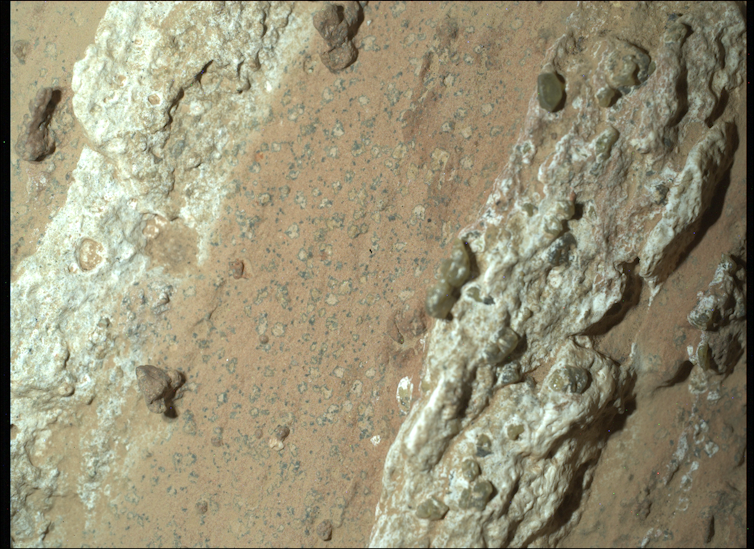
NASA’s search for evidence of past life on Mars just produced an exciting update. On Sept. 10, 2025, a team of scientists published a paper detailing the Perseverance rover’s investigation of a distinctive rock outcrop called Bright Angel on the edge of Mars’ Jezero Crater. This outcrop is notable for its light-toned rocks with striking mineral nodules and multicolored, leopard print-like splotches.

By combining data from five scientific instruments, the team determined that these nodules formed through processes that could have involved microorganisms. While this finding is not direct evidence of life, it’s a compelling discovery that planetary scientists hope to look into more closely.

A streaked and spotted rock surface
Bright Angel rock surface at the Beaver Falls site on Mars shows nodules on the right and a leopard-like pattern at the center. NASA/JPL-Caltech/MSSS

To appreciate how discoveries like this one come about, it’s helpful to understand how scientists engage with rover data — that is, how planetary scientists like me use robots like Perseverance on Mars as extensions of our own senses.

Experiencing Mars through data

When you strap on a virtual reality headset, you suddenly lose your orientation to the immediate surroundings, and your awareness is transported by light and sound to a fabricated environment. For Mars scientists working on rover mission teams, something very similar occurs when rovers send back their daily downlinks of data.

Several developers, including MarsVR, Planetary Visor and Access Mars, have actually worked to build virtual Mars environments for viewing with a virtual reality headset. However, much of Mars scientists’ daily work instead involves analyzing numerical data visualized in graphs and plots. These datasets, produced by state-of-the-art sensors on Mars rovers, extend far beyond human vision and hearing.

A virtual Mars environment developed by Planetary Visor incorporates both 3D landscape data and rover instrument data as pop-up plots. Scientists typically access data without entering a virtual reality space. However, tools like this give the public a sense for how mission scientists experience their work.

Developing an intuition for interpreting these complex datasets takes years, if not entire careers. It is through this “mind-data connection” that scientists build mental models of Martian landscapes – models they then communicate to the world through scientific publications.

The robots’ tool kit: Sensors and instruments

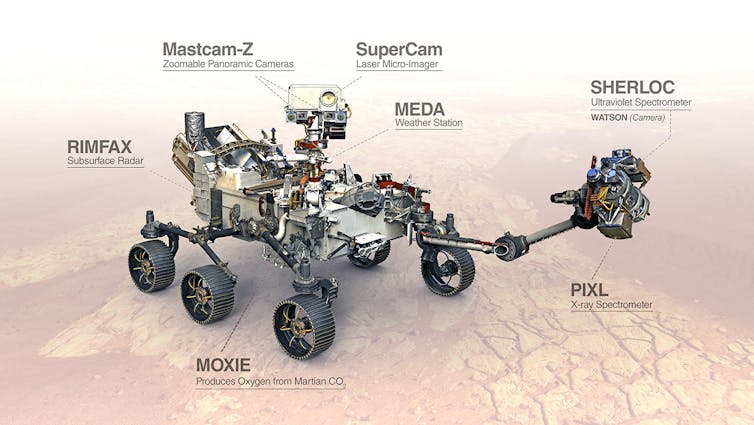
Five primary instruments on Perseverance, aided by machine learning algorithms, helped describe the unusual rock formations at a site called Beaver Falls and the past they record.

Robotic hands: Mounted on the rover’s robotic arm are tools for blowing dust aside and abrading rock surfaces. These ensure the rover analyzes clean samples.

Cameras: Perseverance hosts 19 cameras for navigation, self-inspection and science. Five science-focused cameras played a key role in this study. These cameras captured details unseeable by human eyes, including magnified mineral textures and light in infrared wavelengths. Their images revealed that Bright Angel is a mudstone, a type of sedimentary rock formed from fine sediments deposited in water.

Spectrometers: Instruments such as SuperCam and SHERLOC – scanning habitable environments with Raman and luminescence for organics and chemicals – analyze how rocks reflect or emit light across a range of wavelengths. Think of this as taking hundreds of flash photographs of the same tiny spot, all in different “colors.” These datasets, called spectra, revealed signs of water integrated into mineral structures in the rock and traces of organic molecules: the basic building blocks of life.

Subsurface radar: RIMFAX, the radar imager for Mars subsurface experiment, uses radio waves to peer beneath Mars’ surface and map rock layers. At Beaver Falls, this showed the rocks were layered over other ancient terrains, likely due to the activity of a flowing river. Areas with persistently present water are better habitats for microbes than dry or intermittently wet locations.

X-ray chemistry: PIXL, the planetary instrument for X-ray lithochemistry, bombards rock surfaces with X-rays and observes how the rock glows or reflects them. This technique can tell researchers which elements and minerals the rock contains at a fine scale. PIXL revealed that the leopard-like spots found at Beaver Falls differed chemically from the surrounding rock. The spots resembled patterns on Earth formed by chemical reactions that are mediated by microbes underwater.

A diagram of the Perseverance rover with lines pointing to its instruments
Key Perseverance Mars Rover instruments used in this analysis. NASA

Together, these instruments produce a multifaceted picture of the Martian environment. Some datasets require significant processing, and refined machine learning algorithms help the mission teams turn that information into a more intuitive description of the Jezero Crater’s setting, past and present.

The challenge of uncertainty

Despite Perseverance’s remarkable tools and processing software, uncertainty remains in the results. Science, especially when conducted remotely on another planet, is rarely black and white. In this case, the chemical signatures and mineral formations at Beaver Falls are suggestive – but not conclusive – of past life on Mars.

There actually are tools, such as mass spectrometers, that can show definitively whether a rock sample contains evidence of biological activity. However, these instruments are currently too fragile, heavy and power-intensive for Mars missions.

Fortunately, Perseverance has collected and sealed rock core samples from Beaver Falls and other promising sites in Jezero Crater with the goal of sending them back to Earth. If the current Mars sample return plan can retrieve these samples, laboratories on Earth can scrutinize them far more thoroughly than the rover was able to.

The Perseverance rover on the dusty, rocky Martian surface
Perseverance selfie at Cheyava Falls sampling site in the Beaver Falls location. NASA/JPL-Caltech/MSSS

Investing in our robotic senses

This discovery is a testament to decades of NASA’s sustained investment in Mars exploration and the work of engineering teams that developed these instruments. Yet these investments face an uncertain future.

The White House’s budget office recently proposed cutting 47% of NASA’s science funding. Such reductions could curtail ongoing missions, including Perseverance’s continued operations, which are targeted for a 23% cut, and jeopardize future plans such as the Mars sample return campaign, among many other missions.

Perseverance represents more than a machine. It is a proxy extending humanity’s senses across millions of miles to an alien world. These robotic explorers and the NASA science programs behind them are a key part of the United States’ collective quest to answer profound questions about the universe and life beyond Earth.The Conversation

Ari Koeppel, Earth Sciences Postdoctoral Scientist and Adjunct Associate, Dartmouth College

This article is republished from The Conversation under a Creative Commons license. Read the original article.

  • 144
  • 145
  • 146
  • 147
  • 148
  • 149
  • 150
  • 151
  • 152
  • 153

Community

  • Sheriff’s Activities League and Clearlake Bassmasters offer youth fishing clinic

  • City Nature Challenge takes place April 24 to 27

Public Safety

  • Lakeport Police logs: Wednesday, Feb. 11

  • Lakeport Police logs: Tuesday, Feb. 10

Education

  • Ramos measure requiring school officer training in use of anti-opioid drug moves forward

  • Lake County Chapter of CWA announces annual scholarships 

Health

  • California ranks 24th in America’s Health Rankings Annual Report from United Health Foundation

  • Healthy blood donors especially vital during active flu season

Business

  • Employment law summit takes place March 9

  • Two Lake County Mediacom employees earn company’s top service awards

Obituaries

  • Terry Knight

  • Ellen Thomas

Opinion & Letters

  • Who should pay for AI’s power? Not California ratepayers

  • Crandell: Supporting nephew for reelection in supervisorial race

Veterans

  • State honors fallen chief warrant officer killed in conflict in Iran

  • CalVet and CSU Long Beach team up to improve data collection related to veteran suicides

Recreation

  • April Audubon program will show how volunteers can help monitor local osprey nests

  • First guided nature walk of spring at Anderson Marsh State Historic Park April 11

  • Second Saturday guided nature walks continue at Anderson Marsh State Historic Park

  • Wet weather trail closure in effect on Upper Lake Ranger District

Religion

  • Kelseyville Presbyterian Church plans Easter service

  • Easter ‘Sonrise’ Service returns to Xabatin Community Park

Arts & Life

  • ‘CIA’ delves into the shadowy world of an espionage thriller

  • ‘War Machine’ shifts the battlefield into uncharted territory

Government & Politics

  • Lake County Democratic Central Committee endorses Falkenberg

  • Crandell launches reelection campaign plans March 15 event

Legals

  • April 23 hearing on Lake Coco Farms Major Use Permit

  • NOTICE OF 30-DAY PUBLIC COMMENT PERIOD & NOTICE OF PUBLIC HEARING

How to resolve AdBlock issue?
Refresh this page