How to resolve AdBlock issue?
Refresh this page
Lake County News,California
  • Home
    • Registration Form
  • News
    • Education
    • Veterans
    • Community
      • Obituaries
      • Letters
      • Commentary
    • Police Logs
    • Business
    • Recreation
    • Health
    • Religion
    • Legals
    • Arts & Life
    • Regional
  • Calendar
  • Contact us
    • FAQs
    • Phones, E-Mail
    • Subscribe
  • Advertise Here
  • Login
How to resolve AdBlock issue?
Refresh this page

News

Legislature passes landmark Cap-and-Invest extension, along with four historic energy affordability measures

On Saturday, the Legislature passed a historic affordability, energy and climate package that state leaders say tackles some of California’s most pressing challenges. 

“From energy affordability and bringing down the cost of utility bills, to wildfire prevention, safe drinking water, cleaner air, holding utilities accountable, and environmental protections, Cap-and-Invest will continue to advance bold, statewide solutions for all Californians,” a statement from the State Senate said.

“Today, the Legislature delivered on a promise and sent a groundbreaking affordability, energy and climate package to the governor’s desk,” Senate President pro Tempore Mike McGuire said Saturday. “While the Trump Administration wages attacks on our economy and nation-leading climate progress, California is charting the future — cutting costs, building a stronger economy, protecting our climate progress, and proving our progress can’t be stopped.”

McGuire added, “This has been a year-long journey and these landmark bills will deliver tens of billions of dollars in savings and result in cleaner, cheaper power. A win-win for the Golden State.” 

The agreement comes after a year of what McGuire’s office said was focused work to stabilize consumer energy costs and drive California’s clean energy transition. The Cap-and-Invest extension will power California’s commitment to renewable energy, all while preventing spikes at the gas pump and saving ratepayers tens of billions of dollars.

The Cap-and-Invest reauthorization includes an estimated $60 billion to $90 billion in critical investments to lower utility bills, build thousands of additional affordable housing units, expand safe drinking water, move thousands of additional wildfire prevention projects forward, expand transit and high-speed rail, and reduce local air quality impacts in disadvantaged communities. 

Over the life of the program, at least $60 billion will go toward lowering the utility bills for California households and small businesses. 

Electric bill rebates will be timed around high-cost months, with additional support for low-income Californians, to help families most in need.

The extension also strengthens oversight of the California Air Resources Board, or CARB, and the Greenhouse Gas Reduction Fund, or GGRF, with a dedicated unit to oversee climate programs and ensure that investments deliver real benefits to Californians. 

The package also includes reforms to improve Cap-and-Invest, closing loopholes and ensuring real emission reductions by requiring offsets to be “under the cap.”

Finally, $250 million in ongoing funding will go toward reducing pollution in disadvantaged communities. Similarly, the Bureau of Environmental Justice will be made permanent, ensuring that communities with a disproportionate share of pollution have a permanent legal advocate.

This package includes an estimated:

• $16 billion for affordable housing;
• $20 billion for High-Speed Rail;
• $12 billion for transit programs;
• $5 billion for reducing localized air pollution impacts in frontline communities;
• $4 billion for wildfire risk reduction;
• $2.6 billion for safe drinking water.

The 2025-2026 Energy and Climate Agreement passed by the Legislature today includes: 

• SB 237: Stabilizes fuel supply and prices in California.
• SB 352: Codifies the Environmental Justice Bureau at the Department of Justice and strengthens air quality monitoring and reporting requirements under the AB 617 program, as the first step in implementing the new continuous commitment of $250 million annually for the program.
• SB 254: Provides new savings for utility ratepayers through public infrastructure financing and solutions to protect ratepayers and fire victims through California’s Wildfire Fund.
• AB 825: Unlocks the pathway to a regional electricity partnership across the West to harness more clean and renewable power.
• SB 840 and AB 1207: Reform and reauthorize California’s signature climate program, deliver tens of billions of dollars for critical infrastructure investments, and deliver higher utility rebates for working families.

Over the last 10 years, California’s global leading Cap-and-Invest program has helped distribute over $13.5 billion to residential households, small businesses, and industries. These investments have gone to support 20,361 new affordable housing units, 420,000 additional clean vehicle rebates, and improved air quality. 

More than 11 million households have received electric bill rebates, totaling over $600 per household. Revenues have supported 30,000 jobs, including 20,000 new jobs in clean transportation, with a quarter of all revenues supporting disadvantaged communities and resulting in emissions in regulated facilities within those communities falling by 21%.

Space News: Scientists detected a potential biosignature on Mars – an astrobiologist explains what these traces of life are, and how researchers figure out their source

NASA’s Perseverance rover explores Mars’ Jezero Crater. NASA/JPL-Caltech/MSSS, CC BY-NC

As the Perseverance rover traversed an ancient river valley in Mars’ Jezero Crater back in July 2024, it drilled into the surface and extracted a sample from of a unique, striped rock called Chevaya Falls. The rover’s instruments then analyzed the sample, which is called Sapphire Canyon, and surveyed the surrounding rock.

When scientists started looking into the data, they found two types of iron-rich minerals arranged on the rock in a distinctive, spotted pattern. Both these minerals are associated with life on Earth. One is found around decomposing organic matter on Earth, while the other is produced by certain microbes.

A team of researchers determined in a study published Sept. 10, 2025, that the sample contains a potential biosignature – which could suggest the red planet once hosted microbial life.

These minerals may have formed on the rock when ancient microbes used chemical reactions to produce energy. But chemical reactions not related to life can also produce these minerals under certain conditions.

To learn more, The Conversation U.S. asked Amy J. Williams, an astrobiologist at the University of Florida, about biosignature hunting on Mars and what’s so special about this Sapphire Canyon sample.

What are biosignatures?

A biosignature is any characteristic, element, molecule, substance or feature that serves as evidence for past or present life. It must be something that cannot be produced without life. Some examples include fossils, organic molecules derived from a biological process, or mineral patterns that form only through microbial activity.
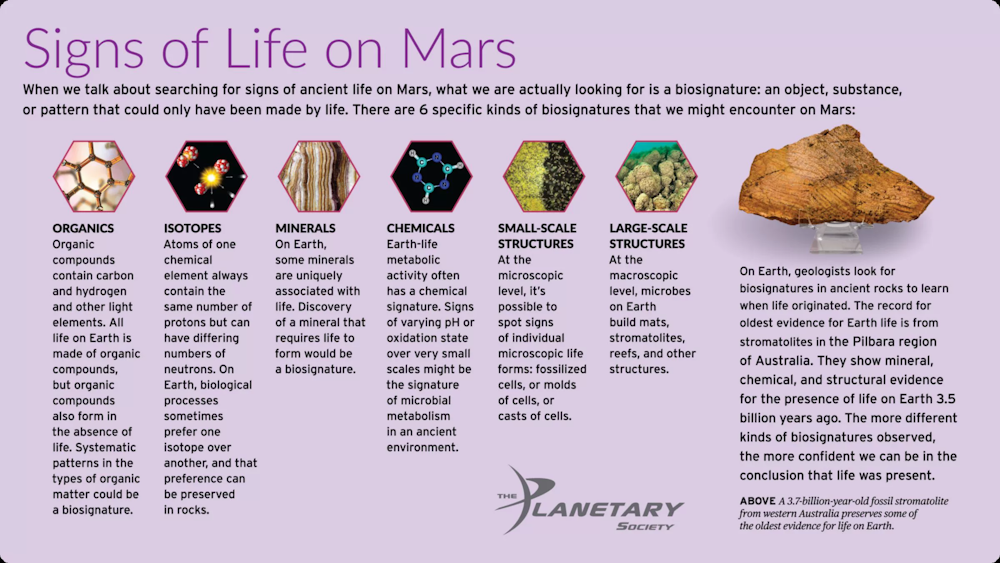
An infographic showing six types of biosignatures, including organics, isotopes, minerals, chemicals, small-scale and large-scale structures
There are six types of biosignatures that scientists may find on Mars. The Planetary Society, CC BY

A potential biosignature, which is how the Sapphire Canyon finding is described, is a substance or structure that might have a biological origin but requires more data or further study before scientists can make a conclusion about the absence or presence of life.

How do scientists determine whether something could be a biosignature on Mars?

Biosignatures come in many different flavors – chemical, physical or structural. Some are rather obvious, like a dinosaur fossil on Earth, but most are far more nuanced.

The search for ancient life on Earth partially informs the search for biosignatures on Mars. Researchers rely on subtle clues preserved in the rock record to address questions such as how long ago microbial life arose on Earth. We search for that evidence in environments such as craters and lake beds with high preservation potential, meaning those that are likely to preserve the biosignatures.

Scientists can apply these techniques to the search for life on Mars. That is why Perseverance was sent to Jezero Crater. In the ancient past, the crater hosted a river-fed lake, which on Earth would represent a habitable environment: one where life would want to live if it ever arose.

This crater was an ideal location to search for ancient life preserved in the rock record on Mars. Astrobiologists then search for chemical, textural and mineral patterns that resemble processes influenced by life back on Earth.

What makes this sample unique and interesting?

The Sapphire Canyon sample is unique because Perseverance’s PIXL and SHERLOC instruments revealed distinctive textures that were dubbed “leopard spots.” These spots are concentric reaction fronts – places where chemical and physical reactions occur – enriched in the minerals vivianite, which contains iron phosphate, and greigite, which is made of iron sulfide.

Dusty rocks on the surface of Mars, speckled with dark spots.
Chevaya Falls, a rock in the Martian Jezero Crater, is speckled with ‘leopard spots,’ which could indicate chemical reactions that may have once supported ancient life. NASA/JPL-Caltech/MSSS

On Earth, vivianite often forms in environments with lots of decaying organic matter, while certain microbes that use sulfate for energy can produce greigite. Compounds in both these minerals are part of a chemical process called redox gradients, which refers to a series of gradual changes over physical space where chemicals can oxidize (lose electrons) or reduce (gain electrons).

One example is leaving your metal bike out in the rain. Over time, the reduced iron (Fe2+) will lose an electron and oxidize to rust (Fe3+). This process can happen nonbiologically, as exposure to water and oxygen drive the chemical changes that take your new bike to a rusty bike – I suggest not leaving it in the rain.

But some oxidation and reduction processes are so slow on their own that the only way they can occur is with living organisms that push the reactions forward. This process is how many microbes, such as bacteria, get the energy to live. Because these two minerals in the Sapphire Canyon sample both occur in redox gradients, scientists predict that microbial life, if it was ever present, could have played a role in the reactions that created these mineral signatures.

Now, scientists are looking into the explanations that wouldn’t require life to form these features on the sample.

Did scientists expect to find a sample like this?

This was a finding that we had hoped for. However, it was somewhat unexpected in this particular location. This sample came from some of the youngest sedimentary rocks the mission has investigated to date. An earlier prediction had assumed signs of ancient life would come from older Martian rock formations.

Finding these features in younger rocks widens the window of time that Mars was potentially habitable and suggests that Mars could have been habitable later in the planet’s history than scientists previously thought, and older rocks might also hold signs of life that are simply harder to detect.

NASA hosted a press conference on Sept. 10, 2025, about the mysterious sample.

What are the next steps to tell whether the sample indicates signs of past life, or whether the signature is from a nonbiological process?

The mineral associations are a potential fingerprint for those redox reactions that can occur when microbes drive the reaction forward – but abiotic processes, such as sustained high temperatures, acidic conditions and binding by organic compounds, could also explain them.

However, the Cheyava Falls rock shows no signs that it’s been exposed to the high heat or acidity usually required for greigite and vivianite to form nonbiologically. Still, the only definitive way to answer this question is to return the sample to Earth, where scientists can use advanced laboratory techniques to distinguish biological from nonbiological origins.The Conversation

Amy J. Williams, Assistant Professor of Geology, University of Florida

This article is republished from The Conversation under a Creative Commons license. Read the original article.
Lake County commemorates 10 years since Valley Fire

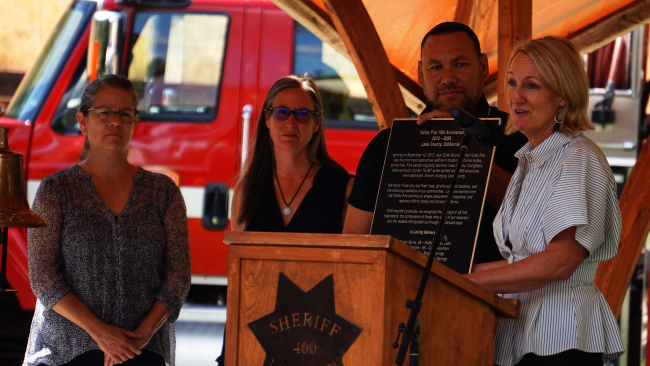
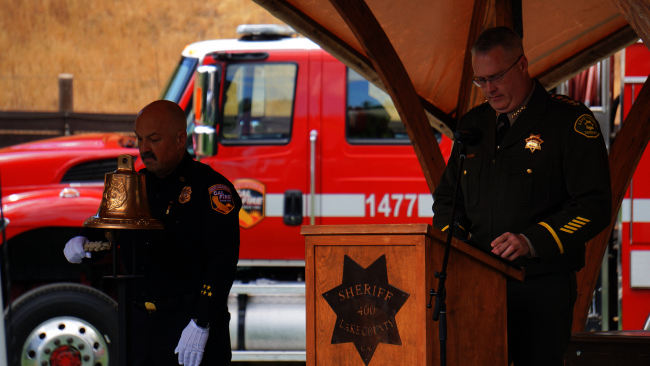
Lake County Sheriff Luke Bingham, right, reads the names of the five people who died during the 2015 Valley Fire while Cal Fire Chief Paul Duncan rings a bell for each of them. Photo by Elizabeth Larson/Lake County News.


LAKE COUNTY, Calif. — Community members and leaders gathered on Friday to remember one of the worst fires in California — and Lake County — history.

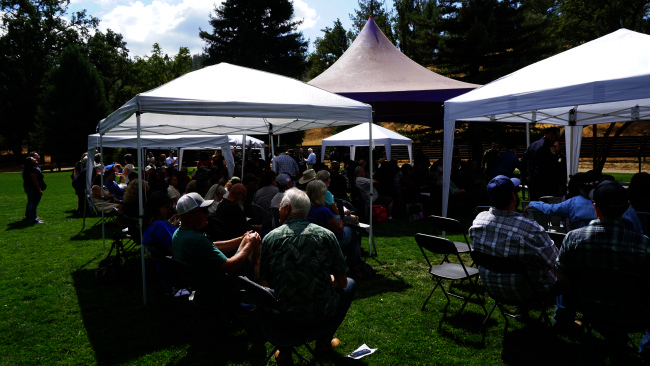
The 10-year commemoration of the Valley Fire began with a minute of silence and the replay of the original Sept. 12, 2015, radio dispatch tones at 1:20 p.m. on the open lawn of Mandala Springs Wellness Retreat Center in Cobb — nearly the same time the fire ignited a decade earlier.

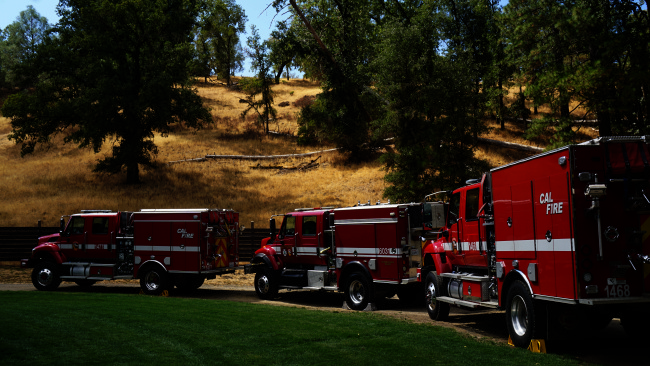
Bright red fire engines and large white tents stood out against the clear blue sky and the green of late-summer grass. 

During the 48 minute ceremony, state and local leaders spoke as first responders, volunteers and community members gathered to remember the lost lives and honor the resilience that the disaster has inspired. 

“The walls around us all came down, and we came together to focus on recovery and rebuilding,” District 5 Supervisor Jessica Pyska said, recalling the community actions in the aftermath. “Government agencies worked side by side with the utilities, with the tribes, with nonprofits, faith based organizations, volunteers and just regular people like a lot of you here — the biggest lesson that we learned is that no one can do this work alone.”

Community members gathered at Mandala Springs in Cobb, California, on Friday, Sept. 12, 2025, for the 10th anniversary of the Valley Fire. Photo by Elizabeth Larson/Lake County News.


The Valley Fire, which burned 76,067 acres, destroyed 1,955 structures, severely injured four firefighters and took five lives, was the third most destructive wildfire in modern California history at the time. 

Sheriff Luke Bingham began his speech reading out the names of the lost lives, with a bell rung to remember them.

They are: 

• Bruce Beven Burns, 65, Hidden Valley Lake;
• Robert Taylor Fletcher, 66, Cobb Mountain;
• Robert Litchman, 62, Seigler Springs;
• Barbara McWilliams, 72, Anderson Springs;
• Leonard Neft, 69, Anderson Springs.

“Resilience was on full display,” Bingham said of how the community came together and supported each other, before moving on to address improved response to emergency. 

While stressing that the response in Valley Fire was “nothing short of extraordinary,” Bingham acknowledged that, “Tragic events such as the Valley Fire also drive improvement.”

“There’s always gaps in our knowledge,” he said, adding that the Lake County Sheriff’s Office and the Office of Emergency Services have spent years evaluating responses to incidents. 

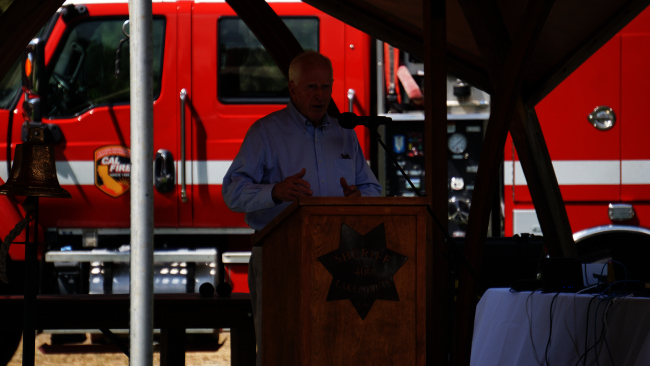
Cal Fire trucks provided the backdrop for the Valley Fire remembrance event on Friday, Sept. 12, 2025. Photo by Elizabeth Larson/Lake County News.


“Because of that process, we have changed how we respond to fires, how we communicate and how we notify our community, and we will continue to evolve,” Bingham said. “We are better prepared today than we have ever been.”

Cal Fire Chief Paul Duncan recalled his role as a firefighter protecting structures in Cobb.

“My resources were two engines, one water tender,” he said, describing how he and a handful of firefighters held the line along the nature trail near Cobb School, preventing the fire from reaching the school and downtown Cobb.

“I'm grateful to those firefighters, grateful to this community, and grateful I was able to welcome students back to Cobb school when it was reopened,” he said.

Congressman Mike Thompson speaks at the Valley Fire remembrance event on Friday, Sept. 12, 2025. Photo by Elizabeth Larson/Lake County News.

Cal Fire Director Joe Tyler talked about state resources. 

“Cal Fire has continued to bolster its resources, both in personnel, in aviation assets and fire engines,” he said. “The governor has invested over $2.8 billion in resilience since the Valley Fire in 2015 and I am grateful to be able to

serve and support all of you to be able to make a difference in your community.”

Congressman Mike Thompson recalled making his way to Lake County from the East Coast in the days after the fire began, stressing the importance for someone to “see with their own eyes what's happening on the ground; to be able to go back to Washington and get the resources that we need.”

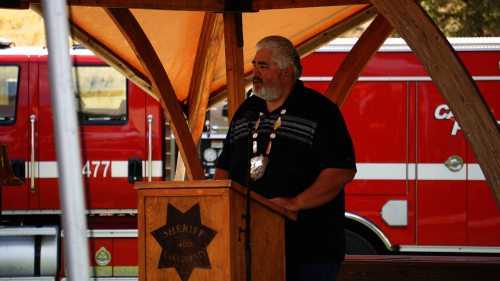
Former District 1 Supervisor Moke Simon speaks during the Valley Fire remembrance event on Friday, Sept. 12, 2025. Photo by Elizabeth Larson/Lake County News.

“I think we're able to get over $100 million for these events,” he said. “And it's equally as important to make sure funding continues to flow to do the resiliency work, so we don't have to deal with situations such as this.”

Middletown Rancheria Chairman Moke Simon also spoke on the community's resilience: “I saw the barriers drop, as Jessica said, I saw us come together and do things that were amazing, and continue to do those things that are amazing.”

Cathy McCarthy and Cindy Leonard of the Cobb Area Council shared the community response and recovery, which was followed by Eliot Hurwitz of Seigler Springs Community Redevelopment Association who spoke on growth of non-profits.

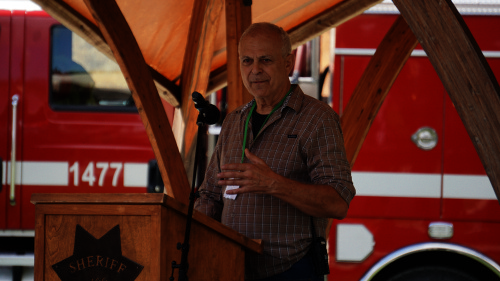
Eliot Hurwitz, executive director of the Seigler Springs Community Redevelopment Association, speaks during the Valley Fire remembrance event on Friday, Sept. 12, 2025. Photo by Elizabeth Larson/Lake County News.


Hurwitz said after the fire, local groups — including more than three dozen nonprofits, churches and social service organizations — played a key role in sustaining the community. 

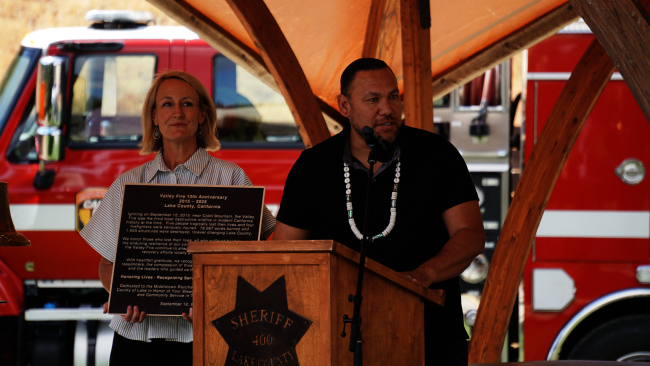
At the end of the ceremony, Pyska along with Board of Supervisors Chair Eddie Crandell presented a bronze plaque to Simon honoring Middletown Rancheria — which has opened their doors to shelter evacuees and provide help — for their “steadfast support, collaboration and community service in times of disasters.”

Pyska also presented another bronze plaque to be placed at the Cobb Area Council in memory of the Valley Fire and lost lives. An identical plaque will be presented by Supervisor Helen Owen to the Middletown community during their Saturday commemoration event. 

The names of those who died in the Valley Fire were carved on the plaques to Cobb and Middletown communities.

Email staff reporter Lingzi Chen at This email address is being protected from spambots. You need JavaScript enabled to view it.. 

Supervisors Jessica Pyska and EJ Crandell with a plaque they presented to Middletown Rancheria during the Valley Fire remembrance event on Friday, Sept. 12, 2025. Photo by Elizabeth Larson/Lake County News.


Cathy McCarthy and Cindy Leonard of the Cobb Area Council look on as supervisors Jessica Pyska and EJ Crandell present them with a plaque during the Valley Fire remembrance event on Friday, Sept. 12, 2025. Photo by Elizabeth Larson/Lake County News.


Forest advises caution ahead of ceremonial Nome Cult Walk

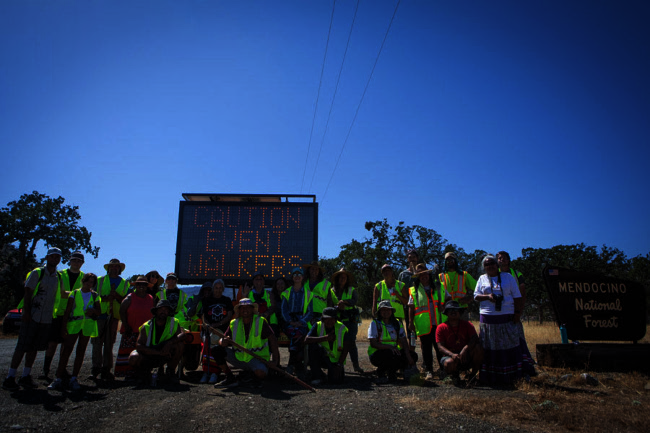
Participants on the Nome Cult Walk in September 2023. Walkers retrace their ancestors’ footsteps, walking on average 15 to 25 miles per day through towns, farmland, foothills and across the North Coast Mountains in California. USDA Forest Service Photo by Andrew Avitt.


MENDOCINO NATIONAL FOREST, Calif. — The 30th annual Nome Cult Walk from Chico through the Mendocino National Forest to Round Valley begins this weekend and continues through Sept. 20.

Forest officials advise motorists along the trail route — M4 Road, County Road 55 and FH7 into Eel River Station and Covelo — to be aware of the event this week and to drive slowly to ensure the safety of pedestrians. 

Caution signs will be posted at the entrance to the national forest, and the walkers’ support team will also have caution signs on their vehicles.

The planned schedule is:

• Sunday, Sept. 14, begin walk toward Orland.
• Monday, Sept. 15, walk toward Newville Cemetery.
• Tuesday, Sept. 16, walk to Black Bear Campground.
• Wednesday, Sept. 17, continue to Log Springs.
• Thursday, Sept. 18, walk to Wells Cabin.
• Friday, Sept. 19, walk to Eel River Campground.
• Saturday, Sept. 20, finish walk to Round Valley Indian Reservation.

In 1863, 461 Native Americans were forced to march 100 miles to Covelo and only 277 survived. 

Today the commemorative Nome Cult Walk brings together many generations and members of several tribes in the area, including descendants of the Concow Maidu, the Round Valley Indian Tribes, Paskenta Band of Nomlaki Indians, Berry Creek Rancheria of Maidu Indians of California, Redding Rancheria, Grindstone Nomlaki, the Mechoopda Tribe, Pit River, Wintu, Nisenan and Greenville Maidu.

Also, this year the Mechoopda Indian Tribe and Chico State University will hold a public event at 2p.m. Saturday, Sept. 13, at Chico State University’s Colusa Hall.

More information about the event and the Nome Cult Walk can be found on the group’s Facebook Page. 

Clearlake Animal Control: ‘Foots’ and the dogs

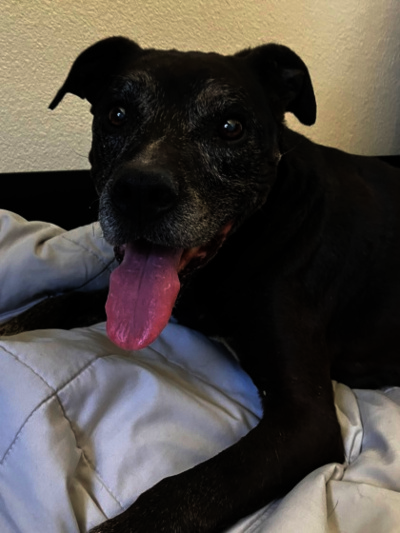
“Foots.” Photo courtesy of Clearlake Animal Control.

CLEARLAKE, Calif. — Clearlake Animal Control has dozens of dogs needing new homes.

The shelter has 48 adoptable dogs listed on its website.

This week’s dogs include “Foots,” a male pit bull mix with a black coat and white markings.

The shelter is located at 6820 Old Highway 53. It’s open from 9 a.m. to 6 p.m. Tuesday through Saturday. 

For more information, call the shelter at 707-762-6227, email This email address is being protected from spambots. You need JavaScript enabled to view it., visit Clearlake Animal Control on Facebook or on the city’s website.

This week’s adoptable dogs are featured below.

Email Elizabeth Larson at This email address is being protected from spambots. You need JavaScript enabled to view it.. Follow her on Twitter, @ERLarson, and on Bluesky, @erlarson.bsky.social. Find Lake County News on the following platforms: Facebook, @LakeCoNews; X, @LakeCoNews; Threads, @lakeconews, and on Bluesky, @lakeconews.bsky.social. 

Space News: The discovery of a gravitational wave 10 years ago shook astrophysics – these ripples in spacetime continue to reveal dark objects in the cosmos

When two massive objects – like black holes or neutron stars – merge, they warp space and time. Mark Garlick/Science Photo Library

Scientists first detected ripples in space known as gravitational waves from the merger of two black holes in September 2015. This discovery marked the culmination of a 100-year quest to prove one of Einstein’s predictions.

Two years after this watershed moment in physics came a second late-summer breakthrough in August 2017: the first detection of gravitational waves accompanied by electromagnetic waves from the merger of two neutron stars.

Gravitational waves are exciting to scientists because they provide a completely new view of the universe. Conventional astronomy relies on electromagnetic waves – like light – but gravitational waves are an independent messenger that can emanate from objects that don’t emit light. Gravitational wave detection has unlocked the universe’s dark side, giving scientists access to phenomena never observed before.

As a gravitational wave physicist with over 20 years of research experience in the LIGO Scientific Collaboration, I have seen firsthand how these discoveries have transformed scientists’ knowledge of the universe.

This summer, in 2025, scientists with the LIGO, Virgo and KAGRA collaboration also marked a new milestone. After a long hiatus to upgrade its equipment, this collaboration just released an updated list of gravitational wave discoveries. The discoveries on this list provide researchers with an unprecedented view of the universe featuring, among other things, the clearest gravitational wave detection yet.

A map showing five yellow points indicating operational gravitational wave observatories: two in the US, two in Europe and one in Japan, and one orange point in India indicating a planned observatory.
The more operational gravitational-wave observatories there are around the globe, the easier it is to pin down the locations and sources of gravitational waves coming from space. Caltech/MIT/LIGO Lab

What are gravitational waves?

Albert Einstein first predicted the existence of gravitational waves in 1916. According to Einstein’s theory of gravity, known as general relativity, massive, dense celestial objects bend space and time.

When these massive objects, like black holes and neutron stars – the end product of a supernova – orbit around each other, they form a binary system. The motion from this system dynamically stretches and squeezes the space around these objects, sending gravitational waves across the universe. These waves ever so slightly change the distance between other objects in the universe as they pass.

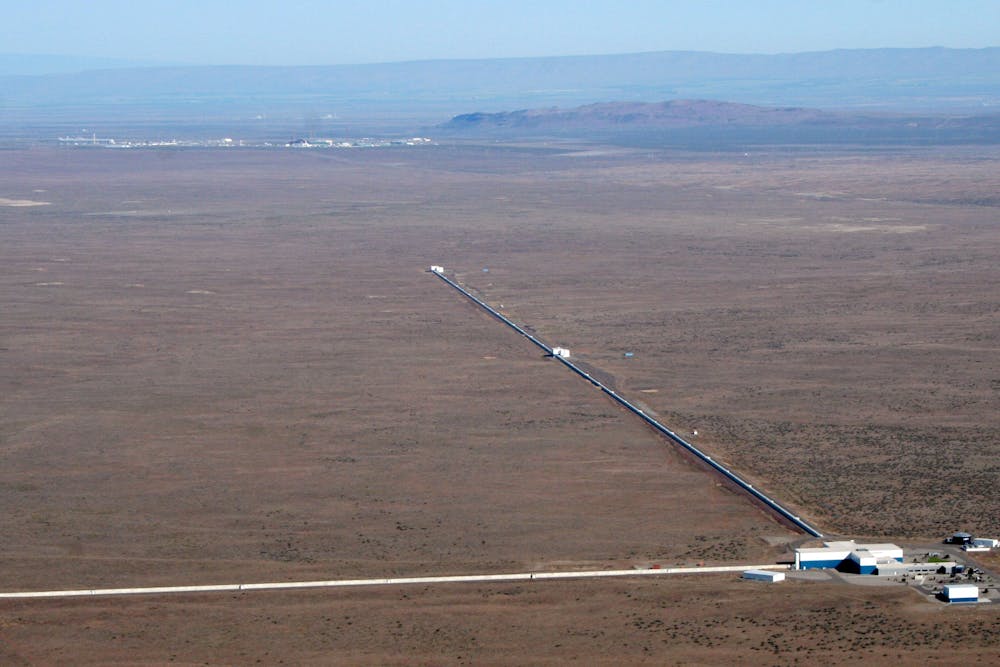
Detecting gravitational waves requires measuring distances very carefully. The LIGO, Virgo and KAGRA collaboration operates four gravitational wave observatories: two LIGO observatories in the U.S., the Virgo observatory in Italy and the KAGRA observatory in Japan.

Each detector has L-shaped arms that span over two miles. Each arm contains a cavity full of reflected laser light that precisely measures the distance between two mirrors.

As a gravitational wave passes, it changes the distance between the mirrors by 10-18 meters — just 0.1% of the diameter of a proton. Astronomers can measure how the mirrors oscillate to track the orbit of black holes.

These tiny changes in distance encode a tremendous amount of information about their source. They can tell us the masses of each black hole or neutron star, their location and whether they are spinning on their own axis.

An L-shaped facility with two long arms extending out from a central building.
The LIGO detector in Hanford, Wash., uses lasers to measure the minuscule stretching of space caused by a gravitational wave. LIGO Laboratory

A neutron star-black hole merger

As mentioned previously, the LIGO, Virgo and KAGRA collaboration recently reported 128 new binary mergers from data taken between May 24, 2023, and Jan. 16, 2024 – which more than doubles the previous count.

Among these new discoveries is a neutron star–black hole merger. This merger consists of a relatively light black hole with mass between 2.5 and 4.5 times the mass of our Sun paired with a neutron star that is 1.4 times the mass of our Sun.

In this kind of system, scientists theorize that the black hole tears the neutron star apart before swallowing it, which releases electromagnetic waves. Sadly, the collaboration didn’t manage to detect any such electromagnetic waves for this particular system.

Detecting an electromagnetic counterpart to a black hole tearing apart a neutron star is among the holy grails of astronomy and astrophysics. These electromagnetic waves will provide the rich datasets required for understanding both the extreme conditions present in matter, and extreme gravity. Scientists hope for better fortune the next time the detectors spot such a system.

A massive binary and clear gravitational waves

In July 2025, the LIGO, Virgo and KAGRA collaboration also announced they’d found the most massive binary black hole merger ever detected. The combined mass of this system is more than 200 times the mass of our Sun. And, one of the two black holes in this system likely has a mass that scientists previously assumed could not be produced from the collapse of a single star.

When two astrophysical objects – like black holes – merge, they send out gravitational waves.

The most recent discovery announced by the LIGO, Virgo and KAGRA collaboration, in September 2025, is the clearest gravitational wave observation to date. This event is a near clone of the first gravitational wave observation from 10 years ago, but because LIGO’s detectors have improved over the last decade, it stands out above the noise three times as much as the first discovery.

Because the observed gravitational wave signal is so clear, scientists could confirm that the final black hole that formed from the merger emitted gravitational waves exactly as it should according to general relativity.

They also showed that the surface area of the final black hole was greater than the surface area of the initial black holes combined, which implies that the merger increased the entropy, according to foundational work from Stephen Hawking and Jacob Bekenstein. Entropy measures how disordered a system is. All physical interactions are expected to increase the disorder of the universe, according to thermodynamics. This recent discovery showed that black holes obey their own laws similar to thermodynamics.

The beginning of a longer legacy

The LIGO, Virgo and KAGRA collaboration’s fourth observing run is ongoing and will last through November. My colleagues and I anticipate more than 100 additional discoveries within the coming year.

New observations starting in 2028 may bring the tally of binary mergers to as many as 1,000 by around 2030, if the collaboration keeps its funding.

Gravitational wave observation is still in its infancy. A proposed upgrade to LIGO called A# may increase the gravitational wave detection rate by another factor of 10. Proposed new observatories called Cosmic Explorer and the Einstein Telescope that may be built in 10 to 20 years would increase the rate of gravitational wave detection by 1,000, relative to the current rate, by further reducing noise in the detector.The Conversation

Chad Hanna, Professor of Physics, Penn State

This article is republished from The Conversation under a Creative Commons license. Read the original article.
  • 149
  • 150
  • 151
  • 152
  • 153
  • 154
  • 155
  • 156
  • 157
  • 158

Community

  • Sheriff’s Activities League and Clearlake Bassmasters offer youth fishing clinic

  • City Nature Challenge takes place April 24 to 27

Public Safety

  • Lakeport Police logs: Wednesday, Feb. 11

  • Lakeport Police logs: Tuesday, Feb. 10

Education

  • Ramos measure requiring school officer training in use of anti-opioid drug moves forward

  • Lake County Chapter of CWA announces annual scholarships 

Health

  • California ranks 24th in America’s Health Rankings Annual Report from United Health Foundation

  • Healthy blood donors especially vital during active flu season

Business

  • Employment law summit takes place March 9

  • Two Lake County Mediacom employees earn company’s top service awards

Obituaries

  • Terry Knight

  • Ellen Thomas

Opinion & Letters

  • Who should pay for AI’s power? Not California ratepayers

  • Crandell: Supporting nephew for reelection in supervisorial race

Veterans

  • State honors fallen chief warrant officer killed in conflict in Iran

  • CalVet and CSU Long Beach team up to improve data collection related to veteran suicides

Recreation

  • April Audubon program will show how volunteers can help monitor local osprey nests

  • First guided nature walk of spring at Anderson Marsh State Historic Park April 11

  • Second Saturday guided nature walks continue at Anderson Marsh State Historic Park

  • Wet weather trail closure in effect on Upper Lake Ranger District

Religion

  • Kelseyville Presbyterian Church plans Easter service

  • Easter ‘Sonrise’ Service returns to Xabatin Community Park

Arts & Life

  • ‘CIA’ delves into the shadowy world of an espionage thriller

  • ‘War Machine’ shifts the battlefield into uncharted territory

Government & Politics

  • Lake County Democratic Central Committee endorses Falkenberg

  • Crandell launches reelection campaign plans March 15 event

Legals

  • April 23 hearing on Lake Coco Farms Major Use Permit

  • NOTICE OF 30-DAY PUBLIC COMMENT PERIOD & NOTICE OF PUBLIC HEARING

How to resolve AdBlock issue?
Refresh this page