How to resolve AdBlock issue?
Refresh this page
Lake County News,California
  • Home
    • Registration Form
  • News
    • Education
    • Veterans
    • Community
      • Obituaries
      • Letters
      • Commentary
    • Police Logs
    • Business
    • Recreation
    • Health
    • Religion
    • Legals
    • Arts & Life
    • Regional
  • Calendar
  • Contact us
    • FAQs
    • Phones, E-Mail
    • Subscribe
  • Advertise Here
  • Login
How to resolve AdBlock issue?
Refresh this page

News

Ramos bill to strengthen Native American student rights to wear tribal regalia at graduation ceremonies sent to governor

Native American students and families will determine what constitutes traditional regalia or recognized objects of religious or cultural significance instead of school officials for purposes of adornments at graduation ceremonies if the governor signs a measure approved on a 73-0 vote Sept. 4 by the Assembly and now headed to the governor.

Assemblymember James C. Ramos (D-San Bernardino) introduced AB 1369 that also prohibits schools from creating any process that would discourage or prevent Native American students from displaying any tribal adornment or ceremonial regalia at graduation ceremonies. 

Despite existing law and clarifying statutes affirming the rights of students to wear cultural adornment at high school graduations, school districts continue to deny students this right.

“Existing legislation and constitutional protections allow students to wear traditional tribal regalia at graduation ceremonies, but Native American youth and their families continue to face obstacles and challenges. Graduation ceremonies are a time for students, their families and tribal communities to share pride and joy in a major accomplishment. AB 1369 adds clarity to current law so that students’ and families’ celebration is not marred by unnecessary turmoil,” Ramos said. 

He noted that regalia might include items such as eagle feathers or beading and represent cultural and religious traditions.

Testifying at a legislative committee hearing was Bella Garcia, a May graduate from Clovis High School, who struggled for almost two years to win approval to wear Native American adornments at her graduation. 

“California sits on the traditional homelands of all California Indian people, and it is important to recognize California tribes’ sovereignty,” Garcia said. “American Indian youth deserve to be recognized, celebrated and uplifted while honoring their ancestors who came before them. Graduation is one of the most momentous milestones especially for California Native Americans.”

In 2018, the Legislature took action to protect student rights by passing AB 1248 (Chapter 804, Statutes of 2018). 

That bill stated, “A pupil may wear traditional tribal regalia or recognized objects of religious or cultural significance as an adornment at school graduation ceremonies.” 

Despite this language, school districts continue to deny Native American students from wearing tribal regalia or attempt to tell them what constitutes authentic or appropriate tribal items.

In 2021, the legislature passed Ramos’s AB 945 (Chapter 285, Statutes of 2021) which established a task force that would provide education leaders with policy, procedure, and best practices recommendations for the implementation of AB 1284. The report is currently being drafted. However, immediate action is required with this measure as instances of denials continue to be reported.

California Indian Legal Services and the Tule River Indian Tribe are the AB 1369 sponsors, and it is also supported by the Fresno Unified School District, ACLU California Action, Habematolel Pomo of Upper Lake and Indigenous Justice, California Federation of Teachers, Cher-Ae Heights Indian Community of the Trinidad Rancheria and California Nations Indian Gaming Association.

Authorities investigate death of man taken into custody at Kelseyville park

LAKE COUNTY, Calif. — The Lake County Sheriff’s Office and the District Attorney’s Office are investigating a Tuesday incident in which a man died after being taken into custody in a Kelseyville park.

The name of the individual who died has so far not been released.

On Tuesday, sheriff’s deputies responded to Kelseyville Community Park, located at 
5270 State St., for reports of an individual acting erratically and harassing people in the park, said sheriff’s spokesperson Lauren Berlinn.

Berlinn said deputies contacted the man and observed that he was lethargic and having difficulty answering questions. They determined he was in need of medical aid and medics were requested to respond.

When medics arrived and attempted to provide treatment, the man’s behavior escalated and he became combative. For the safety of the individual, medics and deputies, he was placed in handcuffs and detained, Berlinn said.

The individual continued to resist medical personnel and prevented them from providing care. During their attempts to assess him, he became unresponsive, Berlinn said.

Berlinn said medics immediately began CPR and transported him to a local hospital, where he was later pronounced deceased.

The cause and manner of death remain under investigation, and the man’s identity will be released once next of kin have been notified, Berlinn said.

Due to the individual being detained prior to his death, Berlinn said the Lake County Sheriff’s Office is treating this as an in-custody death.

The sheriff’s office activated the critical incident protocol and has begun an investigation into the incident, Berlinn said.

The Lake County District Attorney’s Office is the lead investigating agency under the county’s critical incident protocol. 

The Lake County Sheriff’s Office is also conducting an internal investigation to ensure all policies and procedures were followed, Berlinn said.

Redwood Coast Region Economic Summit to take place in November in Lakeport

LAKEPORT, Calif. — This year’s Redwood Coast Region Economic Summit will take place on Nov. 6 and 7 at the Soper Reese Theatre in Lakeport.

The summit will bring together regional leaders, entrepreneurs, and changemakers from Del Norte, Humboldt, Lake, Mendocino and Trinity counties, as well as neighboring tribal lands.

Early bird registration for the summit closes Monday, Sept. 15, offering attendees a final chance to register at the discounted rate of $135 before general admission increases to $150.

This year’s theme, “Harvesting Growth: Transforming Rural Economies,” focuses on downtown revitalization, tourism and innovative rural development, with a spotlight on agri-tourism and the blue economy. 

This marks the first time the summit will be hosted in Lake County, providing a unique opportunity to highlight the region’s growing role in rural innovation. 

From restored historic landmarks and expanded small business support to scenic landscapes and a strong agricultural foundation, Lakeport sets the stage for regional collaboration.

Day one will feature a case study on Kennewick’s waterfront transformation, small business entrepreneurial success stories, and a walking tour of Lakeport’s waterfront revitalization work. Rachael Callahan, of the University of California Agriculture and Natural Resources, will also lead a session focused on agritourism.

Day two begins with a leadership breakfast featuring Six Sigma Ranch, and a panel on outdoor recreation’s role in community revitalization and cannatourism, and legacy farmers. 

Keynotes include Dr. Robert Eyler, from Economic Forensics and Analytics, who will discuss economic data relevant to the region, and Egon Terplan of California Forward, who will discuss regionalism and how to use our rural voice together to gain attention at the State level. 

The event will close with a presentation from State Assembly Majority Leader and Lake County representative, Cecilia Aguiar-Curry.

This annual event is a cornerstone for cross-sector collaboration and long-term economic development planning across California’s North Coast. 

To register, view the full agenda, or explore lodging options, visit https://www.northedgefinancing.org/redwood-coast-region-economic-summit. 

Mendocino County authorities arrest Clearlake men on weapons charges

NORTH COAST, Calif. — Two Clearlake men were arrested last week in Covelo on numerous weapons charges.

Cornelio Solorio, 24, and Fernando Solorio, 30, were taken into custody on Friday, according to a report from Sgt. Jack Woida of the Mendocino County Sheriff’s Office.

At 8:40 p.m. Friday, a Mendocino County Sheriff’s deputy was working patrol in the Covelo area when he observed a vehicle driving on Highway 162 with an inoperable headlight. Woida said the deputy initiated a traffic enforcement stop in the 76000 Block of Highway 162.

The deputy contacted the vehicle’s occupants. Fernando Solorio was the driver and Cornelio Solorio was seated in the front passenger seat. The deputy also observed an open container of alcohol within the passenger compartment of the vehicle, Woida said.

A records check revealed Fernando Solorio's driver’s license was suspended and he was on DMV probation. Both occupants ultimately exited the vehicle, and deputies located an unloaded handgun and a loaded rifle within the passenger compartment of the vehicle. Woida said both firearms were within the immediate area of the occupants.

Based on the unique features of the rifle it met the statutory requirements listed in 30515 PC making it a violation of 30605 PC, possession of an assault weapon, Woida said.

Further investigation was conducted by the investigating deputy which ultimately led to Cornelio Solorio being placed under arrest for possession of a concealed firearm in a vehicle, carrying a loaded firearm in a vehicle and possession of an assault weapon, according to Woida’s report.

Woida said this investigation also led to Fernando Solorio being placed under arrest for possession of a concealed firearm in a vehicle, carrying a loaded firearm in a vehicle, possession of an assault weapon, possession of an unserialized firearm, violation of probation and driving on a suspended license.

Cornelio Solorio and Fernando Solorio were transported to the Mendocino County Jail where they were both to be held in lieu of $15,000 bail, Woida said.

Middletown Area Town Hall to meet Sept. 11

MIDDLETOWN, Calif. — The Middletown Area Town Hall, or MATH, will get a series of updates at its next meeting.

MATH will meet at 7 p.m. Thursday, Sept. 11, in the Middletown Community Meeting Room/Library at 21256 Washington St., Middletown. The meeting is open to the public.

Zoom will not be available. Viewers can participate via PEG TV at www.youtube.com/LakeCountyPegTV. 

On the agenda are reports on the Guenoc Valley Project, revisions to Caltrans plans and South Lake County Fire’s seasonal update.

There also will be a community discussion and MATH open forum on the Housing Action Impact Plan. 

MATH — established by resolution of the Lake County Board of Supervisors on Dec. 12, 2006 — is a municipal advisory council serving the residents of Anderson Springs, Cobb, Coyote Valley (including Hidden Valley Lake), Long Valley and Middletown.

For more information email This email address is being protected from spambots. You need JavaScript enabled to view it.. 

Email Elizabeth Larson at This email address is being protected from spambots. You need JavaScript enabled to view it.. Follow her on Twitter, @ERLarson, and on Bluesky, @erlarson.bsky.social. Find Lake County News on the following platforms: Facebook, @LakeCoNews; X, @LakeCoNews; Threads, @lakeconews, and on Bluesky, @lakeconews.bsky.social. 

Jury trials, a critical part of democracy, are disappearing

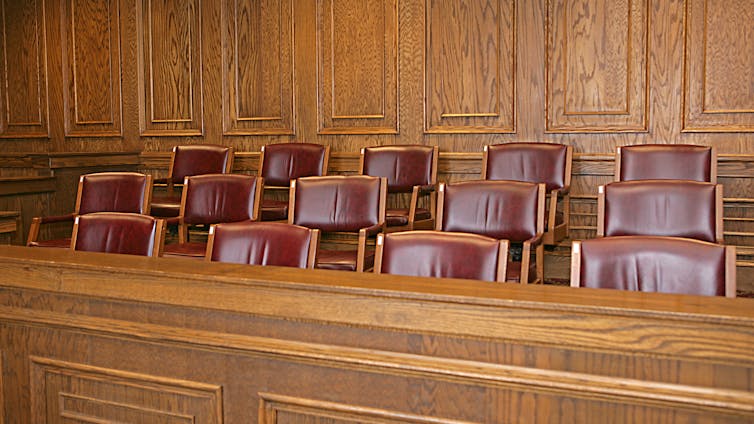
When jurors aren’t involved, rulings are less public − and private interests have more influence over outcomes. ftwitty/E+ via Getty Images

The right to trial by jury in criminal and civil cases is enshrined in the U.S. Constitution. It’s also a critically important way in which citizens can participate in democracy.

The French thinker Alexis de Tocqueville observed early American juries at work. He noted in “Democracy in America” in 1831 that trial by jury “places the real direction of society in the hands of the governed, or of a portion of the governed, instead of leaving it under the authority of the Government.”

Yet, in a change with profound implications, juries now decide only a tiny fraction of criminal and civil cases in the U.S. The decline over time has been dramatic, triggering warnings from scholars since at least the 1920s. In 1962, when federal judicial statistics became reliable enough to track the trend, juries decided about 6% of civil cases; today that share is less then 1%.

In a recent article we wrote with our colleague Robert Peck, we described how in the 1960s a federal judge would typically preside each year over 10 or more civil jury trials – legal disputes between private parties. In 2024, the average federal judge heard only one or two civil jury trials per year.

Criminal cases, in which a defendant is accused of a crime, show a similar pattern. The average federal judge presided over roughly two jury trials in 2024.

In state courts, jury trials have likewise declined over the past decade. In most states, juries now decide just 1% to 2% of criminal and civil cases that come before the courts.

We study how juries work in practice and the jury’s institutional role in the constitutional structure. Both of us have observed how legal and policy shifts in the United States have limited the role juries, and thus citizens, play as a vital democratic check on government power.

Trials make disputes public, and jury trials allow citizens to debate the issues and return verdicts that reflect their community. That visibility and participation make the legal system more accountable and legitimate.

Replacing juries

The U.S. Founding Fathers’ long list of grievances against King George III in the Declaration of Independence included “depriving us in many cases, of the benefits of Trial by Jury.” In drafting the U.S. Constitution, they embedded juries throughout the new federal framework, for both civil and criminal cases. State constitutions likewise entrenched robust jury rights.

Early Americans thus saw jury service not merely as a procedural safeguard against overreaching government authority, but as a way to distribute the power granted by the Constitution, ensuring that ordinary citizens played an important role.

Black-and-white photo of ten men sitting around a table and one standing at the head, addressing the group.
The 1957 film ‘12 Angry Men’ reflects democratic ideas about the role of juries and the importance of jury service. Silver Screen Collection via Getty Images

But over time, state and private actors have chipped away at that authority.

In criminal cases, the main mechanism that has diminished juries’ influence has been private bargains between prosecutors and defendants. Guilty pleas now resolve more than 90% of criminal cases nationwide, according to a 2023 American Bar Association report.

In “Punishment without Trial: Why Plea Bargaining is a Bad Deal,” legal scholar Carissa Byrne Hessick describes how defendants are pressured to plead guilty by the all-too-real threat of longer sentences if they exercise their right to a jury trial rather than accepting an offer from prosecutors. This so-called “trial penalty” has produced what some scholars refer to as an innocence problem, in which even factually innocent people rationally plead guilty.

Efficiency has a role in clearing crowded court dockets. But when almost all cases end in pleas, the legal system loses transparency and public checks on police and prosecutors’ work.

The same trend emerges in civil cases. Mandatory arbitration in consumer and employment contracts, along with legislatively imposed limits on the size of damage awards, have displaced jury determinations of liability and awards.

Jury service dates back to medieval England. Throughout their history in the United States, juries have become more diverse and inclusive.

Procedural shifts since the 1980s also steer cases away from juries at the start. Federal and state rules of procedure are structured so that a civil jury trial is waived by default and must be affirmatively demanded.

The rise of what legal scholar Judith Resnik called “managerial judging,” where judges take a more activist role in supervising cases, channels cases toward private settlements where details are not divulged, even for those who prefer public resolution. Certain expanded pretrial procedures have also given judges the power to displace juries and terminate cases in light of their own “judicial experience and common sense,” as the U.S. Supreme Court put it in a 2008 opinion.

Although many of these changes were done in the name of efficiency, legal scholar Suja Thomas argues in her book “The Missing American Jury” that they also benefit political and economic elites by wresting away some of the power that formerly belonged to juries. The cumulative effect is fewer community judgments and more private, judicial and legislative control over outcomes.

How juries support democracy

In our view, restoring the jury to its original place within the constitutional structure would help revitalize the justice system’s democratic character.

As legal scholar Alexandra Lahav argues in her book “In Praise of Litigation,” trials make disputes public. Jurors hear evidence in open court, deliberate with other citizens about the issues and return verdicts that reflect community standards, in ways that backroom deals and private arbitration cannot.

Jury service also widens the circle of people invested in courts that work and that operate honestly. Although many people are initially dismayed when they are summoned to jury duty, most jurors become more favorable toward the courts once they serve.

These effects can reach beyond the courthouse. Some legal experts assert that restoring the jury could also spark broader democratic renewal at a time when civil society in the U.S. is under enormous strain.

This was evident in a set of studies by political scientist John Gastil and his colleagues that explored the connection between jury service and other forms of civic engagement. Examining jurors’ voting history before and after the period of jury service in seven states, they discovered that jury participation increased the likelihood of voting.

The presence of citizen participation in legal decision-making encourages civic engagement, fosters public trust and reanimates the participatory ideals on which the American republic was founded. John Adams put it well in 1774, when the British Parliament placed the judicial system of Massachusetts under royal control.

“Representative government and trial by jury are the heart and lungs of liberty,” Adams argued. “Without them we have no other fortification against being ridden like horses, fleeced like sheep, worked like cattle, and fed and clothed like swine and hounds.”

This article has been updated to provide more detailed measurement units in the first graph.The Conversation

Valerie P. Hans, Charles F. Rechlin Professor of Law, Cornell Law School, Cornell University and Richard Lorren Jolly, Professor of Law, Southwestern Law School

This article is republished from The Conversation under a Creative Commons license. Read the original article.

  • 152
  • 153
  • 154
  • 155
  • 156
  • 157
  • 158
  • 159
  • 160
  • 161

Community

  • Sheriff’s Activities League and Clearlake Bassmasters offer youth fishing clinic

  • City Nature Challenge takes place April 24 to 27

Public Safety

  • Lakeport Police logs: Wednesday, Feb. 11

  • Lakeport Police logs: Tuesday, Feb. 10

Education

  • Ramos measure requiring school officer training in use of anti-opioid drug moves forward

  • Lake County Chapter of CWA announces annual scholarships 

Health

  • California ranks 24th in America’s Health Rankings Annual Report from United Health Foundation

  • Healthy blood donors especially vital during active flu season

Business

  • Employment law summit takes place March 9

  • Two Lake County Mediacom employees earn company’s top service awards

Obituaries

  • Terry Knight

  • Ellen Thomas

Opinion & Letters

  • Who should pay for AI’s power? Not California ratepayers

  • Crandell: Supporting nephew for reelection in supervisorial race

Veterans

  • State honors fallen chief warrant officer killed in conflict in Iran

  • CalVet and CSU Long Beach team up to improve data collection related to veteran suicides

Recreation

  • April Audubon program will show how volunteers can help monitor local osprey nests

  • First guided nature walk of spring at Anderson Marsh State Historic Park April 11

  • Second Saturday guided nature walks continue at Anderson Marsh State Historic Park

  • Wet weather trail closure in effect on Upper Lake Ranger District

Religion

  • Kelseyville Presbyterian Church plans Easter service

  • Easter ‘Sonrise’ Service returns to Xabatin Community Park

Arts & Life

  • ‘CIA’ delves into the shadowy world of an espionage thriller

  • ‘War Machine’ shifts the battlefield into uncharted territory

Government & Politics

  • Lake County Democratic Central Committee endorses Falkenberg

  • Crandell launches reelection campaign plans March 15 event

Legals

  • April 23 hearing on Lake Coco Farms Major Use Permit

  • NOTICE OF 30-DAY PUBLIC COMMENT PERIOD & NOTICE OF PUBLIC HEARING

How to resolve AdBlock issue?
Refresh this page