How to resolve AdBlock issue?
Refresh this page
Lake County News,California
  • Home
    • Registration Form
  • News
    • Education
    • Veterans
    • Community
      • Obituaries
      • Letters
      • Commentary
    • Police Logs
    • Business
    • Recreation
    • Health
    • Religion
    • Legals
    • Arts & Life
    • Regional
  • Calendar
  • Contact us
    • FAQs
    • Phones, E-Mail
    • Subscribe
  • Advertise Here
  • Login
How to resolve AdBlock issue?
Refresh this page

News

Clearlake City Council approves residential rental registration and inspection ordinance

LAKE COUNTY, Calif. — The Clearlake City Council on Thursday evening voted unanimously to approve a new residential rental registration and inspection ordinance meant to improve conditions for renters in the city.

City staff brought an initial draft of the ordinance to the council in March, but the council held off on making a decision after concerns were raised by local Realtors. 

The result was that over the ensuing six months the city worked on revising the draft ordinance with a Realtors’ task force.

Associate Planner Michael Taylor presented the ordinance to the council, thanking the community for its input, which he said was taken to heart in crafting the final draft. 

Taylor went over the history of the ordinance, which originally was approved Oct. 25, 2001.

Enforcement of that ordinance later was suspended. City officials have variously said that occurred either in 2005 or 2008 due to fiscal constraints. Taylor said the suspension happened in 2008, suggesting it was due to the Great Recession. 

Former Councilmember Joyce Overton confirmed the impact of budget challenges on continuing the program during public comment on Thursday evening.

Taylor said the council initially returned to the matter of the ordinance and directed staff to bring it back for a discussion at the council’s meeting on Aug. 26, 2019.

That direction came in the wake of an incident in the spring of 2019 when a man and his four dogs were found dead of suspected carbon monoxide poisoning in a substandard rental, a case which led to the issuance of notices of violation and citations to the owners of more than 20 properties.

In September of 2019, the council discussed the matter, reached consensus and directed staff to return with some specific recommendations at a later date on how to move forward.

The following year, in June of 2020, the city received a proposal from an outside contractor to provide rental registration and inspection services and the following month the council directed staff to begin implementation of such a program, Taylor said.

In July of 2024, the city funded a building inspector and community development specialist to support, in part, the establishment of a rental inspection program, according to Taylor’s report.

Then on March 20, city staff made its initial presentation on the new ordinance to the council, at which time the Lake County Association of Realtors asked for a continuance to allow more time to review the proposed code amendments, which the council granted.

Taylor said the task force submitted formal comments to city staff on April 17. On April 24 the staff met with the Realtor task force to discuss specific amendments, and they met again on May 22 to review revised ordinance language. 

On June 5, the council considered the matter again and once more continued it to allow more time for the review of code amendments. On July 3, the Realtor Task Force submitted comments, staff incorporated those revisions on Aug. 8 and the city met with the task force again on Aug. 19 to discuss the revised draft.

During the meeting on Aug. 19, staff and Realtors reached consensus on changes that need to be made and areas where it could remain unchanged, Taylor said.

“I think we’ve come to some kind of a consensus,” Taylor said of the city’s work with the Realtors.

Taylor summarized the proposed updates, explaining that inspection and enforcement authority will shift to the building department. Code references have been updated to align with current state fire, building and housing laws, and registration, inspections and reinspections procedures have been clarified.

New provisions also have been added for phased inspections, a self-certification option, tenant and landlord responsibilities, and ownership change requirements, he said.

As part of the process, an inspection checklist has been created along with an online registration portal. 

City official conducts inspection; explains process

City Building Official Mary Jane Montana, who formerly worked as the county of Lake’s Community Development Department director, explained how the process would work.

Montana inspected a two story family dwelling that was converted into three rental units. City Manager Alan Flora said the inspection was the result of a tenant calling the city’s building department due to concerns about the building.

Montana said it was a good opportunity to test out the checklist, which she said she plans to fine tune. 

She showed issues she found, including burned electrical outlets, one of which had metal sticking out of it, and a broken double-paine window that still had shards of glass sitting in it. The bathroom ceiling showed a leak or excessive moisture due to adequate ventilation, there were no adequate garbage receptacles, and the deck and exterior stairway needed to be replaced.

“Those are just a few things,” Montana said, explaining she was requesting a meeting with the owner/operator to go over the corrections needed.

Asked about the time to do such inspections, Montana said it took about an hour to an hour and a half, but could have taken as much as two hours had she been able to see all three units, not just one.

During the meeting, it was estimated that there are about 3,000 rentals in the city. Flora said they believe they can inspect about a third of them each year.

Council member Jessica Hooten, herself a real estate agent, said she thought the Aug. 19 meeting with the city and task force members went well. “I think it was productive.”

Vice Mayor Dirk Slooten agreed, adding that he feels confident it will work.

Some Realtors remain concerned

During the hearing’s public comment portion, real estate broker Timothy Toye, who said he manages 200 properties in the county — many in Clearlake — and has been doing property management for over 40 years, warned city officials that it’s not easy and has a lot of pitfalls. 

Toye acknowledged a good interaction with the task force and an improved ordinance, but nonetheless said the city is about to get into the property management business.

He said Supervisor Bruno Sabatier and others have suggested a trial program, which he supported. “I think there’s unintended consequences coming that you’re not aware of.”

Toye suggested those include increased costs to landlords, increased rents, displaced tenants, fewer rentals, a breakdown of trust between city and citizens, increased homelessness, legal action against the city and a lessened city reputation. 

Former Councilmember Joyce Overton said she had helped put forward the ordinance a long time ago, explaining that it had to be suspended to city finances.

Overton said such ordinances are common in other areas. “It’s the cost of business,” she said, adding that rent has tripled in the city because of the fires.

“I believe we need to step up right away,” she said, explaining that the program is for the safety of the community.

Rick Mayo, a longtime city resident and former planning commissioner, said the people who suffer the most in dilapidated and unsafe housing are the poor, the immigrants, seniors and disabled. “They’re the victims.”

Mayo, who is himself in a wheelchair, said he’s lived in substandard housing in the community and had to take the landlord to court in order to get an accessible shower.

Realtor Katy Evans said she remained opposed to the ordinance. Evans said the only entity that’s poised to gain from the ordinance is the city of Clearlake by getting more money and more data. Like Toye, she recommended a trial period, and said such a program had been voted down by the residents in Salinas.

City resident Margaret Garcia said she thought it would take longer than a three-year rotation to inspect all 3,000 rentals. “I just think you’re being optimistic about the time it’s going to take,” she said, adding that inspections are a good idea but she felt the city is going about it too hastily.

“We can refine this as we go,” Hooten said following public comment.

Councilmember Tara Downey said she’d had such an inspection done when she lived in an apartment in Redwood City in 2013. She said she likes the ordinance and was glad the city could work out the issues. 

Flora said, in response to the mentions of a pilot program, that he had told the Realtors that the city has to adopt an ordinance in order to have something to enforce.

He said he’s happy to come back in six months or a year and meet with Realtors, debrief on lessons learned and bring it back to the council for possible amendments.

“Sounds like a great idea, actually,” said Mayor Russ Cremer. 

Slooten moved to approve the ordinance, with Downey seconding and the council voting 5-0.

Regarding the costs of the inspections, the staff report explained that the original annual inspection cost was $40 for the site and the first unit, and $15 for each additional unit. The fee for noncompliance reinspection is $30 for the site and the first unit, and $10 for each additional unit. 

City staff determined the fees are outdated and may no longer cover the costs necessary to effectively implement and administer the program. Taylor’s report staff will notice a public hearing regarding updates to the fees at an upcoming council meeting.

Also on Thursday, the council approved the Lake County Multi-Jurisdictional Hazard Mitigation Plan and its incorporation into the city’s general plan safety element, and awarded a contract for the Arrowhead Road/Huntington Avenue Drainage Project to Precision Excavating and Grading in the amount of $161,162.

The council also had an hourlong workshop before the regular meeting to discuss city projects with staff.

Email Elizabeth Larson at This email address is being protected from spambots. You need JavaScript enabled to view it.. Follow her on Twitter, @ERLarson, and on Bluesky, @erlarson.bsky.social. Find Lake County News on the following platforms: Facebook, @LakeCoNews; X, @LakeCoNews; Threads, @lakeconews, and on Bluesky, @lakeconews.bsky.social. 

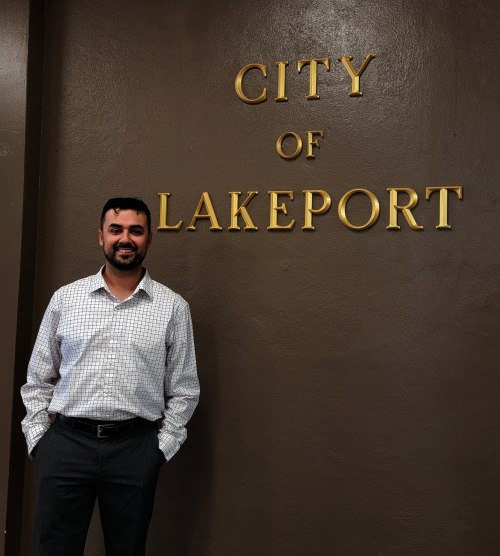
Fernandez promoted to city of Lakeport’s planning services manager

New Lakeport planning services manager Victor Fernandez. Photo courtesy of the city of Lakeport.


LAKEPORT, Calif. — The city of Lakeport has a new planning services manager.

Victor Fernandez has been promoted to the role from associate planner.

In his role as associate planner, Fernandez demonstrated his expertise by managing complex planning projects, guiding applicants through zoning and permitting processes, and preparing critical reports that shaped the city’s growth. 

“His work required not only technical knowledge but also the ability to collaborate with developers, architects, community members, and City leadership to ensure high-quality, sustainable outcomes,” said Community Development Director Joey Hejnowicz.

As planning services manager, Fernandez will step into a leadership role overseeing the city’s day-to-day planning functions, supervising staff and coordinating large development projects. 

This position requires advanced project management skills, long-range planning, and the ability to serve as a key liaison to the Planning Commission, City Council and the community.

“Victor has consistently gone above and beyond — providing high-level support during a period of unprecedented project activity, ensuring continuity in services, and fostering progress across the department,” said City Manager Kevin Ingram. “His leadership, initiative, and dedication have been instrumental in maintaining both the quality and efficiency of Lakeport’s planning services.”

Ingram added, “Please join the city in congratulating Victor on this well-earned promotion. His vision and leadership will help shape the future of Lakeport as we continue to grow and thrive.”

Clearlake Animal Control: ‘Choppa’ and the dogs

“Choppa.” Photo courtesy of Clearlake Animal Control.

CLEARLAKE, Calif. — Clearlake Animal Control has more new dogs and other dogs that have been waiting for their new homes.

The shelter has 45 adoptable dogs listed on its website.

This week’s dogs include “Choppa,” a 4-year-old male Doberman pinscher mix with a brown and black coat. 

The shelter is located at 6820 Old Highway 53. It’s open from 9 a.m. to 6 p.m. Tuesday through Saturday. 

For more information, call the shelter at 707-762-6227, email This email address is being protected from spambots. You need JavaScript enabled to view it., visit Clearlake Animal Control on Facebook or on the city’s website.

This week’s adoptable dogs are featured below.

Email Elizabeth Larson at This email address is being protected from spambots. You need JavaScript enabled to view it.. Follow her on Twitter, @ERLarson, and on Bluesky, @erlarson.bsky.social. Find Lake County News on the following platforms: Facebook, @LakeCoNews; X, @LakeCoNews; Threads, @lakeconews, and on Bluesky, @lakeconews.bsky.social. 


Civil servant exodus: How employees wrestle with whether to stay, speak up or go

Federal civil servants work for a nonpartisan agency, not a specific administration. Kevin Carter/Getty Images

For many Americans, work is not just about earning a paycheck. It is a centerpiece of their lives, and they want their job to be meaningful.

Decades of research suggest this is true for most federal civil servants, who aim to serve not only their organizations and their missions, but also the public and the nation. Over the course of President Donald Trump’s first administration, from 2017-21, we spoke with dozens of federal civil servants. They described their jobs as a calling aligned with their ideals – to serve the government, uphold democracy and serve the public.

Turbulent change during Trump’s first term, however, tested many workers. Over a quarter of the civil servants we spoke with ultimately left the federal government.

Since the start of his second term, Trump has attempted a far more sweeping overhaul of the federal bureaucracy. More than 50,000 federal workers have been fired or targeted for layoffs. The U.S. Agency for International Development was shuttered, for example, and more than 80% of employees have been fired from AmeriCorps and the Consumer Financial Protection Bureau. Another 154,000 federal workers accepted the government’s buyout offers, which are structured as “deferred resignations.”

Yet there are similarities with Trump’s first term, such as his and his appointees’ attacks on civil servants’ loyalty and the administration’s efforts to punish dissent.

Our interviews from Trump’s first term – the basis for the 2025 book “The Loyalty Trap” – may give insight into what civil servants are experiencing today. In some ways, their concerns are unique to government work. Yet they also face a challenge many workers confront during dramatic changes at their organization, regardless of their field: whether to stay or go.

Two people in raincoats stand outside, with one holding a sign that says 'Hands off public servants.'
People protest federal cuts outside the Colorado State Capitol in Denver on May 6, 2025. Helen H. Richardson/MediaNews Group/The Denver Post via Getty Images

Nonpartisan workforce

The federal civil service is composed primarily of career professionals who work for a mission-driven agency, not just a specific administration. These employees consider themselves nonpartisan, prepared to serve presidents from either party.

When a new administration takes over, whether Democratic or Republican, it installs political appointees to lead the agencies that execute federal law. These agencies help develop federal regulations, enforce laws and regulations, provide services and carry out policies. Career civil servants expect to carry out appointees’ instructions, and are under legal and ethical obligations to do so.

The ethical code and oath of office that civil servants swear to upon starting their positions require them to uphold the Constitution, laws and ethical principles, and to “faithfully discharge the duties of [their] office.” They may not “use public office for private gain” and are required to report any “waste, fraud, abuse, and corruption.”

Federal employees expect significant changes in policy direction and describe it as part of the job. As one State Department worker told us in 2018:

“The president is elected by the people and can define his or her own foreign policy, and our job as career officers of the State Department is to enact that person’s policy. So I have no problem — I have my own moral questions about what the president’s foreign policy choices are – but from a commitment and service oath that I’ve taken to work at the State Department, it is my job to implement the intent of the president and the Secretary of State.”

Loyalty trap

Under the first Trump administration, however, many interviewees described a new level of abrupt change and politicization, where personal loyalty to the president seemed prioritized over their agencies’ missions and norms.

Civil servants must abide by the Hatch Act, which forbids some kinds of political activities, like hosting fundraisers – rules meant to shield them from political pressure and keep promotions merit-based. During the first term, however, Trump officials repeatedly violated the Hatch Act, according to a 2021 federal probe.

In this environment during the first Trump administration, “Loyalty [was] to not question,” said a senior officer at the Environmental Protection Agency. Amid increasing mistrust and suspicion, she believed that “whenever you raised a question in this environment, you were thought to be leaking as well.” This cut against some civil servants’ understanding that it was their job, as longtime agency workers and experts, to provide the best advice possible.

Emphasis on personal loyalty was difficult for some of them to reconcile with loyalty to the missions of their agencies or to the public interest, particularly as many policies took a sharp turn. By January 2021, around three-quarters of the regulations, guidance documents and agency memos the Trump administration issued that were challenged in court had been invalidated or withdrawn, according to research at New York University.

Some civil servants working to bolster democracy around the world and at home, for example, were disturbed by shifts in foreign policy. The president frequently praised authoritarian leaders with poor human rights records – such as Vladimir Putin of Russia, Kim Jung Un of North Korea and Reçep Tayyip Erdogan of Turkey – while giving the cold shoulder to allies in Europe.

“The thrust of U.S. foreign policy has generally followed a pretty predictable path,” observed one longtime member of the State Department, who had worked under both Republican and Democratic administrations. “This administration has come in and has basically disregarded the overall imperative that we have to promote democracy and to promote transparency.”

Around 80% of our interviewees said they were experiencing moral dissonance as a result of the sense that their own values, job standards and political leaders’ expectations did not align. These workers were experiencing what we call a “loyalty trap”: the sense of being caught between following higher-ups’ directives and complying with other professional and ethical obligations.

Eyeing the exits

German economist Albert Hirschman’s 1970 book, “Exit, Voice, and Loyalty,” helps explain what workers do when they believe their organization is in decline. Hirschman argued that loyalty to an organization can delay a worker’s decision to leave and motivate them to speak up and push for improvement.

A corner of a computer screen showing a form with options for an employee to select.
A federal worker terminated from her job at the Department of Housing and Urban Development reads over an email asking if she wants to come back to work and be put on administrative leave. Joseph Prezioso/AFP via Getty Images

Other studies since then have also examined how loyalty shapes workers’ decisions. Research on industries from journalism to mining and taxi operations suggests that when employees feel they have no opportunity to voice dissent and influence the group’s direction, even the most loyal workers may eventually decide to exit.

However, loyalty to the mission of an organization can shape a worker’s decision in complex ways. Sociologist Elizabeth A. Hoffman, for example, studied workers in conventional versus cooperative, employee-owned businesses. She found that employees in a cooperative food distribution company – who expressed strong allegiance to the company and their co-workers – were more likely to mention exiting in response to grievances than their counterparts in a conventional company. She concluded that the cooperative’s workers’ greater “zeal” for the group’s mission actually made them more likely to consider leaving when they felt frustrated or betrayed.

These findings echo themes among civil servants we spoke with who wound up leaving the government – people who valued public service but doubted their power to use their voice to do work as they saw fit.

Civil servants’ exits can be costly for them and their families – but also for their governments, as public administration scholars have found in countries around the world. Experienced workers’ departure can result in the loss of institutional knowledge, and they are often replaced with political loyalists. A 2023 review of almost 100 studies – including research from more than 150 countries – concluded that governments where employees were hired based on their education and work experience, not their politics, had less corruption, more efficiency and greater public trust.

Under the current U.S. administration – which is openly punishing dissent among civil servants – we expect an even greater number of employees to contemplate departure.The Conversation

Jaime L. Kucinskas, Associate Professor of Sociology, Hamilton College and Yvonne Zylan, Associate Professor of Sociology, University of Calgary

This article is republished from The Conversation under a Creative Commons license. Read the original article.


Valley fire 10th anniversary commemoration event planned

LAKE COUNTY, Calif. — Ten years after it burned a path of destruction through southern Lake County, community members will gather to remember the Valley fire.

The 10th commemoration of the fire will be held on Friday, Sept. 12, at Mandala Springs Wellness Retreat Center, 14117 Bottle Rock Road in Cobb.

Doors open at 12:45 p.m. The event will take place from 1 to 2 p.m.

The commemorative ceremony will begin promptly at 1:24 p.m., which was the time the fire itself began, with the sounding of emergency tone alerts calling everyone to attention and silence.

The event will honor the community’s solidarity and long-term recovery efforts; recognize the  monumental legislative and cultural changes that followed, including new state fire standards and the revitalization of Indigenous practices; and dedicate a memorial plaque to honor the lives lost in the fire.

In attendance will be designated representatives from the offices of Congressman Mike Thompson, State Senator Mike McGuire, and State Assemblymember Cecilia Aguiar-Curry. The event will also honor first responders, community representatives, and nongovernmental organizations for their contributions to Lake County's disaster response and economic recovery.

Speakers advertised by SSCRA for the event are co-host Eliot Hurwitz, executive director of the Seigler Springs Community Redevelopment Association, one of the event’s cosponsors; District 5 Supervisor Jessica Pyska, another event cohost; Cal Fire Chief Paul Duncan, Director Joe Tyler and Assistant Director Anale Burlew; Lake County Sheriff Luke Bingham; Middletown Rancheria Chair Moke Simon; and Cobb Area Council Chair Cathy McCarthy.

For tickets to the free event, register online at Eventbrite.

Editor’s note: This story has been updated regarding the special guests and speakers to be in attendance.

California, Oregon and Washington to launch new West Coast Health Alliance to uphold scientific integrity in public health

On Wednesday, California Governor Gavin Newsom, Oregon Governor Tina Kotek and Washington Governor Bob Ferguson announced they will launch a new West Coast Health Alliance to ensure residents remain protected by science, not politics. 

The alliance represents a unified regional response to the Trump Administration’s destruction of the U.S. CDC’s credibility and scientific integrity.

“President Trump’s mass firing of CDC doctors and scientists — and his blatant politicization of the agency — is a direct assault on the health and safety of the American people. The CDC has become a political tool that increasingly peddles ideology instead of science, ideology that will lead to severe health consequences. California, Oregon, and Washington will not allow the people of our states to be put at risk,” the three governors said in a joint statement.
 
“The dismantling of public health and dismissal of experienced and respected health leaders and advisors, along with the lack of using science, data, and evidence to improve our nation's health are placing lives at risk," said Erica Pan, MD, MPH, FIDSA, FAAP, director and state Public Health officer, California Department of Public Health. "California stands together with our public health and medical professional colleagues to uphold integrity and support our mission to protect the health of our communities.”

“Our communities deserve clear and transparent communication about vaccines — communication grounded in science, not ideology," said Sejal Hathi, MD, MBA, director, Oregon Health Authority. "Vaccines are among the most powerful tools in modern medicine; they have indisputably saved millions of lives. But when guidance about their use becomes inconsistent or politicized, it undermines public trust at precisely the moment we need it most. That is why Oregon is committed, alongside California and Washington, to leading with science and delivering evidence-based recommendations that protect health, save lives, and restore confidence in our public health system.”

“When federal agencies abandon evidence-based recommendations in favor of ideology, we cannot continue down that same path," said Dennis Worsham, Secretary of Health, Washington State Department of Health. "Washington State will not compromise when it comes to our values: science drives our public health policy. Public health at its core is about prevention — preventing illness, preventing the spread of disease, and preventing early, avoidable deaths. We stand firmly with trusted medical professionals and organizations like the American Academy of Pediatrics and the American College of Obstetricians and Gynecologists, as well as fellow West Coast health agencies — whose guidance remains rooted in rigorous research and clinical expertise. Our commitment is to the health and safety of our communities, protecting lives through prevention, and not yielding to unsubstantiated theories that dismiss decades of proven public health practice.” 

Details about this new alliance

Our three states share a commitment to ensuring that public health recommendations are guided by safety, efficacy, transparency, access and trust. 

The alliance will help safeguard scientific expertise by ensuring that public health policies in California, Oregon and Washington are informed by trusted scientists, clinicians, and other public health leaders. 

Through this partnership, the three states will start coordinating health guidelines by aligning immunization recommendations informed by respected national medical organizations. 

This will allow residents to receive consistent, science-based recommendations they can rely on — regardless of shifting federal actions.

In the coming weeks, the alliance will finalize shared principles to strengthen public confidence in vaccines and in public health. While each state will independently pursue strategies shaped by their unique laws, geographies, histories, and peoples, these shared principles will form the foundations of the alliance. 

Importantly, the three states affirm and respect tribal sovereignty, recognizing that tribes maintain their sovereign authority over vaccine services. 

CDC’s dismantling

Since its founding, the CDC has been central to protecting Americans from disease. But recent leadership changes, reduced transparency, and the sidelining of long-trusted advisory bodies have impaired the agency’s capacity to prepare the nation for respiratory virus season and other public health challenges. 

In a vacuum of clear, evidence-based vaccine guidance, manufacturers lack reliable information to plan production, health care providers struggle to provide consistent plans of care, and families face uncertainty about access and coverage.

In June, California, Oregon, and Washington condemned Secretary Robert F. Kennedy Jr.’s removal of all 17 members of the CDC’s Advisory Committee on Immunization Practices. 

On Wednesday, their affirmed their commitment to science-driven decision-making. 

“We will continue to provide clear, evidence-based guidance to people living in our states, look to scientific experts in trusted medical professional organizations for recommendations, and work with public health leaders across the country to ensure all Americans are protected. The absence of consistent, science-based federal leadership poses a direct threat to our nation’s health security. To protect the health of our communities, the West Coast Health Alliance will continue to ensure that our public health strategies are based on best available science,” the alliance members said in their joint statement.

  • 155
  • 156
  • 157
  • 158
  • 159
  • 160
  • 161
  • 162
  • 163
  • 164

Community

  • Sheriff’s Activities League and Clearlake Bassmasters offer youth fishing clinic

  • City Nature Challenge takes place April 24 to 27

Public Safety

  • Lakeport Police logs: Wednesday, Feb. 11

  • Lakeport Police logs: Tuesday, Feb. 10

Education

  • Ramos measure requiring school officer training in use of anti-opioid drug moves forward

  • Lake County Chapter of CWA announces annual scholarships 

Health

  • California ranks 24th in America’s Health Rankings Annual Report from United Health Foundation

  • Healthy blood donors especially vital during active flu season

Business

  • Employment law summit takes place March 9

  • Two Lake County Mediacom employees earn company’s top service awards

Obituaries

  • Terry Knight

  • Ellen Thomas

Opinion & Letters

  • Who should pay for AI’s power? Not California ratepayers

  • Crandell: Supporting nephew for reelection in supervisorial race

Veterans

  • State honors fallen chief warrant officer killed in conflict in Iran

  • CalVet and CSU Long Beach team up to improve data collection related to veteran suicides

Recreation

  • April Audubon program will show how volunteers can help monitor local osprey nests

  • First guided nature walk of spring at Anderson Marsh State Historic Park April 11

  • Second Saturday guided nature walks continue at Anderson Marsh State Historic Park

  • Wet weather trail closure in effect on Upper Lake Ranger District

Religion

  • Kelseyville Presbyterian Church plans Easter service

  • Easter ‘Sonrise’ Service returns to Xabatin Community Park

Arts & Life

  • ‘CIA’ delves into the shadowy world of an espionage thriller

  • ‘War Machine’ shifts the battlefield into uncharted territory

Government & Politics

  • Lake County Democratic Central Committee endorses Falkenberg

  • Crandell launches reelection campaign plans March 15 event

Legals

  • April 23 hearing on Lake Coco Farms Major Use Permit

  • NOTICE OF 30-DAY PUBLIC COMMENT PERIOD & NOTICE OF PUBLIC HEARING

How to resolve AdBlock issue?
Refresh this page