 How to resolve AdBlock issue?
Opinion
- Details
- Written by: Becky Salato
Dr. Becky Salato. Courtesy photo.
LOWER LAKE, Calif. — As we approach the end of another school year, I find myself reflecting on a phrase I heard recently at a leadership conference that resonated deeply with me: "Better than good."
When someone asks how we're doing, what if instead of the standard "fine” or “good," we could shift our honest answer to "better than good"? This is what we’re going for at Konocti Unified, the mindset (and the results) that make us feel better than good.
Elementary schools: Building strong foundations
This year, our elementary schools maintained their focus on academic development, particularly through the Science of Reading research and training. We're seeing encouraging growth in initial literacy skills, reducing the need for constant intervention to help students catch up.
The collaboration among our four elementary school principals has been outstanding, ensuring alignment across sites and providing consistency for students (which is especially helpful for those who may move between schools).
This coordination ensures all children receive the support they need in a welcoming environment.
Our middle school: Finding our footing
Our middle school is completing its second year, and while we have many goals left to accomplish, we’re right where we expected to be. Year one was kind of a perfect storm. Our district hadn’t had a middle school for years, so seventh and eighth grade students brought strong allegiances from four different elementary schools.
Picture, if you will, hundreds of young adolescents trying to establish a pecking order. At the same time, our teachers and administrators were establishing a lot of firsts, defining what middle school education means for our community — kind of like building a plane while you’re flying it.
Year two brought significant refinements. We began this year with stronger disciplinary structures, but quickly evolved toward restorative practices.
We recognized that our initial block scheduling provided too much time on single topics and adjusted to better manage instructional time for both students and teachers. And our leadership team of three administrators, including two assistant principals recently transitioned from the classroom, has grown together beautifully.
Our veteran principal has provided excellent mentorship and our assistant principals have brought the perspective that comes from having recently been in the classroom.
Looking ahead to year three, we’ll continue to use what we’ve learned thus far to implement more preventive rather than reactive processes. We plan to create an even more inclusive campus to meet the needs of all students, particularly those with special learning requirements.
We're also excited about opening our gymnasium! Next year (and every year), Obsidian Middle School will remain a school full of middle schoolers — dynamic, evolving and full of opportunity.
Our high school: Progress amid construction
Our high school community has shown remarkable resilience while enduring an entire year of disruptive construction at the heart of campus.
Despite these challenges, I'm proud to report that our graduation rates appear to have increased. I believe this success stems, at least in part, from our unwavering focus on student engagement and support, including expanded afterschool programs and growing Career Technical Education, or CTE, pathways.
Our emergency medical technician pathway has expanded, and our agricultural program continues to grow — with sheep and goats thriving on our expanded farm.
Next year, we’ll remodel our culinary facility to enhance our CTE offerings. We are also adding a Certified Nursing Assistant pathway to provide even more opportunities for our students.
When school starts in the fall, the construction of our new administrative building will be complete, featuring well-designed offices and eight classrooms. This will be a nice way to welcome our incoming freshmen.
Alternative education: Continuing to thrive
Our Alternative Education programs continue to adapt to meet the needs of our students. Lewis School, our independent study school, met all accreditation requirements this year.
Carle High School, our continuation high school, has added some traditional student activities, including prom and a student leadership club.
Blue Zones Project: Nurturing well-being district-wide
The Blue Zones initiative has taken root across our district, with champions at every school site leading the charge.
As a reminder, we are working toward becoming a Blue Zones Certified Workplace–a healthy place where people can thrive while they work.
We are enhancing staff breakrooms, partnering with local restaurants to provide healthy lunch options, and we recently held our first major staff recognition event offsite — complete with food, games, and celebrations of our Blue Zones champions, teachers of the year, classified staff members of the year, and retirees.
Thanks to new grant funding, we'll expand our focus from workplace wellness to student wellness in the coming years. We're collaborating with Blue Zones Project Lake County to teach students about the Power 9 principles, empowering them to make healthier choices for longer, more fulfilling lives. We know that by positively influencing our students, our entire community will benefit now and in the future.
Looking ahead: Getting better at getting better
As we prepare for next year, we'll navigate some changes at the district office, including the retirement of our beloved assistant superintendent of education services, Mr. Tim Gill. Happily, we have a capable and enthusiastic administrator stepping into this role: Dr. Shellie Perry.
So the next time someone asks me how our district is doing, my answer won't simply be "good" — we're truly "better than good." And we’re always getting better.
Becky Salato is superintendent of the Konocti Unified School District.
- Details
- Written by: Ben Zientara
Ben Zientara. Courtesy photo.
On March 26, 2025, members of California’s legislature introduced their latest attempt to strip away protections from California residents who have solar panels installed on their home, business, or school, a bill called AB942.
If enacted, AB942 would alter the deal the state of California promised to early solar adopters, greatly reducing the benefits of solar for nearly 2 million people who already have solar panels installed with utility agreements promising 20 years of savings.
The bill's sponsor, Assemblymember Lisa Calderon—who was elected while she was a top lobbyist for a utility company—is trying to claw back what the state promised to its residents.
AB942 should not pass the Legislature, because it would harm the state’s earliest solar owners, force them to use a billing plan their system was not designed for, and set a terrible precedent of the government breaking promises it made to its citizens.
What is proposed in California Bill AB942?
The bill text of AB942, as it was amended on March 25th, would end net metering as of July 1, 2026 for all customer-generators (i.e., solar panel owners) who have had their solar panels for 10 or more years as of that date.
It would also remove net metering protections from any solar installation when the home is sold to a new owner, regardless of whether it has been 10 years since installation.
Introduced by Lisa Calderon, a California State Assembly member and former Edison International employee, the bill claims it will help reduce electricity costs across the state by making solar owners “pay their fair share”.
The cost savings argument comes from a flawed study of the costs and benefits of rooftop solar panels conducted as part of the California Public Utilities Commission’s 2022 decision that brought about NEM 3.0 and a further analysis by the state’s Public Advocates Office that claims net metering has resulted in over $8.5 billion in excess utility payments by non-solar utility customers.
What are the old rules for net metering?
The state of California established its initial NEM program in 1996 to spur solar adoption. It was slightly revised in 2016 under NEM 2.0 to ensure new solar owners would contribute to important state programs. Both NEM programs were wildly successful, and the state now boasts more than 2 million solar installations.
These NEM rules promise that anyone who signed up would continue receiving energy credits under the programs for 20 years. That 20-year timeline is tied to the solar installation and not its owner, meaning that anyone who buys a home with solar panels installed under a NEM agreement will continue to receive the promised savings for the full term.
AB942 seeks to break these promises in the name of electric bill savings, but ignores the millions of bills that would increase because of it.
What will happen if AB942 becomes law?
If AB942 becomes law, around 471,000 solar owners will immediately be kicked off their NEM 1.0 plans on July 1, 2026. All told, there are around 1.78 million solar installations covered under the NEM and NEM 2.0 rules, according to state of California Distributed Generation Statistics (DGstats). Under AB942, solar owners would:
• Be forced to switch to a time of use electricity plan.
• Receive low-value credits for excess solar energy.
• Pay a monthly solar fee.
The vast majority of these solar installations are on single-family homes, and AB942 would significantly raise the energy bills of the families living in them.
The owners of solar panels under NEM 1.0 are currently allowed to take service under the standard residential rate plans available from the utility companies. Their solar systems generate energy over the course of the day, and all of it goes to reducing their cost to use grid power.
Example based on a typical PG&E customer
Looking at California DGstats, the average installation size for residential systems installed before 2020 was around 5.8 kilowatts DC. SolarReviews analysis shows that these systems likely generate an average of around 9,000 kilowatt-hours per year in Pacific Gas & Electric territory.
The owner of the solar system will save about 44.5 cents per kilowatt-hour on the E-1 rate plan under their initial NEM contract. At the rate of 9,000 kWh per year, that’s about $4,000 annually, or $333 per month.
If AB942 becomes law, these people will be kicked off of the residential rate plans they’ve been on for years and forced onto the new E-ELEC time of use plan. Under this plan, there is a new monthly fixed charge of $15 per month, rates that change based on the time of day, and greatly reduced compensation for any solar energy sent to the utility grid.
We estimate that the savings for a homeowner with a NEM 1 solar installation would be reduced by around $1,900 per year if they are forced onto the E-ELEC plan. Instead of seeing $4,000 per year in savings, the homeowner would see just $2,100 per year.
To put it another way, a person whose solar installation had been covering their entire electric bill would now see a bill for $158 per month, and that bill would increase with time over the next 10 years. The state had promised that the NEM program would cover these solar owners during those 10 years, and it should not break that promise.
Final word
Reasonable people can argue whether the CPUC’s NEM 3.0 decision was a bad one or not, but there are certain inarguable facts in this case:
• California state law promised 20 years of coverage under NEM and NEM 2.0.
• The vast majority of solar systems installed under NEM and NEM 2.0 do not include energy storage.
• The NEM 3.0 program was designed to provide NEW SOLAR OWNERS with an incentive to pair their solar installations with energy storage, or face the penalty of lower energy export values.
• Enacting AB942 would break the promises made by the state of California to its earliest solar adopters, forcing them into a rate plan and a solar compensation scheme that was not designed for the way their systems were installed.
Passing AB942 would be a complete tragedy, and it should not happen.
Ben Zientara is a writer, researcher, and solar policy analyst who has written about the residential solar industry, the electric grid, and state utility policy since 2013. His early work included leading the team that produced the annual State Solar Power Rankings Report for the Solar Power Rocks website from 2015 to 2020.
- Details
- Written by: Dr. Nicki Thomas
KELSEYVILLE, Calif. — Last month, in cooperation with the California Highway Patrol, Lake County Sheriff, Lake County Probation, Kelseyville Fire and many others in the community, Kelseyville High School staged a car accident in front of the school as part of Every 15 Minutes, a program that introduces the real-life consequences of drinking and driving to our students.
Programs like this are designed to turn statistics into a sense of reality for teens who often feel as though they are immune from the tragedies associated with driving under the influence of drugs or alcohol.
Teen brains work differently than those of adults when it comes to decision-making and problem-solving. Adolescent behavior is influenced more by the emotional and reactive part of the brain, called the amygdala (sometimes called the lizard brain), and less by the thoughtful, logical frontal cortex (the last part of the brain to develop).
This is part of why connecting teens to an emotional experience like the Every 15 Minutes program has a greater chance of penetrating their sense of invincibility than quoting statistics, as compelling as the data is.
The Kelseyville High School Every 15 Minutes event was the culmination of months of coordination and planning by dozens of people, from school personnel to law enforcement, student families, and local business owners.
At the beginning of the school year, Principal Mike Jones and Vice Principal Sarah Frazell started meeting at least monthly with the organizing team, choosing the students who would participate and planning how the day would unfold.
They carefully selected students who represented all walks of life at the high school, whose loss would affect a great many people. The team focused not only on the major logistics, but also on the small details that brought the experience to life.
On the day of the event, all high school students were brought outside to witness the staged car accident. Then, a student was pulled from class every 15 minutes and a red rose was left on their desk. The students pulled from class were sequestered in the gym with no access to phones and no contact with the outside world until the following day. They were just … gone.
The staged events of the day were video recorded to tell the story of a senior ditch day where students who left school to get drunk then got behind the wheel and caused a fatal accident.
The video, which can be viewed above, follows each of the students — the driver who just wants to call his mom as he is booked into county jail, the nurses who work furiously to save an accident victim but ultimately fail, the disbelief of students as their friends are taken away in an ambulance or medical helicopter.
The video also follows as the chaplain visits parents at their home or workplace to inform them that their child has died, asking where they would like to send their child’s remains. Even those who planned the event and knew what to expect felt the emotional gut punch.
Tombstones of those who died were installed on the KHS lawn by a retired volunteer for the highway patrol. At the “memorial” the following day, the whole high school gathered in the gym to the music of bagpipes played by a CalFire employee. Students walked past a casket, which had a mirror and reflected their own face back to them as they placed a rose. Students received a program with an agenda and obituaries of the students who “died,” including photos, personal details, and aspirations like “hoped to study nursing” or “wanted to become a computer engineer.”
The video of the staged event was shared, displaying students convincingly play-acting the decision to ditch school and get drunk, the resulting accident, and everything that followed. Letters from students who “died” were read aloud, as were letters from parents to the children they would never see again. Counselors and mental health professionals were available to support students as they took it all in.
Our KHS principal and vice principal, Mike and Sarah, asked me to thank the donors and volunteers who made this possible.
Mike said, “We had so many good people helping, from the lady at REACH making sure we had the insurance stuff right to the county guys who closed the roads, to Store 24 (Mount Konocti Gas and Mart) who let us land the helicopter on their property. The lady from Chapel of the Lakes Mortuary provided the hearse and made sure we knew how much room to allow for the casket. The nurses and doctor at Sutter were great. All those people made it happen. They guided us. They see it in real time all the time.”
Also, this program wouldn’t have been possible without the generous donations of our major financial sponsors, California Highway Patrol and Adventist Health, and the countless donations of time and money from so many others.
The good news is that since the Every 15 Minutes program was established decades ago, alcohol-related vehicle fatalities have dropped to every 39 minutes. While we would like the fatalities to drop a lot more, we know this program makes a difference. The student who played the drunk driver in the KHS program said the experience changed his life forever.
As graduation day approaches and end-of-year celebrations get going, we wish everyone a safe and joyful time.
Dr. Nicki Thomas is superintendent of the Kelseyville Unified School District.
- Details
- Written by: Don Amador
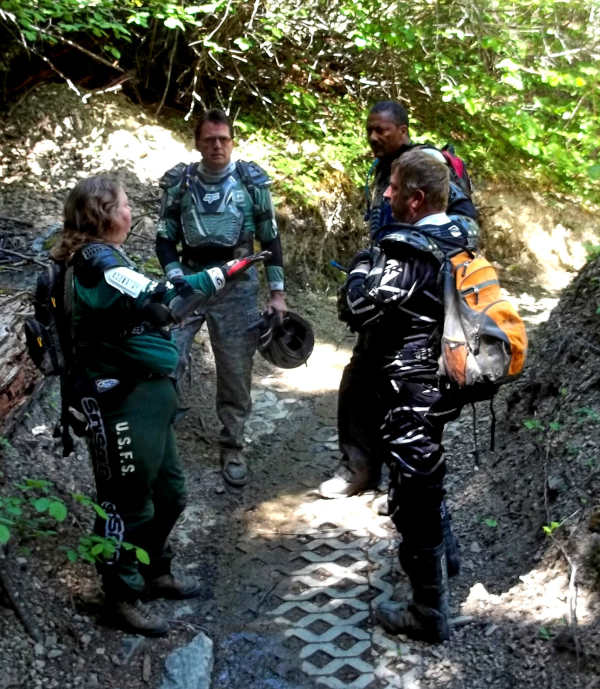
This tribute is published in response to the recent announcement that Forest Service Chief Randy Moore is retiring from the agency.
I had the privilege to meet Randy Moore shortly after his appointment in 2007 to serve as the Pacific Southwestern Regional forester. After shaking his hand and looking him in the eye, I knew he possessed the character, commitment and leadership skills needed to guide the agency through the difficult challenges it faced.
That first meeting at the Region 5 HQ in Vallejo, CA was with a core team of OHV leadership and our partners at the CA State Park Off-Highway Motor Vehicle Division. The discussions were centered on our shared commitment to ecologically-balanced motorized recreation on Forest Service System lands.
After the initial welcomes, Randy opened the meeting by sharing his background and his willingness to meet with OHV and other key stakeholders but that attendees should be aware of what I called Randy’s Rule” and that was, “If you come to my office with a problem, you also need to come with a solution.”
During the course of his tenure as the Regional Forester (2007-2021), the “Trail Community” deeply valued their relationship with Randy and his management team. And, that his door was always open to the recreation community providing your meeting focused on solution-based discussions.
I also appreciated his shared passion for field trips on an ATV or Dirt-Bike where Randy could review some of the important recreation and trail management challenges facing the agency along with solutions being implemented to address those concerns.
Randy should be commended for the collaborative manner that his office and staff conducted themselves during the 2018-2020 intense wildfire seasons to build agency and partnership capacity to address post wildfire recovery efforts of both motorized and non-motorized recreation facilities and areas damaged by wildfires.
I believe that Randy had the right stuff or blend of field level experience, character, administrative and political acumen, and people skills to succeed both as the R5 Regional Forester and Chief of the Forest Service.
I want to thank him for his 45 year career with the Forest Service and for “Caring for the Land and People” along with his strong commitment to working with agency partners in support of managed recreation and resource management of public lands.
I wish him all the best in the next chapter of his life.
Don Amador has been in the trail advocacy and recreation management profession for 35 years. He is president of Quiet Warrior Racing LLC, past president/CEO and current board member of the Post Wildfire OHV Recovery Alliance, and a co-founder and core-team member on FireScape Mendocino, a forest health collaborative that is part of the National Fire Learning Network. Amador served as an AD Driver for the Forest Service North Zone Fire Cache during the 2022, 2023 and 2024 fire seasons. A northwest California native, Amador writes from his home in Cottonwood, California.