How to resolve AdBlock issue?
Recreation
- Details
- Written by: California Department of Fish and Wildlife
The course will take place on Aug. 22, 23, 24 and 27, at 1375 Hoyt Ave. in Lakeport, in the AWP building.
Classes will take place from 6 to 9 p.m. Monday through Wednesday, and 8 a.m. to 1 p.m. Saturday.
Training topics include hunter and firearms safety, ethics and hunter responsibility, basic survival and first aid, wildlife identification and management, hunting techniques and equipment, and wild game care.
This class is required to be eligible to hunt in California.
Students are required to attend all days and hours to receive full credit and must pass the required written and practical tests for certification of completion.
Registration must be completed online by visiting the CDFW website and following the step-by-step instructions.
Class space is limited and on a first come, first served basis. Additional course dates and locations are also located at the website.
For additional information or if your organization would like to host a course, please contact Lt. Mike Pascoe at 707-263-1044 or Roland LeDoux at 707-994-0637.
- Details
- Written by: California Department of Fish and Wildlife
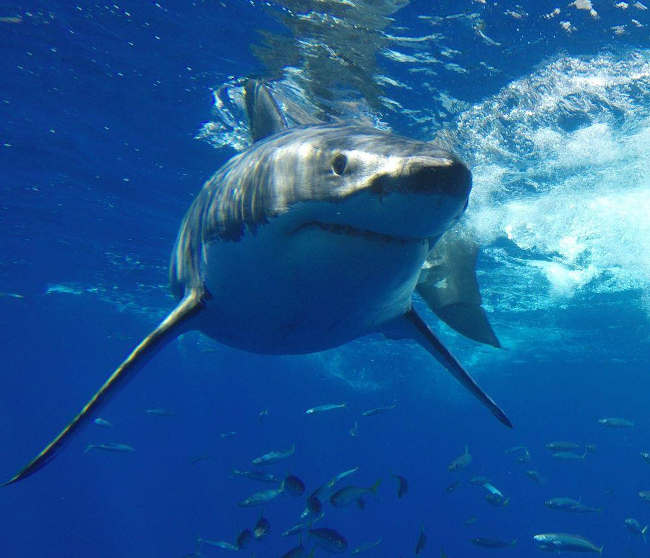
CDFW and white sharks
Q: What is CDFW’s role in managing white sharks?
A: The California Department of Fish and Wildlife (CDFW) manages fisheries in California; this includes sharks. White sharks (Carcharodon carcharias), also known as great white sharks, are protected from all recreational take and most commercial take in California.
One of CDFW’s main roles is tracking landings of white sharks taken incidentally in commercial fisheries, which is allowed only in certain cases. We also track the status of white sharks for management of the species as a whole and for their value as one of California’s natural resources.
CDFW also permits and tracks scientific take of white sharks through its scientific collecting permit process, and maintains an incident database primarily to promote public awareness.
Incidents vs. attacks
Q: Why does CDFW refer to shark “incidents” rather than shark “attacks”? What is a shark incident?
A: As a science-based agency, CDFW wants to be accurate without being sensational. There are multiple reasons why scientists worldwide are moving away from the term “attack” when referring to sharks.
Most shark bites can be attributed to either exploratory bites where a shark is investigating an unknown object in its environment, or incidents in which the shark may have mistaken the person for a natural food source such as a seal or sea lion (in the case of white sharks).
CDFW documents any incident where any species of shark approaches and touches a person in the water or on a board or kayak. We do not track incidents where a sighting occurred without contact.
We also don’t track incidents where a shark was provoked (for example, cases involving fishing or chumming) or incidents where a shark approached or touched larger boats.
Post-incident tracking
Q: Is it possible to track down and identify which specific shark bit a person?
A: It would be nearly impossible to determine which shark was responsible for a bite. One of the primary reasons is that sharks, especially white sharks, are highly mobile. While they may stay in an area for a brief period, white sharks are known to move extreme distances, sometimes migrating thousands of miles. While we can recover DNA from a bite to help determine species, doing the same from a shark after an incident is highly unlikely and we do not have DNA tests for individual sharks.
Another reason is that white sharks are not known to become habituated to people, like some land animals (bears, mountain lions, coyotes, etc.). There is no need to track down a shark after an incident, as another incident is highly unlikely to happen again with the same shark.
Frequency of incidents
Q: Are white shark incidents increasing in California?
A: While the number of non-injury incidents in California appears to be increasing, the number of injuries appears to be very stable and remains low. There are a variety of reasons that may explain the increase in non-injury incidents.
First, the number of people entering the water is increasing, especially in Southern California. Second, our ability to document shark incidents is improving because more people today can record sightings with cameras on their phones.
There has also been a vast increase in the use of personal action cameras such as GoPros, as well as aerial drones. These devices have improved our ability to get our sightline above the ocean, where it is easier to spot sharks.
Also consider that 15 to 20 years ago a shark incident may have gone unreported if a surfer or beachgoer only told friends and family. Today, a similar shark incident may be recorded, posted online and shared on social media, which often leads to even wider coverage by news media.
Risk
Q: What is the likelihood of encountering a shark in the ocean in California?
A: At CDFW we like to reinforce the idea that the ocean is a wilderness. Just as when you go into a forest and may encounter a bear or mountain lion, when you go into the ocean you may encounter a shark. However, the chance of an incident with one is extremely low — as evidenced by the very low number of incidents in California. With tens of thousands of people in the water at California beaches each year, slightly more than 100 shark incidents involving injuries to humans have been documented since 1950.
For comparison purposes, it’s worth noting that by far the most “dangerous” animal in the ocean in terms of number of people injured is the round stingray. Hundreds of people are stung each year by round stingrays.
In fact, in 2019 more than 500 people were stung over the three-day Labor Day weekend in Orange County alone! (Stingrays, like sharks, do not seek out humans; they are simply defending themselves when stepped on. The best way to avoid stingrays is to do the “stingray shuffle” and shuffle your feet in the sand as you enter the water. This will let the stingrays know you are coming so they can swim away.)
- Details
- Written by: Anderson Marsh State Historic Park
The next guided walk will be held on Saturday, July 9, beginning at 8:30 a.m.
The July nature walk will be led by Henry Bornstein, a certified California Naturalist and volunteer State Parks docent.
The hike will cover parts of the Cache Creek Nature Trail, the Marsh Trail and the Ridge Trail.
The hike is over mostly level terrain and will cover about 3 miles at a leisurely pace. The hike should last between 1.5 and two hours.
Bring binoculars and meet in the parking lot at 8:15 a.m. for time to experience the early morning wildlife that can be found in the ranch house and barn complex yard; the walk will begin at 8:30 a.m.
There is no charge for the guided nature walk and parking is free for those attending.
Anderson Marsh State Historic Park is located on Highway 53, between Lower Lake and Clearlake.
For more information about the guided walk, email
- Details
- Written by: Lake County Land Trust
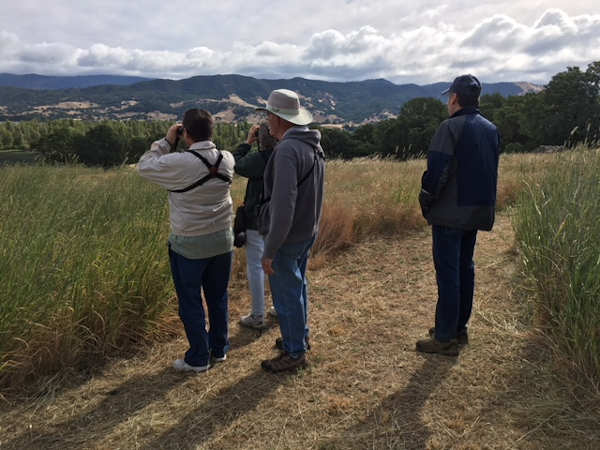
UPPER LAKE, Calif. — The Lake County Land Trust’s Rodman Preserve at 6350 Westlake Drive near Upper Lake is continuing to welcome visitors on Saturdays but hours have changed to 9 a.m. to 1 p.m.
The previous 10 a.m. opening is not appropriate for summer because of the heat.
The preserve offers a moderate one and a half mile walk where visitors will see birdlife and even some mammals like foxes and coyotes.
A volunteer will open the gate at 9 a.m. and visitors are asked to sign in before embarking on a pleasant self-guided morning walk.
The nature center remains closed but visitors are welcome to enjoy the walk and the open air back porch.
Go to the Lake County Land Trust website at www.lakecountylandtrust.org for more information and don’t mistake the Rodman Preserve for the Rodman Slough County Park which is down the road from the Preserve on the Nice-Lucerne Cutoff.