 How to resolve AdBlock issue?
Recreation
- Details
- Written by: Nadine Strauss
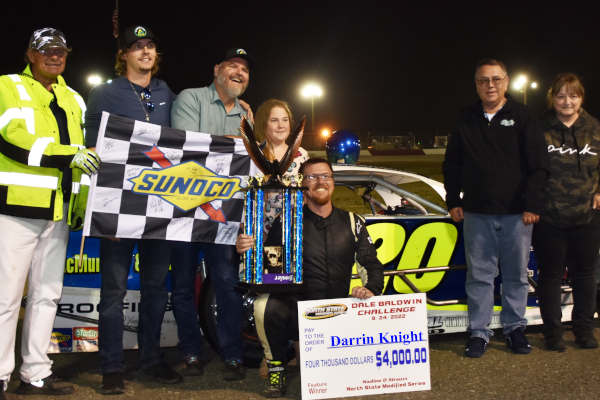
The North State Modified Series celebrated the richest event in its nine year history at Redwood Acres Raceway in Eureka Saturday night.
The “Dale Baldwin Challenge,” presented by McMurray and Sons Roofing, Mark and Sharon Baldwin, Doyce Eaton and Ray Elliott saw some of the heaviest hitters in the modified ranks travel to this prestigious event in hopes of taking home a part of the $20,300 purse payout.
It was the O’Reilly Auto Parts Night at the Races, and it was Darrin Knight of Kelseyville who brought his car out of retirement, borrowed a motor from fellow competitor Ian Elliott of Lakeport, took the lead away from Simi Tour of Potter Valley on a lap 23 restart, and stayed out in front the remainder of the 60 laps to win $4,000 and all the bragging rights that come with a win at an event of this caliber.
Elliott turned the fastest lap of the night at 16.309 seconds. Knight was second fastest at 16.518 and Charlie Collins of Lakeport clocked in third with 16.524. Elliott drew the number eight chip for the invert placing Tour and Keith Bloom in the front row for the start.
When the green flag fell, the pack charged hard into turn one with Bloom getting loose and making slight contact with Brandon White.
All cars continued, but it gave Tour the opportunity he needed to charge out in front and lead the first third of the race. Both White and Knight gained ground as Bloom was trapped in the outside lane and lost positions.
Defending NSMS champ Scott Winters was on the move, passing Cole Brown on lap nine and drove under Sammy Nuno the following round. Meanwhile Tour was putting a healthy distance between his car and the rest of the pack. Knight caught and passed second place White on lap 21.
Two rounds later Richie Pott’s car broke loose and slapped the turn three concrete hard, ending his run. At the same time Elliott, while running in eighth, pitted for repairs.
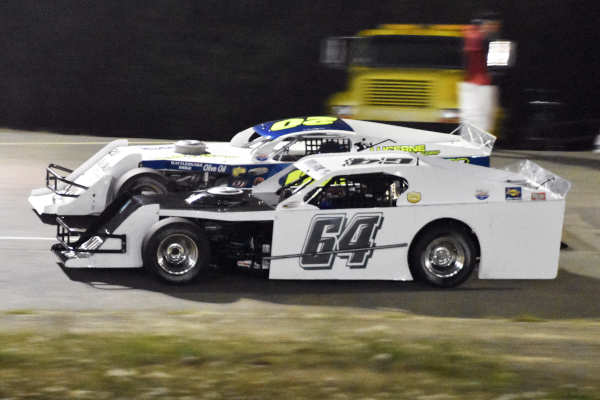
The double-file restart saw Knight pull ahead of Tour to assume the lead. The battle for second waged between Tour and White, with White inching under Tour several times, but could not get it done. Meanwhile the fans were watching Elliott come back through the pack, and by lap 42 he was back running in fourth spot.
With no other yellows to slow the action, Knight sailed to a convincing victory followed by Tour, Winters, Elliott, Charlie Collins, White, Nuno, Brown, Bloom, Dustin DeRosier, Rich Cobb and Orion Mosher.
Mark and Sharon Baldwin, along with Dave McMurray II & Dave McMurray III, presented the $4,000 check and Dale Baldwin Challenge trophy to Knight in front of the near-packed house.
Potts got $250 and the Doyce Eaton Hard Luck trophy for his troubles in the main, and Elliott earned the Ray Elliott Hard Charger Award for making a come-back run after pitting on lap 23. The Naake Suspension certificate went to Tour.
Major sponsors of this race were Mark and Sharon Baldwin, McMurray & Sons Roofing, Ray Elliott and Doyce Eaton. Associate and contingency sponsors were Anderson Logging of Fort Bragg , Scribner Plastics, O’Reilly Auto Parts, Frank’s Radios, Hoosier Tire West, Sunoco Race Fuels and Naake Suspension,
The 2022 NSMS Tribute Tour concludes on October 7-8 at Shasta Speedway in Anderson. The seventh running of the “Lloyd Burton Against the Wind Modified Challenge” will be the final race of the season for the North State Modified Series.
- Details
- Written by: Nadine Strauss
EUREKA, Calif. — The North State Modified Series had a three-part event at Redwood Acres Raceway Saturday night with three different winners earning first place awards.
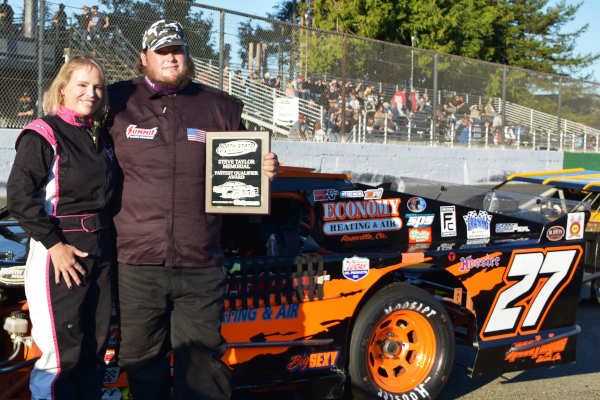
In the Steve Taylor Memorial Qualifying session it was Ian Elliott of Lakeport who turned the fastest lap of the night (16.309 seconds), and was presented the plaque and $100 from Sage Taylor of Cloverdale.
Earlier Elliott was voted the Best Appearing Car and Crew and received that award and $250 from event sponsor Doyce Eaton of Dundee, Oregon.
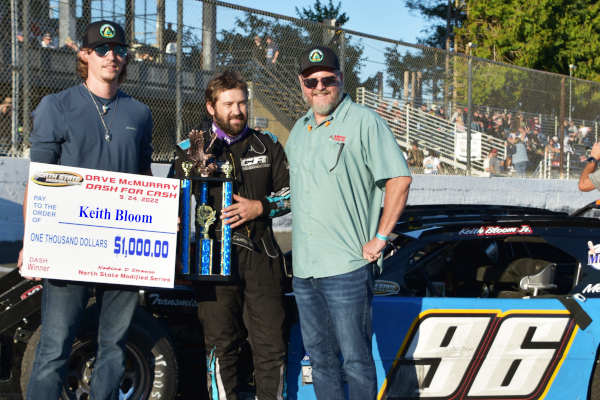
The Dave McMurray Memorial Dash for Cash was open to the six highest drivers in the NSMS points standings who had never won a feature event with the series.
The drivers drew for starting positions with Keith Bloom of Anderson and Elliott starting in the front row, Oregon driver Rich Cobb and local driver Orion Mosher set to start third and fourth, and Cloverdale’s Dustin DeRosier and Cole Brown from Ukiah in row three.
During the pre-race warm-up laps Cobb’s car broke a u-joint, allowing alternate Richie Potts of Petaluma to fill his starting spot.
The eight-lap race saw Bloom power by Elliott at the drop of the green flag. Bloom was determined to stay out in front, and led every lap to the checkered flag.
Elliott settled for second ahead of Potts, DeRosier, Brown and Mosher.
The race paid $1,000 to the winner which was given to Bloom by Dave McMurray’s son and grandson, Dave McMurray II and III.
Other special awards recipients were Scott Winters (Doyce Eaton Long Tow Award $250), and Richie Potts (Doyce Eaton Hard Luck Award $250.)
The Dale Baldwin Challenge feature event, presented by McMurray & Sons Roofing, paid $4000 to winner Darrin Knight of Kelseyville. A followup story will cover that event.
- Details
- Written by: California Department of Fish and Wildlife
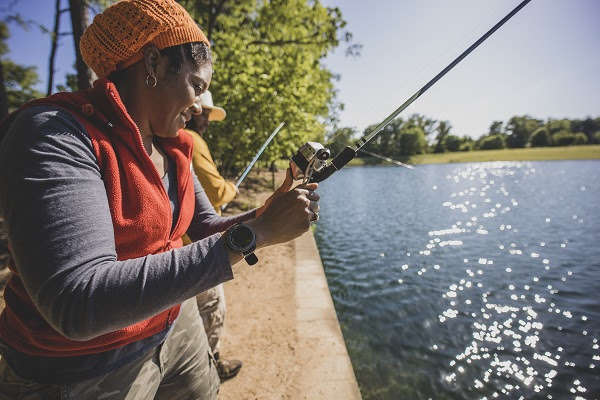
Fishing resources
Q: I want to fish but don’t know how and there are no clinics offered in my area. Does CDFW offer any online learning opportunities?
A: Yes – there is a series of short videos that cover basic fishing skills available on CDFW’s YouTube channel that are captioned in both English and Spanish. The videos cover the basics of fishing including knot tying, casting, rigging, safety and more. One advantage to these videos is that if you are out fishing and need a quick reminder, you can watch them online or download them to your phone. CDFW’s Recruit, Retain, Reactivate (R3) team also has a webpage with information and resources to help you get started fishing. It can also be helpful to ask other anglers along the shoreline for assistance as most are more than happy to help bring new anglers into the sport. Remember a fishing license is required for all anglers 16 years or older. A license can be purchased online or at most stores that sell fishing tackle, including many chain drugstores.
If you’ve mastered the basics and are looking to grow your skills as an angler, consider attending one of the Virtual Gatherings offered by CDFW’s Fishing in the City program. Featuring a different topic each week, these online workshops provide a space to ask questions and learn tips, tricks, and best practices from CDFW staff and other anglers.
Wildlife officers
Q: I’m interested in becoming a wildlife officer. What are the requirements to become one and how does the timing of applications work?
A: Thank you for your interest! The next application cutoff date is Dec. 1, 2022, so mark your calendar and conduct a self-evaluation to see if the career is a good fit for you. The first thing you should do is ensure you meet our minimum qualifications. The most stringent minimum qualification is the education requirement. To be a wildlife officer, you must complete 60 college units with 18 of those coming from a related field (see below). However, you may apply with just 30 units of college, 18 of which must be earned in a related field. In that case, you will have to continue taking college courses during the application/background process to meet the 60-unit requirement by the time you start the academy.
The newly updated related fields are accounting, agriculture, animal science, anthropology, astronomy, biological sciences, botany, business, chemistry, computer science, communication, conservation, criminal justice, ecology, economics, English, entomology, environmental management, environmental science, environmental studies, ethnic studies, fisheries or wildlife management, forestry, geography, geology, herpetology, history, law enforcement, life science, mammalogy, marine biology, marketing, statistics, military transfer credits, multidisciplinary studies, natural resources conservation, oceanography, ornithology, physics, police science, psychology, plant taxonomy, political science, public administration, social studies, sociology and all social sciences, water quality management, wilderness survival and zoology.
You can have 18 units in any combination of the above classes and it does not have to be your major.
Other qualifications include:
• Be a U.S. citizen or lawful permanent resident who has applied for citizenship (you must be a citizen at time of appointment).
• Possess a valid driver license.
• No felony convictions or convictions of any offense which precludes you from carrying a firearm under state or federal law.
• Be of sound physical condition, able to pass the Physical Abilities Test, a medical evaluation and a psychological evaluation.
Last year, the California Department of Fish and Wildlife’s (CDFW) Law Enforcement Division updated its cutoff dates for the application/hiring process. The cut-off dates are March 1, June 1, Sept. 1 and Dec. 1. This means you have more opportunities to start the background/hiring process.
CDFW also made a recent change to its exam process, the POST Entry-Level Law Enforcement Test Battery (PELLETB). The PELLETB tests an applicant’s knowledge of basic grammar and spelling as well as the ability to read, write and understand the English language. CDFW does offer the PELLETB test. However, applicants are encouraged to take the PELLETB test and obtain their “T-Score” at an agency/department/academy where they live. The PELLETB test can be taken every 30 days which gives applicants the opportunity to improve their T-Score. Your PELLETB T-Score will be accepted if you have taken it within three years of your application date and received a score of 42 or greater. You will also need to provide proof (usually an official letter from the proctor) of your PELLETB T-Score when you submit your application.
Applicants who apply before the cut-off dates of March 1, June 1 and Dec. 1 need to provide their own T-Score, or their application will be rejected. Applicants who submit applications without a PELLETB T-score for the Sept 1 cut-off date will be invited to the November PELLETB administration, put on by CDFW.
The following documents are required when applying:
• A completed state examination/employment application (STD 678);
• Unofficial transcripts;
• Criminal Record Supplemental Questionnaire.
PELLETB T-Score (for the March 1, June 1 and December 1 deadlines)
You can submit the required documents through the following email address (emailed documents are preferred):
You can also mail a copy of all the required documents to:
California Department of Fish and Wildlife
Attention: HR - Exam Unit
P.O. Box 944209
Sacramento, CA 94244
To be considered for the next hiring cycle, you must turn in your application prior to December 1, 2022. Please contact our law enforcement recruiter, Lt. Perry Schultz, at
- Details
- Written by: Nadine Strauss
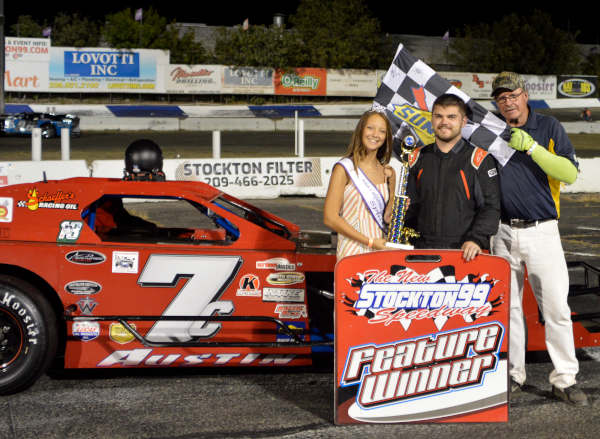
Cameron Austin of Lakeport inherited the lead when race leader Ian Elliott of Lakeport hit fluid on the track in turn four and spun with only 3 laps to go in the Bob Lehman Classic at Stockton 99 Speedway Saturday night.
Because of the anticipated lengthy clean up, race officials yellow-checked the event and declared Austin the winner.
Dustin DeRosier of Cloverdale finished second followed by NSMS points leader Scott Winters of Tracy, Elliott, and Orion Mosher of Eureka.
Mosher won the $100 dash for cash over DeRosier, Jordan Smith and Jason Philpot. Mosher also received $125 for the longest tow.
Rick Avila was given $125 for the hard luck award.
Winters earned the O’Reilly’s Auto Parts fastest qualifier’s award when he clocked in at 14.251 seconds, only .008 second quicker than Austin's time of 14.259.
Elliott earned the O'Reilly's Hard Charger award for coming from the back of the pack to the lead twice in the same race. The Naake Suspension certificate also went to Elliott. The Scribner jugs went home with Winters and Philpot. DeRosier, Keith Bloom and Orion Mosher received gift certificates from Frank’s Radios.
The $500 bonus money from the Lehman family was earned by Mosher, Calvin Hegje, Jordan Smith, Philpot, and Bloom, each receiving $100.
Other bonus money went to Hedge ($100 from Economy Heating & Air) for leading lap one, Bloom ($100 also from Economy Heating and Air) for leading lap 12, Austin ($100 from Smog Busters) for leading lap 43, and Elliott ($100 from Authority Heating and Air) for leading lap 55.
Major sponsors of this race were Anderson Logging of Fort Bragg, Hoosier Tire West, Sunoco Race Fuels, Naake Suspension, Mark & Sharon Baldwin, Ray Elliott, Doyce Eaton, Scribner Plastics, McMurray & Sons Roofing, O’Reilly Auto Parts and Frank’s Radios.
The 2022 NSMS Tribute Tour continues on September 23-24 at Redwood Acres Raceway in Eureka. This event will be the richest event in the History of the North State Modified Series with $4000 going to the winner and $1000 for 10th in the Dale Baldwin 60 lap feature event.. Other cash bonuses will be on the card like $1000 to win the non-NSMS winners Dash for Cash. More details coming soon.