 How to resolve AdBlock issue?
Recreation
- Details
- Written by: California Department of Fish and Wildlife
The closures will help ensure safety and accommodate the needs of fire crews.
The updated list of CDFW land closures can be found here.
The lands listed on the closures page will be closed to all public access and activities including hunting until further notice.
Due to the uncertain nature of the fires and potential damage to state lands, it is unknown when these areas will reopen to the public.
- Details
- Written by: Nadine Strauss
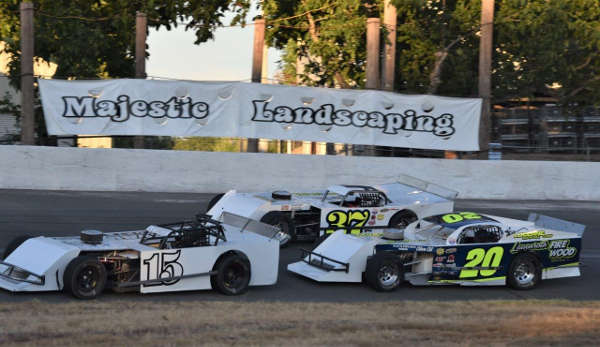
LAKEPORT, Calif. – It was a hot night at the Lakeport Speedway Saturday, not only in temperature, but in racing action for Darrin Knight of Kelseyville (NCRA Modifieds), Donovan Cox of Kelseyville (Taco Bell Bombers), and Ron Portlock of Ukiah (AAA Energy Solutions Pro-4 Modifieds) as each of these competitors had a near clean sweep in their respective classes.
Knight, who claimed his car was running badly all day, first took home the hardware in the modified trophy dash, went on to win the heat race, and led all but seven laps in the 30-lap Anderson Logging-sponsored feature event.
It was Knight’s first appearance at Lakeport this season. The only thing Knight did not lay claim to was the quickest lap in time trials. That honor went to NCRA points leader Mike Sullivan with his 12.845-second fast lap.
The modified main event saw Richard Knight and Robert Schmidt start in the first row with Darrin Knight and Ian Elliott in row two. Richard Knight forged ahead at the start. As Schmidt lost ground, Darrin Knight moved into second place followed by Jeremy Nowlin and Donovan Cox.
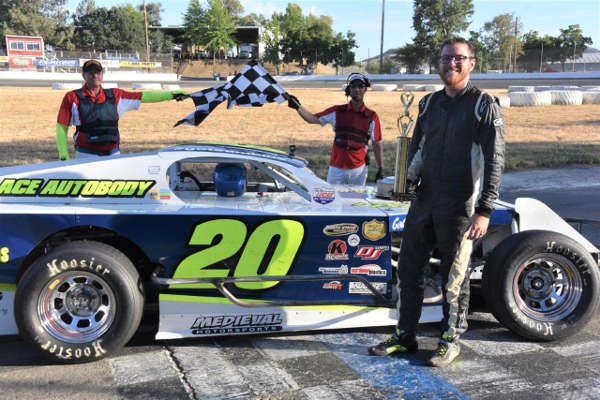
Darrin Knight pulled alongside Richard Knight on lap seven, and just as the cars were entering turn two, Richard Knight’s rear-end drifted high making slight contact with Darrin Knight’s car. The impact was just hard enough to send Richard Knight’s car into a spin in front of the tight pack.
All cars made it through, but before the race could get going again, Donovan Cox (doing double duty in both a modified and bomber) drove into the pits with an electrical problem. Cox’s crew worked under the hood for several minutes but could not get the car back on the track.
This put Nowlin next to Darrin Knight for the restart where they ran side-by-side for two laps before Darrin Knight pulled ahead. Nowlin dropped back on the outside allowing Sullivan and Elliott to gain position. Richard Knight pulled into the pits on lap 22, and at the checkered flag, it was Darrin Knight, Sullivan, Elliott, Nowlin and Schmidt. Cox was the recipient of the Mark and Sharon Baldwin Hoosier tire give-away.
In Taco Bell Bomber action it was Mike Collins who set a new bomber track record of 14.020 and kept Cox from having a perfect night. Cox had previously won the trophy dash and fast heat race.
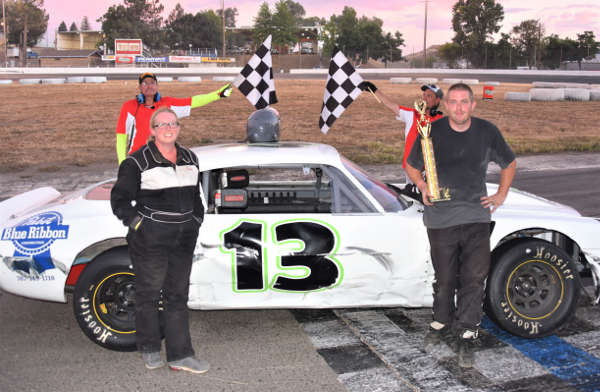
Seth Chew stole the lead away from pole setter Amber Portlock at the drop of the green flag in the bomber 30 lapper with both Klinton Waite and Cox moving into second and third by lap four. Cox motored by Waite on lap five, but Collins was on a mission, passing both Waite and Cox on lap six and driving by Chew for the lead the following round.
Collins began to lap the back-runners on lap 16, but two circuits later his car slowed and headed to the pits with a broken rear-end. After a brief clean-up, the action was back underway with Cox pulling away from Waite, Clew, Jim Kollenborn and Trevor Abella.
Kasey Horat spun on the final lap, and as the cars scattered to get around him, Cox was first to cross the finish line. Kollenborn beat Waite by inches to claim second place, Waite was third followed by Abella and Chew. Chew was the other heat race winner.
A good field of seven Pro-4 Modifieds was reduced to only two by main event time. The heat was brutal on these four-cylinder cars, and engine problems side-lined Andy Leuzinger, Chris Straka, Mike Peterson and Wil Robertson’s cars. Then in the heat race, Anthony Gorrin lost control of the Johnny Barker’s #14 and drove the car hard into the turn three concrete wall.
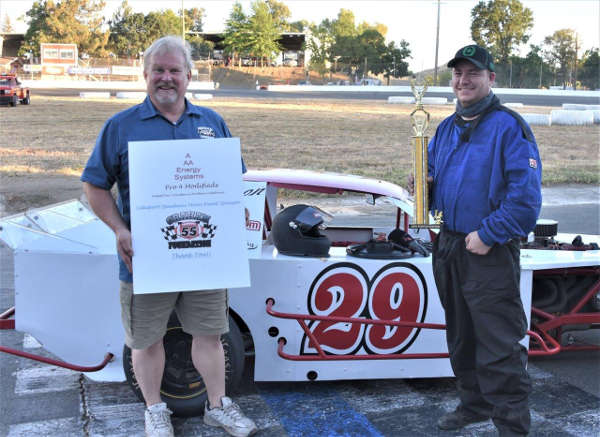
So after winning the trophy dash and heat race, Ron Portlock held off James Gard to score the main event victory. Robertson turned the quickest lap in time trials at 13.228.
Pete Graham of the Graham 55 Foundation donated $500 to the Pro-four drivers and made sure all seven went home with money in pocket. The Pro-4 Modifieds will take next week off to regroup but will return on Sept. 12.
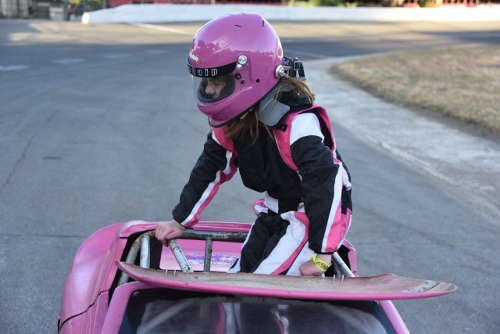
The start of the Bandolero class saw 10-year-old Courtney Portlock of Lucerne race against 6-year-old Braydon White of Kelseyville. Courtney came in first in both the trophy dash and the main event. She gave one of her trophies to Braydon for sharing in her fun.
Racing resumes Saturday night, Aug. 22, with the NCRA Modifieds, The Taco Bell Bombers, the Legends Cars, the Late Models and the 4-Bangers.
Then on Sept. 12, the North State Modified Series will begin its four-race NSMS fall schedule beginning at Lakeport Speedway. Health regulations dictate still no spectators in the grandstands.
NCRA races at Lakeport Speedway are presented by Anderson Logging, Sullivan Const Masonry, Napa Lake Parts, Taco Bell, D&P Pools, Hillside Powersports, Clearlake Redi-Mix, Snap-On Tools, S&K Paving & Striping, O’Reilly Auto Parts, Lucerne Roofing, S & K Automotive, Under the Sun Garden Supply, Perkins Septic Tanks, Lake County Tribal Health, Don Anderson Attorney At Law, Coleman’s Custom Vinyl, Lake County Welders, Kelseyville Lions, Mike Sullivan Consulting, Lake Co. Waste Solutions, Gifford Backhoe Service and Majestic Landscaping.
- Details
- Written by: California Department of Fish and Wildlife
Question: Why aren't there any elk in the San Gabriel Mountains? Has there ever been any discussion of starting a herd there? There is plenty of land, with 970 square miles of space. The San Gabriels are home to bighorn sheep, deer, bear and mountain lions. There are also elk in Tehachapi and the Tejon Ranch, which are not too far away. (Brent)
Answer: Elk are not native to the San Gabriel Mountains, likely because the climate and resources there cannot support large-bodied ungulates. The San Gabriel range tends to be both steep and dry – conditions that are better suited for desert bighorn sheep.
Historically, tule elk (a subspecies of elk native only to California) ranged from Shasta County in the northern portion of the state down to the Tehachapi Mountains in Southern California, occupying the entire Central Valley from the Sierra Nevada foothills in the east to the coast in the west.
Tule elk are uniquely adapted to the Mediterranean climate that the Central Valley and Coastal Mountain ranges provide. The elk population in the Tejon Hills and Tehachapis are the Rocky Mountain subspecies, introduced to Tejon Ranch from Yellowstone National Park in the 1960s.
Though it is possible for the Rocky Mountain elk at Tejon to naturally expand into the San Gabriels in the future, man-made barriers like freeways, fencing and agriculture land-use have so far limited that migration.
Additionally, climate change may further decrease the suitability of the San Gabriels to support elk in the future, even if elk found their way over.
CDFW currently does not have plans to start any new elk herds. Doing so would be a huge undertaking that would require a feasibility study, extensive public outreach and buy-in, and environmental documents.
The good news about California elk is this: our elk populations are robust and we think most of them are stable or increasing in number and distribution.
What about moose – or elk – in the Sierra?
Question: I read the recent column about California's lone wolverine, which is a very interesting tale. It got me wondering, why aren't there any moose or elk in the Sierra? I know that there are elk elsewhere in the state, but at some point in history one would think that a herd of moose or elk would have migrated into the area. (Bill)
Answer: Moose evolved in much cooler climates in boreal forests and other subarctic habitats. Generally, habitats and climates in the Sierra and elsewhere in California are not well-suited for moose.
We do occasionally get reports of elk in the Sierra, primarily bull elk. You might be interested in the story of a single Rocky Mountain elk's solo journey in the northern part of the state. This trailblazing elk traveled 40 miles in six weeks, ending up farther south in the Sierra than had previously been reported. He may have been in search of a mate or new territory.
Historical records don't really tell us about much elk activity in the Sierra, so they may not have been present there historically.
The western slope of the Sierra is close to historical range of tule elk, but they're generally a valley species that use flat lands and tules. The eastern Sierra are quite rugged and elk are built more for moving quickly across plains, rather than traversing rough mountainous terrain.
However, as elk populations continue to grow, and climate change alters suitability of valley habitats for elk, it is possible we may begin to see elk distributions change. CDFW is beginning a study to assess vulnerability of our elk populations to climate change, which will help us better conserve and manage elk populations throughout California.
Beach fishing with two poles
Question: I do a lot of fishing/crabbing off the beach in the San Francisco Bay Area. I've heard from my fellow anglers that you can have as many poles on the beach as long as you can manage them. Is this true? What's the rule on how many lines/poles you can have on the beach for one person? (Leslie)
Answer: Generally, an angler can use as many lines as they'd like while fishing in the ocean. However, there are exceptions - one of which definitely applies to your question if you're fishing inside the Bay. When fishing for finfish in the San Francisco Bay, only one line with no more than three hooks may be used, per California Code of Regulations (CCR) Title 14, section 28.65(a). Also, Dungeness crab may not be taken from or possessed if taken from San Francisco Bay (CCR Title 14, section 28.85(a)(1)).
As far as the number of lines an angler can use, the following rules apply statewide: 1) When fishing on a public pier, no more than two rods and lines, two hand lines, or two nets or traps or other fishing appliances may be used to take crabs (CCR Title 14, section 28.65(b)). 2) When fishing for, or in possession of, rockfish, lingcod, greenlings, Pacific halibut, white sturgeon or cabezon, only one line may be used (CCR Title 14, sections 28.65(c), 28.20(d)(1) and 27.90(d)). 3) Only one line may be used when fishing for, or in possession of, salmon north of Point Conception (CCR Title 14, section 28.65(e)).
If you have a question for the California Department of Fish and Wildlife, email
- Details
- Written by: California Department of Fish and Wildlife
CDFW has closed many of its high use public areas – including fish hatcheries, license counters and other office locations – to slow the spread of COVID-19.
Many successful big game hunters rely on these facilities and the CDFW staff there to validate (countersign) their big game tags.
Hunters this year are strongly advised to plan ahead and contact their nearest CDFW facility in advance of their hunt to understand the tag validation locations, hours and procedures this season, which will differ from facility to facility.
Deer and elk tags need to be validated before transporting a harvested animal – except for the purpose of taking it to the nearest person authorized to validate the tag.
Persons authorized to validate deer and elk tags include CDFW employees but also a long list of other state, federal and local agents, including firefighters, public notaries, peace officers, meat processors, USDA Forest Service staff and others.
A listing of those authorized to validate deer and elk tags is available on page 23 of the 2020 California Big Game Hunting Digest.
Bear tags, on the other hand, can only be validated by a CDFW employee. Bear tags must be validated prior to transporting the bear – except for the purpose of taking the bear to the nearest person authorized to validate the tag en route to the hunter's home. CDFW will not require a bear tooth extraction this season.
A list of CDFW offices that will validate bear tags along with their contact information is available on page 57 of the 2020 California Big Game Hunting Digest.
Hunters must contact these offices ahead of time as many of these facilities and hatcheries are closed.