 How to resolve AdBlock issue?
Recreation
- Details
- Written by: California Department of Fish and Wildlife
Last week, after consultation with fish pathology experts and exhausting all avenues of treatment, CDFW announced that the fish, which are all trout, at the affected facilities must be euthanized in order to stop the spread of the outbreak.
The affected facilities – Mojave River Hatchery, Black Rock Hatchery and Fish Springs Hatchery – usually provide fish for stocking waterways in CDFW’s South Coast Region and Inland Deserts Region.
The euthanization of all the fish at these facilities will have a profound effect on CDFW’s ability to stock fish for anglers in those regions in the near future.
“Euthanizing our hatchery stocks was not a decision we came to lightly, but it had to be done,” said Jay Rowan environmental program manager for CDFW hatcheries. “This bacterium is resistant to all the treatment options we have available for fish. The fish losses were getting worse despite our treatments. The best option we have available that will get us back to planting fish from these hatcheries in the shortest timeline is to clear the raceways, thoroughly disinfect the facilities, and start over.”
CDFW has had the three facilities under quarantine for more than a month, while pathologists and hatchery staff treated the affected fish and researched potential options.
The outbreak of Lactococcus garvieae, which is similar to streptococcus, has been reported in cattle and poultry farms as well as fresh and saltwater fish and shellfish hatcheries around the world, but had never before been detected in fish in California.
Research of treatment options employed at trout farms in Europe and other parts of the world show there is almost no chance for successfully eliminating the bacteria from a facility without depopulation and disinfection.
Fish that are infected with Lactococcus garvieae can show symptoms including bulging eyes, lethargic or erratic swimming and increased mortality, or be asymptomatic and show no signs of infection depending on several factors including water temperature and stress.
Fish-to-human transmission of this bacteria is rare and unlikely but there are several documented instances associated with immunocompromised people consuming infected raw fish and unpasteurized milk products.
Hot Creek Hatchery in the eastern Sierra has tested negative for the bacteria and is still planting eight waters in Inyo and Mono counties. CDFW is in the process of developing a modified stocking plan to reallocate fish from central and northern California hatcheries to a small number of high angler use, easily accessible waters in geographically distinct parts of the eastern Sierra and Southern California.
For real-time updates, California anglers can refer to CDFW’s Fish Planting Schedule. This schedule is updated directly by CDFW hatchery staff. Although it contains current information, all fish plants are subject to change depending on road, water, weather and operational conditions.
For additional information, please see CDFW’s frequently asked questions about the L. garvieae outbreak. Also, members of the public can email questions to
- Details
- Written by: Lake County News Reports
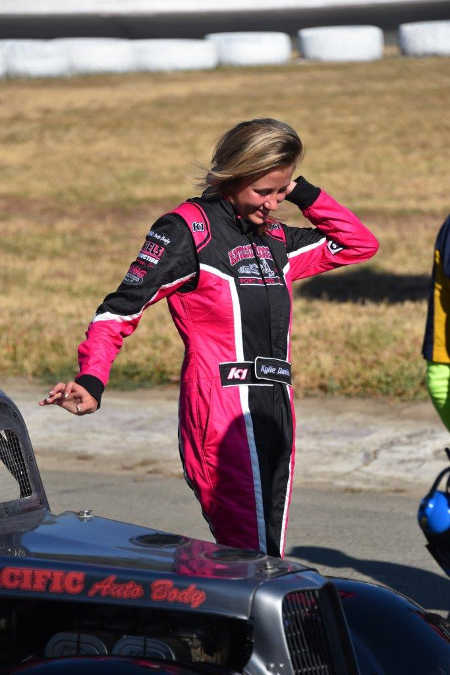
LAKEPORT, Calif. – Coming out of turn four on the last lap, 17-year-old Kylie Daniels of Fort Bragg snuck under veteran driver Dane Nissen and beat him to the checkered flag by inches to claim her first Legends Car win at Lakeport Speedway Saturday during the “O’Reilly Auto Parts Day at the Races.”
Taking the lead away from points leader Donovan Cox on lap nine, Mike Collins of Lucerne chalked up his second consecutive Taco Bell Bomber main event. and Johnny Barker of Upper Lake took home the trophy in the 20 lap AAA Energy Systems Pro-4 Modified class.
In other racing action Kyle Tellstrom of Ukiah collected $1,000 for his win in the North State Modified Series race and also won the Radical Focus Midget series event.
Once again the speedway had to race with no spectators as per the Public Health officer guidelines in Lake County. However, the event was live-streamed and shown on Facebook Live with more than 8,400 people reached.
Aidan Daniels of Fort Bragg turned the quickest lap in the Legends car class (14.012), but he was involved in a crash in his heat race that prevented him from starting the feature event. Kylie Daniels was also the winner of that race. Nissen won the trophy dash.
Nissen started second row outside in the feature and ran side-by-side with Tom Summers for four laps before taking control of the race. Kylie Daniels passed Summers on lap 10 as Nissen was pulling away.
About halfway through the 30-lapper, Nissen’s car seemed to be pushing allowing Daniels to poke her nose in the hole. But Nissen’s experience kept the youngster in second until the last lap.
Then just as it looked like it was Nissen’s race, Daniels drove in low, pulled alongside Nissen and drag-raced him to the checkered flag. Daniels beat Nissen by a bumper to take the win. Summers finished third in front of David Dunlap, Ethan Imperatrice, Nick Reading and Trey Daniels.
In Taco Bell Bomber action Tim Williams set the fast time of 14.061 seconds over the 11 car field with Collins next at 14.110 and Cox turning a 14.202.
Raymond Taylor jumped out in front of pole setter Jim Kollenborn at the drop of the green flag, and as Kollenborn faded, Cox and Collins moved into second and third. Two rounds later Cox drove by Taylor for the lead with Collins following his line.
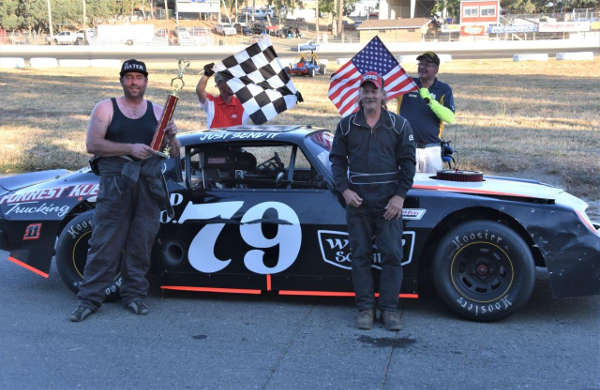
Cox ran out front for five laps before Collins took over the number one slot. The race was slowed on lap 18 when Kollenborn’s hub and spindle caught fire, eliminating him from the competition.
At the same time, both Williams and Trevor Abella retired their cars to the pits. When racing resumed it was Collins, Cox and Taylor out in front of Klinton Waite, Audrey Portlock and Kasey Horat.
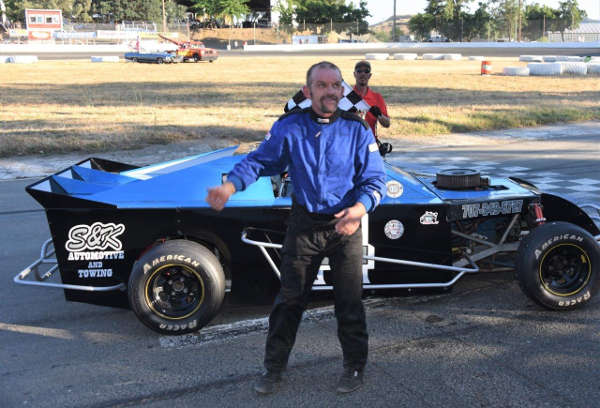
Two more yellow flags flew when Portlock’s car lost power and stalled on the track. Collins continued to lead all the way to the checkers followed by Cox, Taylor, Waite, Horat and Portlock.
Heat wins went to Waite and Collins. Cox won the trophy dash.
Mike Peterson set the fast time (12.767) in the Pro-4 Modifieds, almost a half a second faster than second runner Ron Portlock (13.235.) But Peterson’s car developed problems that kept him from running the main event. Wil Roberton also dropped out early as did Portlock.
This made easy pickings for Barker who led every lap for the win. Bud Anderson finished second with Rick Jelton third and Wade Eldrege fourth. Peterson won the heat race and Anderson captured the trophy dash.
Racing resumes at the Lakeport Speedway next Saturday, July 25, with the second appearance of the Legends of the Pacific. Also for the first time will be the local late models. Rounding out the card are the Taco Bell Bombers and the NCRA modifieds.
NCRA races at Lakeport Speedway are presented by O’Reilly Auto Parts, Anderson Logging, Sullivan Const Masonry, Napa Lake Parts, Bicoastal Media, Taco Bell, D&P Pools, Hillside Powersports, Clearlake Redi-Mix, Snap-On Tools, S&K Paving & Striping, Lucerne Roofing, S & K Automotive, Under the Sun Garden Supply, Perkins Septic Tanks, Lake County Tribal Health, Don Anderson Attorney At Law, Coleman’s Custom Vinyl, Lake County Welders, Steve Taylor Excavation, Dana Stahl Race Cars, Kelseyville Lions, Mike Sullivan Consulting, Lake Co. Waste Solutions, Gifford Backhoe Service and Majestic Landscaping.
- Details
- Written by: CALIFORNIA DEPARTMENT OF FISH AND WILDLIFE
Question: My family would like to rent a house at Stinson Beach in August. I feel silly asking this, but are sharks a legitimate concern for beach visitors in California? Are attacks more common when there are more people in the water, or have I been watching too many horror movies? (Kate)
Answer: Since 1950, there have been 191 shark incidents in California, 14 of which were fatal. Most of these injuries (and all the fatalities) were caused by white sharks – that's the species you typically see portrayed as predators on-screen. In reality, marine biologists do not believe that white sharks intentionally target humans as prey. White sharks typically feed on pinniped populations (like seals), and from their vantage point, a swimmer or surfer might look a lot like a seal or sea lion.
Interestingly, even as the state's population has greatly increased and more people than ever are visiting the beach to surf, swim and scuba dive, the number of shark incidents has not increased proportionally. And while it's true that incidents have been reported in almost every coastal county, when you consider the number of people who visit the coastline overall, the likelihood of coming face-to-face with a shark is extremely slim. Two much more common dangers are rip currents (which occur statewide) and stingrays (in warmer Southern California waters).
So, before you dip your toes into the ocean, take a look around for any posted warning notices by local authorities. Being informed is part of staying safe. You probably won't see a shark, but we hope you enjoy the beauty of our spectacular Pacific Ocean.
Is freshwater spearfishing ever allowed?
Question: It is my understanding that spearfishing in freshwater is not authorized in California. Are there any exceptions for spearing invasive species, like pikeminnow at Lake Pillsbury in Lake County? (Landon)
Answer: Freshwater spearfishing is generally prohibited for fish species in California, aside from a half-dozen or so specific exceptions listed in the California Code of Regulations Title 14, section 2.30. For example, freshwater spearfishing is permitted in the Colorado River Sport Fishing District in Southern California for carp, tilapia, goldfish and mullet all year. You'll find these regulations on page 16 of the 2020-2021 California Freshwater Sport Fishing Regulations booklet.
Lake County and Lake Pillsbury are not included among the areas or specific waters where freshwater spearfishing is allowed for fish species. However, if frog gigging is of any interest to you, invasive American bullfrogs - which make fine table fare - may be taken any time of year, in any number, day or night, by spears, lights, gigs, bow and arrow and fishing tackle, among other methods of take identified in the California Fish and Game Code, section 5.05. Bullfrogs can be taken in most parts of the state provided you have a valid California sport fishing license.
Becoming a wildlife officer
Question: I am a recent high school graduate and turned 18 last month. I want to pursue a career as a wildlife officer. Can I join now? What is the process like? (Troy)
Answer: Congratulations on your graduation - we are happy to hear you're interested in a career with the California Department of Fish and Wildlife! California's wildlife officers have some of the most diverse jobs in law enforcement. The work could include general patrol, enforcing hunting and fishing regulations, serving search warrants or working undercover to catch wildlife traffickers. Or they could be assigned to one of our Cannabis Enforcement Program Teams, a Special Operations Team or an Office of Spill Prevention and Response Team. If you want a unique and rewarding career in law enforcement, this is the job for you!
The first thing you should do is start your college education, in order to meet the minimum qualifications.
These include:
– Sixty semester units of college, 18 of which must be in a specialized, related field (criminal justice, biological sciences, natural resources conservation, ecology or something similar). The good news is that you may apply with just 30 units of college earned, as long 18 of those units are in the specialized field (you will need to complete the full 60 units before appointment).
– Status as a United States citizen or permanent resident alien who has applied for citizenship (you must be a citizen at time of appointment).
The steps of the hiring process are as follows:
– State application and unofficial college transcripts;
– The POST Entry-Level Law Enforcement Test Battery, also known as the PELLETB written exam;
– Background investigation;
– Physical ability test;
– Panel interview;
– Psychological and medical screening.
If you successfully complete the hiring process, you will become a cadet and attend the academy.
Upon successful completion of the academy, you will move on to field training, working with veteran officers and trainers.
Once field training is complete, you would report to your first assigned district as a solo wildlife officer.
It's a long process, but absolutely worth it!
If you have a question for the California Department of Fish and Wildlife, email
- Details
- Written by: California Department of Fish and Wildlife
Agencies will also provide updates on habitat conditions, availability of water for wetlands and possible impacts to hunter access on public lands resulting from the COVID-19 pandemic.
The meeting will be held online via Microsoft Teams on Saturday, Aug. 15, from 9 to 11 a.m.
To attend the online presentation, please RSVP to
CDFW will discuss the following state lands:
– Mendota Wildlife Area;
– Los Banos Wildlife Area including Volta and Mud Slough Units;
– North Grasslands Wildlife Area including Salt Slough, China Island, Gadwall and Widell/Ramaciotti Units.
USFWS will discuss the following federal lands:
– Merced National Wildlife Refuge including the Lone Tree Unit;
– San Luis National Wildlife Refuge including Kesterson, Blue Goose, East and West Bear Creek, and Freitas Units.
The presentation will cover CDFW’s statewide plan to keep hunters and department staff safe during the COVID-19 pandemic and continued efforts to provide recreational opportunities.
California Fish and Game Code section 1758 states CDFW shall annually provide an opportunity for licensed hunters to comment and make recommendations on public hunting programs including anticipated habitat conditions in the hunting areas on Type A Wildlife Areas, as defined under the commission’s regulations, through public meetings or other outreach.
In complying with this section, CDFW may hold regional meetings on its hunting programs for several different wildlife areas.