 How to resolve AdBlock issue?
Recreation
- Details
- Written by: Nadine Strauss

LAKEPORT, Calif. – The NCRA auto races return to Lakeport Speedway for two continuous events on Saturday, Aug. 15, and Saturday, Aug. 22, featuring the NCRA Modifieds, the Taco Bell Bombers, the AAA Energy Solutions Pro-4 Modifieds and the Bandoleros.
The Legends Cars and Late Models will join the line-up on Aug. 22.
Although spectators are still not allowed, the modifieds will be receiving prize money both nights thanks to Mike Anderson of Anderson Logging and several other speedway sponsors. The modified feature will pay $500 to the winner based on 10 or more cars competing.
In addition, all NCRA Taco Bell Bomber drivers will get in free both nights courtesy of donations from the Lakeport Speedway officials. The bomber purse is generated by donations in the pit area.
Line-ups for all races in every class will be determined by Time Trials beginning at 4:30 p.m. Racing begins at 6 p.m. with Trophy Dashes, heat races and main events.
NCRA races at Lakeport Speedway are presented by Anderson Logging, Sullivan Masonry, Napa Lake Parts, Taco Bell, D&P Pools, Hillside Powersports, Clearlake Redi-Mix, Snap-On Tools, S&K Paving & Striping, O’Reilly Auto Parts, Lucerne Roofing, S & K Automotive, Under the Sun Garden Supply, Perkins Septic Tanks, Lake County Tribal Health, Don Anderson Attorney At Law, Coleman’s Custom Vinyl, Lake County Welders, Kelseyville Lions, Mike Sullivan Consulting, Lake Co. Waste Solutions, Gifford Backhoe Service and Majestic Landscaping.
- Details
- Written by: California Department of Fish and Wildlife
"Regulations that either prohibit or limit the collection of species like turban snails, hermit crabs and mussels are meant to protect our tidepools, which are full of fascinating life that's important to the marine ecosystem," said Dr. Craig Shuman, CDFW Marine Region Manager.
Individuals should not remove any animals from tidepools that they don't plan on keeping and should also be aware that even walking over some sensitive areas can unintentionally harm tidepool plants and animals.
"It is important to watch where you walk, not only to avoid unintentionally harming the myriad of sea life that call California's tidepools home, but to avoid an accidental fall," Shuman said.
Tidepool animals have special regulations that limit the species and numbers that can be taken (California Code of Regulations Title 14, section 29.05). Most species found in tidepools can only be collected by hand. The use of pry bars, knives or other devices to remove them from the rocks is not allowed.
There are also regulations that cover fish found in tidepools, which can only be taken by hook and line or hand. No nets or other devices can be used.
In addition, the California Department of Public Health's annual mussel quarantine is in effect until at least Nov. 1, because eating mussels at this time of year may be hazardous to your health. Mussels can be collected for bait but may not be taken for human consumption during this period.
"People may not realize that anyone age 16 or older must have a valid sport fishing license to collect tidepool animals, and that there are limits to how many can be taken," said Assistant Chief Mike Stefanak of the CDFW Marine Law Enforcement Division. "In Southern California, an Ocean Enhancement Validation is also required for tidepool collection."
Most marine protected areas (MPAs) do not allow collection of tidepool animals. MPA maps and regulations are available on CDFW's MPA webpage, and on the mobile-friendly Ocean Sport Fishing interactive web map. Local authorities may also close off other areas to tidepool collecting.
Tidepooling and legal collecting can be a safe outdoor activity that maintains physical distancing from others as we work to minimize transmission of COVID-19. Those interested in participating must make sure to stay six feet from anyone not in their same household, wear a face mask, follow all fishing regulations, watch for incoming waves and where they step, and stay safe.
Any wildlife crimes witnessed can be easily reported to CDFW's "CalTIP" hotline, by calling 1-888-334-2258, or by texting "CALTIP", followed by a space and the message, to 847-411 (tip411).
- Details
- Written by: Lake County News Reports

Due to the no spectators mandate from the state of California, both the Central Valley based tracks at Madera Speedway and Stockton 99 Speedway have postponed the North State Modified Series, presented by Protect the Harvest events for Aug. 8 and Sept. 5.
Madera promoter Kenny Shepherd and Stockton promoter Tony Noceti say they will try to reschedule these events later this fall.
The next event for NSMS will be at Redwood Acres Raceway in Eureka on Sept. 26. It will be the McMurray and Sons Roofing Challenge where the top 20 drivers will receive a $200 bonus courtesy of owner Dave McMurray.
In addition, the top 15 in points will receive tow money from Lucas Oil and Protect the Harvest. This event pays $1,000 to the winner of the 60 lap feature event.
Redwood Acres Raceway is located at the Redwood Acres fairgrounds on Harris Street in Eureka.
NORTH STATE MODIFIED SERIES POINTS STANDINGS
Position; car number; driver; points
1. 5k, Kyle Tellstrom, 83
2. 69, Charlie Collins, 76
3. 5, Mike Sullivan, 68
4. 24, Scott Winters, 66
5. 21, Darrin Sullivan, 64
6. 77, Jeremy Nowlin, 62
7. 08, Chris Salmina, 60
8. 0, Cody Braund, 60
9. 27, Ian Elliott, 58
10. 96, Keith Bloom, 54
11. 16, Rich Cobb, 52
12. 2k, Mikey Snider, 50
13. 12, Dustin DeRosier, 48
14. 15, Richard Knight, 46
15. 37, Robert Schmidt, 44
16. 02, Sal Lopez, 42
17. 02x, Brian Collins, 40
18. 44, Simi Tour, 2

- Details
- Written by: CALIFORNIA DEPARTMENT OF FISH AND WILDLIFE
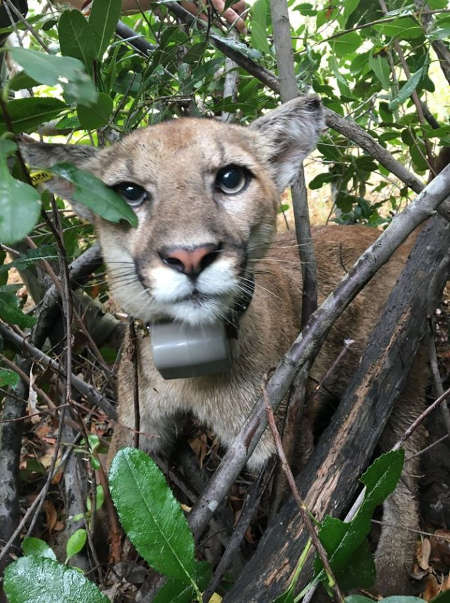
Bulky tracking collars?
Question: I recently saw video of a young mountain lion that was captured in the Bay Area. It was released back into the wild with a tracking collar of some kind. I think it's great that biologists are studying lions and other wildlife, but do the collars have to be so big and bulky? I can't imagine that poor cat can get around in the wild easily with that thing around its neck. (Amy)
Answer: The California Department of Fish and Wildlife has been putting radio collars on animals for decades now, and we've gathered a lot of data and knowledge about how animals react to these devices. Though they may look bulky at first glance, the collars are specially designed to do their job without disrupting the animal's life.
Collars are made from foam and leather with a circuit board housed in strong metal or plastic. We make sure collars weigh less than five percent of the animal's body weight. The collar placed on the 68-pound lion captured in the Bay Area weighed just one pound, which is less than one-and-a-half percent of its weight. All collars feature a remote control or timed release mechanism and are typically programmed to fall off before the battery's charge runs out. For example, if a collar has a battery life of two years, it will likely be programmed to fall off at 22 months. For young animals that haven't reached full size, we use expandable collars that will stretch as the animal grows.
We know from monitoring collared lions that they are able to reproduce, kill prey, maintain a healthy weight and live full lives. A 10-year-old female collared lion that we're monitoring recently had her fifth litter of kittens! Collars are important because they allow for real-time tracking when researchers are on the ground and produce stationary data points when monitoring remotely. We are currently monitoring about 80 collared lions in California, and those collars produce valuable data that we use for conservation efforts.
‘Hunting’ with an airsoft gun?
Question: I have an airsoft rifle with clear marked orange tip and butt stock. I want to try my luck at hunting deer with the airsoft rifle without killing them. Deer have a large body mass so it wouldn't hurt them. I would have to get much closer with the airsoft rifle than with a real rifle, and that would be a greater challenge. Are there any laws that say I can't do this in specified hunting areas? Do I need a license given that I'm not taking or killing anything? (Colin)
Answer: An airsoft gun could indeed harm a deer, especially if it were shot in the eye at close range. Shooting deer with an airsoft gun would be considered harassment of animals, prohibited under the California Code of Regulations Title 14, section 251.1. The regulation prohibits any intentional act which disrupts an animal's normal behavior, including breeding, feeding and sheltering. Violation of this code section may be punishable as a misdemeanor. There is an exception outlined in the code for landowners or tenants who are driving off birds or mammals for the purpose of preventing property damage.
Stingray safety tips
Question: In a recent column, you mentioned that a visitor to a California beach is more likely to be injured by a stingray than by a shark. Do these encounters happen in shallow water or only if you're swimming? What safety tips should I share with my kids? (Yvonne)
Answer: The round stingray (Urolophus halleri) is found throughout California, mostly in sandy areas and more common in warmer southern waters. Stingray injuries generally occur in shallow water, most often while people are wading. These small rays have a barbed spike on their tail that, if stepped on, can flip up and cause a very painful sting.
Stingray stings are indeed common – there were a record 176 people stung in one day at Huntington Beach in 2019! To help avoid being stung while walking in the surf, do the "stingray shuffle," by shuffling your feet across the bottom rather than stepping. If you are stung, the best first aid is to immerse the wound in very hot (not scalding) water. Be sure to clean it to prevent infection.
If you have a question for the California Department of Fish and Wildlife, email