 How to resolve AdBlock issue?
News
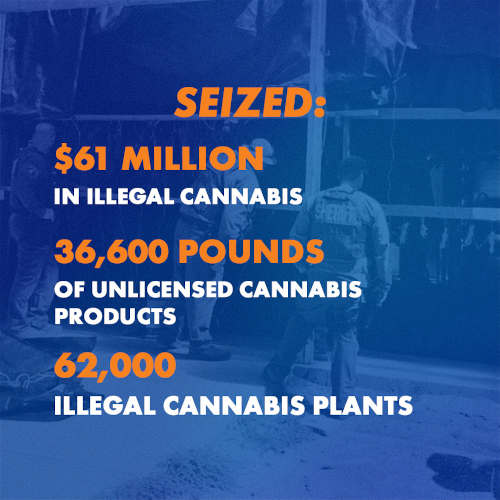
As California continues to support the legal and regulated cannabis market, on Tuesday Gov. Gavin Newsom announced state law enforcement operations that resulted in the seizure of over $61 million in illegal cannabis in the first four months of this calendar year — including 62,135 unlicensed cannabis plants and 36,619 pounds of unlicensed cannabis products.
“While we watch California’s legal cannabis market grow to become the largest worldwide, we are taking down those who operate outside the law,” Newsom said in a statement. “Putting a stop to illegal cannabis operations also means stopping organized crime, human trafficking, and the spread of illegal products that harm the health of Californians and our environment.”
Operations from Jan. 1 through April 30, 2024, through the Governor’s Unified Cannabis Enforcement Taskforce, were conducted in the counties of Alameda, Fresno, Humboldt, Kern, Los Angeles, Riverside, San Joaquin, Trinity, and Orange.
Enforcement highlights include:
• $61,467,088 million in illegal cannabis seized and destroyed.
• 36,619 pounds of unlicensed cannabis seized and destroyed.
• 62,135 unlicensed cannabis plants eradicated.
• 11 firearms seized.
• Five arrests.
Since its inception in 2022, the task force has seized $406,359,957 in unlicensed cannabis through 256 search warrants. The taskforce has also eradicated 409,656 plants and seized 139 firearms.
State agencies and departments participating in these taskforce operations include Department of Cannabis Control, Department of Fish and Wildlife, California National Guard, Department of Tax and Fee Administration, and State Water Resources Control Board Division of Water Rights. In addition, multiple federal and local partners assisted with enforcement operations.
The Unified Cannabis Enforcement Taskforce has been charged by the Governor to further align state efforts and increase cannabis enforcement coordination between state, local, and federal partners.
Newsom’s office said the enforcement actions protect consumer and public safety, safeguard the environment, and deprive illegal cannabis operators and transnational criminal organizations of illicit revenue that harms consumers and undercuts the regulated cannabis market in California.
Beyond the actions of the task force, Gov. Newsom has enacted policies and funding to support legal, regulated cannabis throughout the state.
The governor signed several pieces of legislation to erase past cannabis convictions, combat discrimination against off-the-job cannabis use, ensure statewide access to medicinal cannabis, and pave the way for California to join with other states to build legal interstate cannabis markets that work for everyone.
Previously, the administration enacted a budget that delivered historic tax relief for legal cannabis operators — particularly equity operators — while protecting other vital public investments that cannabis legalization has allowed us to fund.
To learn more about the legal California cannabis market, state licenses, and laws, visit https://cannabis.ca.gov/.
- Details
- Written by: Governor’s Office
CLEARLAKE, Calif. — The Clearlake City Council this week will consider selling a city-owned property and creating a new job in the Community Development Department.
The council will meet at 6 p.m. Thursday, May 16, in the council chambers at Clearlake City Hall, 14050 Olympic Drive.
The agenda can be found here.
The meeting will be broadcast live on the city's YouTube channel or the Lake County PEGTV YouTube Channel.
Community members also can participate via Zoom. The webinar ID is 821 8021 0243, the pass code is 273644. One tap mobile is available at +16694449171,,82180210243#, or join by phone at 669-444-9171 or 253-205-0468.
On the agenda is the presentation of adoptable dogs and a proclamation declaring May 18 to 24 as Safe Boating Week.
Under business, the council will discuss and consider approving the sale of a surplus city-owned property at 14709 Palmer Ave.
The city also will consider the classification and salary range for a community development specialist.
The staff report from Administrative Services Director/City Clerk Melissa Swanson said that the specialist “would be a vital support role within the Community Development Department, tasked with a variety of high level building and planning secretarial and clerical duties to assist the professional staff and the public.”
Swanson said key responsibilities of this new position will include clerical and technical support, public interaction, permit processing, record keeping, presentation preparation and financial management.
“This role not only enhances the operational efficiency of the Building and Planning Department but also fosters the city’s engagement with its citizens and its commitment to sustainable growth,” Swanson said.
On the meeting's consent agenda — items that are considered routine in nature and usually adopted on a single vote — are adoption of the fourth amendment to the fiscal year 2023-24 budget (Resolution 2023-27) adjusting appropriations; warrants, minutes of the April 17 Lake County Vector Control District Board meeting; and continuation of the recommended action: receive and file.
Following the open portion of the meeting, the council will go into closed session to discuss labor negotiations and a case of anticipated litigation.
Email Elizabeth Larson atThis email address is being protected from spambots. You need JavaScript enabled to view it. . Follow her on Twitter, @ERLarson, or Lake County News, @LakeCoNews.
The council will meet at 6 p.m. Thursday, May 16, in the council chambers at Clearlake City Hall, 14050 Olympic Drive.
The agenda can be found here.
The meeting will be broadcast live on the city's YouTube channel or the Lake County PEGTV YouTube Channel.
Community members also can participate via Zoom. The webinar ID is 821 8021 0243, the pass code is 273644. One tap mobile is available at +16694449171,,82180210243#, or join by phone at 669-444-9171 or 253-205-0468.
On the agenda is the presentation of adoptable dogs and a proclamation declaring May 18 to 24 as Safe Boating Week.
Under business, the council will discuss and consider approving the sale of a surplus city-owned property at 14709 Palmer Ave.
The city also will consider the classification and salary range for a community development specialist.
The staff report from Administrative Services Director/City Clerk Melissa Swanson said that the specialist “would be a vital support role within the Community Development Department, tasked with a variety of high level building and planning secretarial and clerical duties to assist the professional staff and the public.”
Swanson said key responsibilities of this new position will include clerical and technical support, public interaction, permit processing, record keeping, presentation preparation and financial management.
“This role not only enhances the operational efficiency of the Building and Planning Department but also fosters the city’s engagement with its citizens and its commitment to sustainable growth,” Swanson said.
On the meeting's consent agenda — items that are considered routine in nature and usually adopted on a single vote — are adoption of the fourth amendment to the fiscal year 2023-24 budget (Resolution 2023-27) adjusting appropriations; warrants, minutes of the April 17 Lake County Vector Control District Board meeting; and continuation of the recommended action: receive and file.
Following the open portion of the meeting, the council will go into closed session to discuss labor negotiations and a case of anticipated litigation.
Email Elizabeth Larson at
- Details
- Written by: Elizabeth Larson
NORTH COAST, Calif. — On Tuesday, May 7, the Lake County Board of Supervisors of the Mendocino County Board of Supervisors each delivered proclamations in recognition of May as Community Action Month and honoring the 60th Anniversary of Community Action in America.
Staff and board members of North Coast Opportunities Inc., or NCO, Lake and Mendocino counties’ local community action agency, were on hand at both events to receive the proclamation.
Since its creation in 1964, Community Action has responded to local needs in every corner of America and helped make America a better place to live.
During this time, the nation’s Community Action Network has inspired a spirit of hope, helped people change their lives and improved communities.
When national, state, tribal, and local leaders partner with Community Action Agencies, workable solutions are created that connect more families to opportunity — and make America a better place to live for everyone.
“(Community Action) did begin with the war on poverty but more than that, I want to say that it is the belief that we can make a difference (in regards) to poverty,” NCO Board of Directors member Pastor Shannon Kimbell-Auth said. “It is the belief that we can make a difference in generational poverty. It is the belief that we, collectively, if we do this work, and we live this commitment, we will make lives better for all, not just some, but all the women and children and men of America. And when we do this work, we are the solution.”
NCO envisions healthy and safe communities with equitable opportunities for all and works to empower people to transform their lives by providing vital services and acting as a community leader to build economic justice and well-being.
The agency serves community members through over 25 programs that range from childcare to workforce development, food access to emergency preparedness and more.
“Thank you, to NCO … (for) the commitment that you have to our community and the impacts that you are making to our community,” County of Lake Board of Supervisors Chair Bruno Sabatier said. “You are involved in just about everything that I can think of, and I couldn’t appreciate it more, thank you for your … service.”
The Community Action vision remains clear — they believe in a nation that creates opportunities for all people to thrive, builds strong, resilient communities, and ensures a more equitable society.
“For 56 years, NCO has been committed to sustaining an equitable and just community by listening and responding to community needs,” said Patty Bruder, NCO’s CEO. “We are energized to continue our work into the future.”
And, there is still work to be done. Nearly 40 million Americans continue to live in poverty, and more are only one missed paycheck away from hardship.
However, Americans in poverty no longer face hardship alone. Today, 99% of counties in America have access to life changing services that create pathways to opportunity and prosperity because of a Community Action Agency.
To learn more about Community Action or NCO go online to www.ncoinc.org.
NCO is the Community Action Agency that serves Lake and Mendocino Counties, as well as parts of Humboldt, Sonoma, Del Norte and Solano counties. NCO reacts and adjusts to community needs, including disaster response and recovery.
For more information visit www.ncoinc.org or call 707-467-3200.
Staff and board members of North Coast Opportunities Inc., or NCO, Lake and Mendocino counties’ local community action agency, were on hand at both events to receive the proclamation.
Since its creation in 1964, Community Action has responded to local needs in every corner of America and helped make America a better place to live.
During this time, the nation’s Community Action Network has inspired a spirit of hope, helped people change their lives and improved communities.
When national, state, tribal, and local leaders partner with Community Action Agencies, workable solutions are created that connect more families to opportunity — and make America a better place to live for everyone.
“(Community Action) did begin with the war on poverty but more than that, I want to say that it is the belief that we can make a difference (in regards) to poverty,” NCO Board of Directors member Pastor Shannon Kimbell-Auth said. “It is the belief that we can make a difference in generational poverty. It is the belief that we, collectively, if we do this work, and we live this commitment, we will make lives better for all, not just some, but all the women and children and men of America. And when we do this work, we are the solution.”
NCO envisions healthy and safe communities with equitable opportunities for all and works to empower people to transform their lives by providing vital services and acting as a community leader to build economic justice and well-being.
The agency serves community members through over 25 programs that range from childcare to workforce development, food access to emergency preparedness and more.
“Thank you, to NCO … (for) the commitment that you have to our community and the impacts that you are making to our community,” County of Lake Board of Supervisors Chair Bruno Sabatier said. “You are involved in just about everything that I can think of, and I couldn’t appreciate it more, thank you for your … service.”
The Community Action vision remains clear — they believe in a nation that creates opportunities for all people to thrive, builds strong, resilient communities, and ensures a more equitable society.
“For 56 years, NCO has been committed to sustaining an equitable and just community by listening and responding to community needs,” said Patty Bruder, NCO’s CEO. “We are energized to continue our work into the future.”
And, there is still work to be done. Nearly 40 million Americans continue to live in poverty, and more are only one missed paycheck away from hardship.
However, Americans in poverty no longer face hardship alone. Today, 99% of counties in America have access to life changing services that create pathways to opportunity and prosperity because of a Community Action Agency.
To learn more about Community Action or NCO go online to www.ncoinc.org.
NCO is the Community Action Agency that serves Lake and Mendocino Counties, as well as parts of Humboldt, Sonoma, Del Norte and Solano counties. NCO reacts and adjusts to community needs, including disaster response and recovery.
For more information visit www.ncoinc.org or call 707-467-3200.
- Details
- Written by: Lake County News reports
An unprecedented number of U.S. workers quit their jobs in 2021 and 2022, the first full two years of the COVID-19 pandemic — a phenomenon dubbed the Great Resignation.
What followed was what’s come to be known as the Great Reshuffling: Some workers exited the labor market entirely, others quit and eventually rejoined the labor force and others changed employers with little or no break in employment.
New U.S. Census Bureau statistics from Longitudinal Employer-Household Dynamics, or LEHD, show to what extent U.S. workers changed jobs across industries during and after the pandemic emergency was declared over in 2023.
LEHD’s Job-to-Job Flows, or J2J, data product now includes an experimental research release of job flow counts across industries from the North American Industry Classification System, or NAICS, down to a more detailed subsector level (three-digit NAICS).
Analyzing industry subsectors rather than just industry sectors captures job shifts within and across industries, painting a richer picture of how frequently workers changed jobs during the pandemic.
For example, Food Service and Drinking Places is a subsector of an industry called Accommodation and Food Services.
Our statistics show that in 2021, workers in this subsector were more likely than they were in 2019 to switch to jobs in another industry subsector like General Merchandise Retailers, part of the Retail Trade sector.
They were also less likely to transition into jobs in Administrative and Support Services, a subsector of yet another industry, during that same period.
These new origin-destination statistics also show that the Administrative and Support Services subsector was a top source and destination of jobs for workers changing employment.
The COVID-19 pandemic had a marked impact on the frequency of job changes between subsectors.
Job switching by industry
Where in the economy did all these job changes take place?
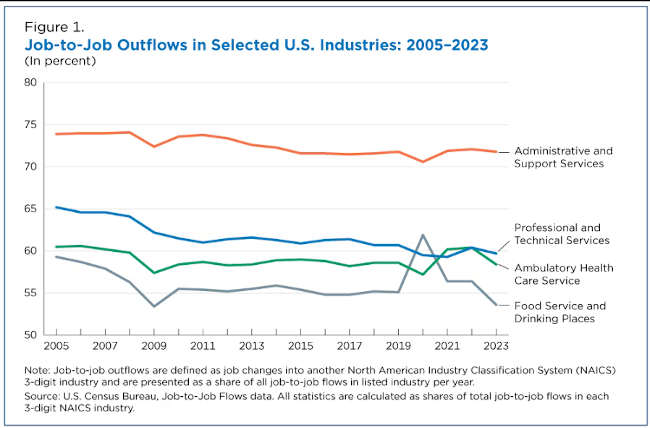
Four industries experienced the largest number of job-to-job transitions in 2021 (Figure 1): administrative and support services; food services and drinking places; professional, scientific, and technical services; and ambulatory health care services. A job transition for workers in these industries often involved a change in industry subsector.
For example, when the pandemic hit in March 2020, many bars and restaurants shuttered leading to a major outflow of workers from Food Services and Drinking Places. But outflows declined rapidly in 2021 and 2022 as establishments began to reopen. Other industries affected by the pandemic also experienced a brief drop in 2020 but recovered in 2021 as safety measures eased.
The new data provide a window into longer-term trends, too, showing for instance that workers in the Professional, Scientific and Technical Services industry were more likely to shift to jobs within their subsector than to one in another industry.
The share of people who switched jobs in that industry to go to a different one declined to less than 60% in 2022 from 65% in 2005.
Destination industries for job switchers
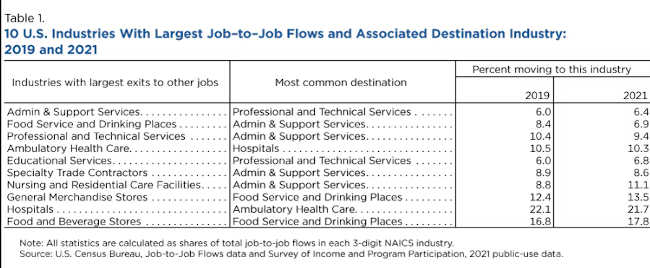
The new J2J Job Flows detailed industry tables tell us where workers who left one industry subsector went (Table 1).
For example, the Professional, Scientific, and Technical Services sector was the top destination of workers who left Administrative and Support Services jobs in 2021, accounting for 6.4% of all job-to-job flows, up slightly from 6.0% in 2019.
The Administrative and Support Services industry was the most common destination of workers who left Food and Drinking Places; Professional and Technical Services; Specialty Trade Contractors; and Nursing and Residential Care Facilities.
What the new data release offers
The new J2J data allows users to calculate the back-and-forth flow of jobs between industries.
For example, while job outflow rates in the Food and Drinking Places industry have now returned to pre-COVID rates, the recently released stats detail where exiting workers went and new ones came from.
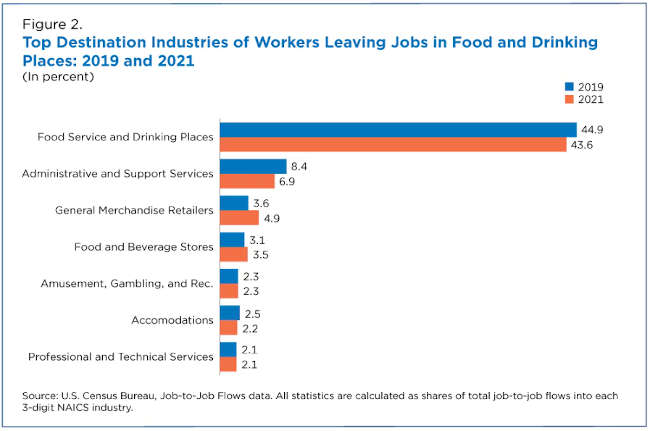
The share of workers who switched from jobs in the Food Service and Drinking Places sector to ones in Administrative and Support Services, for instance, declined from 8.4% in 2019 to 6.9% in 2021 (Table 1).
Figure 2 illustrates that workers who left this industry in 2021 were more likely than they were in 2019 to accept jobs in the General Merchandise Retailers or Food and Beverage Stores.
Hubert Janicki is an economist in LEHD Research at the U.S. Census Bureau’s Center for Economic Studies.
- Details
- Written by: Hubert Janicki