How to resolve AdBlock issue?
Refresh this page
How to resolve AdBlock issue?
Refresh this page
Lake County News,California
  • Home
    • Registration Form
  • News
    • Community
      • Obituaries
      • Letters
      • Commentary
    • Education
    • Veterans
    • Police Logs
    • Business
    • Recreation
    • Health
    • Religion
    • Legals
    • Arts & Life
    • Regional
  • Calendar
  • Contact us
    • FAQs
    • Phones, E-Mail
    • Subscribe
  • Advertise Here
  • Login
How to resolve AdBlock issue?
Refresh this page
How to resolve AdBlock issue?
Refresh this page

News

What are roads made of? A pavement materials engineer explains the science behind the asphalt you drive on


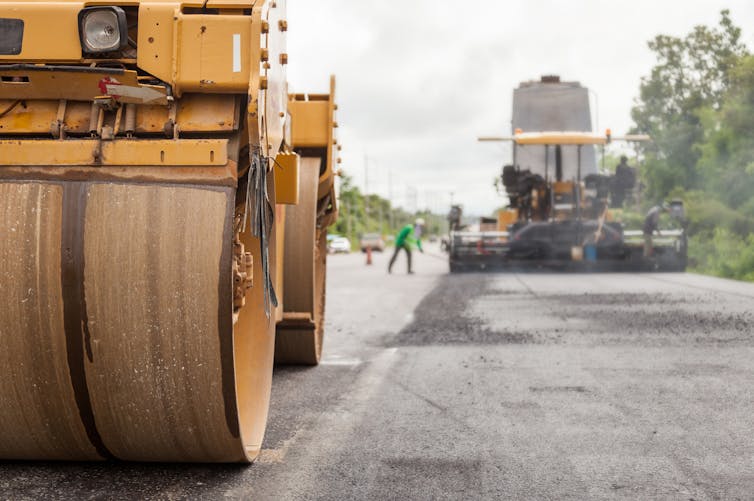
Pavers push the asphalt down during road construction. Pramote Polyamate/Moment via Getty Images

While on the road, you’re probably thinking more about your destination than the pavement you’re driving over. But building roads requires a host of engineering feats, from developing the right pavement materials to using heavy equipment to lay them down. The better they’re built, the longer roads last and the fewer construction delays drivers have to endure.

I am an engineer who does research on materials used in roads. Scholars in my field are working to develop materials that can make roads stronger and last longer.

Road materials

So, what are roads really made of? The simple answer is that they are made of typical construction materials such as aggregates – soils and rocks – as well as asphalt binder and Portland cement, which act like glue to bond it all together.

Asphalt binder is refined from crude oil. From crude oil, refiners first extract gasoline, kerosene and oil, and what remains at the bottom becomes the asphalt. Portland cement is manufactured using several different ingredients, including limestone, sand, clay, silica and alumina.

Engineers compact the mixture of asphalt binder and aggregates together at an elevated temperature, about 300 degrees Fahrenheit (150 degrees Celsius), which glues the aggregates together into the final product, called asphalt concrete.

If they’re using Portland cement rather than asphalt binder to glue the aggregates together, the engineers cure the mixture of the cement and aggregates with water through a process called hydration.

Hydration bonds the cement to the aggregates to make the product, called Portland cement concrete, stronger. With this process, there’s no external heating involved.

Pavement structure

Asphalt concrete’s pavement structure typically has three main layers: the base layer, the intermediate layer and the surface layer.

A diagram showing five distinct pavement layers, including the surface, intermediate and base layers of the concrete, and then the sub-base and subgrade.
The layers that make up pavement. Mansour Solaimanian

Engineers call the existing ground where the pavement goes the subgrade. On top of the subgrade goes a new layer of unbound soil and stone, where the aggregates aren’t glued together. This is called the subbase, or unbound aggregate base.

The base layer can be either stones packed together without any binding agent or a combination of stone and asphalt binder.

Once road builders make the base, it is time to build the asphalt concrete layers: the base layer, the intermediate layer and the surface layer. All these layers contain the aggregates – the pieces of rock and sand – glued together with the asphalt binder in some way.

Engineers determine how many layers to build and how thick to make each layer by figuring out how much traffic will drive over the road. The more traffic, the thicker the pavement needs to be. For example, on interstate highways, the depth of the layers combined could be 20 inches (51 centimeters) or more.

A machine drives over dark pavement.
The asphalt concrete base layer is placed and compacted by a paver. Mansour Solaimanian

Building a strong road

The road builders place the material on the road with an asphalt paving machine called a paver. An operator runs the paver, which takes the materials from a truck and places them on the road. After that, heavy-duty rollers compact it down, make it strong and get it ready for vehicles.

For a strong and durable road, engineers first pick the best subgrade, or place on top of which to build pavement. If the subgrade is too weak, the road might crack and fail – even if the pavement uses the best materials.
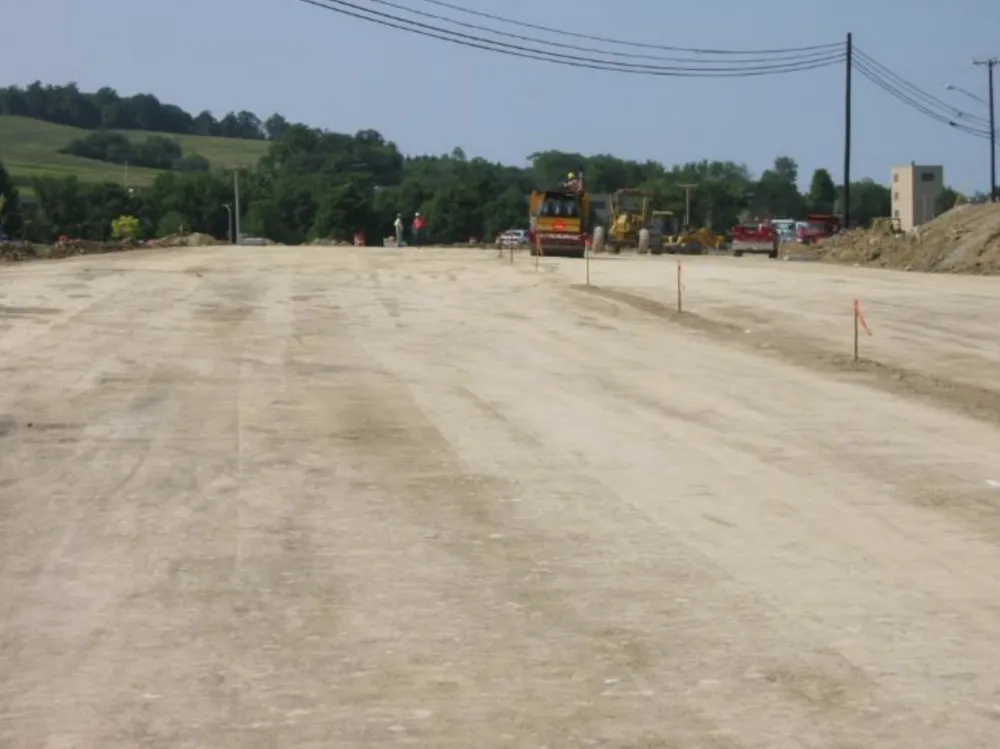
A sandy, grain-like material packed on the ground where a road will go.
Engineers compact the subgrade before the paving process. Mansour Solaimanian

First, the road builders use rollers to pack the subgrade down. Once they’ve compacted the subgrade, they place the stone aggregates directly on top of the subgrade and compact them down. This aggregate base on the subgrade provides a sturdy foundation for the asphalt layers.

If the road builders do not use the right materials, or do not put them together correctly, or do not design the pavement structure for the expected traffic, then the road can crack, rut and fail.

Cracking occurs either at extremely low temperatures or from heavy trucks and buses repeatedly driving over the road. Rutting, which refers to noticeable impressions in the road’s surface, occurs mostly during summer heat under heavy trucks or at road intersections.

Potholes are a big road problem you’ve probably seen before. They often show up in the spring after water trapped in the pavement freezes over winter and then melts in spring. This melting process weakens the road, making it more breakable. Then, when vehicles drive over it, they can create potholes.


A road with a web of cracks in it.
The road may crack over time and with repeated use. Mansour Solaimanian
A car driving over a deep indent in the road.
Rutting, like the indent at this intersection, happens when the road is exposed to standing vehicles. Mansour Solaimanian

Before the road gets built, the materials undergo testing in a laboratory to make sure they can stand the loads from traffic and environment.
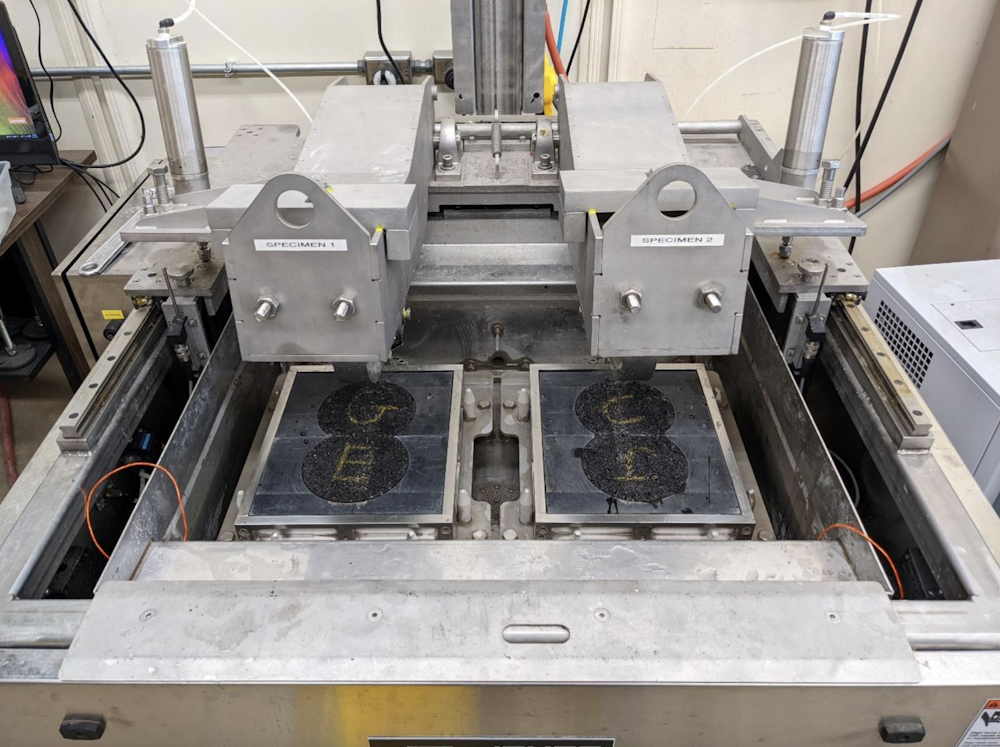
A piece of equipment with 4 patches of pavement inside.
Lab testing of the road materials includes wheel tracking under water to make sure the materials hold up. Mansour Solaimanian

Engineers in the lab expose the pavement materials to both freezing and very hot temperatures to make sure they can withstand any weather. They also expose the pavement materials to water to make sure the materials will not fall apart if it rains or floods.

At the Penn State pavement laboratory, my team is testing asphalt mixtures to which we’ve added substances called modifiers. These include special polymers and fibers that could make the road stronger.

The next time you’re on the road, remember that it takes a good amount of engineering and tremendous teamwork to create that smooth pavement surface you drive on.The Conversation

Mansour Solaimanian, Research Professor, Larson Pennsylvania Transportation Institute, Penn State

This article is republished from The Conversation under a Creative Commons license. Read the original article.
Details
Written by: Mansour Solaimanian, Penn State
Published: 12 May 2024

Space News: NASA field geology training prepares Artemis mission support teams

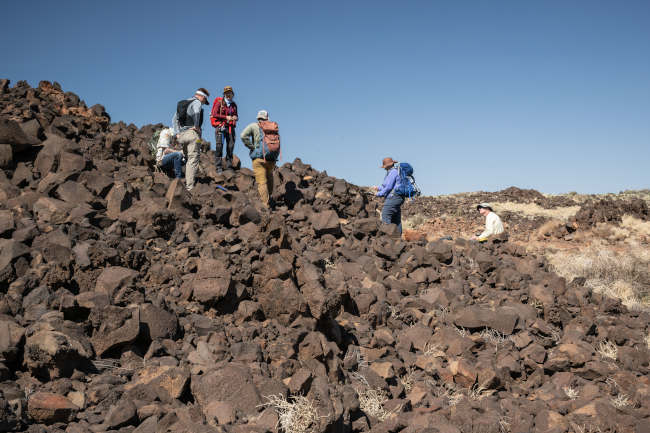
A small team of participants in the Geology 101 field training gather on a large pile of rocks from a lava flow. Photo by NASA/Robert Markowitz.

NASA engineers, managers, and flight directors recently traded their cubicles and conference rooms for an ancient volcanic field in the northern Arizona desert to participate in a field geology course aimed at arming them with first-hand experience in what Artemis astronauts will do when they explore the Moon.

The two-and-a-half-day exercise for Artemis mission support teams was a condensed version of the rigorous training astronauts receive to prepare for Artemis missions to the lunar South Pole region, but shares an important purpose.

“We are building a common language and a common understanding of what it will be like to do field geology on the surface of the Moon,” said Cindy Evans, Artemis geology training lead at NASA’s Johnson Space Center in Houston. “This is so the people who are building spacesuits, building tools, building software systems, the people who will be flight controllers, and the managers who direct and fund all of this, can all understand the interlocking parts of surface exploration.”

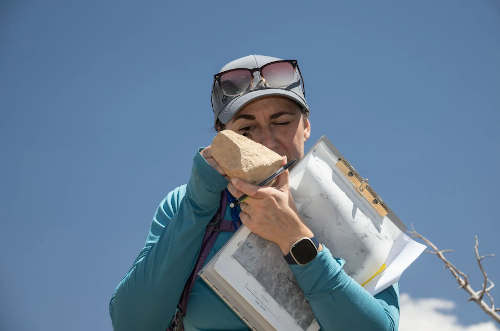
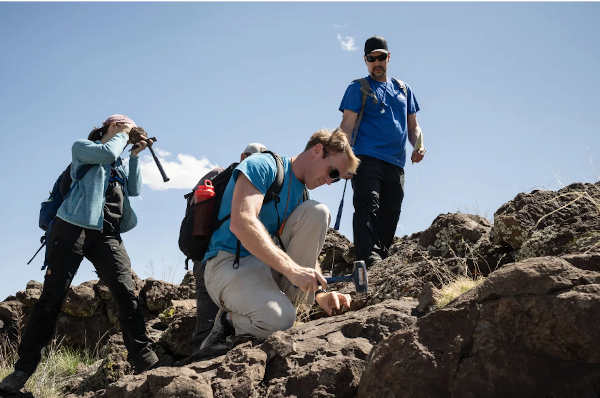
Small teams led by geology experts from NASA, the USGS (U.S. Geological Survey), and academia studied maps, built hypotheses about the geologic history of the area, and trekked for miles to test whether those hypotheses match reality. This field test required smashing rocks with hammers to study their mineral makeup, and carefully selecting a few to examine further after returning from the field in the same way Artemis astronauts will return samples from the Moon.

Geology studies help uncover the rich physical history of an area. Each rock type represents a process and the order of layering of those rocks reveals a story that could unlock a planet’s secrets, offering clues for how it was formed and evolved over time.

“The Moon doesn’t have an atmosphere or flowing water like we have here on Earth, and doesn’t have plate tectonics, which are processes that erase a lot of the evidence from the early Earth,” said Jacob Bleacher, chief exploration scientist in the Exploration Systems Development Mission directorate at NASA Headquarters in Washington. “The Moon still has that evidence, so we can go to the Moon and learn lessons about our home planet that we can’t learn here on the Earth.”

In the desert, as the mission support team members practiced the fundamental methods used by geologists to study an environment, they pieced together the story of the region. The planned walking paths, known as traverses, frequently changed based on what they were finding.

Artemis curation lead Juliane Gross, left, NASA flight controller Grant Harman, center, and imagery scientist Marco Lozano collect and examine samples during the Geology 101 field course. Photo by NASA/Robert Markowitz.

Teams embraced the principle of “flexecution” — or flexible execution — a practice that could come into play as astronauts explore the lunar surface and report findings to a backroom of scientists supporting the mission in the Mission Control Center at Johnson, referred to as the science evaluation room.

“The geologists will be the science evaluation room during Artemis missions, assimilating real-time mission data to understand the observations, tracking the samples, going back to the maps that they’ve built trying to understand how all those pieces fit together on a day-by-day and traverse-by-traverse basis,” said Evans. “When the astronauts return home with the samples and with their full observations, the scientists can hit the ground running to address key science questions.”

With Artemis, NASA will study the history of the Moon and its relationship with Earth and build a blueprint for deeper space exploration.

“What we’re doing now is laying the groundwork for long-term exploration at the Moon,” Bleacher said. “Laying that groundwork will then help us explore other destinations like Mars. The Moon is a part of everything that we understand here on the Earth. It’s also an anchor point to help us understand how to interpret everything else in the solar system.”

NASA conducts field tests in locations on Earth that have lunar-like landscapes to test a variety of operations and procedures, as well as new technologies, before leaving Earth for Artemis missions on the Moon. In addition to this geology training to build a foundation for mission support teams, another team will conduct simulated moonwalks in the Arizona desert this spring with mockup spacesuits to test hardware and new capabilities, like a heads-up display using augmented reality, for future Artemis missions.

Through Artemis, NASA will send astronauts – including the first woman, first person of color, and its first international partner astronaut – to explore more of the lunar surface than ever before prepare for human missions to Mars for the benefit of all.

Rachel Barry works for the Johnson Space Center.

NASA Flight Director Diane Dailey examines a rock at the Geology 101 field training for Artemis mission support teams in the northern Arizona desert. Photo by NASA/Robert Markowitz.
Details
Written by: Rachel Barry
Published: 12 May 2024

Aurora borealis lights up Lake County’s sky

Photo of the aurora borealis taken around 11 p.m. Friday, May 10, 2024, from Kelseyville by Bill Haddon, president of the Friends of Taylor Observatory-Norton Planetarium.


LAKE COUNTY, Calif. — A solar storm is bringing Lake County a special treat this weekend.

Overnight, the aurora borealis was visible in Lake County’s sky.

Photo of the aurora borealis taken around 11 p.m. Friday, May 10, 2024, from Kelseyville by Bill Haddon, president of the Friends of Taylor Observatory-Norton Planetarium.


The light show was faintly visible to the naked eye, but showed up more clearly with use of photography.

An extreme geomagnetic storm is causing the auroras to be more widely visible across the globe.

Based on data from the National Oceanic and Atmospheric Administration, aurora activity was expected to peak early Saturday morning but could continue to be visible through Sunday.

Email Elizabeth Larson at This email address is being protected from spambots. You need JavaScript enabled to view it.. Follow her on Twitter, @ERLarson, or Lake County News, @LakeCoNews.


The different colors of the aurora borealis over Lucerne, California, on Saturday, May 11, 2024. Photo by Elizabeth Larson/Lake County News.

The red glow of the aurora borealis set off the stars over Lucerne, California, on Saturday, May 11, 2024. Photo by Elizabeth Larson/Lake County News.

The aurora borealis and the Milky Way over Lucerne, California, on Saturday, May 11, 2024. Photo by Elizabeth Larson/Lake County News.


Details
Written by: Elizabeth Larson
Published: 11 May 2024

Ingram named Lake County Teacher of the Year

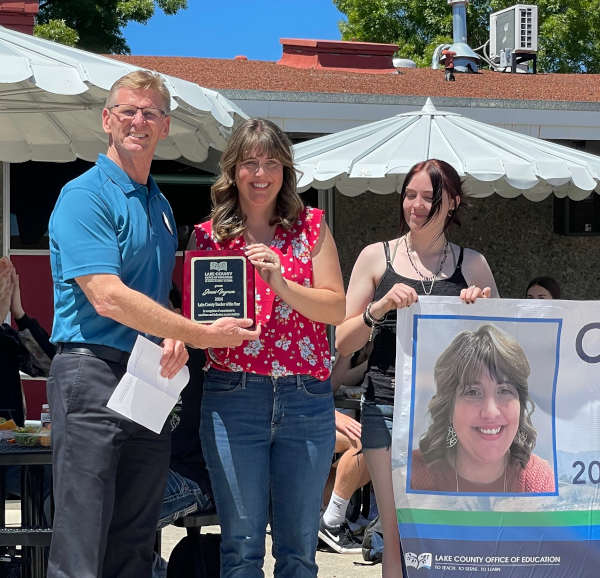
Lake County Superintendent of Schools Brock Falkenberg gives Jenni Ingram, band teacher for Terrace Middle School and Clear Lake High School, a plaque honoring her as the 2024 Lake County Teacher of the Year on Friday, May 10, 2024. Photo courtesy of the Lake County Office of Education.

LAKE COUNTY, Calif. — Jenni Ingram, band teacher at Clear Lake High School and Terrace Middle School, has been named Lake County Teacher of the Year for 2024.

“Jenni Ingram's passion, leadership, and commitment to educational excellence not only inspires her students but also her colleagues and community members," said Liesl Hendrix, principal of Clear Lake High School. “She is a true role model whose influence extends far beyond the classroom.”

Ingram received notification of the honor on Friday, May 10, during Teacher Appreciation Week.

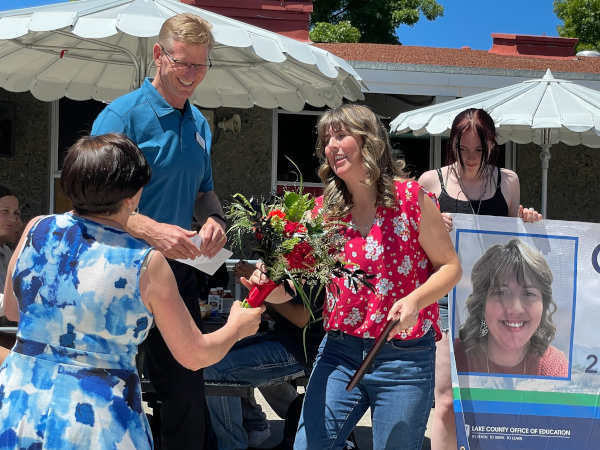
Her students and colleagues gathered at Clear Lake High School, where she was presented with the Teacher of the Year plaque and flowers.

Ingram was chosen as the Lakeport Unified School District Teacher of the Year in March.

In late April, Ingram participated in an interview at the Lake County Office of Education. She was chosen from a group of four other Lake County District Teachers of the Year to represent Lake County at the California Teacher of the Year competition this fall.

Lake County Superintendent of Schools Brock Falkenberg acknowledged the fantastic work of each Lake County teacher. “Each and every one [teacher] works diligently to foster a thriving learning environment for students. Their empathy, courage, and support are exemplary.”

Other District Teachers of the Year include:

• Heather Koschik — Kelseyville Unified School District;
• Jenny Johnson — Konocti Unified School District;
• Angela Stevenson — Middletown Unified School District;
• Mara Hesterberg — Upper Lake Unified School District.

With 16 years of service in the district, Ingram has been pivotal in nurturing the musical talents of students ranging from eager middle school beginners to ambitious upper-class teenagers.

At the heart of Ingram's teaching philosophy is her commitment to creating a supportive and inclusive atmosphere that respects the individuality of each student. Her approach is tailored to meet diverse learning styles, abilities, and backgrounds, ensuring that all students receive the personalized support and resources they need to succeed.

“Music is for everyone,” Ingram said. “Music opens doors to emotional and academic growth for every student. It is more than just learning an instrument, it's about building confidence, empathy, and resilience, which are essential for success in all areas of life.”

Her classroom is more than a learning space; it is a sanctuary where students feel safe, supported, and valued. Here, they are encouraged to express themselves and explore music without fear of judgment.

“Mrs. Ingram’s influence goes beyond the classroom and even beyond the district. She collaborates with band instructors across Lake County, enhancing the musical education of students throughout our community. Her commitment to sharing best practices and resources with fellow educators ensures a high standard of musical instruction and enriches the learning experiences of all band students,” Hendrix said.

Members of the interview panel included: Rebecca Walker, deputy superintendent of schools; Anna Sabalone, Lake County Teacher of the Year 2023; Jennifer Kelly, former Lake County and California Teacher of the Year; Alan Siegel, former Lake County and California Teacher of the Year; and Lake County Superintendent of Schools Brock Falkenberg.

Lake County has had three California Teachers of the Year in the last 18 years. Erica Boomer from Upper Lake Unified School District was named a California Teacher of the Year 2019. Jennifer Kelly from the Middletown Unified School District received the honor in 2011, and Alan Siegel from Konocti Unified School District received the honor in 2005.

The Lake County Teacher of the Year program is administered through the Lake County Office of Education and the California Department of Education. For more information about Jenni Ingram and the Lake County District Teachers of the Year, please visit lakecoe.org/TOY.

Jenni Ingram, band teacher for Terrace Middle School and Clear Lake High School, received flowers for being named Lake County Teacher of the Year during her celebration at the Clear Lake High School as Superintendent of Schools Brock Falkenberg looked on on Friday, May 10, 2024. Photo courtesy of the Lake County Office of Education.
Details
Written by: Lake County News reports
Published: 11 May 2024
  1. California Highway Patrol swears in 106 new CHP officers
  2. Governor unveils revised state budget to address deficit
  3. Space News: Venus is losing water faster than previously thought – here’s what that could mean for the early planet’s habitability

Subcategories

Community

  • 678
  • 679
  • 680
  • 681
  • 682
  • 683
  • 684
  • 685
  • 686
  • 687
How to resolve AdBlock issue?
Refresh this page
Copyright © 2026 Lake County News,California. All Rights Reserved.