LAKE COUNTY, Calif. — Hospitality, health care and workforce will be the topics featured during the fifth Lake Leadership Forum to be held on Wednesday, May 22, at On The Waterfront, 60 Third Street, Lakeport.
The program begins at 1 p.m. and concludes with a walking tour of Xabatin Community Park at 4:30 p.m.
Presented by the Lake County Economic Development Corp., or Lake EDC, along with the Lake County Chamber of Commerce and the Lake County Tourism Improvement District, the Lake Leadership Forum is open to the public with a limited number of tickets available at tinyurl.com/LakeLeader2024.
A limited number of tickets are on sale for $30 per person which includes tapas and a glass of wine or other beverage.
Tickets may also be purchased with a check payable to and sent to Lake EDC, P.O. Box 1257, Lakeport, CA 95453.
Sutter Lakeside Hospital is the presenting sponsor. The event is also generously supported by Calpine, Lake County Tribal Health, Reynolds Systems, Adventist Health Clear Lake, the City of Lakeport, Community First Credit Union, and Savings Bank of Mendocino County.
The event’s keynote speaker is Caroline Beteta, president and CEO of Visit California.
Beteta will share the current state of the tourism industry for the state and her insight on the future of hospitality and rural markets.
Additionally, Clair Whitmer, deputy director for the California Office of the Small Business Advocate, will discuss the state’s efforts to support businesses.
A panel discussion regarding workforce development and attraction in Lake County will include Jonathan Walters, manager of Brassfield Winery; Brock Falkenberg, Lake County superintendent of schools; Greg Panella, co-owner of Stokes Ladders and Panella Orchards; and Jennifer Delgadillo Bevington, co-director of the Redwood Region K16 Educational Collaborative.
Speakers will demonstrate the collaborative spirit of Lake County through presentations by Tonya Hat, proprietor of THAT Ranch; Christian Ahlmann of Six Sigma Ranch & Winery; Annie Tyner, director of Jack’s Lavender Farm; and Akriti Wong, director of Citizens Caring 4 Clear Lake.
The presenting organizations represent people from all over Lake County who love our community and want to see it prosper.
You are invited to participate in this leadership forum and connect with like-minded citizens.
More information is available from Nicole Flora, executive director, Lake EDC, This email address is being protected from spambots. You need JavaScript enabled to view it..
MIDDLETOWN, Calif. — The Middletown Area Town Hall, or MATH, will discuss the latest on key community projects when it meets this week.
MATH will meet at 7 p.m. Thursday, May 9, in the Middletown Community Meeting Room/Library at 21256 Washington St., Middletown. The meeting is open to the public.
To join the meeting via Zoom click on this link; the meeting ID is 869-1824-5695, pass code is 808449. Call in at 669-900-6833.
On the agenda are updates on a major use permit for a 19.6-acre commercial cannabis grow proposed by former Supervisor Jim Comstock under the “Rancho Lake Inc.” name. That project is set to be heard Thursday morning by the Lake County Planning Commission.
The group also will discuss the Pacific Gas and Electric geothermal waste landfill and the Middletown Area Plan update.
MATH’s next meeting will take place on June 13.
MATH — established by resolution of the Lake County Board of Supervisors on Dec. 12, 2006 — is a municipal advisory council serving the residents of Anderson Springs, Cobb, Coyote Valley (including Hidden Valley Lake), Long Valley and Middletown.
For more information email This email address is being protected from spambots. You need JavaScript enabled to view it..
Email Elizabeth Larson at This email address is being protected from spambots. You need JavaScript enabled to view it.. Follow her on Twitter, @ERLarson, or Lake County News, @LakeCoNews.
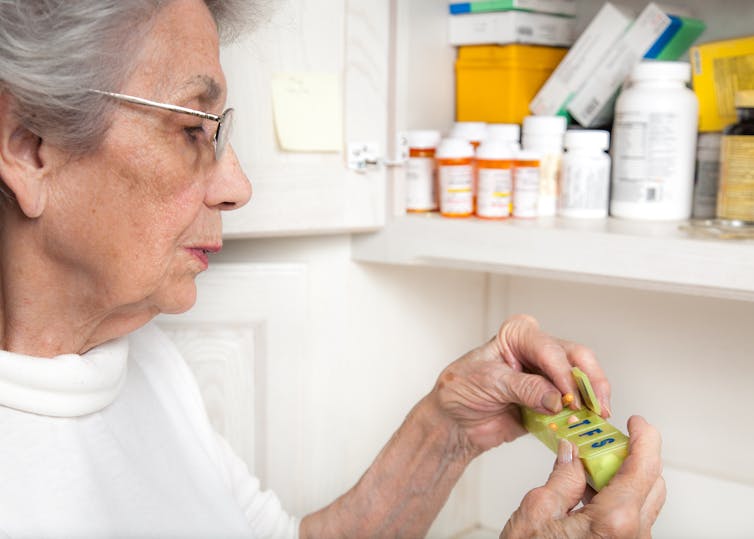
Some boomers are on multiple medications. Combinations of those drugs could have serious side effects. Getty Images / Sporrer/Rupp
Baby boomers – that’s anyone born in the U.S. between 1946 and 1964 – are 20% of the population, more than 70 million Americans. Decades ago, many in that generation experimented with drugs that were both recreational and illegal. Although boomers may not be using those same drugs today, many are taking medications, often several of them. And even if those drugs are legal, there are still risks of interactions and side effects.
The taking of multiple medications is called polypharmacy, typically four or more at the same time. That includes prescriptions from doctors, over-the-counter medicines, supplements and herbs. Sometimes, polypharmacy can be dangerous.
Make sure your doctor is regularly reviewing your medication list.Getty Images / dszc
Reactions to medications can change over time
We geriatricians know that polypharmacy isn’t always bad; multiple medications may be necessary. If you’ve had a heart attack, you might be on four medications or more – beta-blockers, ACE inhibitors, statins and aspirin, for instance. And that’s appropriate.
But about half of older adults take at least one medication that’s not necessary or no longer needed. Doctors need to periodically reevaluate to make sure each medication is still right for the patient and still the correct dose. During treatment, the patient’s weight may fluctuate, either up or down. Even if it stays the same, body composition might change; that occurs as people age. As a result, one may react differently to a drug. That can happen even with a medication a person has been on for years.
Polypharmacy often means higher health care costs and more drug interactions. Patients are more likely to miss medications or stop taking them altogether. Sometimes, physical activity diminshes; falls, cognitive impairment, malnourishment and urinary incontinence increase; there may be less ability to do daily tasks. Those on five or more medications have a much higher incidence of having an ADE – an adverse drug event – compared to those using fewer meds. Making matters worse, the symptoms of polypharmacy are sometimes masked and taken as signs of aging.
Check the list
Studies have suggested solutions, with better coordination among care providers being one. Making the pharmacist an integral part of routine care is another. The increasing use of electronic patient records helps. So do smartphone apps, sometimes an easier way for patients and providers to connect. But so far, there’s no magic pill, and as researchers and clinicians investigate improvements, much of the burden remains on patients and their families.
There are steps you can take to stay safe, however. Regularly clean out the medicine cabinet and get rid of expired medicines or those you’re no longer taking. Either throw them away or ask your doctor or pharmacist about the best way to dispose of them. When seeing the doctor, bring in the meds you take and review each one in detail. Make certain you need to continue taking them all and verify the right dose.
Make sure you regularly check the expiration dates on your medications.Getty Images / dszc
You can also check the PIMs list, also known as the Beer’s List. Published by the American Geriatric Society, it’s an index of medications potentially harmful to the elderly. Some are linked to increased risks of side effects, and not a few are sold over-the-counter without prescription.
That includes medicines containing antihistamines like diphenhydramine, or Benadryl. In the elderly population, Benadryl carries an increased risk of dizziness, confusion and urinary retention. Medicines that are part of the NSAID family (nonsteroidal anti-inflammatory drugs) are also on the list. In some elderly patients, they can cause high blood pressure or kidney failure. Commonly used medicines in the NSAID family are those containing ibuprofen or naproxen.
Just because a medicine is on the Beer’s List doesn’t mean your doctor was wrong to prescribe it, or that you should stop using it. Instead, use the medication with caution and discuss with your doctor to make sure you need it. Determine with your doctor the lowest useful dose, monitor for side effects, and speak up if you have any.
As a geriatrician, I see patients in an outpatient setting, either as their primary care provider or as a specialist consultant. We review medications at every visit: the list, the dose and how often the patient is taking it. A true and accurate medication list is the critical first step in geriatric care.
This is especially important during care transitions, such as when a patient is coming out of the hospital or nursing home. Particularly at that time, we find out if the patient is using the medication as prescribed, or taking it more frequently or less or not at all. Which leads to my final piece of advice: If you’ve strayed with your meds, one way or another, know that we doctors don’t judge or punish patients. Just tell us the truth. That’s all we want to hear. Then we can move forward together to find the best regimen for you.
UPDATE* This video has been updated due to a transcoding error.
KELSEYVILLE, Calif. — At the end of a nearly three-hour special meeting on Tuesday night, the Kelseyville Unified School District Board of Trustees came to a compromise decision regarding a proposed resolution that addressed healing and reconciliation with Lake County’s tribes.
The resolution has drawn pushback due to concerns from some community members that it appeared to support an effort now underway to change Kelseyville’s name.
That continuing community concern — despite the district’s efforts to clear up what it said has been misinformation about the board’s intentions — was in evidence on Tuesday night in the large crowd that sat through the lengthy meeting.
Those concerns were countered by Indigenous community members who turned out in large numbers and spoke to their desire to be seen, acknowledged and included.
But in the end, the school board chose not to move ahead with the resolution for the time being.
“The resolution that is causing so much fear and divisiveness will not be discussed in the near future,” said Board President Rick Winer before he made the motion to table the resolution, which was seconded by Trustee Mary Beth Mosko, who then joked that she wanted to make a resolution that the board not pass any more resolutions.
The board voted unanimously to table the resolution. However, one of the document’s key goals, to establish a land acknowledgement at major school events such as graduation, will go forward, a decision that responded to concerns of Indigenous speakers that they be recognized.
The trustees decided to split out the land acknowledgement and have the senior class and seniors in the high school’s Native American Club sit down with the high school principal and decide on language that the students would approve of for their ceremony.
That suggestion came in response to a report from senior class leadership that an anonymous survey of graduating seniors found that 60% of the 114 seniors were against doing the acknowledgement.
The resolution originally was on the regular April 23 board agenda, but after close to 130 people showed up to the meeting, held in the boardroom with occupancy of 35 people, it was decided to schedule a special meeting at the urging of retired county supervisor, Rob Brown.
Tuesday’s night’s meeting was held at the Tom Aiken Student Center at Kelseyville High School, which had room for the audience that continued to grow during the evening to an estimated size of more than 150 people. Throughout the crowd there were numerous people wearing orange shirts or vests to signify their support for Kelseyville.
Criticism and division
The board has weathered a month and a half of feedback — some of it critical and accusatory — about the proposed resolution, which arose at the same time as a proposal to change the name of the town to “Konocti” is being considered by the U.S. Board on Geographic Names.
The resolution and name change have become so conflated that Winer said board members were getting emails from people imploring them not to change the town’s name, which isn’t a power they have, he said.
To address those concerns, at the start of the meeting, Board Clerk Gilbert Rangel, who wrote the resolution, spoke for more than a half hour about what his intentions had been, as well as what the resolution is meant to do — and not meant to do.
Rangel said the resolution was not meant to be aligned with either of the two opposing groups who are involved in the name change matter. However, he said that after speaking with community members in recent weeks, he could understand how people had come to believe that.
The original draft resolution that Rangel had submitted to the board on March 19 had language that he said could be misinterpreted to suggest that it could have been biased.
That language, in particular, had stated that “this district will not be able to fully and truly honor the citizens of these nations and their ancestors who lived here for generations for as long as it bears a name that for those citizens and their ancestors represent a painful past.” That language was removed in an updated version.
Rangel said the resolution needed to be truthful, and that Native Americans have suffered, not just in Kelseyville but across the nation, and continue to suffer from intergenerational trauma.
He showed examples of land acknowledgements from other school districts and organizations to illustrate that the statements are becoming more common and accepted.
“We are inviting the community to join us in this effort,” he said.
Opponents say resolution is political
A recurring theme in comments made throughout the meeting by those opposed to the resolution was the suggestion that the matter was a political one and that, as a result, the school board shouldn’t be involved with deciding it.
Business leader Mark Borghesani, a member of the Save Kelseyville group, said that the resolution made the board appear to be aligned with the name change proponents Citizens for Healing, who Borghesani said have called anyone who doesn’t agree with them racists. He asked for the board to table the resolution until after a decision is made on the town’s name.
The discussion frequently veered into the wrongs — including rape, murder and enslavement — perpetrated against Lake County tribes by Andrew Kelsey. Kelsey, along with Charles Stone, was murdered by tribal members in December 1849, which led to the Bloody Island Massacre in May of 1850.
A short time after Borghesani spoke, Alan Fletcher, a Citizens for Healing member, said he didn’t know why anyone would want to memorialize someone who raped children before he accused name change opponents of being part of a “commercial operation” to protect the town’s brand.
He then suggested even the proposed name of “Konocti” for the town is too specific and suggested instead that Big Valley would be better. Fletcher was successful in March in convincing the Board of Supervisors to name the new Kelseyville advisory council the Big Valley Advisory Council instead.
Tribal members ask for inclusion
Members of several tribes from around Lake County spoke throughout the evening, urging the school board to accept the resolution as an acknowledgement of past injustices and a way of shaping the future.
Dannette Rangel of Big Valley said she has eight children, seven of them students from kindergarten to high school, in the district’s schools. The eighth graduated last year and wore native regalia to the ceremony.
She said the land acknowledgment is a huge step in the right direction. “I don’t have hate in my heart for the history of the past,” she said, but added that she wanted a simple acknowledgement.
Flaman McCloud, tribal chair of Big Valley Band of Pomo, said he grew up in the city and when he came to Lake County he encountered a situation where he sees everyday what his people go through due to their history.
“You can’t say that it is over because we still live it,” he said.
McCloud said they still feel feet are on their necks, no matter how much economic development they do.
Now, they are asking for acknowledgement, to be told, “We see you,” he said, adding, “That’s all we are asking.”
He said those who oppose the acknowledgement are afraid of losing, but McCloud said they are not coming to take anything; they just want to be recognized and part of the community.
Third generation Kelseyville resident Sheli Wright said she wanted to remind the board of its purpose — to ensure that the schools are doing their job.
Wright said this fight right now is not good. “It is causing political strife, whether we like it or not.”
Katie Ray, a member of the Round Valley tribe which was forcibly removed from the Chico area, spoke accompanied by members of the high school’s Native American Club, who painted the school’s new mural. Ray said they did it for healing and to bring people together.
“If not now, when?” Ray asked, which was in response to previous speakers asking to put the resolution off.
Ray questioned when natives would be included in the community. “In order to have healing, we need to be included.”
Mark Conrad, a teacher and coach of more than 30 years, said he was “a little insulted” to hear of accusations by tribal members of unfair treatment in the schools.
He said everyone was treated the same, with the goal of making students into responsible adults.
Clayton Duncan, a member of Robinson Rancheria, recounted his grandmother Lucy Moore’s escape from soldiers as a small child during the Bloody Island Massacre.
He said he’s tired of being invisible in his own land. “I’m not invisible. I’m a human being,” he said, adding they were only asking for recognition.
Grace Martinez, a Big Valley Pomo, and her family stood at the podium and she explained that her children are proud to go to Kelseyville schools.
Martinez said she’s proud to be Native American. “I come here today to say, acknowledge us. That’s all I'm asking.”
Board consider testimony
After the public testimony drew to a close, the board members considered what they had heard.
Winer said a group of kids were asking to be recognized. “I think that is extremely, extremely important, and we need to get there.”
He said people worried about the name change are concerned that action the board takes will show favoritism about name change.
Winer said the community is right to fear the Board on Geographic Names. “Who knows who these people are.”
He added, “Come back to this room in July when they come here for a town hall to get your input.”
So far, the Board on Geographic Names hasn’t publicized its plans for such a meeting.
Due to the level of fear and divisiveness, Winer said he felt the matter should wait.
Board member Casey Carlson, who supported recognizing tribal members, said she understands concerns about people getting mixed up about the name change situation. She suggested that the district should write a formal letter to the Board on Geographic Names stating its neutral position.
Mosko, who noted she appreciated the Native American Club for doing the mural, said a resolution by the school board means nothing and that the timing of it also struck her as political. She didn’t think the school board needed to weigh in.
She said all students need to be acknowledged, and so she made the recommendation that the senior class — who didn’t have an eighth grade graduation due to COVID — should sit down to discuss a land acknowledgment.
Superintendent Nicki Thomas said that if the board wanted to move forward, they could have Kelseyville High Principal Mike Jones work with the Native American Club on a land acknowledgement.
Board member Tamah McQueen said she wanted the senior class to be involved along with the Native American Club.
In response to comments made during the meeting about educating young people about local tribal history, Superintendent Thomas said an ethnic studies course will be taught at the high school as a result of new legislation.
After Thomas told the board they needed to make a motion to table the resolution or approve it, Winer offered the motion, Mosko seconded and the unanimous vote was taken. Winer adjourned the meeting immediately after the vote.
Editor’s note: The article has been updated to show that Alan Fletcher said the name “Konocti” is too specific, not too broad.
Email Elizabeth Larson at This email address is being protected from spambots. You need JavaScript enabled to view it.. Follow her on Twitter, @ERLarson, or Lake County News, @LakeCoNews.
 How to resolve AdBlock issue?