How to resolve AdBlock issue?
Refresh this page
How to resolve AdBlock issue?
Refresh this page
Lake County News,California
  • Home
    • Registration Form
  • News
    • Community
      • Obituaries
      • Letters
      • Commentary
    • Education
    • Veterans
    • Police Logs
    • Business
    • Recreation
    • Health
    • Religion
    • Legals
    • Arts & Life
    • Regional
  • Calendar
  • Contact us
    • FAQs
    • Phones, E-Mail
    • Subscribe
  • Advertise Here
  • Login
How to resolve AdBlock issue?
Refresh this page
How to resolve AdBlock issue?
Refresh this page

News

Healthy teeth are wondrous and priceless – a dentist explains why and how best to protect them


Healthy teeth are truly priceless. Moncherie/E+ via Getty Images

At an auction in England in 2011, one of John Lennon’s teeth sold for just over US$31,000.

How much are your teeth worth?

Teeth are amazing little miracles. They light up our smiles, we use them to speak and we chew with them more than 600 times at every meal.

Yet, in a society where 1 out of 5 Americans ages 75 and up live without their teeth, many people may not realize that teeth are designed to stay with us for a lifetime.

I’m a dentist and an assistant professor spanning clinical dentistry and craniofacial regeneration research. Researchers like me are still deepening our understanding of tooth development, with the ultimate goal of serving patients with on-demand regrown ones.

In the process, I have developed reverence for natural teeth and for the complex beauty of these biological and mechanical masterpieces.

Designed for lifelong function

The secret of teeth longevity lies in their durability as well as in how they are anchored to the jaw – picture a hammer and its hand grip. For each tooth, durability and anchorage are functions of the complex interface between six different tissues; each alone is a biological marvel.

For anchorage, the cementum, ligament and bone grip the tooth at its root portion that is buried under the gum. The ligament, a soft tissue that is about 0.2 millimeters wide (about the diameter of four hairs), attaches the cementum of the root on one end to the bone of the jaw on the other end. It serves to anchor the tooth as well as to cushion its movement during chewing.

For durability, however, the secret lies in the enamel, dentin and pulp – our focus in this discussion.
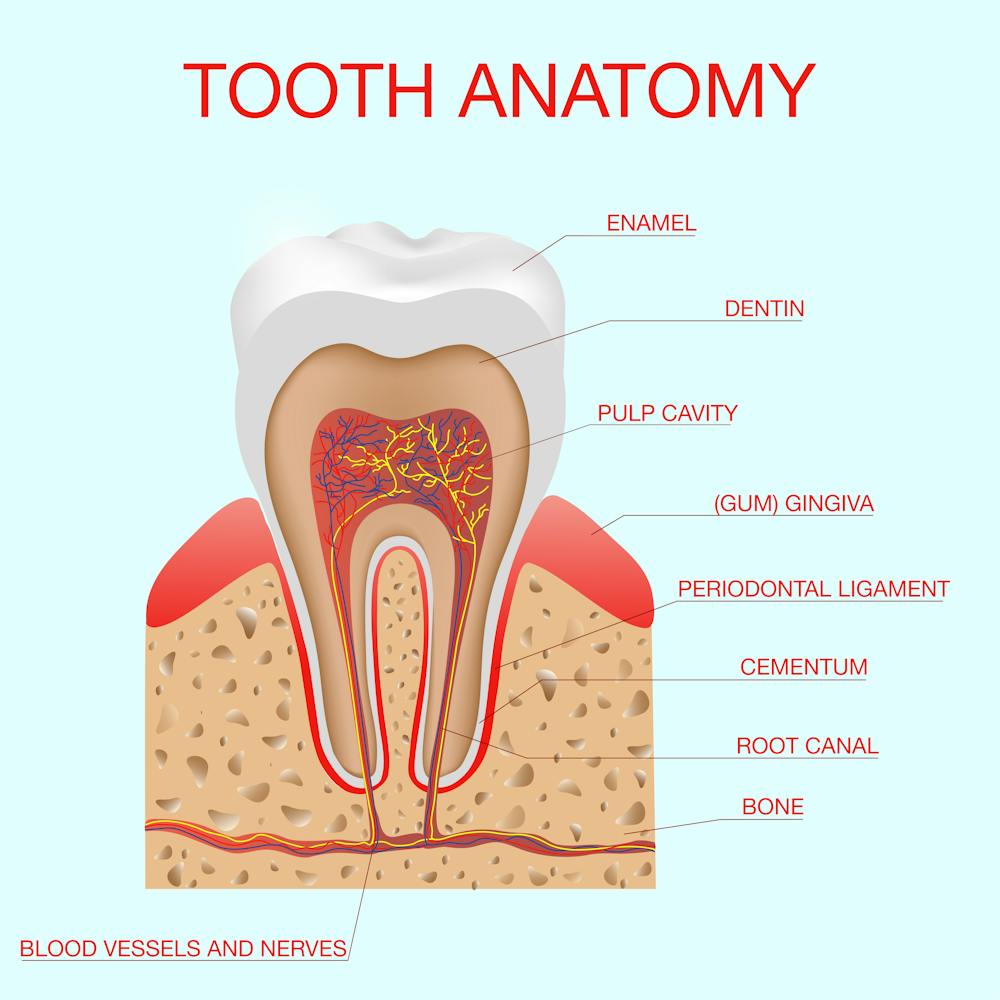
An illustration of tooth anatomy
Dentin and pulp are the body and heart of the tooth. Anna Koroleva/iStock via Getty Images

Enamel – the shield

The enamel is the protective shell that covers the visible part of the tooth above the gum. Thanks to its high mineral content, enamel is the hardest tissue in the body. It needs to be, since it acts as a shield against the constant impact of chewing.

Enamel does not contain cells, blood vessels or nerves, so it is nonliving and nonsensitive. Enamel is also non-regenerating. Once destroyed by decay or broken by misuse such as ice chewing, nail biting or bottle opening – or touched by the dental drill – that part of our priceless enamel is gone for good.

Because it interfaces with a germ-laden world, the enamel is also where decay starts. When acid-generating bacteria accumulate on unbrushed or poorly brushed teeth, they readily dissolve the minerals in the enamel.

How bacteria invade the teeth and cause cavities.

Like hair or fingernails, the non-innervated enamel is not sensitive. The decay advances through the 2.5-millimeter thick (tenth of an inch) layer of enamel painlessly. When caught at that phase during a dental checkup visit, the dentist can treat the decay with a relatively conservative filling that hardly compromises the tooth’s structural integrity.

Because of its high mineral content, enamel is stiff. Its lifelong support is provided by the more resilient infrastructure – the dentin.

Dentin and pulp – body and heart

With less mineral content than enamel, dentin is the resilient body of the tooth. It is a living tissue formed of parallel tiny tubes housing fluid and cellular extensions. Both originate from the pulp.

The pulp is the tooth’s soft tissue core. Vastly rich in cells, blood vessels and nerves, it is the life source of the tooth – its heart – and the key to its longevity.

Like smoke detectors communicating with a remote fire station, the cellular extensions within the dentin sense decay as soon as it breaks through the nonsensitive layer of enamel into dentin. Once the extensions communicate the danger signal to the pulp, our tooth sensitivity alarm goes off: The tooth heart is in flames.

The inflamed pulp initiates two protective actions. The first is to secrete an additional layer of dentin to delay the approaching attack. The second is toothache, a call to visit the dentist.

The earlier the visit, the less the drilling and the smaller the filling. If caught in time, most of the tooth’s natural tissues will be preserved and the pulp will likely regain its healthy state. If caught too late, the pulp slowly dies out.

Without its heart, a nonliving tooth has no defense against further decay invasion. Without a hydration source, a dried-out dentin will sooner or later break under the forces of constant chewing. Besides, a tooth that has already lost a significant portion of its natural structure to decay, cavity preparation or root canal instrumentation becomes weak, with limited longevity.

In other words, the tooth is never the same without its heart. Pulpless, the tooth loses its womb-to-tomb endurance and mother nature’s lifelong warranty.

The tooth coming together

More complex – and more precious – than a pearl within an oyster, the formation of a tooth within our jawbone involves layered mineral deposition. As tooth development progresses in a process of ultimate cellular engineering, the cells of the six aforementioned tissues – enamel, dentin, pulp, cementum, ligament and bone – multiply, specialize and mineralize synchronously with each other to form uniquely interlocking interfaces: enamel to dentin, dentin to pulp, cementum to dentin and cementum to ligament to bone.

Tooth development – the ultimate process of cellular engineering.

In a progress akin to 3D printing, the tooth crown grows vertically to full formation. Simultaneously, the root continues its elongation to eventually launch off the crown from within the bone across the gum to appear in the mouth – the event known as teething. It is about that time, around 12 years of age, that our set of adult teeth is complete. These pearls are set to endure a lifetime and are undoubtedly worth preserving.

Save your teeth, visit the dentist

Tooth decay, the most prevalent disease in humans, is both predictable and preventable. The earlier it is caught, the more the tooth integrity can be preserved. Since the process starts painlessly, it is imperative to visit the dentist regularly to keep those insidious germs in check.

During your checkup visit, the dental professional will clean your teeth and check for early decay. If you are diligent with your daily preventive measures, the good news for you will be no news – enough to make anyone smile.The Conversation

Samer Zaky, Research Assistant Professor in Oral and Craniofacial Sciences, University of Pittsburgh

This article is republished from The Conversation under a Creative Commons license. Read the original article.

Details
Written by: Samer Zaky, University of Pittsburgh
Published: 03 May 2024

Kelseyville Unified fills principal positions with familiar faces

From left to right, top row; Tavis Perkins and Scott Conrad; bottom row, Adriana Rodriguez Macias, Paul McGuire, Mike Jones. Photos courtesy of the Kelseyville Unified School District.

KELSEYVILLE, Calif. — In response to the retirement announcement of Riviera Elementary School Principal Paul McGuire at the end of this school year, Kelseyville Unified School District will do an “admin shuffle,” said Superintendent Dr. Nicki Thomas.

Next year, Kelseyville Elementary School Principal Tavis Perkins will return to Riviera Elementary, Mountain Vista Middle School Principal Scott Conrad will move to Kelseyville Elementary and Kelseyville High School Vice Principal Adriana Rodriguez Macias will become the principal of Mountain Vista Middle School.

Principal Mike Jones will remain at Kelseyville High School, the district said.

Perkins will also oversee the district’s alternative education schools: Kelseyville Learning Academy, Ed Donaldson Continuation High School and the Community Day School.

All three administrators expressed excitement about the changes, while also saying they will miss their current schools.

Returning to “the Riv,” as many refer to Riviera Elementary, is a homecoming of sorts for Perkins. He worked as a teaching assistant the first year the school opened, and years later, it is where he landed as a principal.

Perkins said he looks forward to supporting and expanding programs he started when he was principal there before COVID.

One such program involves professional learning communities, a district initiative to provide teachers with the time and tools to continually improve their skills through collaboration.

“Education evolves, and when our teachers can work with each other to evaluate the data, focus on key standards, and identify gaps in learning, they can support our students even better,” Perkins explained.

Teachers are not the only ones who benefit from sharing ideas. The district reported that the administrators at all Kelseyville schools regularly support each other.

Every week, McGuire and Perkins meet to discuss challenges and opportunities, and Perkins looks forward to continuing these meetings with Conrad, as he takes the helm at the district’s largest elementary school.

Conrad says he is ready for a new challenge and excited about working with the Kelseyville Elementary staff to support students and their families.

Like many administrators, one of Conrad’s first challenges at his new school will be to fill open teaching positions. California faces a statewide teacher shortage, but Conrad believes Kelseyville Unified is in a stronger position than many because of the way it supports new teachers.

“I really feel like we do an exceptional job supporting new teachers, certainly at Mountain Vista Middle School but also districtwide,” he said.

As far as other plans for next year, Conrad says once the school year ends, he will put all his energy into his new school community. He will set priorities based on what he learns from staff and student families.

Two areas of focus already on his radar include supporting English learner students and preparing students for the transition from elementary to middle school.

Conrad said he will miss the students and staff at Mountain Vista Middle School but he’s looking forward to getting to know everyone at Kelseyville Elementary. “The important thing through this admin shuffle is that we are all here to serve the same kids, the same community. All students are ‘our students,’” he said.

He appreciates the district’s practice of hiring from within when possible, because he says it provides “consistency for our community and continuity that is good for kids.”

Like Perkins, Conrad is confident in the leadership taking over in his absence. He calls the combination of incoming principal, Adriana Rodrguez Macias, and the vice principal, Catie Mostin, a “dynamic duo” and says Macias is a great addition to MVMS.

For her part, Macias is eager to take on her new role. “As a school principal, I can bring people together to create more effective change on a bigger scale — education partners, community stakeholders, and even state leaders. When administrators have their heart in the right place, we can be strong resources. It’s amazing what people can do when we work together for kids,” she said.

Her initial goals are to “meet the kids where they are and challenge them to do better.” She believes strong support programs paired with high academic expectations enable students to succeed. She sees middle school as a bridge, a time when students evolve from youngsters to young adults. Having worked at Kelseyville High School for so many years, she knows how to help MVMS students prepare, both in terms of academic rigor and social-emotional development.

“I believe if it doesn’t challenge you, it doesn’t change you,” she said. She wants Mountain Vista Middle School to be a school where students feel empowered to learn and grow.

As McGuire contemplates retirement after 20 years of helping students learn and grow at Kelseyville Unified, he had these parting words.

“I know my colleagues will all do well. I’m looking forward to seeing what happens next year. Mr. Perkins is great with kids, so they’ll love him at the Riv. I think Mr. Conrad will really enjoy learning what the younger students have to teach. And I know Mrs. Macias will do well–the trick is to let kids know you’re on their side, and she already does that,” McGuire said.

He also expressed gratitude for his career at Kelseyville Unified. He thanked John Berry and Dave McQueen for hiring him and making him feel so welcome while also recognizing Dr. Nicki Thomas for encouraging him to become an administrator.

He named Tammy VanHousen, Tavis Perkins and Joyce Paiva as individuals who stood out among so many during his time with the district.

Finally, he said he was grateful to his dad, another school principal, for being a role model and mentor and of course his wife, Suzin, for believing in him.

To learn more about Kelseyville Unified, visit https://kvusd.org/.
Details
Written by: Lake County News reports
Published: 02 May 2024

Missing and Murdered Indigenous People commemorated at State Capitol

Tribal leaders from around the state, Assembly members and senators from both parties, and activists gathered in Sacramento on Wednesday morning and throughout the day to express their commitment to ending violence on California’s tribal lands and to bring the victims home to their loved ones.

The day culminated in an evening vigil at the State Capitol with hundreds in attendance, remarks from victims and their families and First Partner Jennifer Siebel Newsom.

“California ranks fifth in the nation in unresolved and uninvestigated cases involving Missing and Murdered Indigenous People. Today we hold a joint legislative hearing to explore why that is so and the impact on the state’s tribal communities,” said Assemblymember James C. Ramos (D-San Bernardino), chair of the California Legislative Native American Caucus.

Two tribes have declared states of emergency because of the numbers of missing persons on their reservations: the Yurok Tribe and the Coyote Valley Band of Pomo Indians.

The Yurok Tribe took action in December 2021 and the Coyote Valley Band of Pomo Indians issued their declaration on April 25.

The National Institute of Justice reports that:

• 85% of native women experience violence in their lifetime;
• 56% have experienced sexual violence; and
• 75% of them experience it more than once in their lifetimes.

In 2016, the National Crime Information Center reported 5,712 missing American Indian and Alaska Native women and girls in the United States, but only 116 of the cases were logged by the National Missing and Unidentified Persons System.

Ramos said a significant factor contributing to the disproportionate violence was passage of a 1953 federal law — Public Law 280 — that turned most criminal justice responsibility and funding for that responsibility over to six states, including California.

“That law resulted in fewer resources for tribal safety and great jurisdictional confusion among federal, tribal, state and local law enforcement,” Ramos said. “It also undermined public safety in communities neighboring reservations because cities and counties have fewer partners to rely upon when mutual assistance is needed.”

He added that the six states also had among the highest numbers of unresolved MMIP cases.

“Over 70 years ago, Public Law 280 stacked the deck against California tribes by denying tribes the full weight of the federal government and the resources needed to protect public safety,” said U.S. Senator Alex Padilla (D-Calif.). “I’m proud to have successfully urged the federal government to conduct the first-ever study to compare the criminal justice outcomes in PL-280 states versus non-PL-280 states, with a specific directive to look at how PL-280 undermines our MMIP efforts. I’m also fighting for dedicated federal dollars for Tribes in PL-280 states like California, so that we can begin to rectify the funding injustice caused by PL-280 and give tribal governments the resources they need.”

Joining Ramos at the news conference were Erica Pinto, Jamul Indian Village of California; Thomas Tortez, Desert Cahuilla Indians Chairman; Joe James, Yurok Tribal Chairman; Wilton Tribal Court Chief Judge Christine Williams; Sen. Marie Alvarado-Gil (D-Jackson); and Assemblymembers Avelino Valencia (D-Anaheim), Eduardo Garcia (D-Coachella), Liz Ortega (D-San Leandro), Marie Waldron (R-Valley Center) and Tasha Boerner (D-Encinitas).

The morning gathering was followed by a joint hearing of the Assembly Budget Subcommittee No. 6 on Public Safety and Select Committee on Native American Affairs. The hearing explored what tribes are doing to confront the issue, the MMIP impact on their communities.

The evening candlelight vigil featured victims and their families, the Capitol Dome illuminated in red and cultural songs. It is the second year that the candlelight vigil and dome illumination has occurred.

Details
Written by: Lake County News reports
Published: 02 May 2024

Small Business Month declared in California

On Wednesday, Gov. Gavin Newsom issued a proclamation declaring May 2024, as “Small Business Month” in the State of California.

The proclamation honors the millions of small businesses that are key to California’s economy, driving innovation and global competitiveness, and creating the lion’s share of the state’s new jobs.

The text of the proclamation and a copy can be found below.

PROCLAMATION

California’s more than 4.1 million small businesses – the most of any state – embody the entrepreneurial spirit that drives the economy of the Golden State. Small businesses and entrepreneurs accelerate economic growth and mobility in California, creating two-thirds of net new jobs, building wealth, innovating to solve global problems, launching future growth industries, and defining main streets across our local communities.

California’s small businesses account for more than 98 percent of total businesses in the state and employ more than 7 million people – nearly half of the state’s private sector workforce. Our state leads the nation in business startups, and our businesses receive more than 50 percent of the nation’s venture capital with more than $104 billion invested in California in 2022.

California businesses produce more patents per capita and conduct more research and development than any other state in the nation. Our state is the center of manufacturing output in the U.S., with more 1.2 million Californians employed in this space. Our manufacturing firms have created new industries and supplied the world with manufactured goods spanning aerospace, computers, electronics, and zero-emission vehicles.

Our state is leveraging federal funding to support small businesses and entrepreneurs in navigating the funding landscape and successfully accessing the capital they need to start and grow their business here in California. California received more than $1.1 billion in funds for its existing capital support programs from the U.S. Department of the Treasury’s State Small Business Credit Initiative (SSBCI). Separately, the Treasury granted $26.3 million to California to launch a new Technical Assistance for Capital Readiness Program. California has been approved to receive more federal investment through SSBCI than any other state.

For our economy to maintain its strength, we must ensure that all Californians — no matter who they are or where they come from – can pursue their dreams to start, manage, and grow resilient businesses in the Golden State. Further supporting diversity and equity, AB 2019 codified the state’s procurement spending goal of 25 percent to small businesses.

The Small Business Technical Assistance Program, which was made permanent in 2022, helps small businesses and entrepreneurs start, grow, and become more resilient. And through the state’s Accelerate California Inclusive Innovation Hubs, we’re working to expand and diversify the innovation economy by improving access to resources in underserved communities, supporting emerging tech sectors, and catalyzing the creation of high-quality jobs in every corner of the state.

Our small businesses are global leaders in innovation and economic competitiveness and have helped make our economy the envy of the world. This month, we recognize the tremendous contributions of our small businesses, as well as the importance of our ongoing work to support their success and make the California Dream accessible to all.

NOW THEREFORE I, GAVIN NEWSOM, Governor of the State of California, do hereby proclaim May 2024, as “Small Business Month.”

IN WITNESS WHEREOF I have hereunto set my hand and caused the Great Seal of the State of California to be affixed this 30th day of April 2024.

GAVIN NEWSOM
Governor of California

ATTEST:
SHIRLEY N. WEBER, Ph.D.
Secretary of State
Details
Written by: Lake County News reports
Published: 02 May 2024
  1. High interest rates aren’t going away anytime soon – a business economist explains why
  2. Clearlake CIty Council to consider foreclosures in code enforcement cases
  3. Victim of fatal Sunday crash identified

Subcategories

Community

  • 688
  • 689
  • 690
  • 691
  • 692
  • 693
  • 694
  • 695
  • 696
  • 697
How to resolve AdBlock issue?
Refresh this page
Copyright © 2026 Lake County News,California. All Rights Reserved.