Anesthesia can be up to 2,500 times more potent as a greenhouse gas than carbon dioxide. UCSF doctors are leading a national movement to protect patients – and the environment.
UC San Francisco Sustainability Director Gail Lee, REHS, MS, HEM, sat before her laptop and clicked open a file. At first, it didn't seem like much. Just one of a dozen medical supplies purchasing reports she read regularly as part of tracking sustainability efforts throughout UCSF and its associated health facilities.
But then, something caught her eye.
The data was from 2021 during the COVID-19 pandemic. At the time, UCSF Health medical centers, like others, followed public health guidance to postpone non-emergency surgeries.
Surgeries had plummeted but, looking at the report in front of her, it appeared that orders for the anesthesia gas nitrous oxide had not. That was odd.
“It seemed like we were still buying a lot of it – and right in the middle of COVID when we’d reduced elective surgeries,” remembers Lee, who also holds a U.S. Green Building Council LEED Green Associate certification in sustainability practices. “I thought, how can that be?”
She pulled UCSF Health purchasing reports for the last few years and, opening up her email, attached them to a message. She began to type.
“Seema, could you look into this? Why we are purchasing so much nitrous oxide even though we stopped elective surgeries?”
No surprise, a mystery
Modern anesthesia is a San Francisco invention. In 1962, UCSF Anesthesiology Professor Edmond “Ted” Eger II, MD, and colleagues developed the first dosing method. Still the gold standard today, Eger took the guesswork out of anesthesia by establishing the concentration of any gas needed to “put a patient under.”
But the ethers Eger made a career out of measuring are also potent greenhouse gases, trapping heat in our atmosphere like a thick blanket. In California, this fuels more frequent and deadlier wildfires and heat waves, for instance. Globally, health care makes up about 5% of greenhouse emissions. The U.S. churns out more of these emissions than any other nation.
It’s why UCSF Anesthesiology Professor Seema Gandhi’s fight against climate change began nearly a decade ago in the operating room.
What started as small pilot projects conceived of during long nights as the anesthesiologist on duty have blossomed into new ways of reducing anesthesiology’s greenhouse emissions. Today, Gandhi is UCSF Heath’s first medical sustainability director. The techniques she and colleagues have developed help UCSF prevent hundreds of metric tons of emissions a year and have saved the university millions of dollars. Her work to green her field is also helping other University of California campuses curb their emissions and is shaping anesthesiology care nationally.
So, it was no surprise when Lee reached out about the mysterious discrepancy between the number of surgeries and amount of anesthesia being purchased.
Why tackling emissions is part of quality care
Anesthesiologists often rely on a handful of gases to “put patients under.” Which gas they choose depends on a patient’s health and the surgery.
Take three of the most commonly used gases: sevoflurane, desflurane and nitrous oxide. An hour’s use of sevoflurane lets off about as much greenhouse emissions as an 18-mile commute from Orinda to San Francisco. Driving 200 to 400 miles produces about the same emissions as an hour’s use of desflurane. Nitrous oxide is particularly nefarious. It is nearly 300 times more potent than the most common greenhouse gas carbon dioxide, and also nibbles away at the ozone layer in the atmosphere, which protects us from some of the sun’s harmful rays.
“Some of the choices we make as anesthesiologists contribute to emissions and climate change, which affects the patients we swore to take care of," says Gandhi. “As a doctor, I took the Hippocratic oath, which says ‘Do no harm.’”
Pipes and plot twists
By 2019, Gandhi had already successfully advocated for UCSF Health to stop using desflurane widely, a move bolstered by research showing that most patients didn’t need it when other anesthetics were available. Today, UCSF’s decision to discontinue widespread use of desflurane is equivalent to taking 240 cars off San Francisco streets every year.
Around the same time, Gandhi and her colleagues developed a system to alert clinicians to sevoflurane overuse while in surgery: If doctors used too much or too high a flow, a bright yellow box popped up on operating room monitors, allowing doctors to dial back the flow unless medically needed.
So, in 2022, when the mysterious discrepancy caught Lee’s eye, she emailed Gandhi figuring she might have ideas.
Gandhi, it turned out, had been reading new studies on nitrous and saw a potential connection. As the COVID-19 pandemic dominated headlines, researchers globally began releasing startling findings about the gas. “Evidence was coming out that, even in state-of-the-art hospitals with the latest technology, the majority of nitrous oxide was leaking and wasted.” Gandhi says. “Some hospitals were losing up to 98% of the gas they were purchasing.”
Gathering a team, Gandhi decided to dig back into UCSF Health’s digital archives. They wanted to compare nitrous oxide purchases with clinical use over five years, from 2018 to 2022.
The work was long and tedious.
“We looked into our electronic health records system, which is the most granular, purest data we could get on how much nitrous oxide was actually delivered to the patient,” Gandhi says.
The case of the disappearing nitrous
By February 2023, she finally had an answer.
“Between 80% to 90% of the nitrous was never reaching patients,” she says. “There was no problem in the system, it was just the nature of the compressed gas.”
Hospitals store nitrous in large canisters in storage rooms. Pipes in the walls ferry the gas from these cylinders through facility pipes to operating rooms and, finally, to patients. Gandhi’s research confirmed what others were seeing: Nitrous was escaping at every twist, turn and nozzle.
In short? Lee’s blip in the data was the tip of the iceberg. It was a global problem.
Shut off valve
In San Francisco’s Western Addition neighborhood, UCSF’s Mount Zion Medical Center peppers six city blocks. Its glass and stucco buildings rise above sidewalk cafes and old Victorian homes.
Inside, Gandhi and UCSF sustainability analyst Kaiyi Wang walk down a long, white and brown hospital hallway, followed by a local CBS television news crew. The duo turn a corner and Gandhi reaches for her badge, unlocking heavy steel double doors.
Entering an operating room, Gandhi and Wang stop below a series of hoses dangling from the ceiling. The camera pans upwards. A green hose delivers oxygen to surgery patients, a white hose acts as a vacuum during procedures. One hose, a blue one, the newscaster explains, is missing.
Nitrous oxide.
Writing the next chapter: UCSF is first U.S. academic medical center to stem leaks
In June 2023, UCSF Health became the first academic medical center to shut down its nitrous oxide pipes for good based on Gandhi’s findings, switching to less leak-prone portable cylinders.
The shift, captured by the television cameras, has reduced emissions by the equivalent of 2.69 million miles driven, or 340 trips around the Earth, and saved the university $1.2 million so far.
With the support of UCSF Department of Anesthesia and Perioperative Care Chair Michael Gropper, MD, PhD, Gandhi has worked with architects and planners to ensure new UCSF hospitals forgo piped nitrous infrastructure.
She is now creating a manual to help smaller health systems throughout the country do the same. Meanwhile, Gandhi’s low flow alert system for sevoflurane has been adopted at four other University of California health systems, including UCLA Health, UC Davis Health and UC San Diego Health – helping the University of California reduce emissions even further.
In October 2023, the American Society of Anesthesiologists unanimously endorsed the use of the lower doses of sevoflurane on which Gandhi’s alert system is based. The move paves the way for tens of thousands of anesthesia providers across the country to adopt Gandhi’s approach to reducing emissions from sevoflurane in their facilities.
If UCSF’s pioneering discoveries of the 1960s penned modern anesthesiology’s introduction, Gandhi, her colleagues and UCSF anesthesiology trainees are writing its future. Today, no anesthesiology resident graduates without taking classes in environmental stewardship.
And in a world full of big problems like climate change, Gandhi likes to remember she started small.
“I began with pilot projects. Now those pilots have grown into programs used by hospitals across California and are shaping health care nationally,” she says. “One project can have a huge impact.”
“What I have learned in my journey of sustainability is that people want to do the right thing. Sometimes, they just need the tools to do it.”
Laura López González writes for the University of California San Francisco.
You probably know better than to click on links that download unknown files onto your computer. It turns out that uploading files can get you into trouble, too.
Today’s web browsers are much more powerful than earlier generations of browsers. They’re able to manipulate data within both the browser and the computer’s local file system. Users can send and receive email, listen to music or watch a movie within a browser with the click of a button.
Unfortunately, these capabilities also mean that hackers can find clever ways to abuse the browsers to trick you into letting ransomware lock up your files when you think that you’re simply doing your usual tasks online.
The threat applies to Google’s Chrome and Microsoft’s Edge browsers but not Apple’s Safari or Mozilla’s Firefox. Chrome accounts for 65% of browsers used, and Edge accounts for 5%. To the best of my knowledge, there have been no reports of hackers using this method so far.
My colleagues, who include a Google security researcher, and I have communicated with the developers responsible for the File System Access API, and they have expressed support for our work and interest in our approaches to defending against this kind of attack. We also filed a security report to Microsoft but have not heard from them.
Double-edged sword
Today’s browsers are almost operating systems unto themselves. They can run software programs and encrypt files. These capabilities, combined with the browser’s access to the host computer’s files – including ones in the cloud, shared folders and external drives – via the File System Access API creates a new opportunity for ransomware.
Imagine you want to edit photos on a benign-looking free online photo editing tool. When you upload the photos for editing, any hackers who control the malicious editing tool can access the files on your computer via your browser. The hackers would gain access to the folder you are uploading from and all subfolders. Then the hackers could encrypt the files in your file system and demand a ransom payment to decrypt them.
Today’s web browsers are more powerful – and in some ways more vulnerable – than their predecessors.
Ransomware is a growing problem. Attacks have hit individuals as well as organizations, including Fortune 500 companies, banks, cloud service providers, cruise operators, threat-monitoring services, chip manufacturers, governments, medical centers and hospitals, insurance companies, schools, universities and even police departments. In 2023, organizations paid more than US$1.1 billion in ransomware payments to attackers, and 19 ransomware attacks targeted organizations every second.
It is no wonder ransomware is the No. 1 arms race today between hackers and security specialists. Traditional ransomware runs on your computer after hackers have tricked you into downloading it.
New defenses for a new threat
A team of researchers I lead at the Cyber-Physical Systems Security Lab at Florida International University, including postdoctoral researcher Abbas Acar and Ph.D. candidate Harun Oz, in collaboration with Google Senior Research Scientist Güliz Seray Tuncay, have been investigating this new type of potential ransomware for the past two years. Specifically, we have been exploring how powerful modern web browsers have become and how they can be weaponized by hackers to create novel forms of ransomware.
In our paper, RøB: Ransomware over Modern Web Browsers, which was presented at the USENIX Security Symposium in August 2023, we showed how this emerging ransomware strain is easy to design and how damaging it can be. In particular, we designed and implemented the first browser-based ransomware called RøB and analyzed its use with browsers running on three different major operating systems – Windows, Linux and MacOS – five cloud providers and five antivirus products.
Our evaluations showed that RøB is capable of encrypting numerous types of files. Because RøB runs within the browser, there are no malicious payloads for a traditional antivirus program to catch. This means existing ransomware detection systems face several issues against this powerful browser-based ransomware.
We proposed three different defense approaches to mitigate this new ransomware type. These approaches operate at different levels – browser, file system and user – and complement one another.
The first approach temporarily halts a web application – a program that runs in the browser – in order to detect encrypted user files. The second approach monitors the activity of the web application on the user’s computer to identify ransomware-like patterns. The third approach introduces a new permission dialog box to inform users about the risks and implications associated with allowing web applications to access their computer’s file system.
When it comes to protecting your computer, be careful about where you upload as well as download files. Your uploads could be giving hackers an “in” to your computer.
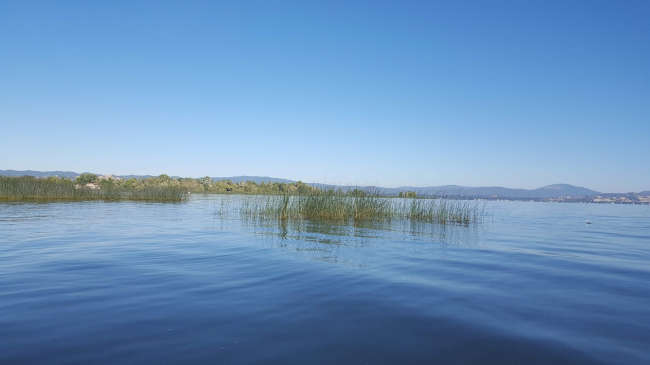
Air quality in Lake County is ranked the best out of all California counties when comparing pollutants like particulate matter, making the argument that Clear Lake was named after clarity of the air and not the water. P: A. DePalma-Dow. Dear Lady of the Lake,
How did Clear Lake get its name? Was the Lake clear at one point? Will it be clear again?
Thank you for your column!
— Susan C, Seeking clarity about Clear Lake
Hello Susan,
Thanks for asking those very interesting questions. I actually get asked this quite a bit, it's a very popular quandary and I wish there was a simple answer!
I have done some extensive research into both Lake County and Napa County histories, as Lake County was a part of Napa County until it was designated as its own county in 1861. So until 1861, Clear Lake was actually a lake within Napa County.
According to research recorded in 1960 by Lake County historian Henry K. Mauldin, the origins of the vernacular “Clear Lake” are unknown (Book 1, pg 12). Both Mauldin and the United States Geological Survey Geographic Names Information System list previous names and variants, as reported by European settlers, hunters, or explorers, to include “Big Lake,” “Lagoona,” “Laguna,” “Laguna Grande” and “Laguna Grande de Napa”, “Kah Shoh.”
Academic studies, such as a 1950 thesis written by the geographer Fredrick J. Simoons indicated that European settlements started as early as 1840, with agricultural settlements starting in 1854, with a dramatic increase in the basin population occurring around 1866-1870. References within this time frame do refer to the lake as “Clear Lake”, so we can surmise that this was the time period where the current lake name originated.
While Clear Lake is the name the lake goes by now, let’s remember that the indigenous residents that lived here for an estimated 20,000 years before european influences and settlements arrived, and these native peoples had their own name and references to Clear Lake.
Clear Lake has been known as Ka-ba-tin [Xa’Batin] or Hok-has-ha, meaning “Big Water'' in some native Pomo languages. Be aware that pronunciation, names and labels vary by region and dialect through space and time.
For example, the meaning and pronunciation of Kabatin vs Xa’Batin: Ka means spider, but the sound for Xa is more of a sound for “H”, think of the sound when you say the name “Howard.” Some people associate the sound with a “K”, which in many instances wrote the name as Kabatin which would actually mean big spider. A good way to sum it up is as follows: Xa = Water, Ka=Spider, Batin=Big, Giant or Tall.
Additionally, I offer this strong Note on the general use of “Pomo” as describing the collective native peoples within Lake County, that this term generally disregards the regional variation among tribes and groups.
So, while the federal government and linguists recognize “Pomo” (or variations such as “Kula Kai Pomo,” “Ballo Kai Pomo”) as the descriptor for the local Indigenous native peoples, some local tribes, have historically self-identified, linguistically, as “Hinthil,” “Gowk Xabatin” or “Kulanapo,” “Kulanapan” or other terms that originated from the distinct tribes, villages or regional collection of peoples within different areas of the Clear Lake basin.
Clear Lake is not clear and probably never was
So now that we have some history for the origins of the name “Clear Lake,” let’s address your second and third question Susan, regarding the clarity of the Lake.
In the majority of the warm summer and fall months, Clear Lake’s water column usually develops an opaque, green color, and in some areas a thick mat of plants or cyanobacteria will develop, sitting (and sometimes stinking!) in the sun. This phenomena definitely encourages some confusion when a lake is named “Clear.”
However, it does not appear that cyanobacteria, also referred to as blue-green algae, are a recent development in Clear Lake. Since water monitoring wasn’t occurring prior to the mid 20th century, the only way to gather information about the lake’s historical water quality, and clarity, is through the lake's sediment.
Sediment cores collected from the bottom of Clear Lake by the United States Geological Survey (USGS) indicate Clear Lake has been nutrient-rich (eutrophic) with high algal populations since the last ice age, which ended approximately 10,000 years ago.
Whatever was growing or floating in the water would end up sinking to the bottom, contributing to the composition of the cores.The sediments act as a time capsule, sequentially exposing the conditions of the lake from the past, through time.
Over the past 50 years there have been several cores studies, and some of the core studies reflect that last 300 years and some of the larger cores capture up to 175,000 years of in-lake information.
The algae pollen cores measured about 2.5 meters in length, and contained information on pollen, nutrients, and metals expanding 300 years from present day (of the 1980s, to be exact).
Generally, what these core contents reveal is that Clear Lake has historically always been green, full of life, and probably not too clear.
To learn more, you can view the Algae Pollen Graph, extracted from the core study, which shows the change in algae pollen over time from a core extracted from the Upper Arm.
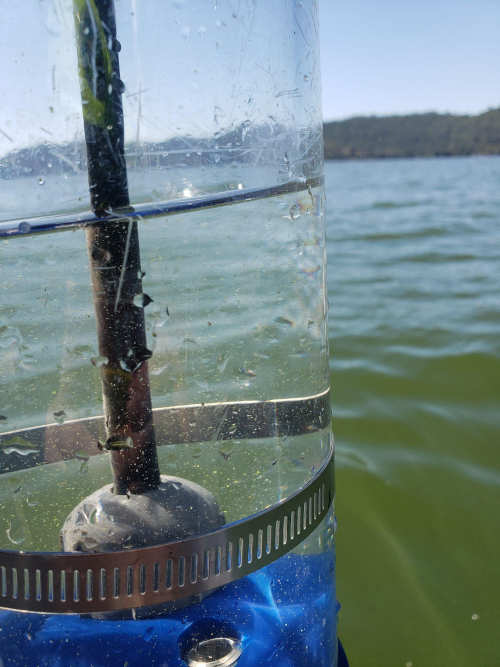
During the summer when the lake looks brown, or green, a discrete water sample collected at the surface can still look relatively clear and small green organisms, or phytoplankton, can be seen floating in the sample. P. A. De Palma-Dow. Historic reporting to Congress about Clear Lake from 1870s
Livingston Stone, a fisheries “expert” and biologist, visited Lake County in 1873 and reported to the U.S. Congress that Clear Lake had significant algal populations at the time. In addition to a detailed month-by-month account of fish in the lake and streams, Stone characterized the eutrophic, nutrient-rich and productive nature of Clear Lake, describing surface blooms and scums during the warmest months of the year.
And excerpt from his written passage is quoted below:
“It is a singular fact, illustrating the inaptness with which names are often given to natural objects, that the water of Clear Lake is never clear. It is so-cloudy, to use a mild word, that you cannot see three feet below the surface. The color of the water is a yellowish brown, varying indefinitely with the varying light. The water has an earthy taste, like swamp-water, and is suggestive of moss and water-plants. In fact, the bottom of the lake, except in deep places, is covered with a deep, dense moss, which sometimes rises to the surface, and often to such an extent in summer as to seriously obstruct the passage of boats through the water.”
During Stone’s seasonal accounts, he describes the water conditions in September:
“The water this month is in its worst condition. It is full of the frothy product of the soda-springs. A green scum covers a large part of the surface, and it is not only uncleanly to look at, but unfit to drink; and yet, strangely enough, this lake, which one would think uninhabitable by fish, fairly teems and swarms with them.”
It would seem, that even in the 1870s, that Clear Lake was not Clear in the summer and fall months, and even then, as now, it seems fitting that the reference to “clarity” does not apply to Clear Lake waters.
You can read the full text of Stone’s Clear Lake, and other California accounts, here: https://penbay.org/cof/cof_1873-1875_xx.pdf or at the Lake County Water Resources website here.
Remember that water clarity in lakes and reservoirs is also influenced by the organic materials floating in the water, the total depth, the temperature, and the composition and content of the surrounding landscape.
More information about what makes Clear Lake colors change throughout the year, from blue, to brown, to green, can be found in my previous column, (February 2022) Brown Water Got you down?
Clear – Air – of Clear Lake
Many newspaper articles and local legends state that Clear Lake was named after the air quality of the valley in which its basin is formed, and not given to the Lake to describe its water quality.
However, in my research I could not find this original reference, only generalized statements within gray literature, without reference to the original source or sources.
This is interesting when you consider how lake names are created across the country. According to a study conducted by Continental Limnology research group, 83% of all the lakes in the US are unnamed, with about 80% of those lakes being smaller than 4 hectares (9.9 acres). Of the 83,000 lakes that did have associated names, the majority of the lakes were named to reflect people’s everyday lives, to inspire creativity, and to incorporate regional indigenous languages.
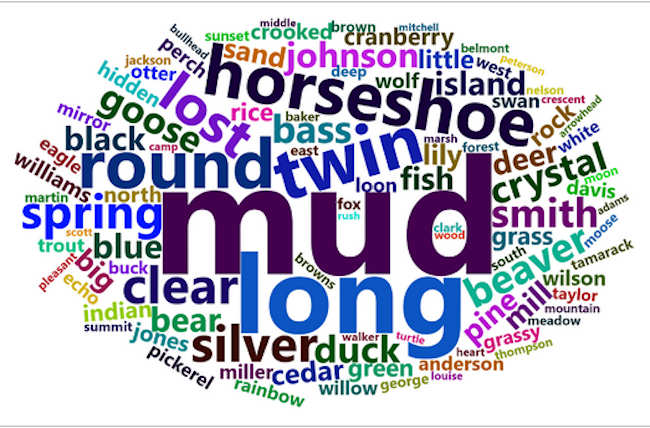
The most common lake name in the U.S. is “Mud.”
Lake names also vary regionally, with co-dominant terms being given to lakes based on region within the US. For example, besides the term “lake,” Arizona, New Mexico and Texas use the term “tank” to refer to lakes or reservoirs, while the Eastern seaboard predominantly refers to lakes as “ponds.” Here in California? We use both Lake and Reservoir pretty consistently throughout the state.
Most common names for lakes, reservoirs, ponds, and tanks, within the conterminous U.S. Wordcloud image: Sorranno et. al. 2020. “What Is in a “Lake” Name? That Which We Call a Lake by Any Other Name“ https://aslopubs.onlinelibrary.wiley.com/doi/full/10.1002/lob.10355
Regardless, Lake County, and especially the valley of which Clear Lake is located, has some of the best air quality in the state, which makes a strong argument for the name bestowed upon the lake.
According to the National Institute of Health Air Pollution Tables, Lake County ranks the best in air quality when comparing the amounts of particulate matter in the air (measured by 2.5 micrograms per liter). In 2019, Lake County recorded the lowest amount at 3.1 mg/L PM2.5 compared to the state average of 7.1 mg/L PM2.5.
And if you want to track current air quality, you can use OpenAir.
IQ Air provided current air quality and pollution indices, along with current wind and wildfire and smoke conditions. <>
I hope this column helped to “clear” the air about how the name Clear came and didn’t come to be. Susan, I also hope that you will join me in being slightly thankful that our beautiful lake didn’t end up being called Mud Lake, am I right?
Sincerely,
Lady of the Lake
Angela De Palma-Dow is a limnologist (limnology = study of fresh inland waters) who lives and works in Lake County. Born in Northern California, she has a Master of Science from Michigan State University. She is a Certified Lake Manager from the North American Lake Management Society, or NALMS, and she is the current president/chair of the California chapter of the Society for Freshwater Science. She can be reached at This email address is being protected from spambots. You need JavaScript enabled to view it..
If you would like to talk to the Lady of the Lake in person, you can stop by her booth at the Big Valley Small Farms Tour, Saturday, May 11, at Ripe Choice Farm, 10 a.m. to 3 p.m.
LAKE COUNTY, Calif. — The city of Lakeport, in collaboration with the Lakeport Police Department and Lake County Behavioral Health Services, will host “Pathways to Stability,” a homelessness and housing resource fair aimed at connecting community members with vital resources and support services.
Scheduled for Wednesday, May 1, from 5:30 to 7:30 p.m., “Pathways to Stability” will take place at Xabatin Community Park at 800 N. Main St.
The event aims to raise awareness of the variety of resources available to individuals facing homelessness or housing insecurity in the Lakeport area.
“Pathways to Stability” will feature informational booths and representatives from organizations including the city of Lakeport, Lakeport Police Department, Lake County Behavioral Health Services, Redwood Community Services, Nation’s Finest, Adventist Health and Sutter Lakeside Hospital.
Attendees will have the opportunity to learn about housing assistance programs, mental health services, and substance use disorder services available in our community.
they can also provide feedback and learn about the recently launched low-barrier navigation center study currently underway in the city of Lakeport.
The project team will be present to discuss what a low-barrier navigation center is and have interactive displays where community members can provide feedback on the concept of a navigation center.
In addition to valuable information, attendees will be treated to a complimentary dinner, provided by the Kiwanis Club of Lakeport.
The event is open to all members of the Lake County community and surrounding areas, whether you are seeking assistance or looking to learn more about resources available in our community.
For more information about “Pathways to Stability,” please contact Megan Morgan at This email address is being protected from spambots. You need JavaScript enabled to view it..
 How to resolve AdBlock issue?