How to resolve AdBlock issue?
Refresh this page
How to resolve AdBlock issue?
Refresh this page
Lake County News,California
  • Home
    • Registration Form
  • News
    • Community
      • Obituaries
      • Letters
      • Commentary
    • Education
    • Veterans
    • Police Logs
    • Business
    • Recreation
    • Health
    • Religion
    • Legals
    • Arts & Life
    • Regional
  • Calendar
  • Contact us
    • FAQs
    • Phones, E-Mail
    • Subscribe
  • Advertise Here
  • Login
How to resolve AdBlock issue?
Refresh this page
How to resolve AdBlock issue?
Refresh this page

News

How bird flu virus fragments get into milk sold in stores, and what the spread of H5N1 in cows means for the dairy industry and milk drinkers

How bird flu virus fragments get into milk sold in stores, and what the spread of H5N1 in cows means for the dairy industry and milk drinkers

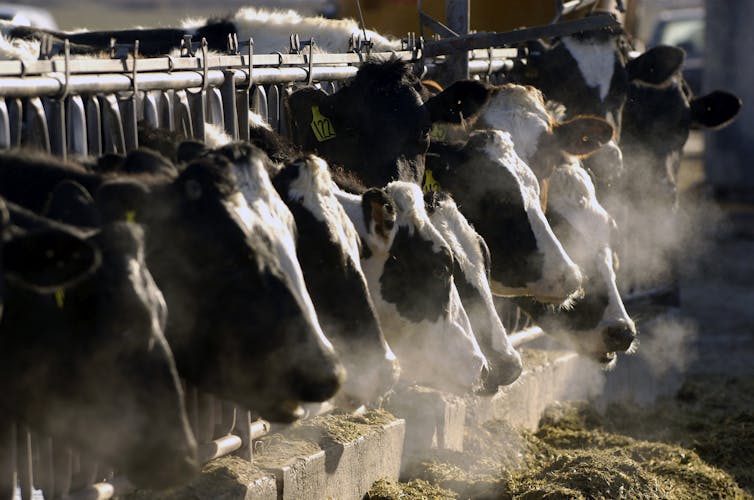
Cows typically get over avian flu in a couple of weeks, but it’s an economic blow for farms. AP Photo/Charlie Litchfield

The discovery of fragments of avian flu virus in milk sold in U.S. stores, including in about 20% of samples in initial testing across the country, suggests that the H5N1 virus may be more widespread in dairy cattle than previously realized.

The Food and Drug Administration, which announced the early results from its nationally representative sampling on April 25, 2024, was quick to stress that it believes the commercial milk supply is safe. The FDA said initial tests did not detect any live, infectious virus. However, highly pathogenic avian influenza virus can make cows sick, and the flu virus’s presence in herds in several states and new federal restrictions on the movement of dairy cows between states are putting economic pressure on farmers.

Five experts in infectious diseases in cattle from the University of California, Davis – Noelia Silva del Rio, Terry Lehenbauer, Richard Pereira, Robert Moeller and Todd Cornish – explain what the test results mean, how bird flu can spread to cattle and the impact on the industry.

What are viral fragments of avian flu, and can they pose risks to people?

It’s crucial to understand that the presence of viral fragments of H5N1 doesn’t indicate the presence of intact virus particles that could cause disease.

The commercial milk supply maintains safety through two critical measures:

  • First, milk sourced from sick animals is promptly diverted or disposed of, ensuring it does not enter the food chain.

  • Second, all milk at grocery stores is heat treated to reduce pathogen load to safe levels, mainly by pasteurization. Pasteurization has been shown to effectively inactivate H5N1 in eggs, and that process occurs at a lower temperature than is used for milk.

The viral fragments were detected using quantitative polymerase chain reaction testing, which is known for its exceptional sensitivity in detecting even trace amounts of viral genetic material. These fragments are only evidence that the virus was present in the milk. They aren’t evidence that the virus is biologically active.

To evaluate whether the presence of the viral fragments corresponds to a virus with the capacity to replicate and cause disease, a different testing approach is necessary. Tests such as embryonated egg viability studies allow scientists to assess the virus’s ability to replicate by injecting a sample into an embryonated chicken egg. That type of testing is underway.

On April 24, 2024, the FDA said it had found no reason to change its assessment that the U.S. milk supply is safe. The agency does strongly advise against consuming raw milk and products derived from it because of its inherent risks of contamination with harmful pathogens, including avian flu viruses.

How does an avian flu virus get into cow’s milk?

Currently, cows confirmed to have H5N1 have different symptoms than the typical flu-like symptoms observed in birds.

Abnormal milk and mastitis, an inflammatory response to infection, are common. While there is speculation that other bodily secretions, such as saliva, respiratory fluids, urine or feces, may also harbor the virus, that has yet to be confirmed.
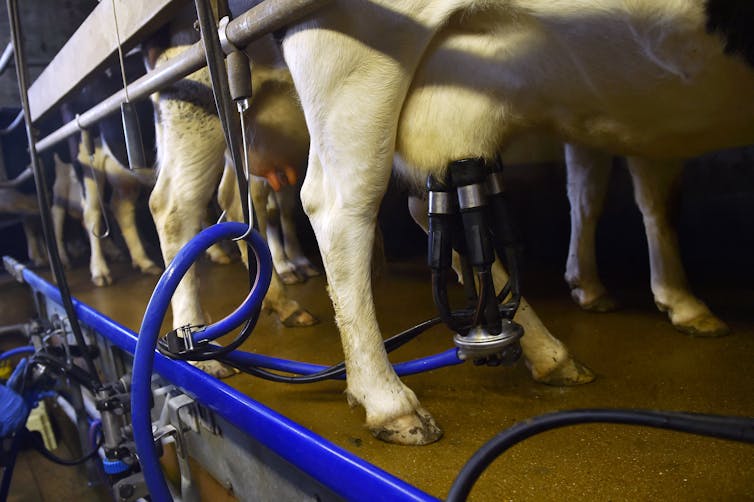
The legs of a cow showing a milking device attached to the udder and tubes for the milk to flow.
Milking equipment can help viruses spread. Loic Venance/AFP via Getty Images

How waterfowl or other birds transmitted H5N1 to cattle is still under investigation. In 2015, an outbreak of highly pathogenic avian influenza in commercial poultry farms reached its peak in April and May, the same time birds migrated north. Birds can shed the virus through their oral, nasal, urine and fecal secretions. So the virus could potentially be transmitted through direct contact, ingesting contaminated feed or water, or inhaling the virus.

Infected dairy cows can shed the virus in milk, and they likely can transmit it to other cows, but that still needs to be proven.

Contagious pathogens that cause mastitis can be transmitted through milking equipment or contaminated milker’s gloves. Ongoing research will help determine whether this is also a potential transmission route for H5N1, and if so, what makes the virus thrive on mammary tissue.

If H5N1 is found to be widespread in milk, what risks can that pose for the dairy industry?

For the dairy industry, infection of cattle with H5N1 avian influenza virus creates challenges at two levels.

The overriding concern is always for the safety and healthfulness of milk and dairy products.

Existing state and federal regulations and industry practices require sick cows or cows with abnormal milk to be segregated so that their milk does not enter the food supply. Proper pasteurization should kill the virus so that it cannot cause infection.

The American Association of Bovine Practitioners has also developed biosecurity guidelines for H5N1, focusing on key practices. These include minimizing wild birds’ contact with cattle and their environment, managing the movement of cattle between farms, isolating affected animals, avoiding feeding unpasteurized (raw) colostrum or milk to calves and other mammals, and ensuring the use of protective personal equipment for animal caretakers.

The other major concern is for the health of the dairy herd and the people who take care of the dairy cattle. A farm worker who handled dairy cows contracted H5N1 in Texas in March 2024, but such cases are rare.

No vaccines or specific therapies are available for avian influenza infections in dairy cattle. But following good sanitation and biosecurity practices for both people and cows will help to reduce risk of exposure and spread of the avian influenza virus among dairy cattle.

For cows that get the virus, providing supportive care, including fluids and fever reducers as needed, can help them get through the illness, which can also cause loss of appetite and affect their milk production.

Dairy farms facing an outbreak will have economic losses from caring for sick animals and the temporary reduction in milk sales. Approximately 5% to 20% of the animals in the affected herds have become ill, according to early estimates. Affected animals typically recover within 10 to 20 days.

At least 22 states have restricted importing dairy cattle to prevent the virus’s spread, and the federal government announced it will require that lactating dairy cattle be tested before they can be moved between states starting April 29, 2024. While the overall impact on U.S. milk production is projected to be minor on an annual basis, it could lead to short-lived supply disruptions.

How worried should people be about avian flu?

The federal government’s monitoring and food safety measures, along with pasteurization, provide important safeguards to protect the public from potential exposure to avian influenza virus through the food chain.

Drinking raw milk, however, does represent a risk for exposure to multiple diseases, including H5N1. This is why the FDA and Centers for Disease Control and Prevention strongly recommend drinking only pasteurized milk and dairy products.

This article, published April 25, 2024, has been updated with new FDA test results.The Conversation

Noelia Silva del Rio, Associate Specialist in Cooperative Extension, Production Medicine and Food Safety, University of California, Davis; Richard V. Pereira, Associate Professor of Veterinary Medicine and Associate Agronomist, University of California, Davis; Robert B. Moeller, Professor of Veterinary Medicine, University of California, Davis; Terry W. Lehenbauer, Professor of Veterinary Medicine, University of California, Davis, and Todd Cornish, Professor of Veterinary Medicine, University of California, Davis

This article is republished from The Conversation under a Creative Commons license. Read the original article.

Details
Written by: Noelia Silva del Rio, University of California, Davis; Richard V. Pereira, University of California, Davis; Robert B. Moeller, University of California, Davis; Terry W. Lehenbauer, University of California, Davis, and Todd Cornish, University of Californi
Published: 30 April 2024

Clearlake woman dies in Sunday night Highway 20 crash

LUCERNE, Calif. — A Clearlake woman died Sunday night after her vehicle went off Highway 20 and hit an embankment east of Lucerne.

The California Highway Patrol’s Clear Lake Area office did not release the name of the woman pending notification of her next of kin.

The CHP said the crash occurred at around 10 p.m. Sunday on Highway 20 east of Verna Way.

The crash was reported to CHP officers at 10:05 p.m. Sunday. When the officers arrived, the CHP said they found an overturned 2000 Honda Civic sedan blocking the westbound traffic lane.

The CHP’s initial investigation concluded that the driver was traveling eastbound on Highway 20 at an unknown speed when she crossed over the solid double yellow lines into the westbound traffic lane, and went off the roadway, where the Honda crashed into the dirt/rock embankment and overturned.

The wreck caused the driver, who was not wearing her seat belt, to be ejected from the vehicle, the CHP said.

The CHP said the driver died at the scene of her injuries.

Officer Cameron Ramsey is leading the investigation for the CHP.

Email Elizabeth Larson at This email address is being protected from spambots. You need JavaScript enabled to view it.. Follow her on Twitter, @ERLarson, or Lake County News, @LakeCoNews.
Details
Written by: Elizabeth Larson
Published: 29 April 2024

Lakeport man pleads not guilty to April 5 drive-by killing of friend’s mother

LAKE COUNTY, Calif. — A Lakeport man has pleaded not guilty to the April 5 killing of a Clearlake woman in a drive-by shooting.

Nathaniel Ladre Hueners, 21, was in court for arraignment last week in the killing of 45-year-old Elizabeth Williams, the mother of one of his close friends.

New Chief Deputy District Attorney Rich Watson said Hueners pleaded not guilty to 10 counts and numerous special allegations and waived his time for preliminary hearing in a Tuesday court appearance.

The charging document mentions a second victim in the shooting, with Hueners also charged in the attempted killing of Nino Davis.

Hueners is set for preliminary hearing on July 24. He’s being defended by Ray Buenaventura, the county chief public defender.

Also charged in the case is David Sandoval with two counts, one for concealing the 9 millimeter Glock handgun used in Williams’ killing, along with a special allegation that “the defendant threatened witnesses, unlawfully prevented and dissuaded witnesses from testifying, suborned perjury, or in any another way illegally interfered with the judicial process.”

Police said Williams was driving in a vehicle near Pacific Avenue and Konocti View Road in Clearlake on the night of Friday, April 5, when another vehicle pulled up next to hers and one of the occupants of the second vehicle shot at Williams' vehicle, striking her one time, before fleeing the scene.

A short time later, just before 11 p.m., police were dispatched to the 15300 block of Pacific Avenue on the report of multiple gunshots being heard in the area.

On the way there, they were notified that the shooting victim, Williams, was being transported to Adventist Health Clear Lake Hospital. She died there a short time later.

Clearlake Police identified Hueners as the suspect shortly after the shooting.

Then, at around 1 a.m. Monday, April 8, Lakeport Police officers responded to a hotel in Lakeport for a noise complaint and contacted three people, including Hueners and Sandoval.

Watson said they also found a firearm there in a parking lot away from the room where the men were found. It is believed that the 9 millimeter handgun was previously in the Hueners’ possession and it matched the caliber of the firearm used to kill Williams. Watson said it is still under investigation as to whether this was the same gun used in the killing.

Regarding the relationship between Sandoval and Hueners, “It’s believed that they are friends. That's still under investigation as far as what they were doing together,” said Watson.

As to the motive for Hueners’ killing of his friend’s mother, “That’s still under review,” said Watson.

While there are theories, nothing has been concluded upon and an intensive investigation is continuing, Watson added.

Court documents show that Hueners has a previous felony conviction from January of 2022 for assault with a firearm in Lake County.

The charges against Hueners are murder; the attempted murder of Nino Davis; assault with a firearm on Williams; assault with a firearm on Williams; assault with a firearm on Davis; discharge of a weapon at an occupied vehicle; two counts of being a felon in possession of a firearm; two counts of being a felon in possession of ammunition; and making criminal threats against Spencer Williams.

He’s also facing special allegations of personally and intentionally discharging a firearm to kill Elizabeth Williams, use of a firearm, personal use of a firearm, personally inflicting great bodily injury on Williams and having been convicted of a prior serious or violent felony — the January 2022 assault with a firearm conviction.

The charging document also offers a special allegation of having several factors in aggravation, including that the crime involved great violence, that Hueners was armed, the victim was particularly vulnerable, he induced others to participate in the commission of the crime, that he threatened witnesses or otherwise interfered with the legal process, and that he was convicted of other crimes for which consecutive sentences could have been imposed but for which concurrent sentences are being imposed instead.

Other aggravating factors included in the charging document are that the manner in which the crime was carried out indicates planning, sophistication and professionalism, the conduct was violent and indicates a serious danger to society, Hueners’ prior convictions as an adult or sustained petitions in juvenile delinquency proceedings are numerous or of increasing seriousness, he was on probation or parole when the crime was committed and his prior performance on probation or parole was unsatisfactory.

Editor’s note: This story has been updated with additional information about the firearm believed to have been used in the crime.

Email Elizabeth Larson at This email address is being protected from spambots. You need JavaScript enabled to view it.. Follow her on Twitter, @ERLarson, or Lake County News, @LakeCoNews.
Details
Written by: Elizabeth Larson
Published: 29 April 2024

East Region Town Hall meets May 1

LAKE COUNTY, Calif. — The East Region Town Hall, or ERTH, will meet on Wednesday, May 1.

The meeting will begin at 4 p.m. at the Moose Lodge, located at 15900 Moose Lodge Lane in Clearlake Oaks.

The meeting will be available via Zoom. The meeting ID is 830 2978 1573, pass code is 503006.

ERTH’s guest speaker on Wednesday will be Lake County Community Development Director Mireya Turner, who will discuss the Shoreline Area Plan update, which will guide county decisions on land use, open space, circulation, housing, conservation, safety, noise and environmental justice.

Agenda items also include a special presentation by Northshore Fire Protection District Chief Mike Ciancio.

ERTH’s next meeting will take place on June 5.

ERTH’s members are Denise Loustalot, Jim Burton, Tony Morris and Pamela Kicenski and Maria Kann.

For more information visit the group’s Facebook page.
Details
Written by: Elizabeth Larson
Published: 29 April 2024
  1. How ‘going under’ is getting greener
  2. Cybersecurity researchers spotlight a new ransomware threat – be careful where you upload files
  3. Lady of the Lake: What’s in a name? How Clear Lake got its name

Subcategories

Community

  • 691
  • 692
  • 693
  • 694
  • 695
  • 696
  • 697
  • 698
  • 699
  • 700
How to resolve AdBlock issue?
Refresh this page
Copyright © 2026 Lake County News,California. All Rights Reserved.