 How to resolve AdBlock issue?
News
LAKE COUNTY, Calif. — Ahead of the summer fire season, state Sen. Mike McGuire is planning to hold a town hall on wildfire preparedness and prevention.
The online event will take place beginning at 6:30 p.m. Wednesday, May 8.
RSVP and submit questions for the town hall here.
It can be watched live here.
“The state has invested mightily over the past several years making the Golden State more fire safe,” McGuire said. “We've significantly beefed up firefighting resources in every corner of the state, hiring thousands of additional Cal Fire firefighters and we've advanced record funding for vegetation management, dead and dying tree removal and creating new fire breaks around communities. That said, we know there's much more work to do.”
McGuire will be joined by Cal Fire Chief Joe Tyler to share the latest updates and take questions.
The online event will take place beginning at 6:30 p.m. Wednesday, May 8.
RSVP and submit questions for the town hall here.
It can be watched live here.
“The state has invested mightily over the past several years making the Golden State more fire safe,” McGuire said. “We've significantly beefed up firefighting resources in every corner of the state, hiring thousands of additional Cal Fire firefighters and we've advanced record funding for vegetation management, dead and dying tree removal and creating new fire breaks around communities. That said, we know there's much more work to do.”
McGuire will be joined by Cal Fire Chief Joe Tyler to share the latest updates and take questions.
- Details
- Written by: Lake County News reports
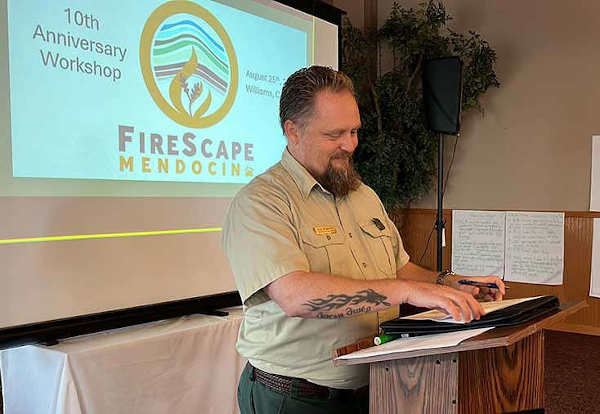
MENDOCINO NATIONAL FOREST, Calif. — The increasing frequency and extent of high-intensity wildfires pose a significant threat to California’s ecosystems.
To address the current wildfire crisis and restore forest health, Mendocino National Forest Supervisor Wade McMaster has signed a decision on the Mendocino Prescribed Fire and Fuels Management Strategy.
McMaster signed the document in front of a diverse group of local partners, tribal representatives and community members at a FireScape Mendocino workshop and 10th anniversary celebration, held in Williams on Thursday, April 25.
“The Mendocino Prescribed Fire and Fuels Management Strategy is incredibly important to me and my team, especially after we’ve had several catastrophic, dynamic fire seasons and other challenges with insect infestation, drought and back-to-back winters with severe storms,” said McMaster. “This forest-wide and multi-phased approach will allow us to more quickly adapt to changing conditions, reduce impacts from future fire and improve forest resilience and health.”
With this decision, forest managers can use prescribed fire with manual and mechanical treatments to reduce the build-up of hazardous fuels such as grasses, brush, small-diameter trees, downed trees and woody debris.
Treatments will be phased over time, targeting overly dense forest underbrush and small trees before and after wildfires.
Prescribed fires will be applied at varying intensities, sizes, frequencies, seasons and places, and manual and mechanical fuels-reduction tools will be utilized up to 20,000 acres per year to achieve and maintain desired vegetative conditions.
Treatments will vary across the landscape and will depend on several factors, including terrain, fire severity, desired conditions and ecology. Several constraints are in place to protect key Resources.
The strategy excludes treatment within Wilderness Areas and within 100-acre nest groves for the endangered northern spotted owl.
Also, treatments like thinning to reduce fuels are limited to small trees, up to 12 inches in diameter. No new roads or landings will be constructed under the strategy.
Projects under the strategy will have to meet site-specific conditions. Before the forest can implement in the field, projects will be vetted by an interdisciplinary team in a screening process.
Local tribes, partners and collaborative groups like FireScape Mendocino will also play an important role in monitoring and helping identify potential areas for treatment.
“As we look to return fire to the landscape, our relationships are going to be key. I am excited to work alongside our tribal partners to incorporate cultural burning and healing as we move forward,” McMaster said.
The Mendocino Prescribed Fire and Fuels Management Strategy is consistent with the post-fire restoration framework and conforms to several elements of the 2023 Wildfire Crisis Strategy, which calls for a new paradigm to step up the pace and scale of the fuels and forest health Treatments.
More information about the Mendocino Prescribed Fire and Fuels Management Strategy, including the decision notice and environmental assessment are available on the project website.
- Details
- Written by: LAKE COUNTY NEWS REPORTS
Nationally, public school spending per student rose 8.9% from $14,358 in FY 2021 to $15,633 in FY 2022, according to new data from the 2022 Annual Survey of School System Finances released by the U.S. Census Bureau.
This represents the largest percentage increase in public school spending per pupil in the 50 states and the District of Columbia in over 20 years. Statistics are not adjusted for inflation or cost-of-living differences between geographic areas.
The states spending the most per pupil were New York ($29,873), the District of Columbia ($27,425), New Jersey ($25,099), Vermont ($24,608) and Connecticut ($24,453).
The states spending the least per pupil were Utah ($9,552), Idaho ($9,670), Arizona ($10,315), Oklahoma ($10,890) and Mississippi ($10,984).
California came up in the middle, with $17,049 spent per pupil.
Among the 100 largest school systems (by enrollment), New York City School District in New York ($35,914) spent the most per pupil in FY 2022, followed by Washington Schools in the District of Columbia ($27,425), San Francisco Unified in California ($23,654), Atlanta School District in Georgia ($22,882), Los Angeles Unified in California ($21,940) and Detroit School District in Michigan ($21,771).
Public school systems in Mississippi (23.3%), South Dakota (21.7%), Montana (20.9%), Alaska (20.6%), and Arkansas (20.4%) had the highest percentage of revenue from federal sources compared to their total revenue in FY 2022, while those in New York (7.2%), New Jersey (7.4%), Connecticut (8.0%), New Hampshire (8.8%), and Massachusetts (9.4%) had the lowest.
Total school district debt increased by 2.1% from $532.5 billion in FY 2021 to $543.9 billion in FY 2022.
On the revenue side, elementary and secondary education revenue from all sources in FY 2022 amounted to $878.2 billion, up 8.4% from the prior year.
Revenue raised from local sources amounted to $375.2 billion (42.7%) of elementary-secondary funding, while the federal government contributed $119.1 billion (13.6%).
Of the $375.2 billion schools received from local sources, $326.2 billion was from taxes and parent government contributions while property taxes accounted for 65.4% of revenue from local sources.
State governments contributed the greatest share (43.7% or $383.9 billion) of all public school system funding.
Regarding expenditures, total expenditure by public elementary-secondary school systems totaled $857.3 billion in FY 2022, up 7.8% from the prior year.
Of the total expenditure for elementary and secondary education, current spending made up $746.9 billion (87.1%) and capital outlay made up $84.2 billion (9.8%).
The largest expenditure category was instructional salaries with public elementary and secondary school systems spending $266.4 billion for salaries in FY 2022, which was 31.1% of total expenditures.
Expenditure for instruction for all school systems amounted to $446.9 billion or 59.8% of total current spending, while expenditure for support services amounted to $264.6 billion (35.4%).
This represents the largest percentage increase in public school spending per pupil in the 50 states and the District of Columbia in over 20 years. Statistics are not adjusted for inflation or cost-of-living differences between geographic areas.
The states spending the most per pupil were New York ($29,873), the District of Columbia ($27,425), New Jersey ($25,099), Vermont ($24,608) and Connecticut ($24,453).
The states spending the least per pupil were Utah ($9,552), Idaho ($9,670), Arizona ($10,315), Oklahoma ($10,890) and Mississippi ($10,984).
California came up in the middle, with $17,049 spent per pupil.
Among the 100 largest school systems (by enrollment), New York City School District in New York ($35,914) spent the most per pupil in FY 2022, followed by Washington Schools in the District of Columbia ($27,425), San Francisco Unified in California ($23,654), Atlanta School District in Georgia ($22,882), Los Angeles Unified in California ($21,940) and Detroit School District in Michigan ($21,771).
Public school systems in Mississippi (23.3%), South Dakota (21.7%), Montana (20.9%), Alaska (20.6%), and Arkansas (20.4%) had the highest percentage of revenue from federal sources compared to their total revenue in FY 2022, while those in New York (7.2%), New Jersey (7.4%), Connecticut (8.0%), New Hampshire (8.8%), and Massachusetts (9.4%) had the lowest.
Total school district debt increased by 2.1% from $532.5 billion in FY 2021 to $543.9 billion in FY 2022.
On the revenue side, elementary and secondary education revenue from all sources in FY 2022 amounted to $878.2 billion, up 8.4% from the prior year.
Revenue raised from local sources amounted to $375.2 billion (42.7%) of elementary-secondary funding, while the federal government contributed $119.1 billion (13.6%).
Of the $375.2 billion schools received from local sources, $326.2 billion was from taxes and parent government contributions while property taxes accounted for 65.4% of revenue from local sources.
State governments contributed the greatest share (43.7% or $383.9 billion) of all public school system funding.
Regarding expenditures, total expenditure by public elementary-secondary school systems totaled $857.3 billion in FY 2022, up 7.8% from the prior year.
Of the total expenditure for elementary and secondary education, current spending made up $746.9 billion (87.1%) and capital outlay made up $84.2 billion (9.8%).
The largest expenditure category was instructional salaries with public elementary and secondary school systems spending $266.4 billion for salaries in FY 2022, which was 31.1% of total expenditures.
Expenditure for instruction for all school systems amounted to $446.9 billion or 59.8% of total current spending, while expenditure for support services amounted to $264.6 billion (35.4%).
- Details
- Written by: U.S. Census Bureau

With fewer high school students across the country filing for federal student aid so far this year, California is promoting a statewide campaign to mobilize local partners and engage high school seniors in completing the Free Application for Federal Student Aid, or FAFSA, or the California Dream Act Application, known also as CADAA.
From tuition to textbooks and other costs of attendance, financial aid is essential to making college more accessible and supporting student success.
In light of delays and issues impacting the federal rollout of the 2024-25 FAFSA, Gov. Gavin Newsom in March signed an urgency measure by Assemblymember Sabrina Cervantes (D-Riverside) to support students navigating the process by extending the application deadline for state financial aid programs from April 2 to May 2.
Students bound for four-year institutions should complete the FAFSA or CADAA by the May 2 priority deadline to be eligible for various state financial aid programs, including the Cal Grant and Middle Class Scholarship.
For community college students and foster youth, the deadline is Sept. 3, 2024.
To find out more or apply, click here.
The governor issued the following letter highlighting the state’s outreach efforts to ensure students don’t leave money on the table for college, including financial aid workshops scheduled across the state through May 2 for students, high school counselors and other partners.
A copy of the Governor’s letter can be found here and the text is below.
2024-25 Race to Submit: Cash for College
California is committed to helping students – our future leaders and innovators – pursue their college dreams and reach their full career potential. Financial aid helps hundreds of thousands of students in our state to achieve their higher education goals, and it’s critical that everyone who could benefit has the opportunity to enroll. The first step in accessing financial aid is timely submission of the Free Application for Federal Student Aid (FAFSA), which unlocks federal, state and institutional aid.
This year, California passed an urgency measure to extend the application deadline for state financial aid programs from April 2 to May 2, meaning students have an additional month to submit their FAFSA by the state’s priority deadline. This action was taken to help students who have been impacted by challenges in the federal rollout of changes to the FAFSA.
The California Department of Education and the California Student Aid Commission are teaming up with local partners throughout the state to offer financial aid workshops for students, counselors and others in the community, among other resources to support outreach and training.
We’ll keep working with partners throughout the state to get the word out and help students and their families unlock these crucial opportunities to get them on the path to college success.
Sincerely,
Governor Gavin Newsom
- Details
- Written by: Lake County News reports