How to resolve AdBlock issue?
Refresh this page
Lake County News,California
  • Home
    • Registration Form
  • News
    • Education
    • Veterans
    • Community
      • Obituaries
      • Letters
      • Commentary
    • Police Logs
    • Business
    • Recreation
    • Health
    • Religion
    • Legals
    • Arts & Life
    • Regional
  • Calendar
  • Contact us
    • FAQs
    • Phones, E-Mail
    • Subscribe
  • Advertise Here
  • Login
How to resolve AdBlock issue?

Refresh this page

News

Middletown Area Town Hall to meet Aug. 14

MIDDLETOWN, Calif. — The Middletown Area Town Hall, or MATH, will discuss public power generation and get reports on recent meetings.

MATH will meet at 7 p.m. Thursday, Aug. 14, in the Middletown Community Meeting Room/Library at 21256 Washington St., Middletown. The meeting is open to the public.

Zoom will not be available. Viewers can participate via PEG TV at www.youtube.com/LakeCountyPegTV. 

On the agenda is a presentation from Sonoma Clean Power regarding exploring the option of public power generation.

There also will be presentations by South Lake County Fire and from Ben Rickelman of the county of Lake and Jeff Lucas of Community Development Services regarding economic development.

There also will be reports on the special meeting for the Guenoc Valley project, the July 24 Lake County Planning Commission, the Aug. 5 Board of Supervisors meeting during which they discussed a proposed moratorium on cannabis and approved the MATH bylaws, and a Caltrans meeting on Aug. 7.

MATH — established by resolution of the Lake County Board of Supervisors on Dec. 12, 2006 — is a municipal advisory council serving the residents of Anderson Springs, Cobb, Coyote Valley (including Hidden Valley Lake), Long Valley and Middletown.

For more information email This email address is being protected from spambots. You need JavaScript enabled to view it.. 

Email Elizabeth Larson at This email address is being protected from spambots. You need JavaScript enabled to view it.. Follow her on Twitter, @ERLarson, and on Bluesky, @erlarson.bsky.social. Find Lake County News on the following platforms: Facebook, @LakeCoNews; X, @LakeCoNews; Threads, @lakeconews, and on Bluesky, @lakeconews.bsky.social. AFDC-453C-4DA7

Lake County Planning Commission to hold special Aug. 18 meeting

LAKEPORT, Calif. — The Lake County Planning Commission will hold a special meeting next week in order to make corrections to key planning documents for a south county luxury resort.

The meeting will begin at 2 p.m. Monday, Aug. 18, in the board chambers on the first floor of the Lake County Courthouse, 255 N. Forbes St., Lakeport.

The agenda is here.

To participate in real-time, join the Zoom meeting by clicking this link. 

The webinar ID is 994 1760 2765, the pass code is 155982. 

Access the meeting via one tap mobile at +16699006833,,99417602765#,,,,*155982# or dial in at 669-900-6833.

The single item of business on the commission’s agenda is the consideration of corrections to the resolution adopting an amendment to the Lake County General Plan Policy for the Guenoc Valley Mixed Use Planned Development Project and the ordinance establishing regulations and development standards for the Guenoc Valley Zoning District District.

At a special meeting on Aug. 8, the commission voted to approve the new environmental impact report and most permit requests for the large-scale, mixed-use resort and residential development project near Middletown.

The project luxury destination that at full buildout will include up to 400 hotel rooms, 450 resort residential units, 1,400 residential estates and 500 workforce co-housing units on a portion of the 16,000-acre Guenoc property.

Community Development Director Mireya Turner’s report to the commission explains that after its special Aug. 8 meeting, typographical errors were noted in various project documents. 

“Most were simple and non-substantive formatting or spelling errors. The two documents included in this agenda item had more significant corrections made. Out of an abundance of caution, these corrections are presented for Commission consideration and possible reaffirmation of the related actions previously taken,” Turner wrote in her report.

Email Elizabeth Larson at This email address is being protected from spambots. You need JavaScript enabled to view it.. Follow her on Twitter, @ERLarson, and on Bluesky, @erlarson.bsky.social. Find Lake County News on the following platforms: Facebook, @LakeCoNews; X, @LakeCoNews; Threads, @lakeconews, and on Bluesky, @lakeconews.bsky.social. 

Purrfect Pals: Many kittens and cats

LAKE COUNTY, Calif. — Lake County Animal Care and Control has many kittens and cats waiting for their new homes this week.

The kittens and cats at the shelter that are shown on this page have been cleared for adoption.

Call Lake County Animal Care and Control at 707-263-0278 or visit the shelter online for information on visiting or adopting.

The shelter is located at 4949 Helbush in Lakeport.

Email Elizabeth Larson at This email address is being protected from spambots. You need JavaScript enabled to view it.. Follow her on Twitter, @ERLarson, and on Bluesky, @erlarson.bsky.social. Find Lake County News on the following platforms: Facebook, @LakeCoNews; X, @LakeCoNews; Threads, @lakeconews, and on Bluesky, @lakeconews.bsky.social. 

A#117b's preview photo
A#117b

A#117c's preview photo
A#117c

A#117d's preview photo
A#117d

B#49 (Toffee)'s preview photo
B#49 (Toffee)

A#43a's preview photo
A#43a

A#43B(Red) Benedict's preview photo
A#43B(Red) Benedict

A#43c(Yellow)'s preview photo
A#43c(Yellow)

A#43f(Green)'s preview photo
A#43f(Green)

A#43g(Blue)'s preview photo
A#43g(Blue)
 
A#123's preview photo
A#123

C#24's preview photo
C#24


AI literacy: What it is, what it isn’t, who needs it and why it’s hard to define

AI literacy is a lot more than simply knowing how to prompt an AI chatbot. DNY59/E+ via Getty Images

It is “the policy of the United States to promote AI literacy and proficiency among Americans,” reads an executive order President Donald Trump issued on April 23, 2025. The executive order, titled Advancing Artificial Intelligence Education for American Youth, signals that advancing AI literacy is now an official national priority.

This raises a series of important questions: What exactly is AI literacy, who needs it, and how do you go about building it thoughtfully and responsibly?

The implications of AI literacy, or lack thereof, are far-reaching. They extend beyond national ambitions to remain “a global leader in this technological revolution” or even prepare an “AI-skilled workforce,” as the executive order states. Without basic literacy, citizens and consumers are not well equipped to understand the algorithmic platforms and decisions that affect so many domains of their lives: government services, privacy, lending, health care, news recommendations and more. And the lack of AI literacy risks ceding important aspects of society’s future to a handful of multinational companies.

How, then, can institutions help people understand and use – or resist – AI as individuals, workers, parents, innovators, job seekers, students, employers and citizens? We are a policy scientist and two educational researchers who study AI literacy, and we explore these issues in our research.

What AI literacy is and isn’t

At its foundation, AI literacy includes a mix of knowledge, skills and attitudes that are technical, social and ethical in nature. According to one prominent definition, AI literacy refers to “a set of competencies that enables individuals to critically evaluate AI technologies; communicate and collaborate effectively with AI; and use AI as a tool online, at home, and in the workplace.”

AI literacy is not simply programming or the mechanics of neural networks, and it is certainly not just prompt engineering – that is, the act of carefully writing prompts for chatbots. Vibe coding, or using AI to write software code, might be fun and important, but restricting the definition of literacy to the newest trend or the latest need of employers won’t cover the bases in the long term. And while a single master definition may not be needed, or even desirable, too much variation makes it tricky to decide on organizational, educational or policy strategies.

Who needs AI literacy? Everyone, including the employees and students using it, and the citizens grappling with its growing impacts. Every sector and sphere of society is now involved with AI, even if this isn’t always easy for people to see.

Exactly how much literacy everyone needs and how to get there is a much tougher question. Are a few quick HR training sessions enough, or do we need to embed AI across K-12 curricula and deliver university micro credentials and hands-on workshops? There is much that researchers don’t know, which leads to the need to measure AI literacy and the effectiveness of different training approaches.

Ethics is an important aspect of AI literacy.

Measuring AI literacy

While there is a growing and bipartisan consensus that AI literacy matters, there’s much less consensus on how to actually understand people’s AI literacy levels. Researchers have focused on different aspects, such as technical or ethical skills, or on different populations – for example, business managers and students – or even on subdomains like generative AI.

A recent review study identified more than a dozen questionnaires designed to measure AI literacy, the vast majority of which rely on self-reported responses to questions and statements such as “I feel confident about using AI.” There’s also a lack of testing to see whether these questionnaires work well for people from different cultural backgrounds.

Moreover, the rise of generative AI has exposed gaps and challenges: Is it possible to create a stable way to measure AI literacy when AI is itself so dynamic?

In our research collaboration, we’ve tried to help address some of these problems. In particular, we’ve focused on creating objective knowledge assessments, such as multiple-choice surveys tested with thorough statistical analyses to ensure that they accurately measure AI literacy. We’ve so far tested a multiple-choice survey in the U.S., U.K. and Germany and found that it works consistently and fairly across these three countries.

There’s a lot more work to do to create reliable and feasible testing approaches. But going forward, just asking people to self-report their AI literacy probably isn’t enough to understand where different groups of people are and what supports they need.

Approaches to building AI literacy

Governments, universities and industry are trying to advance AI literacy.

Finland launched the Elements of AI series in 2018 with the hope of educating its general public on AI. Estonia’s AI Leap initiative partners with Anthropic and OpenAI to provide access to AI tools for tens of thousands of students and thousands of teachers. And China is now requiring at least eight hours of AI education annually as early as elementary school, which goes a step beyond the new U.S. executive order. On the university level, Purdue University and the University of Pennsylvania have launched new master’s in AI programs, targeting future AI leaders.

Despite these efforts, these initiatives face an unclear and evolving understanding of AI literacy. They also face challenges to measuring effectiveness and minimal knowledge on what teaching approaches actually work. And there are long-standing issues with respect to equity − for example, reaching schools, communities, segments of the population and businesses that are stretched or under-resourced.

Next moves on AI literacy

Based on our research, experience as educators and collaboration with policymakers and technology companies, we think a few steps might be prudent.

Building AI literacy starts with recognizing it’s not just about tech: People also need to grasp the social and ethical sides of the technology. To see whether we’re getting there, we researchers and educators should use clear, reliable tests that track progress for different age groups and communities. Universities and companies can try out new teaching ideas first, then share what works through an independent hub. Educators, meanwhile, need proper training and resources, not just additional curricula, to bring AI into the classroom. And because opportunity isn’t spread evenly, partnerships that reach under-resourced schools and neighborhoods are essential so everyone can benefit.

Critically, achieving widespread AI literacy may be even harder than building digital and media literacy, so getting there will require serious investment – not cuts – to education and research.

There is widespread consensus that AI literacy is important, whether to boost AI trust and adoption or to empower citizens to challenge AI or shape its future. As with AI itself, we believe it’s important to approach AI literacy carefully, avoiding hype or an overly technical focus. The right approach can prepare students to become “active and responsible participants in the workforce of the future” and empower Americans to “thrive in an increasingly digital society,” as the AI literacy executive order calls for.

The Conversation will be hosting a free webinar on practical and safe use of AI with our tech editor and an AI expert on June 24 at 2pm ET/11am PT. Sign up to get your questions answered.The Conversation

Daniel S. Schiff, Assistant Professor of Political Science, Purdue University; Arne Bewersdorff, Post Doctoral Researcher in Educational Sciences, Technical University of Munich, and Marie Hornberger, Research Associate at the School of Social Sciences and Technology, Technical University of Munich

This article is republished from The Conversation under a Creative Commons license. Read the original article.

Sutter Lakeside frontline care workers picket for better working conditions and care

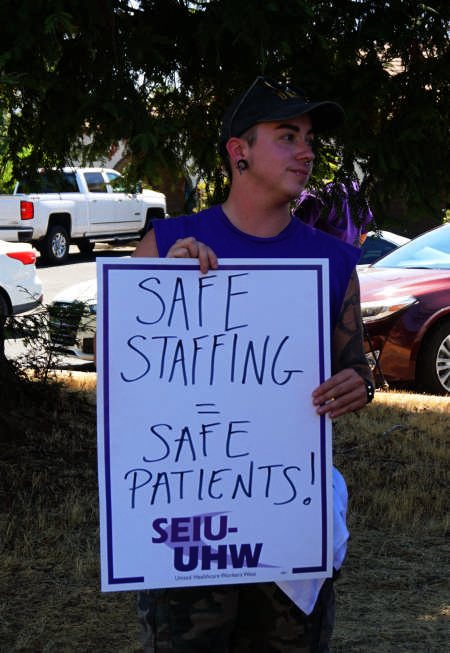
SEIU-United Healthcare Workers West members, now in negotiations with Sutter Health for a new contract, picketed at Sutter Lakeside Hospital in Lakeport, California, on Tuesday, August 12, 2025, to bring attention to concerns including staffing levels and and patient safety. Photo by Elizabeth Larson/Lake County News.

LAKEPORT, Calif. — Frontline care workers from Sutter Lakeside and other Sutter Health hospitals gathered on Tuesday to hold a picket to advocate for better working conditions for staff and increased service for patients, with hospital leadership responding with assurances of their commitments to patient care and staff.

The picket took place from 11:30 a.m. to 1 p.m. Tuesday in the Sutter Lakeside Hospital complex, on property owned by Quest Diagnostics.

Staff with SEIU-United Healthcare Workers West held signs and waved at honking visitors in the middle of the Tuesday heat.

They also chanted. 

“What do we want?” 

“One contract!”

“When do we want it?”

“Now!”

Sutter Lakeside, hailed as “tiny but mighty” by its staff, is facing key issues such as staffing cuts and what they emphasized are unsafe staffing levels, cutting of services and corporate greed, with six chief executive officers in the Sutter system making over $1 million each.

Staff also are concerned about what’s ahead for the hospital in light of deep federal cuts to Medicaid passed by Congress earlier this year. They said that they are not receiving a clear picture of the hospital’s future and communications with hospital leadership are very poor.

Victoria Halvorsen has worked at Sutter Lakeside for nine years. She previously worked in the emergency room and now serves as the physical therapy department coordinator.

“We need help here,” said Halvorsen, adding that the hospital’s front line workers make the money to pay those CEOs.

Halvorsen worries that the cuts to Medicaid — which in California is known as Medi-Cal — will have a heavy impact on Sutter Lakeside, which is one of the only hospitals to accept that funding for physical therapy. 

“It is going to hit these hospitals,” she said.

Halvorsen and Andy Hurt, who works in the emergency room at Sutter Santa Rosa, Sutter Lakeside’s sister hospital, raised issues of unsafe staffing.

Andy Hurt, who works in the emergency department at Sutter Santa Rosa, made the trip over to Sutter Lakeside Hospital in Lakeport, California, on Tuesday, August 12, 2025, to take part in a rolling picket across Sutter facilities. Photo by Elizabeth Larson/Lake County News.

Hurt said Sutter Lakeside is the first contact for the northern part of the Sutter Health hospital system. It stabilizes patients before moving them to the next hospital. “We are so thankful for Lakeside.”

“We want the best care for our communities and our patients,” said Halvorsen, adding that their patients are their family.

Hurt said sometimes they take care of their patients their entire lives.

Halvorsen, who has seen the hospital so busy that patients were lined up in the hallways, pointed to particular concerns in her department. She said respiratory therapists have to stay with patients and can't leave them, and that there have been instances where there has only been one therapist for multiple patients, causing them to have to make decisions about who to care for. 

“How do you live with having to pick and choose?” Halvorsen asked.

She said there were instances in which therapists had to stay on duty for 16 to 24 hours because they couldn't leave a patient.

Hurt also pointed to the need for ancillary staff for cleaning, and for specific cleaning such as after tuberculosis patients, and not having that kind of help available.

While staff raised issues with quality of care, Sutter Lakeside leadership told Lake County News in an emailed statement afterward, “Our hospital has received a five-star rating for overall hospital quality from the Centers for Medicare & Medicaid Services (CMS) and multiple ‘A’ grades from The Leapfrog Group for hospital safety — recognitions that reflect our commitment to preventing errors and ensuring patient well-being and placing us among the top 10% of hospitals nationwide.”

Regarding the concerns about respiratory therapy, staffing levels and safety, the hospital said it’s “committed to providing the highest standard of care, including ensuring that respiratory therapists and all clinical staff have the support they need to care for patients safely and effectively. Staffing is continuously monitored and adjusted to meet patient needs, and we follow strict protocols to prioritize patient safety at all times. We also offer clear and accessible channels for staff to surface their concerns directly to leadership so they can be addressed.”

Union officials said they started negotiations with Sutter on July 24. The last time they ended negotiations on a contract was in December 2021, and those had required a federal negotiator to bring them to a conclusion.

As she watched staff come out on their breaks to join her and her fellow picketers, Halvorsen said, “I am so proud of this little facility.”

A picket took place at Sutter Santa Rosa on Monday. In addition to Santa Rosa and Lakeport, rolling pickets are planned across six more Sutter facilities into next week. 

They include Sutter Solano in Vallejo, 10 a.m. to 2:30 p.m. Thursday, Aug. 14; Alta Bates, Berkeley, 10 a.m. to 4 p.m., Monday, Aug. 18; Roseville, 10 a.m. to 2 p.m., Tuesday, Aug. 19; California Pacific Medical Center, San Francisco, 10 a.m. to 2 p.m. Thursday, Aug. 21; Sutter Eden, Castro Valley, 10 a.m. to 4 p.m. Friday, Aug. 22; and Sutter Delta, Antioch, 10 a.m. to 4 p.m., Monday, Aug. 25.

Email Elizabeth Larson at This email address is being protected from spambots. You need JavaScript enabled to view it.. Follow her on Twitter, @ERLarson, and on Bluesky, @erlarson.bsky.social. Find Lake County News on the following platforms: Facebook, @LakeCoNews; X, @LakeCoNews; Threads, @lakeconews, and on Bluesky, @lakeconews.bsky.social. 

SEIU-United Healthcare Workers West members picket at Sutter Lakeside Hospital in Lakeport, California, on Tuesday, August 12, 2025. Photo by Elizabeth Larson/Lake County News.

Guenoc Valley resort project clears Planning Commission, advances to supervisors

The Guenoc Valley resort site, as shown in county planning documents. Photo courtesy of the county of Lake.


LAKE COUNTY, Calif. — The Lake County Planning Commission on Friday took a major step that moves the Guenoc Valley project forward, approving the new environmental impact report and most permit requests for the large-scale, mixed-use resort and residential development project near Middletown.

The Guenoc Valley Mixed Use Planned Development Project is a luxury destination that at full buildout will include up to 400 hotel rooms, 450 resort residential units, 1,400 residential estates and 500 workforce co-housing units on a portion of the 16,000-acre, 82-parcel Guenoc property, according to the staff report.

The commission certified the project’s updated environmental impact report addressing wildfire risks and evacuation plans, and approved most of its permits and amendment requests, including zoning changes to create a new district for mixed-use development.

However, a motion to rezone part of the project’s Santa Clara site from single-family residential to two-family residential ended in a tie vote. Commissioners Everardo Chavez Perez and Batsulwin Brown supported the rezoning, while Monica Rosenthal and Sharron Zoller opposed it. Commissioner Maile Field was absent for the vote.

“I would prefer not to see the change in density,” said Rosenthal, citing the county’s newly approved housing plan, which aims to reduce the area’s housing density to 2.39 people per house in the next two decades. 

“So I have to question why we are proposing four and five bedroom units, and I'd very much like to see that in conformity with the current Middletown Area Plan,” she added.

Deputy County Counsel Nicole Johnson said that the tie vote amounts to an "automatic denial,” and triggers an appeal to the Board of Supervisors, which will hold a public hearing on the project Aug. 26.

Developer Jonathan Breene, one of the project’s three main partners, told commissioners the project could generate $3.8 billion in economic benefits for Lake County over 25 years, including $2.47 billion in labor income, $635 million in local taxes and $212 million in state taxes. It would also create an estimated 2,688 jobs annually.

Plans also include building a fire station operated by Cal Fire and five emergency refuge points. 

Kathleen Cutter, wildfire mitigation specialist at UC Berkeley, said onsite facilities and personnel will be essential during fires. “The response time is just a game changer,” she said. 

The project applicant, San Francisco-based Lotusland Investment Holdings, has owned the property since 2016. Its owner, Chinese developer Yiming Xu, moved from China to Canada in 1996. Since the early 2000s, he has been involved in various real estate and luxury resort developments in China. 

According to the project’s official website, the Guenoc Valley project development is now led by Breene, Indonesian hotelier Adrian Zecha and Yiming Xu’s son, Alex Xu.

Shifting community attitudes

The Planning Commission first discussed the project on July 24 but requested more time for review. Between that meeting and Friday’s vote, some commissioners and community representatives toured the site during visits organized by the developer, as they disclosed. 

Unlike in July — where commissioners, local agency representatives and residents mainly voiced concerns about the project over wildfire risks — Friday’s meeting brought mostly support for the project, with no broad objection, though some resistance remained to the higher-density housing proposal.

As she did at the previous meeting, Rev. Julia Bono of Rainbow Church in Middletown “vehemently” opposed the worker co-housing site proposed for Santa Clara Avenue as part of the project, citing the higher-density proposal’s incompatibility with the community’s strong preference for low density, single-family residential character of the town. 

Middletown Rancheria Vice Chair Larry Galupe voiced support for the project during public comment. It’s important to continue the conversations about development on the “culturally sensitive sites” for all the tribes, he said. “But I’m very excited about the opportunity of what could happen here for Lake County too.”

Farm Bureau Executive Director Rebecca Harper — who in July spoke against the project’s “significant and unavoidable impact” rezoning 325 acres of farmland — said that she had met with the developer representatives and many of the concerns were addressed. 

“A very minimal amount of the agricultural land that's proposed for rezoning will be intensively developed; the majority will remain in ag use,” Harper said during public comment. 

Harper also said that the project’s current mitigation measure to offset the loss of agricultural land on other parcels within 100 miles is too broad. “We believe that mitigation should be limited to land within Lake County.”

Questions about local ties and donations

Commissioner Field asked if the developer had made any donations to local communities, specifically mentioning the Lake County Chamber of Commerce. 

“The reason I’m asking is I hear things in the community and I want to hear it from the source,” Field said. 

Breene replied that Lotusland’s only significant local donation was $1 million in 2017 to assist with post-Valley Fire rebuilding. 

Lake County News reported at the time that the donation went to Hope City, a ministry of the faith-based Hope Crisis Response Network in partnership with a number of area churches. 

On the same day as Hope City received the call about Xu wanting to make a donation, Xu and the principals of his company introduced themselves and shared their early vision for the Guenoc Valley project over a dinner at Langtry House for dozens of community leaders.

Responding further to Field’s questions, Kevin Case, a partner with the developer, said they joined the Chamber of Commerce about three months ago. 

“If it's a donation, we sponsored an event at the Greenview golf club that was asked of us,” Case said, adding that they have also been to several auctions and donated money for auctions “for South Lake Fire, primarily, and for Cal Fire and those fundraisers.” 

“Everything’s done in a very ethical and legal manner. So I just want to go on record where we're not reckless at all with that; we're very, very calculated and do it the right way,” Case said. 

The discussion at the meeting did not include specific dollar amounts for these activities. 

End of legal fights?

By the end of August, the project will go before the Board of Supervisors — once again. 

The board first approved the project’s initial Environmental Impact Report, or EIR, in July 2020. 

Just two months later, the Center for Biological Diversity and the California Native Plant Society sued the county over the project, with the California Attorney General’s Office intervening in support of them. 

In January, 2022, Lake County Superior Court Judge J. David Markham ruled that the EIR was inadequate in its community evacuation analysis. 

The Center for Biological Diversity appealed the case, and in October 2024, the California First District Appellate Court ruled that a new EIR must be prepared as the previous document didn’t disclose the project’s wildfire ignition risks.

On July 25 of this year, the Attorney General’s Office issued a letter to Lotusland, intending to confirm that the developer has addressed the wildfire risk and evacuation requirements laid out in a January 2023 settlement agreement.

Then on Thursday — the day before the Planning Commission's vote — the developer and the two environmental groups announced a habitat conservation agreement to protect 3,717 acres of the Guenoc property, alongside implementation of measures to reduce greenhouse gas emissions, with $2 million for additional off-site conservation.

At Friday’s meeting, the developer’s attorney, Robert Hodil, said the agreement means these acreage “will not be developed as part of this project and [will be] preserved in perpetuity, " responding to Lake County News’ question during public comment. 

Does this agreement mean the end of legal challenges to the project?

“The groups have agreed not to pursue legal action to challenge Phase 1 of the project, which is the phase of the project that’s up for approval,” said Peter Broderick, urban wildlands legal director and senior attorney for the Center for Biological Diversity, in a phone call with Lake County News.

It does not guarantee the same for future phases, he said. 

Email staff reporters Lingzi Chen at This email address is being protected from spambots. You need JavaScript enabled to view it..

  • 170
  • 171
  • 172
  • 173
  • 174
  • 175
  • 176
  • 177
  • 178
  • 179

Community

  • Sheriff’s Activities League and Clearlake Bassmasters offer youth fishing clinic

  • City Nature Challenge takes place April 24 to 27

Public Safety

  • Lakeport Police logs: Wednesday, Feb. 11

  • Lakeport Police logs: Tuesday, Feb. 10

Education

  • Ramos measure requiring school officer training in use of anti-opioid drug moves forward

  • Lake County Chapter of CWA announces annual scholarships 

Health

  • California ranks 24th in America’s Health Rankings Annual Report from United Health Foundation

  • Healthy blood donors especially vital during active flu season

Business

  • Employment law summit takes place March 9

  • Two Lake County Mediacom employees earn company’s top service awards

Obituaries

  • Terry Knight

  • Ellen Thomas

Opinion & Letters

  • Who should pay for AI’s power? Not California ratepayers

  • Crandell: Supporting nephew for reelection in supervisorial race

Veterans

  • State honors fallen chief warrant officer killed in conflict in Iran

  • CalVet and CSU Long Beach team up to improve data collection related to veteran suicides

Recreation

  • April Audubon program will show how volunteers can help monitor local osprey nests

  • First guided nature walk of spring at Anderson Marsh State Historic Park April 11

  • Second Saturday guided nature walks continue at Anderson Marsh State Historic Park

  • Wet weather trail closure in effect on Upper Lake Ranger District

Religion

  • Kelseyville Presbyterian Church plans Easter service

  • Easter ‘Sonrise’ Service returns to Xabatin Community Park

Arts & Life

  • ‘CIA’ delves into the shadowy world of an espionage thriller

  • ‘War Machine’ shifts the battlefield into uncharted territory

Government & Politics

  • Lake County Democratic Central Committee endorses Falkenberg

  • Crandell launches reelection campaign plans March 15 event

Legals

  • April 23 hearing on Lake Coco Farms Major Use Permit

  • NOTICE OF 30-DAY PUBLIC COMMENT PERIOD & NOTICE OF PUBLIC HEARING

How to resolve AdBlock issue?

Refresh this page