How to resolve AdBlock issue?
Refresh this page
Lake County News,California
  • Home
    • Registration Form
  • News
    • Education
    • Veterans
    • Community
      • Obituaries
      • Letters
      • Commentary
    • Police Logs
    • Business
    • Recreation
    • Health
    • Religion
    • Legals
    • Arts & Life
    • Regional
  • Calendar
  • Contact us
    • FAQs
    • Phones, E-Mail
    • Subscribe
  • Advertise Here
  • Login
How to resolve AdBlock issue?
Refresh this page

News

For America’s 35M small businesses, tariff uncertainty hits especially hard


Imagine it’s April 2025 and you’re the owner of a small but fast-growing e-commerce business. Historically, you’ve sourced products from China, but the president just announced tariffs of 145% on these goods. Do you set up operations in Thailand – requiring new investment and a lot of work – or wait until there’s more clarity on trade? What if waiting too long means you miss your chance to pull it off?

This isn’t a hypothetical – it’s a real dilemma faced by a real business owner who spoke with one of us over coffee this past spring. And she’s not alone. As of 2023, of those U.S. companies that import goods, more than 97% of them were small businesses. For these companies, tariff uncertainty isn’t just frustrating – it’s paralyzing.

As a family business researcher and former deputy administrator of the U.S. Small Business Administration and entrepreneur, we hear from a lot of small-business owners grappling with these challenges. And what they tell us is that tariff uncertainty is stressing their time, resources and attention.

The data backs up our anecdotal experience: More than 70% of small-business owners say constant shifts in trade policy create a “whiplash effect” that makes it difficult to plan, a recent national survey showed.

Unlike larger organizations with teams of analysts to inform their decision-making, small-business owners are often on their own. In an all-hands-on-deck operation, every hour spent focusing on trade policy news or filling out additional paperwork means precious time away from day-to-day, core operations. That means rapid trade policy shifts leave small businesses especially at a disadvantage.

Planning for stability in an uncertain landscape

Critics and supporters alike can agree: The Trump administration has taken an unpredictable approach to trade policy, promising and delaying new tariffs again and again. Consider its so-called “reciprocal” tariffs. Back in April, Trump pledged a baseline 10% tariff on imports from nearly everywhere, with extra hikes on many countries. Not long afterward, it hit pause on its plans for 90 days. That period just ended, and the administration followed up with a new executive order on July 31 naming different tariff rates for about 70 countries. The one constant has been change.

Bloomberg TV covers the administration’s “surprise announcements” on trade the day before a key self-imposed deadline.

This approach has upended long-standing trade relationships in a matter of days or weeks. And regardless of the outcomes, the uncertainty itself is especially disruptive to small businesses. One recent survey of 4,000 small-business owners found that the biggest challenge of tariff policies is the sheer uncertainty they cause.

This isn’t just a problem for small-business owners themselves. These companies employ nearly half of working Americans and play an essential role in the U.S. economy. That may partly explain why Americans overwhelmingly support small businesses, viewing them as positive for society and a key path for achieving the American dream. If you’re skeptical, just look at the growing number of MBA graduates who are turning down offers at big companies to buy and run small businesses.

But this consensus doesn’t always translate into policies that help small businesses thrive. In fact, because small businesses often operate on thinner margins and have less capacity to absorb disruptions, any policy shift is likely to be more difficult for them to weather than it would be for a larger firm with deeper pockets. The ongoing tariff saga is just the most recent example.

Slow, steady policies help small-business owners

Given these realities, we recommend the final negotiated changes to trade policy be rolled out slowly. Although that wouldn’t prevent businesses from facing supply chain disruptions, it would at least give them time to consider alternate suppliers or prepare in other ways. From the perspective of a small-business owner, having that space to plan can make a real difference.

Similarly, if policymakers want to bring more manufacturing back to the U.S., tariffs alone can accomplish only so much. Small manufacturers need to hire people, and with unemployment at just over 4%, there’s already a shortage of workers qualified for increasingly high-skilled manufacturing roles.

Making reshoring a true long-term policy objective would require creating pathways for legal immigration and investing significantly in job training. And if the path toward reshoring is more about automation than labor, then preparing small-business owners for the changes ahead and helping them fund growth strategically will be crucial.

Small businesses would benefit from more government-backed funding and training. The Small Business Administration is uniquely positioned to support small firms as they adjust their supply chains and manufacturing – it could offer affordable financing for imports and exports, restructure existing loans that small businesses have had to take on, and offer technical support and education on new regulations and paperwork. Unfortunately, the SBA has slashed 43% of its workforce and closed offices in major cities including Atlanta, Chicago, Denver, New Orleans and Los Angeles. We think this is a step in the wrong direction.

Universities also have an important role to play in supporting small businesses. Research shows that teaching core management skills can improve key business outcomes, such as profitability and growth. We recommend business and trade schools increase their focus on small firms and the unique challenges they face. Whether through executive programs for small-business owners or student consulting projects, universities have a significant opportunity to lean into supporting Main Street entrepreneurs.

Thirty-five million small businesses are the engine of the U.S. economy. They are the job creators in cities and towns across this country. They are the heartbeat of American communities. As the nation undergoes rapid and profound policy shifts, we encourage leaders in government and academia to take action to ensure that Main Streets across America not only endure but thrive.

The authors would like to thank Gretchen Abraham and Matt Sonneborn for their support.The Conversation

Peter Boumgarden, Professor of Family Enterprise, Washington University in St. Louis and Dilawar Syed, Associate Professor of Instruction, Department of Business, Government and Society, The University of Texas at Austin

This article is republished from The Conversation under a Creative Commons license. Read the original article.


Thompson leads group seeking support for universal background checks

Following the mass shooting in a Midtown Manhattan office building in late July, Gun Violence Prevention Task Force Chairman Mike Thompson (CA-04), Democratic Leader Hakeem Jeffries (NY-08), and Representative Jerrold Nadler (NY-12) led the New York Democratic delegation in a letter on Friday calling on every Republican representing New York in Congress to back universal background checks.  

In their letter, the lawmakers called on Representatives Nick LaLota (NY-01), Andrew Garbarino (NY-02), Nicole Malliotakis (NY-11), Mike Lawler (NY-17), Elise Stefanik (NY-21), Nick Langworthy (NY-23), and Claudia Tenney (NY-24) to sign on in support of Rep. Thompson’s bipartisan legislation establishing universal background checks for firearm purchases. 

“Every day, background checks stop more than 160 felons and some 50 domestic abusers from getting a gun from a federally licensed dealer. Unfortunately, in some states, those same prohibited purchasers can go to an unlicensed dealer and get a firearm without a background check,” wrote the lawmakers. 

“Importantly, this bill would make no changes for New Yorkers’ access to firearms as New York already has a strong universal state background law. The bill would reduce the flow of guns trafficked into New York and used by felons, domestic abusers and those with mental illnesses who are a danger to themselves or others. Over 80 percent of the guns traced at crime scenes in New York by the ATF originate from outside of New York with the most guns coming from Georgia.

“The Bipartisan Background Checks Act of 2025 is a commonsense approach supported by more than 80 percent of Republicans and 77 percent of self-described Second Amendment supporters in America. The bill would require that every sale of a firearm include a background check,” continued the lawmakers. 

The lawmakers went on to urge all Republican members representing constituents who live and work in New York City to cosponsor the bill en bloc on the one-month anniversary of the Manhattan mass shooting on August 28th.

Gun Violence Prevention Task Force Chairman Mike Thompson has introduced background check legislation every Congress since the 2012 Sandy Hook Elementary shooting, which killed 20 children and six adult staff members. The Bipartisan Background Checks Act of 2025 (H.R. 18) is endorsed by 205 Members of Congress. 

Endorsing organizations for H.R. 18 include: GIFFORDS, Brady, Everytown for Gun Safety, March For Our Lives, Newtown Action Alliance, Sandy Hook Promise, and Equality California.

Representatives Mike Thompson (CA-04), Jerrold Nadler (NY-12), Hakeem Jeffries (NY-08), Timothy Kennedy (NY-26), Dan Goldman (NY-10), Grace Meng (NY-06), Patrick Ryan (NY-18), Paul Tonko (NY-20), Alexandria Ocasio-Cortez (NY-14), Ritchie Torres (NY-15), Gregory Meeks (NY-05), Yvette Clarke (NY-09), Adriano Espaillat (NY-13), and Nydia Velázquez (NY-07) signed onto the letter. 

Read the full letter below. 

Dear Congressman LaLota, Congressman Garbarino, Congresswoman Malliotakis, Congressman Lawler, Congresswoman Stefanik, Congressman Langworthy and Congresswoman Tenney,

In the wake of the deadliest mass shooting in New York City in 25 years, we invite you to cosponsor H.R. 18, the Bipartisan Background Checks Act of 2025.

As you may know, current law requires every federally licensed dealer to run a background check on every gun they sell. There is proof these background checks work. Every day, background checks stop more than 160 felons and some 50 domestic abusers from getting a gun from a federally licensed dealer. Unfortunately, in some states, those same prohibited purchasers can go to an unlicensed dealer and get a firearm without a background check.

Importantly, this bill would make no changes for New Yorkers’ access to firearms as New York already has a strong universal state background law. The bill would reduce the flow of guns trafficked into New York and used by felons, domestic abusers and those with mental illnesses who are a danger to themselves or others. Over 80 percent of the guns traced at crime scenes in New York by the ATF originate from outside of New York with the most guns coming from Georgia.

The Bipartisan Background Checks Act of 2025 is a commonsense approach supported by more than 80 percent of Republicans and 77 percent of self-described Second Amendment supporters in America. The bill would require that every sale of a firearm include a background check. The bill includes exemptions for family transfers and temporary hunting transfers.

We understand the sensitivities around gun violence legislation and urge members representing constituents who live and work in New York City to cosponsor the bill en bloc on the one-month anniversary of the Manhattan mass shooting on August 28th.

To join as a cosponsor contact Rep. Mike Thompson’s office. Thank you for your consideration.

Thompson representS California’s Fourth Congressional District, which includes all or part of Lake, Napa, Solano, Sonoma and Yolo counties. 

Lucerne Elementary celebrates new playground ahead of start of school

Children enjoy  the new playground equipment at Lucerne Elementary School on Thursday, August 8, 2025. Photo by Elizabeth Larson/Lake County News.

LAKE COUNTY, Calif. — As school gets ready to start this week, Lucerne Elementary School District has introduced its latest campus improvement project.

On Thursday, school leaders, staff and families gathered at the campus for a ribbon cutting for its newly renovated playground, which features a new play structure.

Children blew bubbles and admired the playground’s steps and slide while munching on frosted cookies with the school mascot, an eagle, in the school’s colors of blue and white.

The playground structure, which is seated on artificial turf that will help keep the area cleaner and safer, cost approximately $648,233, said Superintendent/Principal Megan Grant.

The funds came from Measure A, a 2016 school bond approved by Lucerne voters by a margin of 71.16 to 28.84 percent.

Lucerne Elementary Superintendent/Principal Megan Grant thanks the community, teachers and staff at the dedication of the new playground equipment at Lucerne Elementary School on Thursday, August 8, 2025. Photo by Elizabeth Larson/Lake County News.


Measure A provided the district with $4 million to conduct needed upgrades to the campus.

Grant said the bond funded three new classroom buildings — for a total of six classrooms — plus the playground.

She credited the community for supporting the bond, and the school board and the bond committee for their work to carry out the bond’s requirements.

““Our school is truly a special place and this is going to be an incredible edition,” Grant said.

Grant said it’s not just a playground, but a place to come together.

She reminded students that it will be up to them to help care for it.

School Board member Elise Jones, whose four children attended school in Lucerne, said it was easy to make the decisions related to the bond.

Another school board member, Nicole Zwinge, whose three children also attended Lucerne Elementary, then stepped up with a pair of large ceremonial scissors to cut the blue ribbon before the children charged up to start enjoying the playground.

Children wait to try out the new playground equipment at Lucerne Elementary School on Thursday, August 8, 2025. Photo by Elizabeth Larson/Lake County News.

Grant told Lake County News that the bond funds have been expended, although there are still some projects to complete.

Those include the construction of a storage building on 17th Avenue and the planned resurfacing of the rest of the playground and parking lot. 

The new playground is ready just in time for school, which begins on Wednesday. 

Grant said she didn’t have firm enrollment numbers yet, but students at the start of the school year are expected to total about 285.

Editor’s note: Editor Elizabeth Larson is a member of Lucerne Elementary’s bond oversight committee.

Email Elizabeth Larson at This email address is being protected from spambots. You need JavaScript enabled to view it.. Follow her on Twitter, @ERLarson, and on Bluesky, @erlarson.bsky.social. Find Lake County News on the following platforms: Facebook, @LakeCoNews; X, @LakeCoNews; Threads, @lakeconews, and on Bluesky, @lakeconews.bsky.social. 

The new storage district storage building on 17th Avenue in Lucerne, California. Photo by Elizabeth Larson/Lake County News.


Sutter Lakeside Hospital responds to union’s picket plan

LAKEPORT, Calif. — As health care workers plan to picket at its campus on Tuesday, Sutter Lakeside Hospital leadership said it’s disappointed in the action in the midst of negotiations for a new contract.

The picket will take place from 11:30 a.m. to 1 p.m. Tuesday at Sutter Lakeside Hospital in Lakeport.

SEIU-United Healthcare Workers West said frontline health care workers represented by the union — from nursing assistants, respiratory therapists and licensed vocational nurses, to cooks and technicians — will hold protests at Sutter Lakeside Hospital and seven other Sutter hospitals and medical Centers across California on Tuesday in response to short staffing and wages that don’t keep up with inflation.

In response to the action, Sutter Lakeside issued a statement to Lake County News in which it noted, “We are disappointed by SEIU’s decision to prioritize public demonstrations over engaging in constructive dialogue.”The statement continued, “The union announced pickets after just one week of bargaining. Sutter Health is focused on reaching a fair and equitable agreement through good-faith negotiations at the bargaining table, and we believe that isn’t achieved through unproductive picket lines.

“While we respect the right to demonstrate, these pickets are not impacting patient care. Our hospitals and clinics remain open and fully operational, and we continue to provide safe, high-quality care to the communities we serve. We remain focused on reaching a fair agreement through continued collaboration at the bargaining table.” 

If the protest goes forward in Lakeport, it would be the first time such an action has taken place at the hospital in over three years.

Wildfire season is starting weeks earlier in California – a new study shows how climate change is driving the expansion

Firefighters battle in Pacific Palisades, Calif., on Jan. 7, 2025. David Swanson/AFP via Getty Images

Fire season is expanding in California, with an earlier start to wildfire activity in most of the state. In parts of the northern mountains, the season is now starting more than 10 weeks earlier than it did in the 1990s, a new study shows.

Atmospheric scientists Gavin Madakumbura and Alex Hall, two authors of the study, explain how climate warming has been driving this trend and why the trend is likely to continue.

What did your study find about how wildfire season is changing?

Over the past three decades, California has seen a trend toward more destructive wildfire seasons, with more land burned, but also an earlier start to fire season. We wanted to find out how much of a role climate change was playing in that shift to an earlier start.

We looked at hundreds of thousands of fire records from 1992 to 2020 and documented when fire season started in each region of the state as temperatures rose and vegetation dried out.

While other research has observed changes in the timing of fire season in the western U.S., we identified the drivers of this trend and quantified their effects.

The typical onset of summer fire season, which is in May or June in many regions, has shifted earlier by at least one month in most of the state since the 1990s, and by about 2½ months in some regions, including the northern mountains. Of that, we found that human-caused climate change was responsible for advancing the season between six and 46 days earlier across most of the state from 1992 to 2020.

Our results suggest that as climate warming trends continue, this pattern will likely persist, with earlier starts to fire season in the coming years. This means longer fire seasons, increasing the potential for more of the state to burn.

California typically leads the nation in the number of wildfires, as well as the cost of wildfire damage. But the results also provide some insight into the risks ahead for other fire-prone parts of North America.

What’s driving the earlier start to fire season?

There are a few big contributors to long-term changes in wildfire activity. One is how much fuel is available to burn, such as grasses and trees. Another is the increase in ignition sources, including power lines, as more people move into wildland areas. A third is how dry the fuel is, or fuel aridity.

We found that fuel aridity, which is controlled by climate conditions, had the strongest influence on year-to-year shifts in the timing of the onset of fire season. The amount of potential fuel and increase in ignition sources, while contributing to fires overall, didn’t drive the trend in earlier fires.

Year-to-year, there will always be some natural fluctuations. Some years are wet, others dry. Some years are hotter than others. In our study, we separated the natural climate variations from changes driven by human-caused climate warming.

We found that increased temperatures and vapor pressure deficit – a measure of how dry the air is – are the primary ways climate warming is shifting the timing of the onset of fire season.

Just as a warmer, drier year can lead to an earlier fire season in a single year, gradual warming and drying caused by climate change are systematically advancing the start of fire seasons. This is happening because it is increasing fuel flammability.

Why has the start to fire season shifted more in some regions than others?

The biggest shifts we’ve seen in fire season timing in California have been in the northern mountains.

In the mountains, the winter snowpack typically keeps the ground and forests wet into summer, making it harder for fires to burn. But in warmer years, when the snowpack melts earlier, the fire potential rises earlier too.

A map of California shows where fires season is starting earlier. Most of the state is starting at least 1 days per year earlier now.
Gavin Madakumbura, et al., Science Advances, 2025

Those warmer years are becoming more common. The reason climate change has a stronger impact in mountain regions is that snowpack is highly sensitive to warming. And when it melts sooner, vegetation dries out sooner.

In contrast, drier regions, such as desert ecoregions, are more sensitive to precipitation changes than to temperature changes. When assessing the influence of climate change in these areas, we mainly look at whether precipitation patterns have shifted due to climate warming. However, there is a lot of natural year-to-year variability in precipitation, and that makes it harder to identify the influence of climate change.

It’s possible that when precipitation changes driven by climate warming become strong enough, we may detect a stronger effect in these regions as well.The Conversation

Gavin D. Madakumbura, Postdoctoral Researcher, University of California, Los Angeles and Alex Hall, Professor and Director, UCLA Center for Climate Science, University of California, Los Angeles, University of California, Los Angeles

This article is republished from The Conversation under a Creative Commons license. Read the original article.

Report: Pups confirmed in only three of California’s 10 wolf packs

Lassen pack wolf pups seen in 2017. Photo by California Department of Fish and Wildlife. Image is available for media use.

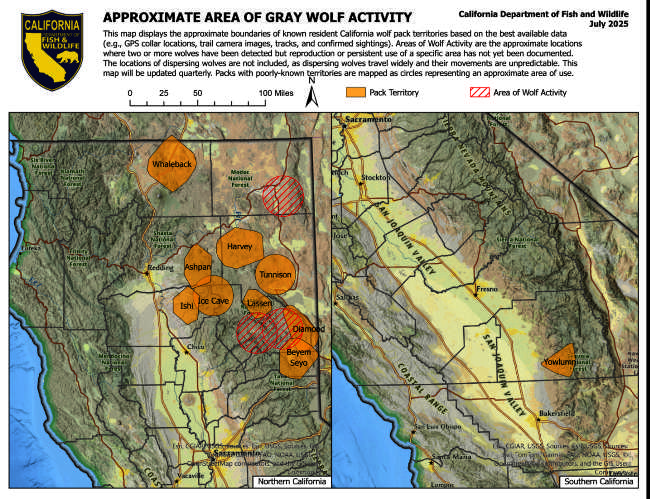
Only three of California’s 10 known wolf families have produced pups this year, according to the California Department of Fish and Game’s quarterly update, which details known wolf information from April through June. 

The department also issued a new report, which includes updated information through July.

“I’m glad to know at least three of California’s wolf families had pups this year but it’s concerning that there’s no indication the other seven packs have had pups,” said Amaroq Weiss, a senior wolf advocate at the Center for Biological Diversity. “Wolf recovery here is still in its infancy and for recovery to stay on track there need to be more wolves in more places.”

The agency’s updates, published Friday, said the Harvey pack had at least seven pups this year, the Beyem Seyo pack had a minimum of six pups and the Whaleback pack produced at least nine pups.

No indication of reproduction was indicated for the Ashpan, Diamond, Ice Cave, Ishi, Lassen, Tunnison or Yowlumni packs. 

Previously, the Lassen pack had litters each year from 2017 to 2024 and the Yowlumni pack had litters in 2023 and 2024.

On Friday the department also released an updated map of each of the 10 known packs’ territories, and additional areas of wolf activity where wolves have been repeatedly spotted but don’t yet qualify as packs. 

The packs and additional wolves live in portions of seven counties: Siskiyou, Lassen, Plumas, Sierra, Shasta, Tehama and Tulare.

During the second quarter of 2025, one male wolf from the Beyem Seyo pack made his way into Oregon. And a female Beyem Seyo wolf roamed several hundred miles south to join up with the Yowlumni pack in Tulare County. Two wolves of unknown origin were detected separately in the Tehachapi Mountains in Kern County.

Wolves are fully protected in California under the federal Endangered Species Act and under California’s own endangered species act.

The reestablishment of wolves in California after a nearly 100-year absence began when wolf OR-7, a radio-collared wolf born in northeast Oregon, made his way across that state in late 2011 and entered California. One of his daughters is a founding member of the Yowlumni pack in Tulare County.

“We hope it turns out more packs had litters this year than the department has been able to confirm so far,” said Weiss. “Wolf recovery in California affirms that when adequate legal protections are in place, even a species that’s been gone for nearly 100 years can return.”


  • 171
  • 172
  • 173
  • 174
  • 175
  • 176
  • 177
  • 178
  • 179
  • 180

Community

  • Sheriff’s Activities League and Clearlake Bassmasters offer youth fishing clinic

  • City Nature Challenge takes place April 24 to 27

Public Safety

  • Lakeport Police logs: Wednesday, Feb. 11

  • Lakeport Police logs: Tuesday, Feb. 10

Education

  • Ramos measure requiring school officer training in use of anti-opioid drug moves forward

  • Lake County Chapter of CWA announces annual scholarships 

Health

  • California ranks 24th in America’s Health Rankings Annual Report from United Health Foundation

  • Healthy blood donors especially vital during active flu season

Business

  • Employment law summit takes place March 9

  • Two Lake County Mediacom employees earn company’s top service awards

Obituaries

  • Terry Knight

  • Ellen Thomas

Opinion & Letters

  • Who should pay for AI’s power? Not California ratepayers

  • Crandell: Supporting nephew for reelection in supervisorial race

Veterans

  • State honors fallen chief warrant officer killed in conflict in Iran

  • CalVet and CSU Long Beach team up to improve data collection related to veteran suicides

Recreation

  • April Audubon program will show how volunteers can help monitor local osprey nests

  • First guided nature walk of spring at Anderson Marsh State Historic Park April 11

  • Second Saturday guided nature walks continue at Anderson Marsh State Historic Park

  • Wet weather trail closure in effect on Upper Lake Ranger District

Religion

  • Kelseyville Presbyterian Church plans Easter service

  • Easter ‘Sonrise’ Service returns to Xabatin Community Park

Arts & Life

  • ‘CIA’ delves into the shadowy world of an espionage thriller

  • ‘War Machine’ shifts the battlefield into uncharted territory

Government & Politics

  • Lake County Democratic Central Committee endorses Falkenberg

  • Crandell launches reelection campaign plans March 15 event

Legals

  • April 23 hearing on Lake Coco Farms Major Use Permit

  • NOTICE OF 30-DAY PUBLIC COMMENT PERIOD & NOTICE OF PUBLIC HEARING

How to resolve AdBlock issue?
Refresh this page