How to resolve AdBlock issue?
Refresh this page
Lake County News,California
  • Home
    • Registration Form
  • News
    • Education
    • Veterans
    • Community
      • Obituaries
      • Letters
      • Commentary
    • Police Logs
    • Business
    • Recreation
    • Health
    • Religion
    • Legals
    • Arts & Life
    • Regional
  • Calendar
  • Contact us
    • FAQs
    • Phones, E-Mail
    • Subscribe
  • Advertise Here
  • Login
How to resolve AdBlock issue?
Refresh this page

News

Clearlake Animal Control: ‘Happy’ and the dogs

“Happy.” Photo courtesy of Clearlake Animal Control.


CLEARLAKE, Calif. — Clearlake Animal Control has dozens of dogs needing new homes.

The shelter has 48 adoptable dogs listed on its website.

This week’s dogs include “Happy,” a male pit bull terrier mix with a short black and white coat.

The shelter is located at 6820 Old Highway 53. It’s open from 9 a.m. to 6 p.m. Tuesday through Saturday. 

For more information, call the shelter at 707-762-6227, email This email address is being protected from spambots. You need JavaScript enabled to view it., visit Clearlake Animal Control on Facebook or on the city’s website.

This week’s adoptable dogs are featured below.

Email Elizabeth Larson at This email address is being protected from spambots. You need JavaScript enabled to view it.. Follow her on Twitter, @ERLarson, and on Bluesky, @erlarson.bsky.social. Find Lake County News on the following platforms: Facebook, @LakeCoNews; X, @LakeCoNews; Threads, @lakeconews, and on Bluesky, @lakeconews.bsky.social. 

Vaccines hold tantalizing promise in the fight against dementia

Researchers are in the earliest phase of piecing together how the shingles vaccine could play a role in lowering the risk of dementia. PM Images/DigitalVision via Getty Images

Over the past two centuries, vaccines have been critical for preventing infectious diseases. The World Health Organization estimates that vaccination prevents between 3 million and 5 million deaths annually from diseases like diphtheria, tetanus, influenza, measles and, more recently, COVID-19.

While there has long been broad scientific consensus that vaccines prevent or mitigate the spread of infections, there is new research suggesting that the therapeutic impact might go beyond the benefit of preventing infectious diseases.

An April 2025 study published in the prominent journal Nature found tantalizing evidence that the herpes zoster – or shingles – vaccine could lower the risk of dementia in the general population by as much as 20%.

We are a team of physician scientists with expertise in the clinical and basic science of neurodegenerative disorders and dementia.

We believe that this study potentially opens the door to other breakthroughs in understanding and treating dementia and other degenerative disorders of the brain.

A role for vaccines in reducing dementia risk?

One of the major challenges researchers face when trying to study the effects of vaccines is finding an unvaccinated “control group” for comparison – a group that is similar to the vaccine group in all respects, save for the fact that they haven’t received the active vaccine. That’s because it’s unethical to assign some patients to the control group and deprive them of vaccine protection against a disease such as shingles.

The Nature study took advantage of a policy change in Wales that went into effect in 2013, stating that people born on or after September 2, 1933, were eligible for the herpes zoster vaccination for at least a year, while those born before that cutoff date were not. The vaccine was administered to prevent shingles, a painful condition caused by the same virus that causes chickenpox, which can lie dormant in the body and be reactivated later in life.

The researchers used the policy change as a natural laboratory of sorts to study the effect of shingles vaccination on long-term health outcomes. In a statistically sophisticated analysis of health records, the team found that the vaccine reduced the probability of getting dementia by one-fifth over a seven-year period. This means that people who received the shingles vaccine were less likely to develop clinical dementia over the seven-year follow-up period, and women benefited more than men.

The study design allowed researchers to compare two groups without actively depriving any one group of access to vaccination. The two groups were also of comparable age and had similar medical comorbidities – meaning similar rates of other medical conditions such as diabetes or high blood pressure.

Results from this and other related studies raise the possibility that vaccines may have a broader role in experimental therapeutics outside the realm of infectious diseases.

These studies also raise provocative questions about how vaccines work and how our immune system can potentially prevent dementia.

How vaccines might be protective

One scientific explanation for the reduction of dementia by the herpes zoster vaccine could be the direct protection against the shingles virus, which may play a role in exacerbating dementia.

However, there is also the possibility that the vaccine may have conferred protection by activating the immune system and providing “trained immunity,” in which the immune system is strengthened by repeated exposure to vaccines or viruses.

The study did not differentiate between different types of dementia, such as dementia due to Alzheimer’s disease or dementia due to stroke. Additionally, researchers cannot draw any definitive conclusions about possible mechanisms for how the vaccines could be protective from an analysis of health records alone.

The next step would be a prospective, randomized, double-blind, placebo-controlled study – the “gold standard” for clinical trials in medicine – to directly examine how the herpes zoster vaccine compares with a placebo in their ability to reduce the risk of dementia over time. Such studies are necessary before any vaccines, as well as other potential therapies, can be recommended for routine clinical use in the prevention of dementia.

Brain image of early Alzheimer's disease
Randomized, placebo-controlled trials are needed in order to determine how the shingles vaccine compares with a placebo over time in protecting against dementia. Peter Dazeley/Getty Images News

The challenges of untangling dementia

Dementia is a major noncommunicable disease that is a leading cause of death around the world.

A January 2025 study provided updated figures on lifetime dementia risk across different subsets of the U.S. population. The researchers estimate that the lifetime risk of dementia after age 55 is 42% – more than double earlier estimates. The dementia risk was 4% by age 75, and 20% by age 85, with the majority of risk occurring after 85. The researchers projected that the number of new cases of dementia in the U.S. would double over the next four decades from approximately 514,000 cases in 2020 to 1 million in 2060.

Once considered a disease largely confined to the developed world, the deleterious effects of dementia are now apparent throughout the globe, as life expectancy increases in many formerly developing countries. While there are different forms of dementia with varying clinical manifestations and underlying neurobiology, Alzheimer’s disease is the most common.

Prospective studies that specifically test how giving a vaccine changes the risk for future dementia may benefit from studying patient populations with specific types of dementia because each version of dementia might require distinct treatments.

Unfortunately, for the past two to three decades, the amyloid hypothesis of Alzheimer’s disease – which posits that accumulation of a protein called amyloid in the brain contributes to the disorder – dominated the scientific conversation. As a result, most of the efforts in the experimental therapeutics of Alzheimer’s disease have focused on drugs that lower the levels of amyloid in the brain.

However, results to date have been modest and disappointing. The two recently approved amyloid-lowering therapies have only a minimal impact on slowing the decline, are expensive and have potentially serious side effects. And no drug currently approved by the Food and Drug Administration for clinical use reverses the cognitive decline.

Studies based on health records suggest that past exposure to viruses increase the risk of dementia, while routine vaccines, including those against tetanus, diphtheria, pertussis, pneumonia, shingles and others, reduce the risk.

Innovation and an open mind

There is sometimes a tendency among scientists to cling to older, familiar models of disease and a reluctance to move in more unconventional directions.

Yet the process of doing science has a way of teaching researchers like us humility, opening our minds to new information, learning from our mistakes and going where that data takes us in our quest for effective, lifesaving therapies.

Vaccines may be one of those paths less traveled. It is an exciting possibility that may open the door to other breakthroughs in understanding and treating degenerative disorders of the brain.The Conversation

Anand Kumar, Professor and Department Head of Psychiatry, University of Illinois Chicago and Jalees Rehman, Department Chair and Professor of Biochemistry and Molecular Genetics, University of Illinois Chicago

This article is republished from The Conversation under a Creative Commons license. Read the original article.
Middletown man receives mental health diversion in violent assault, break-in case

LAKEPORT, Calif. — A year after he assaulted the mother of his children and was shot during a struggle with her husband, a Middletown man has been given mental health diversion, with the judge laying out strict guidelines and warning that he will be prosecuted if he drops out of the program.

Judge Shanda Harry approved the mental health diversion request for Justin Simon Lord, 42, during a Wednesday afternoon hearing.

Late on the night of Aug. 8, 2024, authorities said Lord’s former girlfriend and the mother of his three children awoke to find him standing over her bed in her Kelseyville home.

The victim, known in court proceedings as “C.V.,” said an intoxicated Lord grabbed her by her hair, pulled a blade off the ceiling fan and hit her with it, and pinned her against the bed before shoving her into a metal clothes rack.

He then broke a metal bar off the clothes rack, used it to break the bedroom television and then hit C.V. in the head with it, before chasing her and their 9-year-old daughter down a hallway and into the living room, breaking a closet door and another television in the living room as he went. 

During the struggle, the child called 911 — it was her call that alerted authorities — and Lord took the phone and threw it out of her reach. 

Lord left the home, C.V. and the girl hid in the bathroom and then Lord was involved in a struggle with C.V.’s husband. Lord was shot in the leg and also was found to have a broken leg after the struggle, authorities said.

He was taken to an out-of-county hospital, treated and released. It was not until the end of August 2024 that he was arrested, and he’s remained in custody since then.

Last year, the District Attorney’s Office charged Lord with 11 felonies, one misdemeanor and a special allegation.

The felonies include burglary; inflicting corporal injury on the mother of his children, with a previous conviction for that crime in December 2020; two counts of stalking, with a February 2022 conviction for violating a restraining order; assault with a deadly weapon, in this case, the metal rod from the clothes rack; assault with force likely to cause great bodily injury; vandalism; two counts of making criminal threats, one for C.V. and one for her husband and the neighbor who fought with Lord; and assault with a deadly weapon, a knife, on the man who shot Lord during the struggle.

The misdemeanor charge was for damaging a communications device to prevent help, specifically, when he took the phone from his daughter. The special allegation is based on the violence of the crime, the fact that Lord was armed with a knife, the victims’ vulnerability, his threats, previous convictions and unsatisfactory probation performance.

Despite the violence of the crime and his criminal record, last year Lord’s attorney, Justin Petersen of Ukiah, filed for his case to be handled through mental health diversion, which would completely dismiss the criminal case against Lord.

Enacted in 2018, mental health diversion allows for defendants to be diverted from criminal prosecution into mental health treatment if they meet two key criteria — they have been diagnosed with a mental disorder and if that mental disorder “was a significant factor in the commission of the charged offense.”

If those criteria are met, four other criteria must be met: A qualified mental health expert’s opinion is that the criminal behavior would respond to mental health treatment; the defendant consents to diversion and waives their right to a speedy trial, unless they’ve been found to be an appropriate candidate for diversion in lieu of commitment; the defendant agrees to comply with treatment as a condition of diversion, unless the defendant has been found to be an appropriate candidate for diversion in lieu of commitment for restoration of competency treatment; and the defendant will not pose an unreasonable risk of danger to public safety.

Whether Lord met the suitability requirements for mental health diversion was an ongoing question. It resulted in his preliminary hearing — which was held on Sept. 5 — being repeatedly continued for a determination on his suitability.

In all, there were 13 continued hearings for that preliminary hearing from September through June before Harry ordered him to be held to answer to the case in June. From there, another four arraignment hearings were scheduled, with three of them continued and the final one taking place on Wednesday. 

Attorneys, judge hold closed door discussions

Ahead of the Wednesday afternoon hearing being called, Judge Harry, Petersen, Senior Deputy District Attorney Rachel Abelson and C.V.’s attorney Angela Carter spent nearly an hour in Harry’s chambers discussing her decision and the order she planned to give. 

Harry, once she emerged and took the bench, acknowledged, “We have had many hearings,” noting the preliminary hearing had been combined with the motion for mental health diversion.

Petersen called to the stand Jennifer Nauert, a Lake County Tribal Health employee who spoke about the mental health assessments done for Lord and the recommendation that he attend a live-in program at Inter Tribal Long Term Recovery Foundation in San Diego which handles both alcoholism and mental health, and which offers culturally sensitive treatment approaches.

“I think this is a suitable program considering the extent of this case,” Abelson said during the court hearing, adding she hopes Lord will take it seriously and there will be benefit for everyone in the community, as well as Lord’s family and victims.

Petersen said he also hoped Lord will take the opportunity to earn a way back into the community and the lives of his children. “This is your chance.”

He added that he believed Lord had never had the chance to address his underlying mental health issues. “I hope you don’t expect to get another chance like this,” said Petersen, noting that if Lord fails, the next step is to go to prison.

Lord nodded as he attorney spoke.

C.V. was then called forward to sit with Abelson at the prosecution table. Asked if she wanted to say anything, she said she wanted to play the four-minute recording from Lord’s phone that he had inadvertently done during the August 2024 break-in and assault. 

“He should have to hear what he did to us,” C.V. said.

Petersen objected, Judge Harry initially denied the request and Abelson took C.V. out to speak in the hallway. When they returned, Abelson said C.V. still wished to play the recording and Harry granted it. 

In the recording, C.V. could be heard screaming, and directing her daughter to call 911. In the background, Lord’s voice could be heard, as well as what sounded like breaking items.

When the recording ended, C.V. rose from the prosecution table, turned and walked out of the courtroom, not to return.

Harry would note repeatedly in her comments that followed that she was sad C.V. had left, because she wanted to speak to her about her decision. “I want her to feel as comfortable as possible with what’s going on here.”

She also spoke to Lord, explaining, “There’s a lot of findings that the court has to make before one can be granted mental health diversion.”

The judge said that had Lord gone to trial and been convicted, he would have likely received a four to six year state prison sentence. With time served and credits, Lord would most likely have served about a year and a half in state prison.

“There’s a lot of considerations that go into this,” said Harry, telling Lord if he failed to comply with the terms of mental health diversion, he would go back to criminal court. When she asked him if he understood, he said yes.

Harry said the District Attorney’s Office objected to Lord’s suitability for mental health diversion. One factor is dangerousness, and Harry said she had to make a finding that Lord will not pose an unreasonable risk to public safety and that, in the future, he would not commit a “super strike.” Super strikes are crimes that are sexually violent, use weapons, involve weapons of mass destruction, and murder punishable by life without the possibility of parole.

“It is a very high standard,” Harry said.

Harry said Lord has a mental health diagnosis that qualifies him for mental health diversion, specifically, substance use disorder involving alcohol and cocaine; schizoaffective disorder, a condition that includes symptoms of schizophrenia, delusions, mania and depression; and childhood onset post traumatic stress disorder.

The treatment program Lord is being assigned to will deal with his substance abuse and mental health issues, with treatment tailored to his needs, which Harry said is appropriate and necessary for her to allow for mental health diversion.

Harry ordered Lord into two years of mental health diversion, starting on Wednesday. She said he must enter the program in San Diego and complete it, then must go into a sober living environment. Afterward, he must continue treatment as designed for him by Lake County Behavioral Health and pursue lifelong treatment of some sort for substance abuse.

C.V. will be protected by a 10-year civil restraining order and there also are restraining orders protecting her and the children and restitution, said Harry. 

Lord is not allowed to drink alcohol and is prohibited from being in Lake County for the coming year.

Harry’s order included having Lake County Probation report to the jail on Thursday morning to fit Lord with an ankle monitor. He will then be released to his sister, who will drive him to the San Diego treatment center.

The judge emphasized that she did not want them stopping anywhere in Lake County — not even for gas or coffee — but to continue south and make their stops after they pass Sacramento. He is then ordered to attend court via Zoom on a regular basis. 

“I really wanted to talk to her about all this and I’m sad she left, but I understand her concerns and her stress,” Harry said of C.V.

C.V.’s attorney, Angela Carter, wished Lord well, saying that everyone wants him to succeed. She added of his children, "They're beautiful, amazing people, and they need dad.”

“We all want you to succeed,” said Harry, adding that it’s better for Lord, his children, C.V. and society at large.

Email Elizabeth Larson at This email address is being protected from spambots. You need JavaScript enabled to view it.. Follow her on Twitter, @ERLarson, and on Bluesky, @erlarson.bsky.social. Find Lake County News on the following platforms: Facebook, @LakeCoNews; X, @LakeCoNews; Threads, @lakeconews, and on Bluesky, @lakeconews.bsky.social. 

Lake County Planning Commission to continue discussion of new environmental impact report for Guenoc Valley resort

LAKEPORT, Calif. — On Friday, the Lake County Planning Commission will hold a special meeting to continue its discussion of the new environmental impact report for a proposed south county luxury resort.

The meeting will begin at 9 a.m. Friday, Aug. 8, in the board chambers on the first floor of the Lake County Courthouse, 255 N. Forbes St., Lakeport.

The agenda is here.

To participate in real-time, join the Zoom meeting by clicking this link. 

The webinar ID is 994 1760 2765, the pass code is 155982. 

Access the meeting via one tap mobile at +16699006833,,99417602765#,,,,*155982# or dial in at 669-900-6833 or 1-669-444-9171.

The meeting also can be viewed on the county’s website or Facebook page.

The commission met on July 24 to discuss the Guenoc Valley Mixed Use Planned Development Project and whether or not to approve the project’s new environmental documents and recommend possible zoning changes to the Board of Supervisors.

The commissioners asked for more time to consider the hundreds of pages of documents included in the environmental impact report, and voted to hold the hearing over for a few weeks.

Email Elizabeth Larson at This email address is being protected from spambots. You need JavaScript enabled to view it.. Follow her on Twitter, @ERLarson, and on Bluesky, @erlarson.bsky.social. Find Lake County News on the following platforms: Facebook, @LakeCoNews; X, @LakeCoNews; Threads, @lakeconews, and on Bluesky, @lakeconews.bsky.social. 

Work continues in Lake fire area

LAKE COUNTY, Calif. — The work to fully contain a wildland fire that began on Sunday is continuing this week.

The Lake fire was first reported at 2:20 p.m. Sunday at Nacimiento Lake Drive and Oak Street, south of Borax Lake in Clearlake.

Cal Fire said Wednesday that the fire’s size is holding at 401 acres, with containment up to 78%.

Updated damage estimate numbers include five damaged structures and six destroyed structures, according to Cal Fire.

On Wednesday, Cal Fire said firefighters are continuing the extensive mop-up operations on the fire, ensuring that it is completely extinguished. 

There is still a heavy resource commitment with 90 total personnel assigned, and Cal Fire said people can expect to see firefighters at the site daily into the weekend until they reach their goal of 100 percent containment of the fire. 

After that is reached, the fire will move into patrol status where it will be monitored until there are three consecutive days with no smoke coming from the site, Cal Fire said.

In addition to the 90 personnel, assigned resources on Wednesday included nine engines, four water tenders and three crews.

Email Elizabeth Larson at This email address is being protected from spambots. You need JavaScript enabled to view it.. Follow her on Twitter, @ERLarson, and on Bluesky, @erlarson.bsky.social. Find Lake County News on the following platforms: Facebook, @LakeCoNews; X, @LakeCoNews; Threads, @lakeconews, and on Bluesky, @lakeconews.bsky.social. 

PBS accounts for nearly half of first graders’ most frequently watched educational TV and video programs

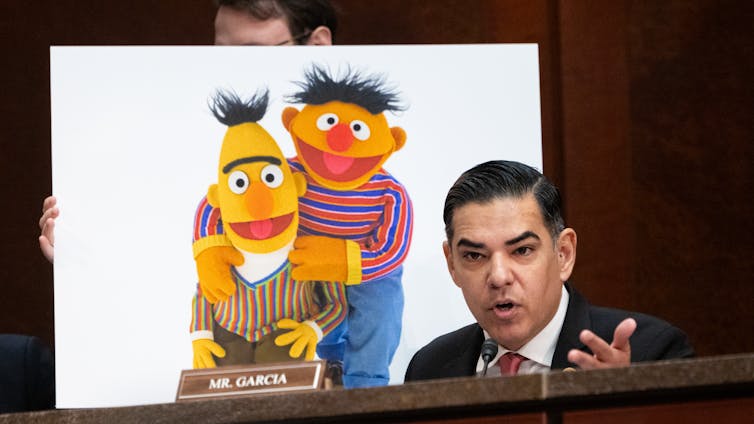
Rep. Robert Garcia, a California Democrat, speaks during a House hearing in March 2025, months before Congress rescinded two years of public media funding. Nathan Posner/Anadolu via Getty Images

CC BY-ND

At U.S. President Donald Trump’s request, Congress voted in July 2025 to claw back US$1.1 billion it had previously approved for the Corporation for Public Broadcasting. That measure, which passed in the House and the Senate by very narrow margins, will cut off all federal tax dollars that would have otherwise flowed to PBS and its affiliated TV stations for the next two fiscal years.

The public media network has played a crucial role in producing educational TV programs, especially for children, for nearly 60 years. It has been getting 15% of its budget in recent years from the federal government. Many of its affiliate stations are far more reliant on Washington than that – leading to a flurry of announcements regarding planned program cuts.

“Sesame Street” is still in production, joined by newer TV shows like “Wild Kratts” and “Daniel Tiger’s Neighborhood.” PBS KIDS, in addition to producing popular age-appropriate programs, has a website and multiple apps with games and activities that provide other opportunities for learning.

Local PBS affiliate stations offer educational programming and other resources for schools, families and communities.

I’m a child development researcher studying how kids engage with digital media and how educational programming and other kinds of content help them learn. I also have two children under 5, so I’m now immersed in children’s media both at work and at home.

What kids watch

In a study about the kinds of media kids consume that the Journal of Applied Developmental Psychology published in June 2025, my colleagues and I surveyed the parents and other kinds of caregivers of 346 first graders. The study participants listed the TV shows, videos, apps and games the kids used the most.

Our research team then used a systematic coding process to look at how much children access educational programming in their favorite media – whether it’s through their favorite TV shows, web videos or video games.

We found that only 12% of this content could be described as educational. This amount varied widely: For some children, according to the adults we surveyed, educational media comprised their top three to five sources. Others listed no educational media consumption at all.

We also looked into who is taking advantage of educational media.

Our team found no differences in kids’ educational media use according to how many years of education their parents had. That finding suggests that kids of all backgrounds are equally likely to consume it.

A tween boy plays a videogame with two screens.
The vast majority of the media that kids consume has little educational value. Neilson Barnard/Getty Images

The Role of PBS

This peer-reviewed study didn’t break down our results by specific media outlets. But in light of the cessation of federal funding, I wanted to find out how much of the educational content that children watch comes from PBS.

By revisiting our data with this objective in mind, I learned that PBS accounted for 45% of the educational TV or videos parents said their kids watched most often. This makes PBS the top source for children’s educational programming by far. Nickelodeon/Nick Jr. was in second place with 14%, and YouTube, at 9%, came in third.

PBS accounted for a smaller portion, just 6%, of all educational apps and games. I believe that could be because a few non-PBS apps, like Prodigy and i-Ready, which can be introduced in school, dominate this category.

‘Daniel Tiger’s Neighborhood,’ a cartoon, will seem familiar to anyone who grew up watching ‘Mr. Rogers’ Neighborhood.‘

An Uncertain future

Independent production companies collaborating on programming with PBS consult experts in child development and children’s media and conduct research throughout the production process to see how children respond and learn, often in partnership with PBS KIDS.

This rigorous production process can include observing children watching the show, conducting focus groups and surveying parents about their experiences. It requires a lot of time and money to produce this kind of thoughtfully crafted educational media. This process ensures that the programming is both fun for children and helps them learn.

What the end of federal funding will mean for PBS’ educational programming for kids is still unclear. But to me, it seems inevitable that my children – and everyone else’s kids – will have fewer research-informed and freely accessible options for years to come.

At the same time, there will likely be no shortage of flashy and shallow content marketed to kids that offers little of value for their learning.The Conversation

Rebecca Dore, Director of Research of the Crane Center for Early Childhood Research and Policy, The Ohio State University

This article is republished from The Conversation under a Creative Commons license. Read the original article.

  • 175
  • 176
  • 177
  • 178
  • 179
  • 180
  • 181
  • 182
  • 183
  • 184

Community

  • Sheriff’s Activities League and Clearlake Bassmasters offer youth fishing clinic

  • City Nature Challenge takes place April 24 to 27

Public Safety

  • Lakeport Police logs: Wednesday, Feb. 11

  • Lakeport Police logs: Tuesday, Feb. 10

Education

  • Ramos measure requiring school officer training in use of anti-opioid drug moves forward

  • Lake County Chapter of CWA announces annual scholarships 

Health

  • California ranks 24th in America’s Health Rankings Annual Report from United Health Foundation

  • Healthy blood donors especially vital during active flu season

Business

  • Employment law summit takes place March 9

  • Two Lake County Mediacom employees earn company’s top service awards

Obituaries

  • Terry Knight

  • Ellen Thomas

Opinion & Letters

  • Who should pay for AI’s power? Not California ratepayers

  • Crandell: Supporting nephew for reelection in supervisorial race

Veterans

  • State honors fallen chief warrant officer killed in conflict in Iran

  • CalVet and CSU Long Beach team up to improve data collection related to veteran suicides

Recreation

  • April Audubon program will show how volunteers can help monitor local osprey nests

  • First guided nature walk of spring at Anderson Marsh State Historic Park April 11

  • Second Saturday guided nature walks continue at Anderson Marsh State Historic Park

  • Wet weather trail closure in effect on Upper Lake Ranger District

Religion

  • Kelseyville Presbyterian Church plans Easter service

  • Easter ‘Sonrise’ Service returns to Xabatin Community Park

Arts & Life

  • ‘CIA’ delves into the shadowy world of an espionage thriller

  • ‘War Machine’ shifts the battlefield into uncharted territory

Government & Politics

  • Lake County Democratic Central Committee endorses Falkenberg

  • Crandell launches reelection campaign plans March 15 event

Legals

  • April 23 hearing on Lake Coco Farms Major Use Permit

  • NOTICE OF 30-DAY PUBLIC COMMENT PERIOD & NOTICE OF PUBLIC HEARING

How to resolve AdBlock issue?
Refresh this page