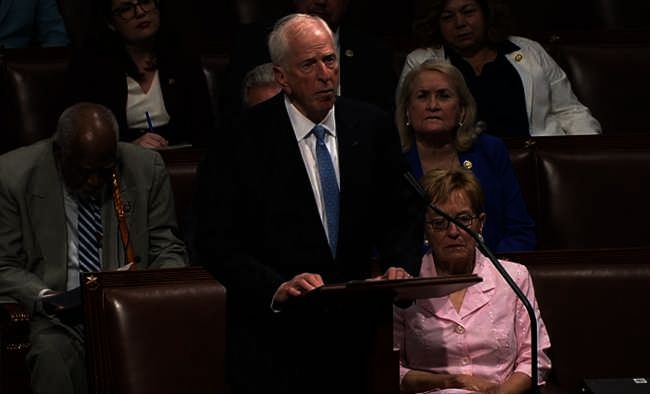
Rep. Mike Thompson at the dais on the floor of the U.S. House of Representatives speaking out against the bill. Courtesy photo.
State and federal leaders on Thursday responded with harsh criticism for Congress after the passage on a razor-thin margin of a budget bill expected to strip millions of people of health care and food benefits, and leave rural hospitals in danger of closing.
H.R. 1 passed on Thursday with a straight party line vote — 2018 to 2014, with every House Democrat voting no.
Republicans call the bill the “One Big Beautiful Bill,” while Democrats and other opponents called names such as the “big, ugly bill.”
Lake County’s member of the House, Congressman Mike Thompson, who also is a ranking member of the House Committee on Ways and Means, was on the floor early Friday morning to speak against the bill.
In his remarks, given shortly after 4:15 a.m. Eastern time, Thompson said the bill “shamelessly hurts our constituents.”
He pointed to its impacts on those who need food assistance and health care, the potential for rural hospitals to close and how that it cedes leadership in the green energy economy to China.
Thompson said the bill pushes the American Dream out of reach for millions of people, and is bad for constituents, America and the future.
In a followup statement on Thursday, Thompson said, “Congressional Republicans’ big, ugly bill is a bad deal for the American people.”
He continued, “In one bill, my Republican colleagues have managed to rip health care away from 17 million people, take food away from 11 million people, gut my green energy investments responsible for our manufacturing boom, and drive up our national debt by a whopping $5 trillion dollars. All of this just to give tax breaks to their billionaire donors who don’t need the help.”
In the Fourth Congressional District, which includes Lake County, Thompson said that “22,000 of our friends, family members, and neighbors stand to lose health care coverage. Another 14,000 could go hungry. Twenty-eight rural hospitals in California and one in four nursing homes across our state will close. This isn’t just bad policy — it’s cruelty.”
He added, “We have a responsibility as members of Congress to work for everyone, not just the well-off and well connected. This bill will saddle our future generations with debilitating debt in order to give handouts to people who don’t need the help. Every hardworking American, regardless of party stripe, ought to be outraged. And my colleagues on the other side of the aisle ought to be ashamed.”
Another North Coast member of Congress, Jared Huffman, called the bill “one of the most shameless betrayals in recent memory,” adding that “ Trump’s Big, Ugly Bill is a full-blown catastrophe for the American people. President Trump promised affordability, and now Americans will pay higher energy bills. Republicans campaigned on energy independence, but they’re giving China the deal of the century. They promised a stronger economy, yet they just kneecapped hundreds of thousands of good-paying jobs. They promised to protect our public lands, and now they’ve auctioned our resources off to polluters and developers.”
Gov. Gavin Newsom also offered fierce criticism of the bill.
“This bill is a tragedy for the American people, and a complete moral failure,” Newsom said. “The president and his MAGA enablers are ripping care from cancer patients, meals from children, and money from working families — just to give tax breaks to the ultra-rich. With this measure, Donald J. Trump's legacy is now forever cemented: he has created a more unequal, more indebted, and more dangerous America. Shame on him.”
“These federal cuts are more than just language in a bill — they are direct and real threats to the health, stability, and dignity of millions of Californians,” said Kim Johnson, secretary of the California Health & Human Services Agency. “Stripping food and health care access from families will deepen poverty, widen health disparities, and push people into crisis. CalFresh and Medi-Cal are not only lifelines for individuals and families; they are foundational pillars of local economies and health care infrastructure. Weakening them weakens all of us. These federal cuts are taking food and health care away from those who need it most. California has made real progress toward a healthier, more equitable future. These federal cuts are moving us backward, and will be devastating to families in California and across the nation.”
Anticipated impacts for California
The Governor’s Office released the following information about potential impacts of the bill on California.
Eliminates jobs: Puts 686,000 California jobs at risk, through the elimination of the Inflation Reduction Act’s clean energy tax credits. North America's Building Trades Unions says that if enacted, “this stands to be the biggest job-killing bill in the history of this country.”
Significantly cuts critical family support programs: More than $28.4 billion slashed in federal Medicaid funding to California — increasing medical debt and jeopardizing health care providers’ ability to keep their doors open. Roughly 17 million people would lose coverage and become uninsured by 2034 due to various Medicaid reductions and the exclusion of enhanced premium subsidies. Cuts necessary food assistance for people for 3 million people nationwide in need of quality nutrition and food.
Establishes a tax hike for parents who pay for child care: Rural hospitals across the state are likely to see care offered cut or doors closed entirely.
Defunds public safety: $646 million from the Federal Emergency Management Agency, or FEMA, for violence and terrorism prevention; $545 million from the Federal Bureau of Investigation, cutting its workforce by more than 2,000 personnel and reducing its capacity to keep criminals off the street; $491 million from the Cybersecurity and Infrastructure Security Agency, making our cyber and physical infrastructure more vulnerable to attack; $468 million from the Bureau of Alcohol, Tobacco, and Firearms, greatly reducing its ability to crack down on firearm trafficking and reduce gun violence; $212 million from the Drug Enforcement Administration (DEA), greatly reducing its capacity to help state and local law enforcement and weakening efforts to fight international drug smuggling impacting the United States; $107 million from Bureau of Indian Affairs Public Safety and Justice, exacerbating current understaffing and making tribal communities less safe.
Endangers wildfire-prone communities: Cuts wildfire prevention programs like — raking the forests, forest management services — and eliminates personnel hired to fight wildfires.
Defunds Planned Parenthood: Defunds Planned Parenthood — essentially creating a backdoor abortion ban — that could put health care for 1.1 million patients at risk and force nearly 200 health centers to close, mostly in states where abortion care is legal.
Unfairly targets green vehicles: Creates penalties for families who own a hybrid or electric vehicle – increasing the cost of taking personal responsibility even more.
Unjustly targets American students: Takes away college access from millions of children by limiting families’ ability to access financial aid for college, including Pell Grants. Betrays student loan borrowers by ending student loan deferment for borrowers who experience job loss or other financial hardships, and forbids any future student loan forgiveness programs.
Raises costs and separates American families: Pours billions of dollars into supercharging the cruel and reckless raids like we have seen in Southern California and across agricultural areas, expanding the targeting of families, workers and businesses and harassment of U.S. citizens nationwide. Americans overwhelmingly agree we should have a pathway to citizenship for immigrants who have been here for years, pay their taxes, and are good members of their communities, such as farmworkers, Dreamers and mixed-status families.
National impacts on food and farming
House Agriculture Committee Ranking Member Angie Craig (MN-02) said the bill’s passage “marks a grave turning point for our country, one which leaves rural communities and farmers behind, and places us on the road toward increased hunger, less prosperity and fewer opportunities for working families. This bill takes food away from millions of children, seniors, veterans and people with disabilities.”
Craig said the bill decimates the farm bill’s Nutrition Title and abandons the historically bipartisan farm bill coalition.
Impacts Craig outlined include the following.
Slashing SNAP benefits: The bill puts in jeopardy SNAP benefits for 42 million Americans depending on SNAP to help put food on their tables, including: 16 million children, 8 million seniors (aged 60+), 4 million people with disabilities (below 60), and 1.2 million veterans. It also slashes $1 billion from Summer EBT, which provides food assistance to children in low-income families over the summer and $1 billion from Puerto Rico’s Nutrition Assistance Program.
Taking food away from millions of Americans: The bill’s expanded SNAP paperwork requirements puts five million people, including about 800,000 children and more than 500,000 adults aged 65 or older and adults with disabilities, at risk of losing some or all of their SNAP benefits.
Taking benefits away from veterans, homeless people and former foster youth: CBO estimates that due to the budget bill, roughly 270,000 veterans, homeless people and former foster youth (up to age 24), will lose their food assistance each month.
Forcing states or counties to raise local taxes or cut services: In nine states — including California — that use counties to administer SNAP, counties’ costs are projected to jump by more than $850 million per year. In some states, counties could see their expenses rise by $250 million per year.
Pushing states to eliminate SNAP entirely: The reconciliation bill shifts $65 billion in benefit and administrative costs to states and counties, which could result in states being forced to pull out of the program altogether due to increased costs. Governors, county commissioners, SNAP administrators, and Congressional Budget Office have all warned that there is no alternative if states and counties cannot meet the amount demanded.
Rewarding states with high error rates: For months, it’s been said that the bill is meant to “root out” waste, fraud and abuse. SNAP payment error rates have been called the problem and mischaracterized as a measurement of “fraud,” when it is actually a measurement of states’ payment calculation accuracy. Republicans said they wanted to “crack down on the worst offenders.” Yet, in the final bill they did a 180-degree turn and decided to give only states with the highest error rates the ability to avoid the new SNAP benefit cost shift. Now, Craign said Republicans are punishing states that are making more progress, while rewarding those making the least. “Clearly, this was never about waste, fraud and abuse,” she said. “This is about using any means possible to cut food assistance programs to give tax breaks to the richest Americans and the largest corporations.”
Breaking up the long-standing farm bill coalition: With costs up, prices down, and the threat of a trade war that has already cost farmers’ markets, now more than ever, family farmers, ranchers and producers need the certainty that a five-year, 12-title farm bill provides. If SNAP, a farm bill program, is decimated, the coalition that has been essential to the successful passage of bipartisan farm bills will be forever undermined, making it tougher to pass not just a full farm bill this year but all future farm bills, Craig said.
Reducing farm revenue: The massive SNAP cuts will also result in a $25 billion drop in farm revenue at a time when every dollar counts.
Hurting rural communities: SNAP cuts will hit rural America hardest. SNAP’s economic impact is particularly strong in rural communities (16 percent) and small towns (15 percent), where people participate at higher rates than in urban areas (13 percent),and where SNAP dollars provide even higher returns to the local economy.
Harming rural grocers: 27,000 retailers in largely rural counties have the highest risk of being harmed by SNAP cuts, due to the program’s significant economic impact in rural communities. SNAP is responsible for 249,700 grocery industry jobs annually, with direct wages totaling $10.3 billion.
Damaging the food economy: Cuts to SNAP have significant negative impacts on the farmers who grow the food, manufacturers that package it, truckers who distribute it and stores and small businesses in our communities that sell it. In 2024, SNAP created nearly 139,000 new jobs in supporting industries, including agriculture, manufacturing, transportation, and municipal services, with direct wages totaling $9.8 billion. More than $20 billion in direct wages derived from the 388,700 grocery and supporting industry jobs supported by SNAP result in over $4.5 billion in state and federal tax revenue per year.
As Californians gear up to celebrate July 4, Gov. Gavin Newsom on Thursday highlighted how the state is rolling out safety measures — from wildfire enforcement and extra highway patrols to real-time heat alerts — to help keep the fun going and our communities safe.
Entering peak wildfire season
In California, human activities account for about 95% of all wildfire starts, often starting from preventable actions like improperly extinguished campfires, malfunctioning equipment, and fireworks.
With July 4 celebrations set to go off, Gov. Newsom and state fire officials remind all Californians that the state has no tolerance for illegal fireworks.
Over 600,000 pounds of illegal fireworks have already been seized in 2025. The sale, transport, or use of fireworks without the “Office of the State Fire Marshal Safe and Sane” seal is illegal, as is possessing or using any fireworks in communities where they are not allowed.
Violators face potential fines up to $50,000 as well as a year in jail. For a fun and safe Fourth of July, know your local fireworks laws. Some California communities ban all fireworks, while others allow certain “Safe and Sane” fireworks.
Hitting the road
To keep Californians safe, the California Highway Patrol is implementing a holiday enforcement period beginning at 6:01 p.m. on Thursday, July 3, and continuing through 11:59 p.m. on Sunday, July 6 — keep an eye on distracted and dangerous drivers on the highways.
Don’t forget — save the celebrations until you’ve reached your destination. During the 2024 Independence Day holiday period, 29 people were killed in crashes on California roads and CHP officers made 1,336 arrests for DUI — one arrest every 17 minutes.
Staying smart in the heat
California has launched CalHeatScore — a groundbreaking tool to help protect vulnerable populations from dangerous heatwaves. The state’s new tool provides localized warnings and resources for extreme heat events.
When high temperatures impact Californians, many regions can experience triple-digit weather. Residents should visit here for resources, including heat safety information and places to stay cool.
Emergency preparedness
Californians are encouraged to sign up for free emergency alerts at listoscalifornia.org/alerts. Emergency alerts are important messages you receive to help keep you safe during a disaster.
The Disaster Ready Guide, available in multiple languages, includes other important information, such as packing a go-bag and making a plan.
• Recreate responsibly with these helpful tips. • Carry extra food, water and clothing if you plan to be outdoors for an extended period of time. Check the weather forecast before you leave. • Stay aware and alert near bodies of water. Wear a life jacket, supervise children and do not enter cold and/or swift-water areas. • Be mindful of insects and wildlife, take precautions including wearing long sleeve clothing and repellents. • Boat sober.
Make an outdoor plan
For those looking to engage with some of California’s natural beauty during the weekend with a visit to one of its 280 state parks, California’s State Parks encourages Californians to be conscientious of their impact on the land around them. Staying on trails, making sure to keep watch on and extinguish any campfires, picking up your trash, and planning ahead can keep you and your families safe, and the wilderness protected for those that come after you.
• Whether you're camping, hiking, or just going outside for some relaxation, know the route you'll be taking and how long you plan to be gone. Tell a responsible person about your plans and when you anticipate you'll be home. • Carry extra food, water and clothing if you plan to be outdoors for an extended period of time. • Check the weather forecast before you leave. • Stay aware and alert near bodies of water. Wear a life jacket, supervise children and do not enter cold and/or swift-water areas. • Be mindful of insects and wildlife, take precautions including wearing long sleeve clothing and repellents.
Keep your little ones in mind
As temperatures heat up, many people want to go outside and take their children and pets with them.
While they love outdoor adventures, the heat can take a toll on them, too. Be sure to limit their outside exposure on hot days.
With increased flows in waterways during the summer, don't leave anyone unsupervised near streams or rivers.
Most importantly, never leave your kids or pets alone in a hot vehicle.
A wolf in the wild. Photo courtesy of the California Department of Fish and Wildlife.
The California Department of Fish and Wildlife, or CDFW, this week published a report summarizing its management and conservation activities for gray wolves (Canis lupus) over the past 10 years.
“Ten Years of Gray Wolf Conservation and Management in California: 2015-2024” details CDFW’s wolf conservation and management efforts, including wolf monitoring techniques, wolf-livestock depredation investigations, wolf captures and population data for the state’s wolf packs known through 2024, including the minimum number of individuals, breeding pairs and litters produced.
Wolves were extirpated in California by 1924 and naturally returned to the state in 2011. The first pups born in California were documented in 2015.
At the end of 2024, CDFW wildlife biologists documented at least 50 wolves in the state.
Wolves are listed as endangered species under the California Endangered Species Act and the federal Endangered Species Act.
“Since the wolves’ return CDFW has been monitoring the growing wolf population, working to mitigate wolf-livestock conflict and conducting significant outreach to livestock producers and the public,” said CDFW Director Charlton H. Bonham. “Through these monitoring efforts, studies and outreach, CDFW and partners are building a toolkit that will offer solutions and resources for livestock producers while also allowing a native species to successfully come home.”
“The return of wolves to California is an epic tale and this report marks an important milestone in that story,” said Amaroq Weiss, a senior wolf advocate at the Center for Biological Diversity. “California’s decade of the wolf demonstrates that when essential legal protections are in place, there can be comeback stories for desperately imperiled animals.”
Starting in 2026, CDFW plans to produce an annual report about its wolf management and conservation activities. Wolf management and conservation is guided by CDFW’s 2016 Conservation Plan for Gray Wolves in California.
This first report describes 10 years of work by CDFW, such as community engagement efforts, non-lethal deterrent use and the creation of the Wolf-Livestock Compensation Program.
Maps included in the report show wolf activity in California as well as migration of collared wolves. While the Yowlumni pack has established in Tulare County, all other known packs have home ranges in northeastern California.
The report highlights include a summary of past and ongoing research that will inform CDFW’s future management of wolves.
Wolves return after a century
The first wolf in nearly a century to make California part of his range was OR-7, a radio-collared wolf from Oregon that entered California in late 2011. OR-7 traveled across seven northeastern counties in California before returning to southwestern Oregon, where he found a mate and settled down, forming the Rogue pack.
Several of OR-7’s offspring have since come to California and established packs. Those include the original breeding male of the Lassen pack and the breeding female of the Yowlumni pack residing in Tulare County. The Shasta pack, California’s first confirmed wolf pack in nearly 100 years, was discovered in 2015 but disappeared a few months later.
The gray wolf is native to California but was driven to extinction in the state by the mid-1920s. After OR-7 left Oregon for California, the Center and allies successfully petitioned the state to fully protect wolves under California’s endangered species act. Wolves are also federally protected in California under the federal Endangered Species Act. It is illegal to intentionally kill any wolves in the state except in defense of human life.
While California’s first known wolf in modern times entered the state in late 2011, it was not until summer 2015 that the first wolf family here in 100 years, the Shasta pack, was confirmed. At the end of 2024, seven known packs composed of around 50 to 70 wolves ranged across multiple counties in California.
According to the report, between 2015 and 2024, the agency was able to collar 12 wolves across five packs, a known 21 litters of wolf pups were born, and there have been at least nine known wolf deaths.
Of these mortalities, cause of death could not be determined in four instances, three wolves died after being struck by vehicles, one wolf was killed illegally and one wolf’s death is still under investigation.
This spring, the agency confirmed the existence of an additional three packs, bringing the current tally to 10 known wolf families in the state. Nine of those packs are in northeastern California and one pack is 200 miles further south, near Sequoia National Forest.
Months after the first wolf arrived in California, CDFW formed a stakeholder working group that was divided into three subgroups: A wolf-livestock subgroup focused on wolf impacts on livestock and agriculture, a wolf-ungulates subgroup focused on wolf impacts on deer and elk populations, and a wolf conservation subgroup focused on wolf sustainability and health issues. The outcomes of 44 meetings were analyzed.
Most prevalent were topics relating to the importance of and need for data on wolves in California, including their impact on livestock, wild prey and natural ecological communities; identifying wolf population recovery goals and whether a sustainable population can be maintained over time; how the California Endangered Species Act affects wolf management options; and where lethal controls would fit into wolf management.
The report also includes an analysis of the Lassen pack’s diet and notes the work of CDFW’s Wildlife Forensics Lab to create a reference library of wolf genetic samples.
The genetic samples are used to determine the origins and relatedness of California’s wolves, differentiate scats and depredations by coyotes and dogs, identify the genetic “fingerprints” of individual wolves and even determine the coat color of wolves detected only by their DNA.
“California’s wolves are still in the infancy of their recovery, and ongoing legal protections are essential to keep their small population growing,” said Weiss. “This 10-year report is worth celebrating but California gets this opportunity to celebrate only because we’ve decided wolves are worth protecting.”
The University of California, Davis, Wildlife Health Center initiated The Wolf Project in 2022, with research funded by the Wildlife Conservation Network. In 2023 CDFW began collaborating with researchers at the University of California, Berkeley, on the California Wolf Project. More information about the The Wolf Project and California Wolf Project are available online.
For more information about wolf conservation in California, CDFW Wolf Livestock Compensation Grants or to view the CDFW Wolf Tracker wolf location map go to CDFW's gray wolf web page.
The Ten Years of Gray Wolf Conservation and Management in California: 2015-2024 report is now available online.
For many people around the world, the very first moments of the new year will be filled with the sounds and colorful light shows of fireworks. From loud bangs to long whistles, bright reds to pale blues, there are thousands of variations of fireworks and an entire branch of chemistry that explores these fun explosions.
I’m a chemist and president of the Pyrotechnics Guild International, an organization that promotes the safe use of fireworks and their use to celebrate holidays like the New Year.
There are hundreds of chemical formulas – or as I like to think of them, pyrotechnic recipes – for fireworks. These recipes are still based off an ancient mixture of chemicals that produces the quintessential bang, but modern fireworks use all sorts of chemical magic to put on the incredible shows of today.
The first ingredient of any firework is the ancient explosive black powder. It was discovered by Chinese alchemists more than a thousand years ago, and the recipe has been virtually unchanged in the centuries since. To make black powder, all you need to do is mix 75% potassium nitrate, 15% charcoal and 10% sulfur. To make a basic firework or fire cracker, you just put this powder in a container, usually made of thick cardboard or paper.
Black powder is used to launch the firework in the air as well as ignite and propel the effects – like color – into a pattern in the sky. So how does it work?
Once lit with a fuse or spark, the sulfur melts first at 235 F (112.8 C). The sulfur flows over the potassium nitrate and charcoal, which then burn. This combustion reaction quickly produces a large amount of energy and gas – in other words, an explosion. If there is a small hole for the gas to escape, the reaction launches the firework into the air. In a very confined space, it blasts the components of the firework apart and ignites everything nearby.
In addition to changing how confined the black powder is, changing the size of the granules of powder can change how fast it burns, too. Think about a campfire. When you add a large tree limb the flames burn longer and slower. If you toss a handful of sawdust into the flame it burns hot and fast. Black powder works similarly, and this makes it easy to control how much and how fast energy is released.
If you put very fine black powder powder in a confined space it explodes in a cloud of heat, gas and noise. So where do the colors and bright light come from?
When you heat up any material, what you’re really doing is putting energy into the electrons of that material’s atoms. If you excite the electrons enough, when they fall back to their normal energy levels they release that excess energy as light.
There are a number of different elements that, when added to a firework and heated, release different wavelengths of light that appear as different colors. Strontium makes red. Barium produces green. Copper burns blue, and so on.
[The Conversation’s science, health and technology editors pick their favorite stories.Weekly on Wednesdays.]
Making fireworks that produce blues has long been a challenge for fireworks chemists. Deep blues are too dark and can’t be seen against the night sky. But if the blue is too light, it appears white. So the wavelength of the “perfect blue” has to be very precise. This is hard to achieve because blue light has a shorter wavelength – meaning the distance between the peaks and valleys of the wave of light are very close together.
Certain elements produce different colors, but what about sparkles and flashes? To make these effects, various metals can be added to the pyrotechnic formulas. Aluminum, magnesium and titanium all produce white sparks. By adding iron you get gold sparks. Mixing in various types of charcoal can produce red and orange sparks. Each of these elements burns at a different speed and in a different way and so produces varying colors and intensities of light.
Special formulas and rocket shapes can produce sound effects like whistles.
Making a whistle or a boom
The final piece of a good firework is an exciting sound effect.
To add sound effects to fireworks you need a formula that produces a large amount of gas very quickly. If a firework has a small opening for the gas to exit through it will produce a whistling sound. The velocity of the gas and size of the opening will vary the pitch and sound of a whistle.
Making a boom is much easier. Simply put an energetic formula in a confined space with nowhere for the gas to go. When ignited, the pressure will build and the firework will explode, producing a sudden boom or bang.
As you watch the fireworks this New Year’s Eve or launch some of your own in the backyard, you’ll now know how they work. Fireworks are a lot of fun, but the explosions and burning chemicals are dangerous – even if they do come in colorful packaging. If you can legally launch consumer fireworks in your town, please handle them properly.
Fireworks at the Clearlake Independence Day celebration in June 2018. Photo by Elizabeth Larson/Lake County News.
LAKE COUNTY, Calif. — Lake County is gearing up for events celebrating Independence Day.
From festivals to fireworks, celebrations in communities around the lake will begin on Thursday and continue through Saturday.
The following is a schedule of the planned fireworks displays.
THURSDAY, JULY 3
CLEARLAKE OAKS
Clearlake Oaks Independence Day Celebration
The Clearlake Oaks Independence Day Celebration will take place from 11 a.m. to 5 p.m. Thursday, July 3, at Nylander Park.
There will be vendors, food trucks and family fun in the park.
The Maxine Sherman Memorial annual fireworks display will take place on Thursday night.
The fireworks will be launched at dusk from the lake at the Clearlake Oaks public launch ramp.
FRIDAY, JULY 4
LAKEPORT
City of Lakeport celebration
The city of Lakeport’s July 4 celebration will include a daylong street and craft fair, vendors and food trucks from 11 a.m. to 8 p.m.
At 6 p.m., the boat parade will make its return, traveling along the city's waterfront with a variety of watercraft welcome to participate. Register your boat here: https://forms.gle/AWPEcwJTpmZKiu2t7.
The city’s fireworks display will cap off the day. The display will be shot off from a barge offshore of Library Park at dusk.
SATURDAY, JULY 5
CLEARLAKE
Redbud Parade and Festival
The Lakeshore Lion’s Club of Clearlake is sponsoring its 67th annual Redbud Parade and Festival.
The parade will start at Redbud Park at 11 a.m. on Saturday, July 5, and will proceed down Lakeshore Drive to Austin Park.
The theme of this year’s parade is “Cruising the 50s.”
The event will feature local marchers, marching bands, decorated floats, vintage cars, parade and show horses, fire and police vehicles, and much more.
The city of Clearlake will host a free concert showcasing Dylan Schneider at 7 p.m.
The Lakeshore Lion’s Club will sponsor the firework display at dark.
LAKEPORT
Konocti Vista community fireworks show and party
Konocti Vista Casino will hold its free community fireworks show.
The evening will begin with a party at 6 p.m. featuring vendors, food, a DJ and bar, with the Fun Zone Arcade open indoors.
Fireworks start at dusk, approximately 9:30 p.m. They can be viewed from the marina and parking lot.
Konocti Vista is located at 2755 Mission Rancheria Road.
Lakeport Speedway fireworks display
Lakeport Speedway will host its annual fireworks display following an evening of racing on Saturday, July 5.
Grandstands open at 5 p.m. with racing at 7 p.m. and fireworks to follow.
LAKEPORT, Calif. — After receiving approval in mid-June for a plan to move its Early Head Start program to a new location, Lake Family Resource Center said it is changing course and exploring other options.
At its June 11 meeting, the Lakeport Planning Commission approved the application by Lake Family Resource Center, or LFRC, to temporarily relocate its Early Head Start child development center to Clear Lake Baptist Church, located at 555 N. Forbes St.
Last year, LFRC’s Lakeport headquarters moved to its new location at the former Ruzicka Associates building on Parallel Drive from the Vista Point Shopping Center, now owned by the Lake County Tribal Health Consortium.
At that point, LFRC was still exploring options for where to relocate Early Head Start, which was set to remain at Vista Point through June 30.
After discussing LFRC’s plan on June 11, the commission voted to approve it.
Executive Director Lisa Morrow told Lake County News that they appreciated the commission’s approval.
“That was a big step, and we really appreciate the support from the City and the folks who helped move it forward,” Morrow said in an email.
However, in the weeks since the approval, Morrow said LFRC is now looking at taking another approach.
“Unfortunately, after digging deeper into the renovation costs at the church site, it just wasn’t feasible to bring it up to ADA [Americans with Disabilities Act] and child care licensing standards — it’s simply too expensive,” Morrow wrote. “So now we’re pivoting to a new plan: temporarily relocating Early Head Start to our offices at 2495 Parallel Drive. That space will also need some work to meet licensing requirements and align with the use permit that was approved back in November 2024, but it’s a more manageable option.”
Morrow said the new plan still allowed them to remain on track to be out of the Lakeport Boulevard site by June 30. The last day of on-site child development services there was June 19.
She said Early Head Start is anticipated to be operating in temporary status on Parallel Drive for about 24 months.
That site will also eventually be home to LFRC’s new, permanent child development center once LFRC’s federal application for Head Start funding for the project is approved, Morrow said.
If all goes well, Morrow said construction for the new Head Start child development center will take about 18 to 24 months.
Email Elizabeth Larson at This email address is being protected from spambots. You need JavaScript enabled to view it.. Follow her on Twitter, @ERLarson, and on Bluesky, @erlarson.bsky.social. Find Lake County News on the following platforms: Facebook, @LakeCoNews; X, @LakeCoNews; Threads, @lakeconews, and on Bluesky, @lakeconews.bsky.social.
 How to resolve AdBlock issue?