How to resolve AdBlock issue?
Refresh this page
Lake County News,California
  • Home
    • Registration Form
  • News
    • Education
    • Veterans
    • Community
      • Obituaries
      • Letters
      • Commentary
    • Police Logs
    • Business
    • Recreation
    • Health
    • Religion
    • Legals
    • Arts & Life
    • Regional
  • Calendar
  • Contact us
    • FAQs
    • Phones, E-Mail
    • Subscribe
  • Advertise Here
  • Login
How to resolve AdBlock issue?
Refresh this page

News

Celebrate Earth Day at State Parks with in-person and virtual events

SACRAMENTO — Celebrate Earth Day this month with California State Parks at any of the 280 unique state parks.

State Parks will host numerous Earth Day-themed events throughout April 19 to 27.

They include in-person activities, such as guided nature walks, beach cleanups, interactive junior ranger programs and hands-on restoration projects, as well as virtual programming with a live dive broadcast exploring the hidden world of the ocean.

“Earth Day is a celebration of our connection to the land, the water and each other,” said California State Parks Director Armando Quintero. “California State Parks is proud to protect the places that inspire stewardship, spark curiosity, and remind us why connecting with nature is important and worth preserving. Join us in celebrating Earth Day every day!”

A list of statewide Earth Day events for departments, conservancies and commissions under the California Natural Resources Agency is available at resources.ca.gov/earthday2025. 

While Earth Day is Tuesday, April 22, it is being celebrated throughout the month. Here are some in-person and virtual events being held at state parks:

Event: Earth Week PORTScast 
Date and time: Sunday, April 20 – Friday, April 25
Location: Virtual
Description: PORTScast LIVE broadcasts will bring the wonders of California’s state parks into classrooms, wherever you may be. Join staff for several special Earth Week events covering a range of topics from the difference between baleen and toothed whales to learn how some forest fires can actually be good for the ecosystem. Find a virtual event here: https://ports.parks.ca.gov/2-portscast/portscasts-calendar/ 

Event: Earth Day Celebration at California Natural Resources Agency
Date and time: Tuesday, April 22 – 3-5 p.m.
Location: 715 P Street, Sacramento, CA 95814
Description: Discover the great work underway to conserve, protect, and restore California's natural and cultural resources. Fun activities for all ages with indoor and outdoor interactive activities with giveaways and more. The event is open to the public — free admission.

State Parks looks forward to seeing Californians on trails, beaches, mountains, and the deserts on Earth Day, but asks for all to please recreate responsibly:

Know Before You Go: Prior to leaving home, check the status of the park you want to visit to find out what restrictions and guidelines are in place, and to find out if your destination may be temporarily closed. Have a backup plan in case your destination is crowded.

Play It Safe: Find out what precautions you should take when exploring the outdoors, especially if this is your first time visiting the State Park System. For example, make sure to dress in layers, bring plenty of snacks and water, and wear appropriate hiking shoes.

Leave No Trace: Leave areas better than how you found them by staying on designated trails and packing out all trash. Do not disturb wildlife or plants.

Download Mobile App: Visitors are invited to download the California State Parks mobile app, which allows users to download park unit maps and receive up-to-date information on any trail closures and events. Powered by OuterSpatial, the app has park information, route details, and virtual badges you can collect as you visit parks. Visitors can download the app here.

California’s state park system has 280 state park units, over 340 miles of coastline, 970 miles of lake and river frontage, 15,000 campsites, 5,200 miles of trails, 3,195 historic buildings, and more than 11,000 known prehistoric and historic archaeological sites. Plus, there are also many other local and national parks across the state that Californians can enjoy on Earth Day and year-round.

California launches streamlined online permitting process to fast-track critical wildfire safety projects

State officials report that a new online streamlining request process cuts bureaucratic red tape and now makes it faster to get state approval to implement forest and vegetation management projects, which are critical to reducing the risk of catastrophic wildfires.

This new process will shorten project approvals to as little as 30 days — saving a year or more of review and red tape for more complicated projects.

Officials said this builds on consecutive years of intensive and focused work by the State of California to confront the severe ongoing risk of catastrophic wildfires, and most recently Governor Newsom’s emergency proclamation.

Full information on project eligibility and the suspension request form are available here.

The new process to accelerate critical wildfire safety projects advances some of the essential actions identified in the Governor’s Wildfire and Forest Resilience Task Force’s ambitious 25 key deliverables for 2025, and builds on statewide efforts to move fast to prepare communities ahead of peak wildfire season by promoting key safety measures such as hardening homes and creating defensible space.

“Peak fire season is still ahead of us, yet this year has already been marked by some of the most destructive wildfires in California’s history. We need to move faster and go bigger,” said Gov. Gavin Newsom. “This new streamlined process, which builds on historic investments and nation leading actions to confront catastrophic wildfires, cuts red tape to fast-track more wildfire projects than ever before.”

Faster permitting without compromising environmental protections

The new process will allow practitioners across the state to move faster without compromising important environmental protections.

A new Statewide Fuels Reduction Environmental Protection Plan, or EPP, has been developed to enable critical wildfire safety projects to proceed expeditiously while protecting public health and the environment.

The EPP requires applicants to comply with best management practices and measures to minimize impacts to environmental resources while completing fuels reduction projects, ensuring the safeguarding of water and air quality, tribal cultural resources, and special-status species and their habitats.

Expanding prescribed and cultural fire

In addition to streamlining permitting, leaders from across the state have already come together in response to the Emergency Proclamation to start developing recommendations on specific actions to expand and expedite the implementation of prescribed and cultural fire.

On April 11, a virtual briefing provided an overview on the execution of the proclamation and provided the public an opportunity to share recommendations for expanding beneficial fire.

Building on unprecedented progress

New, bold moves to streamline state-level regulatory processes builds long-term efforts already underway in California to increase wildfire response and forest management in the face of a hotter, drier climate. A full list of California’s progress on wildfire resilience is available here.

Highlights of achievements to date include:

Historic investments — Overall, the state has more than doubled investments in wildfire prevention and landscape resilience efforts, providing more than $2.5 billion in wildfire resilience since 2020, with an additional $1.5 billion to be allocated from the 2024 Climate Bond.

On-the-ground progress — More than 2,200 landscape health and fire prevention projects are complete or underway, and from 2021-2023, the State and its partners treated nearly 1.9 million acres, including nearly 730,000 acres in 2023.

Increasing transparency — The Governor’s Task Force launched an Interagency Treatment Dashboard to display wildfire resilience work across federal, state, local, and privately managed lands across the State. The Dashboard, launched in 2023, provides transparency, tracks progress, facilitates planning, and informs firefighting efforts.

Hardening communities — Adding to California’s nation-leading fire safety standards, Governor Newsom signed an executive order to further improve community hardening and wildfire mitigation strategies to neighborhood resilience statewide. Since 2019, CAL FIRE has awarded more than $450 million for 450 wildfire prevention projects across the state and conducts Defensible Space Inspections on more than 250,000 homes each year.

Leveraging cutting-edge technology — On top of expanding the world’s largest aerial firefighting fleet, Cal Fire has doubled its use of Uncrewed Aerial Systems and the state is utilizing AI-powered tools to spot fires quicker.

Space News: Why the meteorites that hit Earth have less water than the asteroid bits brought back by space probes – a planetary scientist explains new research


This image overlays over 100 fireball images recorded between 2016 and 2020. The streaks are fireballs; the dots are star positions at different times. Desert Fireball Network

Much of what scientists know about the early solar system comes from meteorites – ancient rocks that travel through space and survive a fiery plunge through Earth’s atmosphere. Among meteorites, one type – called carbonaceous chondrites – stands out as the most primitive and provides a unique glimpse into the solar system’s infancy.

The carbonaceous chondrites are rich in water, carbon and organic compounds. They’re “hydrated,” which means they contain water bound within minerals in the rock. The components of the water are locked into crystal structures. Many researchers believe these ancient rocks played a crucial role in delivering water to early Earth.

Before hitting the Earth, rocks traveling through space are generally referred to as asteroids, meteoroids or comets, depending on their size and composition. If a piece of one of these objects makes it all the way to Earth, it becomes a “meteorite.”

From observing asteroids with telescopes, scientists know that most asteroids have water-rich, carbonaceous compositions. Models predict that most meteorites – over half – should also be carbonaceous. But less than 4% of all the meteorites found on Earth are carbonaceous. So why is there such a mismatch?

In a study published in the journal Nature Astronomy on April 14, 2025, my planetary scientist colleagues and I tried to answer an age-old question: Where are all the carbonaceous chondrites?

Sample-return missions

Scientists’ desire to study these ancient rocks has driven recent sample-return space missions. NASA’s OSIRIS‑REx and JAXA’s Hayabusa2 missions have transformed what researchers know about primitive, carbon‑rich asteroids.

Meteorites found sitting on the ground are exposed to rain, snow and plants, which can significantly change them and make analysis more difficult. So, the OSIRIS‑REx mission ventured to the asteroid Bennu to retrieve an unaltered sample. Retrieving this sample allowed scientists to examine the asteroid’s composition in detail.

Similarly, Hayabusa2’s journey to the asteroid Ryugu provided pristine samples of another, similarly water-rich asteroid.

Together these missions have let planetary scientists like me study pristine, fragile carbonaceous material from asteroids. These asteroids are a direct window into the building blocks of our solar system and the origins of life.

A dusty, rocky asteroid against a dark backdrop.
Carbonaceous near-Earth asteroid Bennu as seen from NASA’s OSIRIS-REx sample-return spacecraft. NASA

The carbonaceous chondrite puzzle

For a long time, scientists assumed that the Earth’s atmosphere filtered out carbonaceous debris.

When an object hits Earth’s atmosphere, it has to survive significant pressures and high temperatures. Carbonaceous chondrites tend to be weaker and more crumbly than other meteorites, so these objects just don’t stand as much of a chance.

Meteorites usually start their journey when two asteroids collide. These collisions create a bunch of centimeter- to meter-size rock fragments. These cosmic crumbs streak through the solar system and can, eventually, fall to Earth. When they’re smaller than a meter, scientists call them meteoroids.

Meteoroids are far too small for researchers to see with a telescope, unless they’re about to hit the Earth, and astronomers get lucky.

But there is another way scientists can study this population, and, in turn, understand why meteorites have such different compositions.

Meteor and fireball observation networks

Our research team used the Earth’s atmosphere as our detector.

Most of the meteoroids that reach Earth are tiny, sand-sized particles, but occasionally, bodies up to a couple of meters in diameter hit. Researchers estimate that about 5,000 metric tons of micrometeorites land on Earth annually. And, each year, between 4,000 and 10,000 large meteorites – golf ball-sized or larger – land on Earth. That’s more than 20 each day.

A fireball observed by the FRIPON network in Normandy, France, in 2019.

Today, digital cameras have rendered round-the-clock observations of the night sky both practical and affordable. Low-cost, high-sensitivity sensors and automated detection software allow researchers to monitor large sections of the night sky for bright flashes, which signal a meteoroid hitting the atmosphere.

Research teams can sift through these real-time observations using automated analysis techniques – or a very dedicated Ph.D. student – to find invaluable information.

Our team manages two global systems: FRIPON, a French-led network with stations in 15 countries; and the Global Fireball Observatory, a collaboration started by the team behind the Desert Fireball Network in Australia. Together with other open-access datasets, my colleagues and I used the trajectories of nearly 8,000 impacts observed by 19 observation networks spread across 39 countries.

A camera, which looks like a glass sphere, attached to a metal stand on a railing overlooking mountains.
FRIPON camera installed at the Pic du Midi Observatory in the French Pyrenees. FRIPON

By comparing all meteoroid impacts recorded in Earth’s atmosphere with those that successfully reach the surface as meteorites, we can pinpoint which asteroids produce fragments that are strong enough to survive the journey. Or, conversely, we can also pinpoint which asteroids produce weak material that do not show up as often on Earth as meteorites.
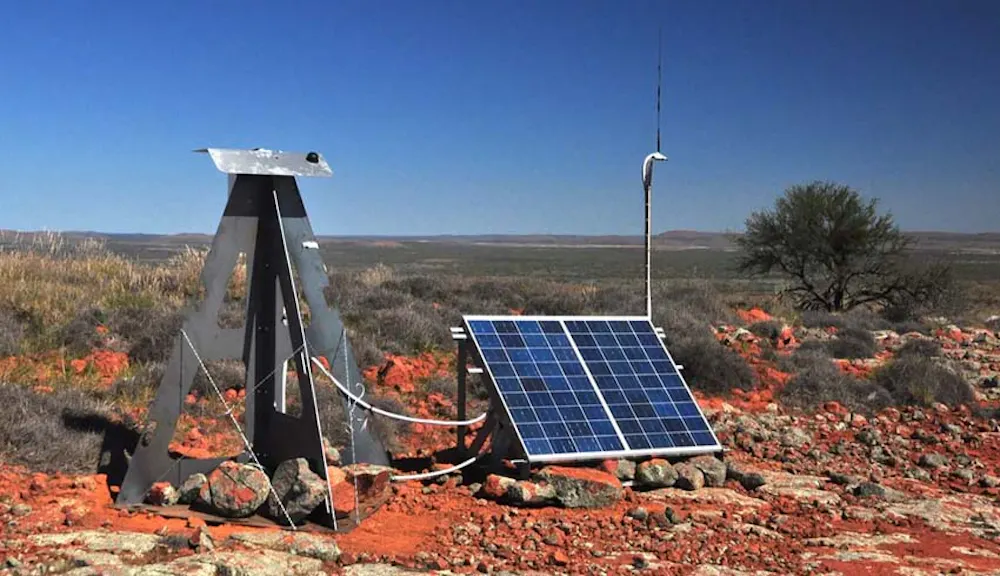
A mechanical panel sitting in a desert in Australia
Desert Fireball Network automated remote observatory in South Australia. The Desert Fireball Network

The Sun is baking the rocks too much

Surprisingly, we found that many asteroid pieces don’t even make it to Earth. Something starts removing the weak stuff while the fragment is still in space. The carbonaceous material, which isn’t very durable, likely gets broken down through heat stress when its orbit takes it close to the Sun.

As carbonaceous chondrites orbit close, and then away from the Sun, the temperature swings form cracks in their material. This process effectively fragments and removes weak, hydrated boulders from the population of objects near the Earth. Anything left over after this thermal cracking then has to survive the atmosphere.

Only 30%-50% of the remaining objects survive the atmospheric passage and become meteorites. The debris pieces whose orbits bring them closer to the Sun tend to be significantly more durable, making them far more likely to survive the difficult passage through Earth’s atmosphere. We call this a survival bias.

For decades, scientists have presumed that Earth’s atmosphere alone explains the scarcity of carbonaceous meteorites, but our work indicates that much of the removal occurs beforehand in space.

Going forward, new scientific advances can help confirm these findings and better identify meteoroid compositions. Scientists need to get better at using telescopes to detect objects right before they hit the Earth. More detailed modeling of how these objects break up in the atmosphere can also help researchers study them.

Lastly, future studies can come up with better methods to identify what these fireballs are made of using the colors of the meteors.The Conversation

Patrick M. Shober, Postdoctoral Fellow in Planetary Sciences, NASA

This article is republished from The Conversation under a Creative Commons license. Read the original article.

Clear Lake Splash In returns to Lake County April 25 to 27

Seaplanes will descend on Lakeport from April 25 to 27, 2025. Lake County News file photo/Elizabeth Larson.

LAKEPORT, Calif. — Organizers are preparing to put out the ramps and red carpet for seaplanes from around the country that will descend on Lake County for the 2025 Clear Lake Splash In from April 25 to 27.

The Splash In is the West Coast's premier seaplane gathering, bringing together pilots, enthusiasts and industry professionals.

The three-day event includes seminars on seaplane operations, demonstrations of innovative aircraft, discussions about developing Clear Lake's seaplane infrastructure, and opportunities to view seaplanes up close at the Skylark Shores Resort.

Seaplanes will begin arriving at 8 a.m. Friday, April 25, kicking off the festivities.

The public is welcome to view seaplanes at the Skylark Shores Resort at no charge from 9 a.m. to 6 p.m. on Friday, April 25, and Saturday, April 26.

On the evening of Saturday, April 26, the event’s award dinner and seaplane film screening will take place beginning at 6 p.m. at the Lakeport Yacht Club.

Splash In organizers have announced special pricing for Lake County residents to attend the dinner and screening, a highlight of the annual seaplane gathering.

Local residents can take advantage of a $25 discount on the regular ticket price for the elegant Italian-inspired dinner and exclusive film screening.

“We're excited to offer this special opportunity for our local community to connect with visiting seaplane pilots and experience the fascinating world of seaplanes,” said Herb Lingl, Clear Lake Splash In coordinator. “This event celebrates both our local community and the rich heritage of seaplane aviation.”

The evening features a gourmet dinner prepared by Park Place in Lakeport and served by the Lakeport Early Lake Lions Club, with the Kiwanis Club of Lakeport hosting a cash bar featuring local Lake County wines.

Following dinner, attendees will enjoy a curated screening of historical and contemporary seaplane films, including rare footage not available to the general public and a special segment created exclusively for the event by Italy's prestigious Aero Club Como, established in 1930.

Tickets for Lake County residents are available at the special price through the event website: bit.ly/4cfxQuL. Seating is limited, and early reservations are encouraged.

Other event highlights include:

• Expert presentations on seaplane operations in Alaska and Montana.
• The popular “Which Seaplane Is Right For You?” seminar series.
• Technical presentations from industry innovators.
• FAA WINGS credit-eligible safety seminars.
• Proposals for developing Clear Lake's seaplane infrastructure.

For more information about the full program of events, visit www.clearlakeflyingclub.com/Clear-Lake-Splash-In-2025_Program.pdf.

Governor vows to fight dismantling of AmeriCorps

On Thursday, Gov. Gavin Newsom announced that as the Trump Administration dismantles the AmeriCorps service program, California will both challenge the illegal action in court and accelerate recruitment for the California Service Corps program — already the largest service corps in the nation, surpassing the size of the Peace Corps.

“We’ve gone from the New Deal, the New Frontier, and the Great Society to a federal government that gives the middle finger to volunteers serving their fellow Americans. We will sue to stop this,” said Newsom.

When the devastating fires struck Los Angeles earlier this year, AmeriCorps members were on the ground, distributing supplies and supporting families.

As recently as this week, AmeriCorps members were on the ground assisting in recovery. The agency’s shutdown hamstrings these efforts.

In Lake County, AmeriCorps members assist with educational programs in the schools, take part in food drives, and have participated in projects benefiting the Clear Lake State Park, the Lake County Fire Protection District, Anderson Marsh State Historic Park and the Lake County Land Trust. In the case of the Land Trust, they built a boardwalk at the Rodman Preserve near Upper Lake.

“DOGE’s actions aren’t about making government work better — it’s about making communities weaker,” said GO-Serve Director Josh Fryday. “These actions will dismantle vital lifelines in communities across California. AmeriCorps members are out in the field teaching children to read, supporting seniors and helping families recover after disasters. AmeriCorps is not bureaucracy; it’s boots on the ground.”

California Service Corps is the largest service force in the nation, consisting of four paid service programs:

• #CaliforniansForAll College Corps.
• California Climate Action Corps.
• Youth Service Corps.
• AmeriCorps California.

Combined, it is a force larger than the Peace Corps and is mobilized at a time when California is addressing post-pandemic academic recovery, rebuilding from the LA fires and planning for the future of the state’s workforce.

The federal government provides more than half of the funding for California Climate Action Corps and about 5% of College Corps, while the state fully funds the Youth Service Corps.

In the 2023-24 service year, 6,264 AmeriCorps members in California:

• Provided 4,397,674 hours of service.
• Tutored/mentored 73,833 students.
• Supported 17,000 foster youth with education and employment.
• Planted 39,288 trees.
• Members helped 26,000 households impacted by the LA fires and packed 21,000 food boxes.

Caltrans honors 194 fallen highway workers at 35th annual Memorial Ceremony, highlighting road safety for all

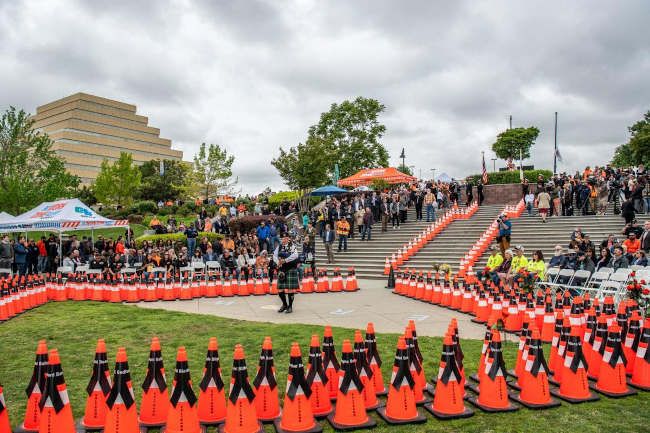
The 35th annual Caltrans Memorial Ceremony on Thursday, April 17, 2025. Photo courtesy of Caltrans.

Caltrans, the families of fallen workers, employees and dignitaries on Thursday honored the 194 Caltrans workers who have lost their lives while working on the state highway system since 1921.

This year’s ceremony is dedicated to the memory of Equipment Operator Alexander Rodish. He died on July 22, 2024, after being struck by a vehicle while working on Interstate 5 in San Clemente.

“We remain committed in honoring these fallen workers and their families while imploring travelers to drive safely on our roads, protecting highway workers and the public,” said Caltrans Director Tony Tavares. “Tragically, this year, we lost one of our own. We mourn alongside the family, friends and coworkers of Alexander Rodish, who lost his life while helping to build a safer state highway system. His legacy will continue to inspire us.”

In 2022, Caltrans instituted a new Director’s Policy on Road Safety, which commits the department to the Safe System approach by prioritizing safety first in design planning and focusing on improving safety on the state’s transportation network.

During the ceremony, Caltrans emphasized road safety and reaffirmed the department’s vision of reaching zero fatalities and serious injuries on state highways by 2050. It also used 194 signature orange cones to create a diamond “caution sign” configuration with each displaying the name of an employee who died on duty.

One black cone in the center of the diamond represented all people killed while working on the state’s highways, including private contractors, tow truck drivers, California Highway Patrol officers and other emergency responders. A second black cone represented Alexander Rodish.

The annual April memorial event provides a poignant setting for families and co-workers to formally pay their respects and provide solemn tributes, while creating a stark reminder for motorists to drive safely and attentively when traveling through highway work zones.

April is National Distracted Driving Awareness Month. It is dedicated to educating drivers about behaviors that often divert attention from the roadway and how safe driving habits can drastically reduce the number of deaths and serious injuries on our roadways.

The commemoration also included the nine-member Caltrans Honor Guard. Additionally, flags flew at half-staff at the State Capitol. In homage to Caltrans’ pride and traditional color scheme, orange light bathed the Capitol dome.

Caltrans partners with the California Transportation Foundation on two funds to benefit the families of workers killed on the job.

The Fallen Workers Assistance and Memorial Fund helps with the initial needs a surviving family faces, and the Caltrans Fallen Workers Memorial Scholarship is available to the children of these workers. For more information or to make donations, visit the California Transportation Foundation.

This year, Ashly Shaw was selected as the recipient of the 2025 Caltrans Fallen Workers Memorial Scholarship. Shaw is the daughter of Si Si Han, who was killed while on duty as a Bay Bridge toll taker in December 2017. She is a senior at KIPP King Collegiate High School in San Lorenzo, where she is the president of the UNICEF Club and has also been recognized as an AP Scholar. Shaw plans to attend the University of California, Davis in the fall.
  • 252
  • 253
  • 254
  • 255
  • 256
  • 257
  • 258
  • 259
  • 260
  • 261

Community

  • Sheriff’s Activities League and Clearlake Bassmasters offer youth fishing clinic

  • City Nature Challenge takes place April 24 to 27

Public Safety

  • Lakeport Police logs: Wednesday, Feb. 11

  • Lakeport Police logs: Tuesday, Feb. 10

Education

  • Ramos measure requiring school officer training in use of anti-opioid drug moves forward

  • Lake County Chapter of CWA announces annual scholarships 

Health

  • California ranks 24th in America’s Health Rankings Annual Report from United Health Foundation

  • Healthy blood donors especially vital during active flu season

Business

  • Employment law summit takes place March 9

  • Two Lake County Mediacom employees earn company’s top service awards

Obituaries

  • Terry Knight

  • Ellen Thomas

Opinion & Letters

  • Who should pay for AI’s power? Not California ratepayers

  • Crandell: Supporting nephew for reelection in supervisorial race

Veterans

  • State honors fallen chief warrant officer killed in conflict in Iran

  • CalVet and CSU Long Beach team up to improve data collection related to veteran suicides

Recreation

  • April Audubon program will show how volunteers can help monitor local osprey nests

  • First guided nature walk of spring at Anderson Marsh State Historic Park April 11

  • Second Saturday guided nature walks continue at Anderson Marsh State Historic Park

  • Wet weather trail closure in effect on Upper Lake Ranger District

Religion

  • Kelseyville Presbyterian Church plans Easter service

  • Easter ‘Sonrise’ Service returns to Xabatin Community Park

Arts & Life

  • ‘CIA’ delves into the shadowy world of an espionage thriller

  • ‘War Machine’ shifts the battlefield into uncharted territory

Government & Politics

  • Lake County Democratic Central Committee endorses Falkenberg

  • Crandell launches reelection campaign plans March 15 event

Legals

  • April 23 hearing on Lake Coco Farms Major Use Permit

  • NOTICE OF 30-DAY PUBLIC COMMENT PERIOD & NOTICE OF PUBLIC HEARING

How to resolve AdBlock issue?
Refresh this page