How to resolve AdBlock issue?
Refresh this page
Lake County News,California
  • Home
    • Registration Form
  • News
    • Education
    • Veterans
    • Community
      • Obituaries
      • Letters
      • Commentary
    • Police Logs
    • Business
    • Recreation
    • Health
    • Religion
    • Legals
    • Arts & Life
    • Regional
  • Calendar
  • Contact us
    • FAQs
    • Phones, E-Mail
    • Subscribe
  • Advertise Here
  • Login
How to resolve AdBlock issue?
Refresh this page

News

Tuleyome Tales: California buckeye – elegance in every season

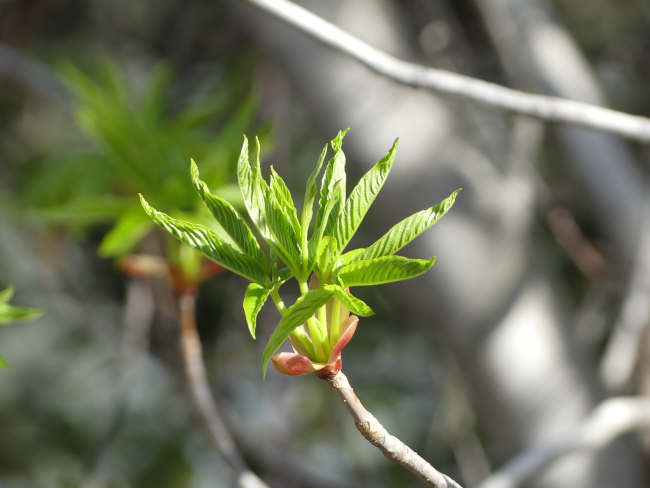
California Buckeye leaves emerging. Photo by Roxanne Moger.


NORTHERN CALIFORNIA — My favorite way of enjoying nature is to watch small changes unfold over the seasons, to visit the same tree for example, throughout the year and see the passing of time written in the branches.

Our native California buckeyes (Aesculus californica) are a feast for the eyes in every season and one of my favorites to visit in this way.

California buckeyes have a graceful appearance with elegant silver-gray bark and branches that meander gently as they lengthen.

Growing in both shrub and tree forms, between 15 and 40 feet, they typically have multi-trunked structures, and rounded crowns that grow as wide as they do tall, giving them a pleasing symmetry.

Aesculus californica are endemic to California and southern Oregon, meaning that they are not found growing naturally anywhere else.

Paleobotanists (scientists who study the evolutionary history of plants) consider them a paleoendemic species, indicating they were once much more widespread, their range restricted over time to a smaller more specialized geographic area.

Today California buckeyes grow along the central coast ranges, in the foothills of the Sierra Nevada and Cascade ranges and in woodlands throughout the Central Valley. They can be found on dry slopes, in canyons, and along stream edges providing natural erosion control, and have been known to live up to 300 years.

These gorgeous trees are a beautiful example of the resilience of California native plants to the challenges of our Mediterranean climate, with hot dry summers and mild wet winters. These adaptations are part of what make this tree so dynamic and compelling to observe.

In mid to late winter Aesculus californica is one of the first trees of the year to put out new foliage, their soft chartreuse buds bursting with new growth as early as February. This early start helps them to take advantage of the winter rains while avoiding the heat of late summer.

By March and April their branches will be flush with shiny dark green, palmately-compound leaves up to 7 inches around. Each leaf has 5 to 7 oblong-lanceolate leaflets, with finely serrated edges radiating from a single point, like fingers on a hand.

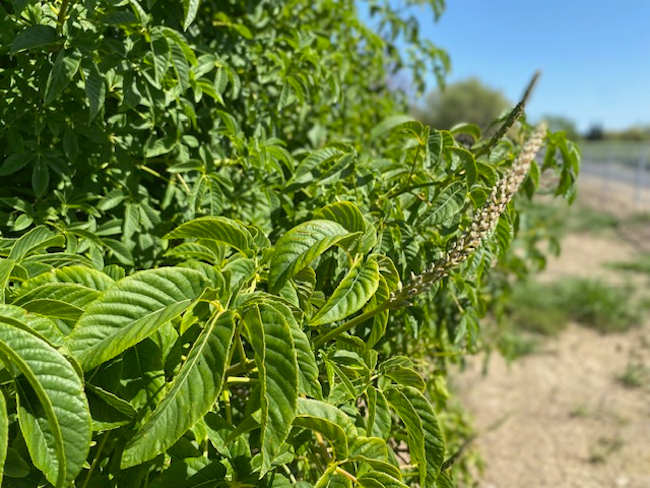
The leaves alone are beautiful, but California buckeyes really begin showing off in May and June with their stunning floral displays. In full bloom, the tree looks like a giant bouquet. The flowers form in panicles, conelike clusters between 6 to 12 inches in length, made up of many pink and cream blooms, with four delicate petals, and long stamens carrying bright orange pollen.

Abundant blooms provide nectar to hummingbirds, butterflies, moths, and many species of native bees which in return provide the service of pollination. Most commonly one or two buckeyes will develop per flower cluster, each resembling a small green pear.

California buckeye trees have developed several clever ways to protect themselves and ensure reproductive success. One of those strategies is that all parts of the tree are poisonous to humans and other mammals.

Toxicity increases the chances of their seeds being left to sprout rather than being eaten in large numbers and ensures that their leaves will not be overgrazed. Tender early leaf growth has lower levels of toxicity and is sometimes grazed upon by deer and California ground squirrels are the only mammal adapted to the toxicity of raw buckeye seeds.

These protective toxins are also present in the nectar and pollen of the tree. Native bees have coevolved with the trees in our region and are able to tolerate the toxins, whereas European honeybees, brought to North America by European settlers in the early 1620s, are not adapted to these toxins and can be harmed if they consume the nectar in large quantities.

Beekeepers have found ways of mitigating the risks to European honeybees by planting other plants with similar bloom times nearby, allowing for a wider range of nectar sources thereby reducing the risk of overconsumption by a hive, or by moving hives during the buckeye flowering period.

California Buckeye leaves and unopened flowers. Photo by Kristie Ehrhardt.


While European honeybees are the most recognizable bee to most of us, California is home to over 1600 species of native bees, many of whom depend on California buckeye blooms for nectar. California native bees range in size from the Perdita minima (currently known to be the smallest bee in the world!) measuring just under two millimeters, to our largest species, the Valley Carpenter Bee or Xylocopa varipuncta that grow up to an inch in length.

Visiting a California buckeye in bloom is a fantastic opportunity for curious naturalists and hikers to get to know some of our native pollinators.

California buckeyes are a culturally significant plant for many indigenous Californians. Various parts of the buckeye tree were used for medicine, and fire drilling. Buckeye seeds were used for fishing, by mashing the seeds and pouring them into water, which dazed or killed fish, making them easier to catch.

Many indigenous Californian peoples including Costanoan, Salinan, Kitanemuk, Serrano, Wappo, Sierra Miwok, Coast Miwok, Chumash, Kawaiisu, and Northern Maidu used buckeye seeds for food in times of scarcity, while the Pomo used them even when other food sources were plentiful.

Raw buckeyes are poisonous, but after an extensive process of grinding, boiling and leaching the toxic tannins, a meal could be formed for use in cooking, similar to the process of leaching toxins from acorns.

Most deciduous trees hold onto their leaves until October or November, but California buckeyes are summer deciduous, dropping their leaves in July and August when temperatures are high and water is scarce. Going dormant in midsummer, the tree conserves water, and is more resistant to drought, another clever adaptation to our intense summers.

Leaves gone, the pear-shaped buckeyes are left hanging like ornaments on the branches. As summer turns to fall, the husks dry, split open, and the glossy brown-orange buckeye is revealed giving a sense of the tree’s namesake, the eye of a deer.

In October and November buckeye seeds begin falling to the ground, leaving the branches ever more graceful in their simplicity. The tree will remain dormant until February comes and starts the process anew and last year’s fallen buckeyes will begin sending down their tap roots shortly after the first rain.

The best way to plant a buckeye is to grow one from a freshly fallen seed, as they dry out quickly. Plant them directly in the ground rather than in a pot which can inhibit the tap root and stunt the tree long term. Once established they are drought tolerant, easy to maintain and provide dynamic nature watching and beauty throughout the year.

Diana Drips is a Certified California Naturalist. Tuleyome is a 501 (c)(3) nonprofit conservation organization based in Woodland, California. For more information go to www.tuleyome.org. 

Helping Paws: Dogs for Easter

LAKE COUNTY, Calif. — Lake County Animal Care and Control has dogs waiting for their new homes at Easter.

The dogs available for adoption this week include mixes of Australian shepherd, border collie, bull mastiff, Catahoula leopard dog, cattle dog, Chihuahua, French bulldog, German shepherd, husky, Labrador Retriever, pit bull terrier, poodle, Rottweiler and Siberian husky.

Dogs that are adopted from Lake County Animal Care and Control are either neutered or spayed, microchipped and, if old enough, given a rabies shot and county license before being released to their new owner. License fees do not apply to residents of the cities of Lakeport or Clearlake.

Those dogs and the others shown on this page at the Lake County Animal Care and Control shelter have been cleared for adoption.

Call Lake County Animal Care and Control at 707-263-0278 or visit the shelter online for information on visiting or adopting.

The shelter is located at 4949 Helbush in Lakeport.

Email Elizabeth Larson at This email address is being protected from spambots. You need JavaScript enabled to view it.. Follow her on Twitter, @ERLarson, and on Bluesky, @erlarson.bsky.social. Find Lake County News on the following platforms: Facebook, @LakeCoNews; X, @LakeCoNews; Threads, @lakeconews, and on Bluesky, @lakeconews.bsky.social.


Oliver's preview photo
Oliver

Mila's preview photo
Mila

Charles's preview photo
Charles

Toby's preview photo
Toby

Timmy's preview photo
Timmy

Mister's preview photo
Mister

O'Reiley's preview photo
O'Reiley

Billy's preview photo
Billy

Chuck's preview photo
Chuck

Lady's preview photo
Lady

Hershey's preview photo
Hershey

Pinto's preview photo
Pinto

Argo's preview photo
Argo

Sadie's preview photo
Sadie

 
Finn's preview photo
Finn

Rome's preview photo
Rome

Karl's preview photo
Karl

Kiley's preview photo
Kiley

Marjorie's preview photo
Marjorie

Lisa's preview photo
Lisa

Maggie's preview photo
Maggie

Talley's preview photo
Talley

Kennel#26(Booty)'s preview photo
Kennel#26(Booty)

Bristol 's preview photo
Bristol

Zena's preview photo
Zena

Kennel#17's preview photo
Kennel#17


Kennel#6's preview photo
Kennel#6

Kennel#8's preview photo
Kennel#8

Kennel#2's preview photo
Kennel#2

Crime is nonpartisan and the blame game on crime in cities is wrong – on both sides


Neither party – Democrats nor Republicans – is doing a better job at fixing crime. Carl Ballou - iStock/Getty Images Plus

Following George Floyd’s death at the hands of police in Minneapolis in 2020, the U.S. has undergone a national reckoning over crime prevention and police reform.

Across the country, calls went out from activists to rethink the scope and role of the police. Some on the left vowed to “defund” the police. Others on the right promised to instead “back the blue” and maintain or increase police funding.

This rhetorical tug-of-war unfolded while many cities across the country grappled with spiking crime rates during the first months of the COVID-19 pandemic.

Blaming crime on Democratic city leaders was a centerpiece of Donald Trump’s 2024 presidential campaign. He repeatedly made claims about crime spikes in recent years without evidence or context.

More recently, Republican congressional leaders have called several Democratic mayors from across the country to testify before Congress about their sanctuary city policies that are aimed at protecting noncitizens from deportation. These congressional politicians have asserted that these Democratic mayors – Brandon Johnson of Chicago, Mike Johnston of Denver, Michelle Wu of Boston, and Eric Adams of New York – have “created a public safety nightmare” in their cities by allowing immigrants without legal authorization to stay there.

Journalists and politicians on both sides of the aisle have claimed that local election results over the past four years in places like San Francisco and Los Angeles reflect a widespread frustration with Democratic policies on crime in cities.

Under this argument, Democratic city leaders need to change their approach on crime to satisfy voters. It’s become a political axiom of sorts that policies championed largely by Democratic city leaders over the past half decade have resulted in rising crime levels.

As researchers of politics and public policy, we wanted to figure out if that was true.

Screenshot of a New York Times headline that says 'Progressive Backlash in California Fuels Democratic Debate Over Crime.'
A New York Times headline from June 8, 2022, linking crime rates and the Democratic Party. The New York Times

Neither party does a better job

As any student of introductory statistics learns, correlation doesn’t imply causation. Looking at increases or decreases in crime rates in Republican or Democratic cities and claiming either party is to blame would be making exactly this error: confusing correlation with causation.

We put to the test the argument that one side or the other is better at fighting crime in our research published in January 2025. By employing three decades of data on mayoral elections from across the country, we were able to disentangle city leaders’ partisanship from other features of cities.

Contrary to much of the political rhetoric and media coverage aimed at most Americans, our results show that neither party is doing a better job at actually causing crime to decrease.

In Dallas, Mayor Eric Johnson has claimed that Democratic leaders aren’t taking public safety seriously and that the Democratic Party is “with the criminals.” Johnson switched from being a Democrat to a Republican in 2023 and attributes his decision at least partially to this partisan difference on crime and policing and the seriousness with which he takes this policy issue.

But our research shows that Johnson’s and others’ claims about Democratic cities becoming more dangerous just aren’t true: Mayors from the Democratic Party aren’t making cities any more – or less – dangerous than mayors from the Republican Party.

Nor, it turns out, is there any support for claims by some progressive Democrats that they would reduce the role – and enormous budgets – of police departments in cities across the country.

When we examined the number of sworn police officers in cities and how much money those cities spend on the police, Democratic and Republican mayors alike have had surprisingly little influence on police department budgets or sizes.

In other words, Democrats aren’t cutting police budgets, nor are Republicans increasing police budgets. Most cities have increased police budgets in the past few years, possibly due to pressure from police unions.

A man at a lectern in a large room with the word 'POLICE' on the wall behind him.
Dallas Mayor Eric Johnson speaks during the second day of the 2024 Republican National Convention in Milwaukee on July 16, 2024. Andrew Caballero-Reynolds/AFP via Getty Images

‘Crime is nonpartisan’

It turns out that campaign promises from both sides of the partisan aisle about crime and policing have little bearing on what’s happening on the ground in most cities and police departments across the country.

Neither party is doing a better job at reducing crime. Nor is either party actually addressing the ballooning financial cost of local police forces in the U.S., nor the long-term reputational costs from police misconduct for trust in the police and government more broadly.

As others have said: crime is nonpartisan.

Crime has decreased across the U.S. during the past three decades overall, and the isolated cities where crime has increased recently can reverse these temporary trends.

Partisan blame narratives do little to actually lower crime and make neighborhoods safer, though.

There are real evidence-backed policies that reduce crime – such as youth jobs programs in Chicago and Boston. Other policies reduce racial disparities in the criminal justice system – such as alternative 911 response programs that use unarmed behavioral health workers to respond to some types of emergencies.

These policies and interventions might not be as slogan-worthy as “defund the police” or “back the blue.” Nor is implementing these policies as politically convenient as blaming sanctuary city mayors. But research shows that they work and can move cities toward the shared goal of improved public safety for their residents.The Conversation

Justin de Benedictis-Kessner, Associate Professor of Public Policy, Harvard Kennedy School and Christopher S. Warshaw, Professor of Political Science, George Washington University

This article is republished from The Conversation under a Creative Commons license. Read the original article.

Lakeport City-Wide Yard Sale set for April 26

LAKEPORT, Calif. — The countdown is on for one of Lakeport’s most anticipated community events—the Lakeport City-Wide Yard Sale, happening Saturday, April 26.

With over 70 yard sales already signed up, the city is ready to transform into a shopper’s paradise filled with hidden gems, great bargains and small-town charm.

Whether you're a seasoned thrifter, vintage hunter or just looking for a fun way to explore Lakeport, this is the perfect opportunity to spend the day strolling through neighborhoods and supporting local families, businesses and community spirit.

Still want to join the fun? It’s not too late to register your yard sale. Sign up now at www.DiscoverLakeportCA.com to get your sale listed on the official yard sale map and downloadable list.

How to plan your yard sale adventure:

• Yard sale list and map available Friday, April 25 at www.DiscoverLakeportCA.com.
• Early access? Newsletter subscribers will receive the full list straight to their inbox on Thursday, April 24. Go to the website to sign up for the newsletter.
• Printed copies of the yard sale list will be available starting at 6 a.m. on April 26 at Susie Q’s Donuts and Espresso or Jitter Bean Lakeport (North Lakeport location).

And it’s not just homes participating — many local stores are offering special sales too, and these deals are also included on the official yard sale list.

Come out and enjoy a day of fun, shopping and community connection. With so many sales and surprises around every corner, there’s truly something for everyone.

For more details or to register your yard sale, visit www.DiscoverLakeportCA.com.

Space News: Scientists found a potential sign of life on a distant planet – an astronomer explains why many are still skeptical


An illustration of the exoplanet K2-18b, which some research suggests may be covered by deep oceans. NASA, ESA, CSA, Joseph Olmsted (STScI)

A team of astronomers announced on April 16, 2025, that in the process of studying a planet around another star, they had found evidence for an unexpected atmospheric gas. On Earth, that gas – called dimethyl sulfide – is mostly produced by living organisms.

In April 2024, the James Webb Space Telescope stared at the host star of the planet K2-18b for nearly six hours. During that time, the orbiting planet passed in front of the star. Starlight filtered through its atmosphere, carrying the fingerprints of atmospheric molecules to the telescope.

A diagram showing planets and stars emitting light, which goes through JWST detectors, where it's split into different wavelengths to make a spectrum. Each spectrum suggests the presence of a different element.
JWST’s cameras can detect molecules in the atmosphere of a planet by looking at light that passed through that atmosphere. European Space Agency

By comparing those fingerprints to 20 different molecules that they would potentially expect to observe in the atmosphere, the astronomers concluded that the most probable match was a gas that, on Earth, is a good indicator of life.

I am an astronomer and astrobiologist who studies planets around other stars and their atmospheres. In my work, I try to understand which nearby planets may be suitable for life.

K2-18b, a mysterious world

To understand what this discovery means, let’s start with the bizarre world it was found in. The planet’s name is K2-18b, meaning it is the first planet in the 18th planetary system found by the extended NASA Kepler mission, K2. Astronomers assign the “b” label to the first planet in the system, not “a,” to avoid possible confusion with the star.

K2-18b is a little over 120 light-years from Earth – on a galactic scale, this world is practically in our backyard.

Although astronomers know very little about K2-18b, we do know that it is very unlike Earth. To start, it is about eight times more massive than Earth, and it has a volume that’s about 18 times larger. This means that it’s only about half as dense as Earth. In other words, it must have a lot of water, which isn’t very dense, or a very big atmosphere, which is even less dense.

Astronomers think that this world could either be a smaller version of our solar system’s ice giant Neptune, called a mini-Neptune, or perhaps a rocky planet with no water but a massive hydrogen atmosphere, called a gas dwarf.

Another option, as University of Cambridge astronomer Nikku Madhusudhan recently proposed, is that the planet is a “hycean world”.

That term means hydrogen-over-ocean, since astronomers predict that hycean worlds are planets with global oceans many times deeper than Earth’s oceans, and without any continents. These oceans are covered by massive hydrogen atmospheres that are thousands of miles high.

Astronomers do not know yet for certain that hycean worlds exist, but models for what those would look like match the limited data JWST and other telescopes have collected on K2-18b.

This is where the story becomes exciting. Mini-Neptunes and gas dwarfs are unlikely to be hospitable for life, because they probably don’t have liquid water, and their interior surfaces have enormous pressures. But a hycean planet would have a large and likely temperate ocean. So could the oceans of hycean worlds be habitable – or even inhabited?

Detecting DMS

In 2023, Madhusudhan and his colleagues used the James Webb Space Telescope’s short-wavelength infrared camera to inspect starlight that filtered through K2-18b’s atmosphere for the first time.

They found evidence for the presence of two simple carbon-bearing molecules – carbon monoxide and methane – and showed that the planet’s upper atmosphere lacked water vapor. This atmospheric composition supported, but did not prove, the idea that K2-18b could be a hycean world. In a hycean world, water would be trapped in the deeper and warmer atmosphere, closer to the oceans than the upper atmosphere probed by JWST observations.

Intriguingly, the data also showed an additional, very weak signal. The team found that this weak signal matched a gas called dimethyl sulfide, or DMS. On Earth, DMS is produced in large quantities by marine algae. It has very few, if any, nonbiological sources.

This signal made the initial detection exciting: on a planet that may have a massive ocean, there is likely a gas that is, on Earth, emitted by biological organisms.

An illustration of what scientists imagine K2-18b to look like, which looks a little like Earth, with clouds and a translucent surface.
K2-18b could have a deep ocean spanning the planet, and a hydrogen atmosphere. Amanda Smith, Nikku Madhusudhan (University of Cambridge), CC BY-SA

Scientists had a mixed response to this initial announcement. While the findings were exciting, some astronomers pointed out that the DMS signal seen was weak and that the hycean nature of K2-18b is very uncertain.

To address these concerns, Mashusudhan’s team turned JWST back to K2-18b a year later. This time, they used another camera on JWST that looks for another range of wavelengths of light. The new results – announced on April 16, 2025 – supported their initial findings.

These new data show a stronger – but still relatively weak – signal that the team attributes to DMS or a very similar molecule. The fact that the DMS signal showed up on another camera during another set of observations made the interpretation of DMS in the atmosphere stronger.

Madhusudhan’s team also presented a very detailed analysis of the uncertainties in the data and interpretation. In real-life measurements, there are always some uncertainties. They found that these uncertainties are unlikely to account for the signal in the data, further supporting the DMS interpretation. As an astronomer, I find that analysis exciting.

Is life out there?

Does this mean that scientists have found life on another world? Perhaps – but we still cannot be sure.

First, does K2-18b really have an ocean deep beneath its thick atmosphere? Astronomers should test this.

Second, is the signal seen in two cameras two years apart really from dimethyl sulfide? Scientists will need more sensitive measurements and more observations of the planet’s atmosphere to be sure.

Third, if it is indeed DMS, does this mean that there is life? This may be the most difficult question to answer. Life itself is not detectable with existing technology. Astronomers will need to evaluate and exclude all other potential options to build their confidence in this possibility.

The new measurements may lead researchers toward a historic discovery. However, important uncertainties remain. Astrobiologists will need a much deeper understanding of K2-18b and similar worlds before they can be confident in the presence of DMS and its interpretation as a signature of life.

Scientists around the world are already scrutinizing the published study and will work on new tests of the findings, since independent verification is at the heart of science.

Moving forward, K2-18b is going to be an important target for JWST, the world’s most sensitive telescope. JWST may soon observe other potential hycean worlds to see if the signal appears in the atmospheres of those planets, too.

With more data, these tentative conclusions may not stand the test of time. But for now, just the prospect that astronomers may have detected gasses emitted by an alien ecosystem that bubbled up in a dark, blue-hued alien ocean is an incredibly fascinating possibility.

Regardless of the true nature of K2-18b, the new results show how using the JWST to survey other worlds for clues of alien life will guarantee that the next years will be thrilling for astrobiologists.The Conversation

Daniel Apai, Associate Dean for Research and Professor of Astronomy and Planetary Sciences, University of Arizona

This article is republished from The Conversation under a Creative Commons license. Read the original article.

Soper Reese Theatre renovation groundbreaking planned April 26

LAKEPORT, Calif. — A new phase in the renovation of Lakeport’s Soper Reese Theatre is kicking off next week.

The renovation’s ceremonial groundbreaking will be part of a public event at 1 p.m. Saturday, April 26, at the theatre, 275 S. Main St., Lakeport.

Members of the Soper Reese management team invite donors, patrons and supporters to join them for a history of the former movie theater, which was built in 1947 by the Reese family and purchased in 1997 by the Lake County Arts Council to become a venue for the performing arts and other community uses.

The building has been used for concerts, classic movies, plays, dances, award ceremonies, town halls, conferences and fundraising events all while undergoing continuous upgrades, repairs and maintenance.

The theater is the home of the Lake County Symphony Association and used for performances by the Lake County Theatre Company.

The afternoon’s program will include depictions of the next phases and costs of development to provide enhanced accessibility for all users.

After a brief presentation and orientation inside the theatre, the gathering will move outdoors to the Martin Street courtyard where participants will don hard hats and wield shovels to break ground to start the renovation.

The immediate construction work will include foundations for new restrooms and the loading dock at the rear of the building, creating compliance for safe entry and exit.

Fundraising for the next phases of renovation is a continuing effort by volunteers.

The management team and the Lake County Arts Council appreciate the supporters from Lake County and beyond who have championed and funded the transformation of the former movie theatre into a modern-day, multi-use community venue.

More information for tax-deductible contributions may be found at https://soperreesetheatre.com/donate/. 

Contact Nina Marino at This email address is being protected from spambots. You need JavaScript enabled to view it. for more information about the groundbreaking event.
  • 251
  • 252
  • 253
  • 254
  • 255
  • 256
  • 257
  • 258
  • 259
  • 260

Community

  • Sheriff’s Activities League and Clearlake Bassmasters offer youth fishing clinic

  • City Nature Challenge takes place April 24 to 27

Public Safety

  • Lakeport Police logs: Wednesday, Feb. 11

  • Lakeport Police logs: Tuesday, Feb. 10

Education

  • Ramos measure requiring school officer training in use of anti-opioid drug moves forward

  • Lake County Chapter of CWA announces annual scholarships 

Health

  • California ranks 24th in America’s Health Rankings Annual Report from United Health Foundation

  • Healthy blood donors especially vital during active flu season

Business

  • Employment law summit takes place March 9

  • Two Lake County Mediacom employees earn company’s top service awards

Obituaries

  • Terry Knight

  • Ellen Thomas

Opinion & Letters

  • Who should pay for AI’s power? Not California ratepayers

  • Crandell: Supporting nephew for reelection in supervisorial race

Veterans

  • State honors fallen chief warrant officer killed in conflict in Iran

  • CalVet and CSU Long Beach team up to improve data collection related to veteran suicides

Recreation

  • April Audubon program will show how volunteers can help monitor local osprey nests

  • First guided nature walk of spring at Anderson Marsh State Historic Park April 11

  • Second Saturday guided nature walks continue at Anderson Marsh State Historic Park

  • Wet weather trail closure in effect on Upper Lake Ranger District

Religion

  • Kelseyville Presbyterian Church plans Easter service

  • Easter ‘Sonrise’ Service returns to Xabatin Community Park

Arts & Life

  • ‘CIA’ delves into the shadowy world of an espionage thriller

  • ‘War Machine’ shifts the battlefield into uncharted territory

Government & Politics

  • Lake County Democratic Central Committee endorses Falkenberg

  • Crandell launches reelection campaign plans March 15 event

Legals

  • April 23 hearing on Lake Coco Farms Major Use Permit

  • NOTICE OF 30-DAY PUBLIC COMMENT PERIOD & NOTICE OF PUBLIC HEARING

How to resolve AdBlock issue?
Refresh this page