How to resolve AdBlock issue?
Refresh this page
Lake County News,California
  • Home
    • Registration Form
  • News
    • Education
    • Veterans
    • Community
      • Obituaries
      • Letters
      • Commentary
    • Police Logs
    • Business
    • Recreation
    • Health
    • Religion
    • Legals
    • Arts & Life
    • Regional
  • Calendar
  • Contact us
    • FAQs
    • Phones, E-Mail
    • Subscribe
  • Advertise Here
  • Login
How to resolve AdBlock issue?
Refresh this page

News

The battle over a global energy transition is on between petro-states and electro-states – here’s what to watch for in 2026

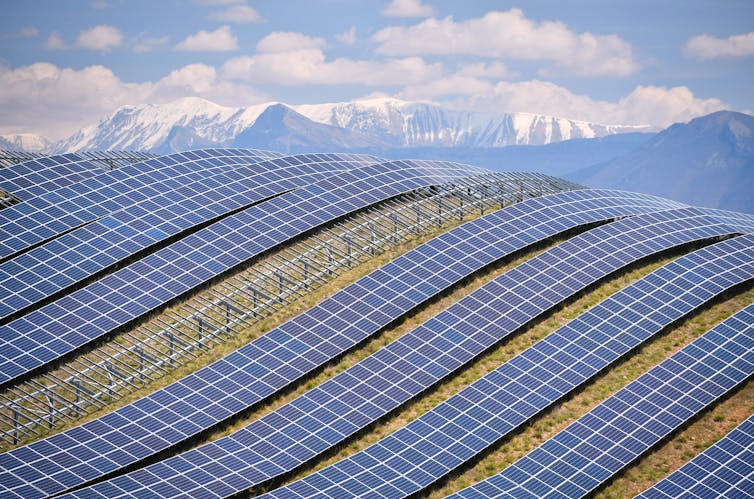
Solar power has been expanding quickly, but natural gas is also booming. Gerard Julien/AFP via Getty Images

Two years ago, countries around the world set a goal of “transitioning away from fossil fuels in energy systems in a just, orderly and equitable manner.” The plan included tripling renewable energy capacity and doubling energy efficiency gains by 2030 – important steps for slowing climate change since the energy sector makes up about 75% of the global carbon dioxide emissions that are heating up the planet.

The world is making progress: More than 90% of new power capacity added in 2024 came from renewable energy sources, and 2025 saw similar growth.

However, fossil fuel production is also still expanding. And the United States, the world’s leading producer of both oil and natural gas, is now aggressively pressuring countries to keep buying and burning fossil fuels.

The energy transition was not meant to be a main topic when world leaders and negotiators met at the 2025 United Nations climate summit, COP30, in November in Belém, Brazil. But it took center stage from the start to the very end, bringing attention to the real-world geopolitical energy debate underway and the stakes at hand.

Brazilian President Luiz Inácio Lula da Silva began the conference by calling for the creation of a formal road map, essentially a strategic process in which countries could participate to “overcome dependence on fossil fuels.” It would take the global decision to transition away from fossil fuels from words to action.

President Lula Da Silva gestures with his hands as he speaks in front of a picture of the Amazon.
Brazilian President Luiz Inácio Lula da Silva speaks at COP30, where he promoted the idea of a road map to help the world speed up its transition from fossil fuels to clean energy. AP Photo/Andre Penner)

More than 80 countries said they supported the idea, ranging from vulnerable small island nations like Vanuatu that are losing land and lives from sea level rise and more intense storms, to countries like Kenya that see business opportunities in clean energy, to Australia, a large fossil-fuel-producing country.

Opposition, led by the Arab Group’s oil- and gas-producing countries, kept any mention of a “road map” energy transition plan out of the final agreement from the climate conference, but supporters are pushing ahead.

I was in Belém for COP30, and I follow developments closely as former special climate envoy and head of delegation for Germany and senior fellow at the Fletcher School at Tufts University. The fight over whether there should even be a road map shows how much countries that depend on fossil fuels are working to slow down the transition, and how others are positioning themselves to benefit from the growth of renewables. And it is a key area to watch in 2026.

The battle between electro-states and petro-states

Brazilian diplomat and COP30 President André Aranha Corrêa do Lago has committed to lead an effort in 2026 to create two road maps: one on halting and reversing deforestation and another on transitioning away from fossil fuels in energy systems in a just, orderly and equitable manner.

What those road maps will look like is still unclear. They are likely to be centered on a process for countries to discuss and debate how to reverse deforestation and phase out fossil fuels.

Over the coming months, Corrêa plans to convene high-level meetings among global leaders, including fossil fuel producers and consumers, international organizations, industries, workers, scholars and advocacy groups.

For the road map to both be accepted and be useful, the process will need to address the global market issues of supply and demand, as well as equity. For example, in some fossil fuel-producing countries, oil, gas or coal revenues are the main source of income. What can the road ahead look like for those countries that will need to diversify their economies?

A man speaks into a microphone. Behind him, a person holds a sign reading: 'Shell: Own up, clean up, pay up'
Nigeria’s Bodo community is suing Renaissance Africa Energy Company Limited, an oil consortium that acquired Shell’s Nigerian subsidiary, over two major oil spills in the Niger Delta in 2008. Shell admitted liability and settled with the community in 2014, committing to cleanup efforts. However, the Bodo community has been critical of the quality and transparency of Shell’s cleanup, and is seeking further damages and remediation. Here, activists protest the company’s actions. Leon Neal/Getty Images

Nigeria is an interesting case study for weighing that question.

Oil exports consistently provide the bulk of Nigeria’s revenue, accounting for around 80% to over 90% of total government revenue and foreign exchange earnings. At the same time, roughly 39% of Nigeria’s population has no access to electricity, which is the highest proportion of people without electricity of any nation. And Nigeria possesses abundant renewable energy resources across the country, which are largely untapped: solar, hydro, geothermal and wind, providing new opportunities.

What a road map might look like

In Belém, representatives talked about creating a road map that would be science-based and aligned with the Paris climate agreement, and would include various pathways to achieve a just transition for fossil-fuel-dependent regions.

Some inspiration for helping fossil-fuel-producing countries transition to cleaner energy could come from Brazil and Norway.

In Brazil, Lula asked his ministries to prepare guidelines for developing a road map for gradually reducing Brazil’s dependency on fossil fuels and find a way to financially support the changes.

His decree specifically mentions creating an energy transition fund, which could be supported by government revenues from oil and gas exploration. While Brazil supports moving away from fossil fuels, it is also still a large oil producer and recently approved new exploratory drilling near the mouth of the Amazon River.

Norway, a major oil and gas producer, is establishing a formal transition commission to study and plan its economy’s shift away from fossil fuels, particularly focusing on how the workforce and the natural resources of Norway can be used more effectively to create new and different jobs.

Both countries are just getting started, but their work could help point the way for other countries and inform a global road map process.

The European Union has implemented a series of policies and laws aimed at reducing fossil fuel demand. It has a target for 42.5% of its energy to come from renewable sources by 2030. And its EU Emissions Trading System, which steadily reduces the emissions that companies can emit, will soon be expanded to cover housing and transportation. The Emissions Trading System already includes power generation, energy-intensive industry and civil aviation.

Fossil fuel and renewable energy growth ahead

In the U.S., the Trump administration has made clear through its policymaking and diplomacy that it is pursuing the opposite approach: to keep fossil fuels as the main energy source for decades to come.

The International Energy Agency still expects to see renewable energy grow faster than any other major energy source in all scenarios going forward, as renewable energy’s lower costs make it an attractive option in many countries. Globally, the agency expects investment in renewable energy in 2025 to be twice that of fossil fuels.

At the same time, however, fossil fuel investments are also rising with fast-growing energy demand.

The IEA’s World Energy Outlook described a surge in new funding for liquefied natural gas, or LNG, projects in 2025. It now expects a 50% increase in global LNG supply by 2030, about half of that from the U.S. However, the World Energy Outlook notes that “questions still linger about where all the new LNG will go” once it’s produced.

What to watch for

The Belém road map dialogue and how it balances countries’ needs will reflect on the world’s ability to handle climate change.

Corrêa plans to report on its progress at the next annual U.N. climate conference, COP31, in late 2026. The conference will be hosted by Turkey, but Australia, which supported the call for a road map, will be leading the negotiations.

With more time to discuss and prepare, COP31 may just bring a transition away from fossil fuels back into the global negotiations.The Conversation

Jennifer Morgan, Senior Fellow, Center for International Environment and Resource Policy and Climate Policy Lab, Tufts University

This article is republished from The Conversation under a Creative Commons license. Read the original article.
City of Clearlake declares emergency over massive Robin Lane sewage spill

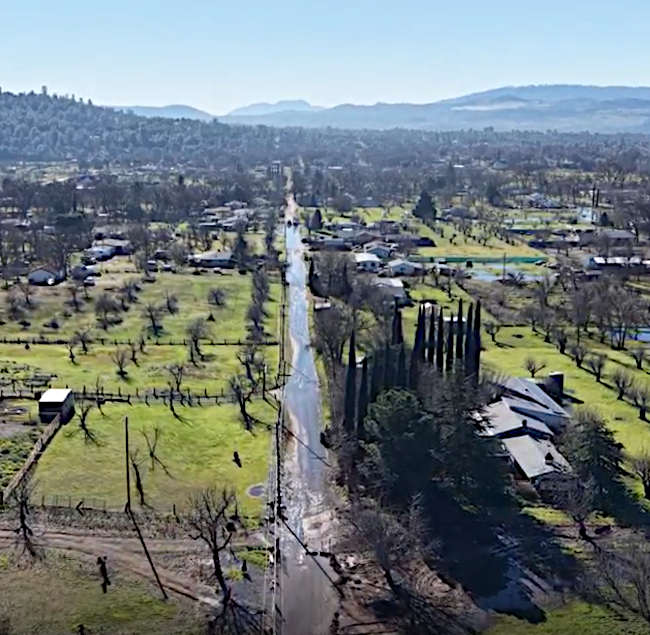
This still image from drone footage shows the Robin Lane sewage spill stretching down a roadway and onto properties. 


LAKE COUNTY, Calif. — The city of Clearlake has declared a local emergency in response to a massive ongoing sewage spill that began on Sunday due to a failure in the county-managed wastewater system.

The incident on Robin Lane, which began on Sunday morning, has impacted dozens of homes in and around the city of Clearlake, spilling raw sewage that has flooded the area south of Pond
Road, north of Rumsey Road, east of Pamela Lane and west of Robin Lane, and spreading into drainage ditches, waterways, Burns Valley Creek and Clear Lake, officials reported.

The wastewater system is managed by the Lake County Sanitation District, or Lacosan, which is under Lake County Special Districts, headed by Administrator Robin Borre.

Lacosan has urged property owners to use bottled water only and not use private well water over concerns for contamination, with an emergency station for clean drinking water having been established at Pond Road and Old Highway 53. 

Water provided by public water systems remains safe to use, Special Districts reported.

While posts on social media sites included statements from area residents about the extent of the spill — with at least one estimating more than 2.5 million gallons released — on Monday afternoon, county spokesman Trevor Mockel said the extent of the release had not yet been fully calculated due to the ongoing nature of the response and repair work.

He said Lake County Special Districts “is actively mitigating the situation to stem the spread while repairs are underway, and assessments are continuing in real time.”

Mockel added, “Until crews are able to fully access the forced main and complete a thorough assessment, all we can confirm at this point is that the forced main failed underground.”

He said a confirmed cause of the failure “will only be determined after repairs are complete and a full evaluation of the line can be conducted.”

Clearlake City Manager Alan Flora told Lake County News that multiple repairs were supposedly completed on Monday, but when he was on-site of the spill’s source in the afternoon, it was still leaking.

“No city facilities have been impacted yet,” Flora said. 

Flora said the city helped with traffic control on Sunday “but that is the only request we have received” to assist the county. 

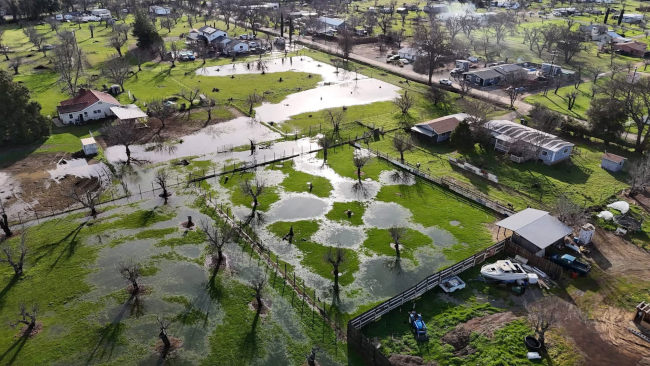
Video of the spill site shared by the city of Clearlake showed the wastewater flowing down roadways, across fields and yards, with pumper trucks and large hoses in place throughout the area.

The Robin Lane sewage spill spread across multiple properties. Photo courtesy of the city of Clearlake.

Emergency declaration gives more details on spill

On Monday night, Flora issued the city’s emergency proclamation, which is expected to be ratified by the Clearlake City Council at its first meeting of the year on Thursday.

The document gave greater details about the incident, which began at 7:45 a.m. Sunday when a 16-inch force main located on Robin Lane ruptured, spilling raw sewage.

The proclamation noted that “the spill quickly resulted in raw sewage flooding the area south of Pond Road and north of Rumsey Road, east of Pamela Lane and west of Robin Lane.”

The city reported that an estimated 58 properties within the spill’s footprint have been directly impacted, “with the majority of those homes using private wells for water supply.”

The document also noted, “multiple faulty valves prohibited isolating the leak and the leak continues up to this point,” and “impacts to the properties, the underlying aquifer, the City’s storm drainage system, road network, creeks and waterways, Clear Lake and many residents is on-going and still unknown in total scope.”

The city’s proclamation requests that the county of Lake and Lacosan also declare a local emergency and a public health emergency.

With the emergency declaration, the city also is seeking from the governor a proclamation declaring an emergency in the city of Clearlake. 

The city’s declaration opens the door for the city to receive recovery assistance from the state and help through federal disaster relief programs.

If the spill is in fact in the millions of gallons, it would put it on par with an April 2006 incident in which between 3.6 and 6 million gallons of treated wastewater ran off the City of Lakeport Municipal Sewer District site, into a tributary of Clear Lake and eventually into the lake itself.

That event resulted in the city being required to make numerous upgrades to its wastewater system in order to address state actions including a hookup ban.

Email Elizabeth Larson at This email address is being protected from spambots. You need JavaScript enabled to view it.. Follow her on Twitter, @ERLarson, and on Bluesky, @erlarson.bsky.social. Find Lake County News on the following platforms: Facebook, @LakeCoNews; X, @LakeCoNews; Threads, @lakeconews, and on Bluesky, @lakeconews.bsky.social. 

Sewer Spill Emergency Declaration 1-12-26 by LakeCoNews

County officials say years of internal reserve spending led to Community Development Department deficit

LAKE COUNTY, Calif.  – What led to the Lake County Community Development Department’s deficit just months after approval of its final budget, necessitating a loan request to the Board of Supervisors to support the department’s operations?

It wasn’t just a drop in building permits that drove the Community Development Department into the red. It was a years-long practice of spending about $1 million in Building Division reserves to prop up other divisions, officials revealed in December.

When the Community Development Department, or CDD, requested a $390,000 emergency loan from the county on Nov. 18 to meet payrolls amid a budget deficit — just two months after supervisors approved a “balanced” budget — CDD Director Mireya Turner attributed the shortfall to “a significant drop in building permits.” 

But on Dec. 9, staff exposed a deeper structural issue at the Board of Supervisors meeting: The department’s Building Division, which is funded primarily by building permit fees, had been effectively using the division reserve to subsidize the Planning and Code Enforcement divisions for multiple years until the reserve was drained.

The years-long transfer of Building Division reserves within CDD went through multiple budget cycles without being identified and corrected by the county’s budgeting process that involved the department, the administrative office as well as the Board of Supervisors.

While the board directed staff to provide further analysis in January, questions regarding the legality of transferring division reserves remain unanswered, as does the concern of paying back general fund loans using income from future permitting costs.

“The source of this problem is a slow and steady trend of reserve spending,” CDD Deputy Administrator Shannon Walker-Smith told the board on Dec. 9. 

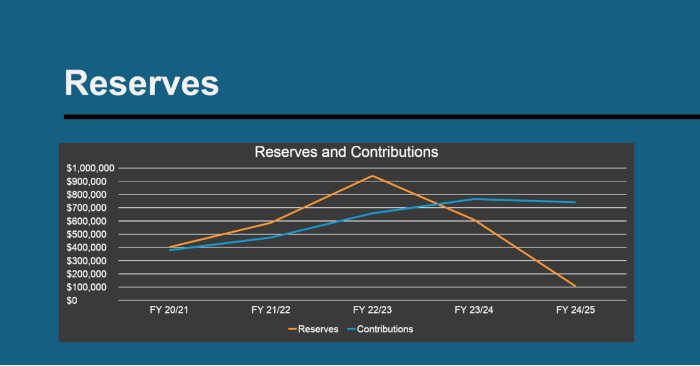
“Most of that is due to contributions to Code and Planning department operations that began in Fiscal Year 2022-23 when Building’s reserves have gotten significantly high,” Walker-Smith said, indicating that the Building Division’s reserve got up to over $900,000 at that time. 

“So the Community Development [Department] was directed to start spending down those reserves as was appropriate at the time,” she said. “Unfortunately, that spending continued.”

Deputy County Administrative Officer Casey Moreno later cited a higher figure, saying more than $1 million had been internally transferred to cover salaries in the receiving divisions.

“Over the past three years, about $1.1 million has been transferred as contributions to those divisions, while just over a million was for salaries,” Moreno said. “Last year, the amount transferred to Code nearly doubled.”

“We did know reserves were spending down, you know, at a rate that was unsustainable,” Walker-Smith said during her presentation. “But it's very difficult when most of the budget revenue is locked up in salaries and other obligated expenses.” 

Department records showed the internal transfer of reserves, labeled as “contributions,” started as early as fiscal year 2020-21 at about $400,000 and peaked at almost $800,000 in fiscal year 2023-24. 


Fiscal year 2023-24 “would have been a good time for us to start looking at course correction,” Walker-Smith said. “But unfortunately, that did not happen.”

Turner admitted that it was her “error” as the department head to “take on the direction of spending down the reserves without a proper full-circle understanding of where that stops and like the long term use of those reserves,” she said. “So I do apologize for that.”

The admission marks a distinct shift in the department's narrative over just three weeks: what was first presented as an external shock — a drop in permitting revenue — is now acknowledged as a result of internal financial decisions.

Lake County News reached out to the county asking about the conflicting explanations of the CDD’s deficit. 

Chief Deputy County Administrative Officer Matthew Rothstein, the administrative office’s spokesperson, said the CDD staff shared “initial impressions” in November with the intent to conduct further analysis. 

“From a budgetary standpoint, revenue did not support appropriations,” Rothstein said in an email on Dec. 11, indicating the department was spending more than it was bringing in. “However, further analysis revealed reserve spending in recent budget years was the greater concern.”

“Director Turner acknowledged that the recent investigation had grown her understanding,” he added.

The financial “course correction” that officials admit was needed years ago appeared to be happening now. 

“Immediately, we have a pause on all intradepartmental funding,” Walker-Smith said. “So no more contributions from Building to Code and Planning, beginning this entire fiscal year.” 

However, the sudden stop of these internal transfers creates an immediate hole in the Code and Planning budgets, which rely on that money for salaries.

“That’s a direct 100% hit to the general fund that obviously we don't necessarily have,” said Assistant County Administrative Officer Stephen Carter. “We need to work out part of that plan at the same time.”

Carter suggested coming up with a CDD plan, not just a plan for the Building Division. 

Staff from the CDD, Administrative Office, and County Counsel are scheduled to provide further analysis of the financial problem, repayment plan, and legality at the Board of Supervisors meeting this Tuesday, at 2 p.m. 

Repayment proposal: Extended from one year to three years

The resolution of the CDD loan approved in November requires a full payback by June 30, 2026 — the end of the current fiscal year. 

“We do anticipate a return to historic norms of permitting in the future, and are confident that we will be able to repay this loan within the fiscal year,” Turner said.

All supervisors at that time said they were skeptical about the viability of the plan. Nonetheless, they voted unanimously to approve the request, with Supervisor Eddie Crandell absent.

“Obviously we have to do something; We’ve got to make payroll,” Supervisor Brad Rasmussen said back then. 

“But I don’t see how we’re going to get paid back,” Supervisor Jessica Pyska added.  

In December, staff reiterated that confidence — but with a significantly extended timeline.
“We do think we can recover and rebuild this budget within a three-year period,” said Walker-Smith.

Carter said the reason for the three-year proposal is because the department needs to build back their reserve which is now depleted. 

Without recovering the reserves, “every July, they’ll have a cash flow problem where they would need a loan of about two months worth of salary,” Carter said. “So that's why, at the same time as paying us back, you need to put a little bit in reserve.”

Supervisors were less skeptical about the longer repayment timeline. 

“I’m comfortable with the three-year repayment, because I think it's important to be able to build reserves while at the same time paying that back,” said Supervisor Rasmussen.

Still, Supervisor Bruno Sabatier warned that there is an opportunity cost with loans the county gives out.

“Anything that we loan out is coming out of our general fund reserves,” he said, adding that these reserves are being invested and generating revenues in the pool. “We’re losing that.”

He continued: “We’re handing — wrong term — we are ‘providing support’ in loans which take away from our taxpayers’ dollars to be invested and create more dollars to put back into services, into our community.”  

“So the longer the loan is, the more we lose out on those opportunities,” Sabatier added.

Right now, the county has given out two loans to avoid disruptions in departmental operations. 

In addition to the $390,000 lent to CDD, the Board of Supervisors in June approved a $2 million loan to Behavioral Health which initially required payback within 90 days. That deadline was not met.

In September, the board approved a 180-day extension for the repayment with Sabatier the sole dissenting vote. 

The December meeting did not result in any formal changes to the CDD’s loan agreement. 

Concerns on legality of loan repayment and reserve spending

At the November meeting, Supervisor Sabatier said he had “grave concerns” about a repayment plan that depends on future permit revenues. 

At that time, he noted that the county is not supposed to “make money off” the rates on county services, raising doubts on the legality of using future permit revenues to pay for services rendered in the past. 

In December, Sabatier brought it up again.

Sabatier said he received a “white paper” from staff saying it is allowable to use permit fees for the loan repayment — and that he disagrees. 

“I just don't understand how a developer in March can pay a fee that helps repay for salaries spent in October,” he said. “That, to me, makes no sense at all.”

Sabatier’s concerns were also compounded by the new discovery of reserve transfers and overspending. 

“I do still have concerns in the way that we have used our funds, the sense that we've used reserves from Building to help pay for Planning — completely different projects.”

Lake County News requested a copy of the “white paper” from the county after the December meeting. Rothstein said in an email that the document was “not disclosable on grounds including attorney-client privilege and attorney work-product privilege.”

What is the legal justification for using these restricted funds of the Building Division to subsidize other divisions? Has the Board of Supervisors authorized such transfers, or is there a section of county code that permits them? 

Lake County News posed these questions in the same request to the county. 

Rothstein’s response did not provide an immediate reference to county code. He reiterated the unavailability of a legal explanation. “As previously noted, legal analysis supporting those statements is not disclosable at this time.”

He added that County Counsel Lloyd Guintivano will be prepared to publicly discuss some of the issues in January.  

Unanswered questions

However, as of the last public discussion in December, many questions regarding the department’s financial decisions and the county’s budgeting oversight remained untouched:

How had the Building Division accumulated a reserve pool of over $900,000 in the first place? Who or what processes directed and authorized the inter-division transfer of those reserves for years? Why wasn’t a “course correction” made sooner — and why did the Board of Supervisors and county staff only appear to recognize the problem after the division reserve was drained and a loan was needed to cover salaries? 

Why didn’t this discussion surface at the June budget hearings — or at least, prior to the final budget approval in September? 

“The Administrative Office relies on departments who accurately project their financial needs to sustain operations,” Moreno said at one point, before she went into details of the CDD’s reserve spending. “During the annual budgeting process, we meet with each department to review their budget and as needed throughout the year.”

Later, Turner of CDD briefly brought up the lack of sufficient, productive time with the administrative office during budgeting. 

“Additionally, in preparation for this meeting, we have had a number of meetings with admin that have been productive and helpful,” Turner said. “And there, we were able to have the types of discussions that we don't usually get to have when we're preparing a budget, because they're busy with everybody's budgets, and so we get a little bit of time.”

Lingzi Chen is a staff reporter at Lake County News and a 2024-2026 California Local News Fellow. Email her at This email address is being protected from spambots. You need JavaScript enabled to view it.. 

Lakeport Planning Commission to consider allowing temporary cannabis events at fairgrounds

LAKEPORT, Calif. — The Lakeport Planning Commission will consider an ordinance to change city code to allow for temporary cannabis events at the Lake County Fairgrounds.

The commission will meet at 5:30 p.m. Wednesday, Jan. 14, in the council chambers at Lakeport City Hall, 225 Park St.

The agenda is available here.

To speak on an agenda item, access the meeting remotely here; the meeting ID is 814 1135 4347, pass code is 847985. 

To join by phone, dial 1-669-444-9171; for one tap mobile, +16694449171,,81411354347#,,,,*847985#.

Comments can be submitted by email to This email address is being protected from spambots. You need JavaScript enabled to view it.. To give the city clerk adequate time to print out comments for consideration at the meeting, please submit written comments before 4:30 p.m. on Wednesday, Jan. 14.

The commission’s main item of business is its consideration of the recommendation of an ordinance amending sections of the Lakeport Municipal Code regarding commercial cannabis events.

Specifically, the proposed changes would allow limited temporary cannabis events at the Lake County Fairgrounds, whose chief executive officer recently contacted the city about a proposal to host a temporary cannabis event this spring with cannabis retail sales permitted, according to a report to the commission from Community Development Director Joey Hejnowicz.

“The Lake County Fairgrounds has expressed interest in hosting a cannabis-related event as part of its broader, year-round event programming strategy intended to increase community engagement, attract visitors, and support the long-term financial sustainability of the Fairgrounds,” Hejnowicz wrote. “The Fairgrounds regularly hosts large, managed events and has the infrastructure, staffing capacity, and security experience necessary to accommodate specialized, regulated events.”

He said the proposed cannabis event “is envisioned as a springtime gathering designed to showcase and celebrate Lake County's local cannabis growers and farmers, many of whom are long-standing agricultural producers within the region. The event would combine cannabis-related programming with live music and entertainment to create a destination-style
event that highlights Lake County's unique agricultural identity and emerging cannabis economy.”

Hejnowicz’s report said the amendment to the municipal code “is structured as a prohibition citywide with a limited exception at a single established venue,” in this case, the fairgrounds, and requires compliance with state law and all Department of Cannabis Control license conditions. 

Staff is recommending the commission adopt the draft ordinance with the changes and find that the proposed amendment to Chapter 5.34 of the Lakeport Municipal Code “appropriately balances local control with state cannabis regulations, supports economic development and community events at an established venue, and maintains robust safeguards to protect public health, safety, and welfare.”

Email Elizabeth Larson at This email address is being protected from spambots. You need JavaScript enabled to view it.. Follow her on Twitter, @ERLarson, and on Bluesky, @erlarson.bsky.social. Find Lake County News on the following platforms: Facebook, @LakeCoNews; X, @LakeCoNews; Threads, @lakeconews, and on Bluesky, @lakeconews.bsky.social. 

Viral outbreaks are always on the horizon – here are the viruses an infectious disease expert is watching in 2026

Viruses know no borders. mammuth/iStock via Getty Images Plus

A new year might mean new viral threats.

Old viruses are constantly evolving. A warming and increasingly populated planet puts humans in contact with more and different viruses. And increased mobility means that viruses can rapidly travel across the globe along with their human hosts.

As an infectious diseases physician and researcher, I’ll be keeping an eye on a few viruses in 2026 that could be poised to cause infections in unexpected places or in unexpected numbers.

Influenza A – on the cusp of a pandemic

Influenza A is a perennial threat. The virus infects a wide range of animals and has the ability to mutate rapidly. The most recent influenza pandemic – caused by the H1N1 subtype of influenza in 2009 – killed over 280,000 people worldwide in its first year, and the virus continues to circulate today. This virus was often called swine flu because it originated in pigs in Mexico before circulating around the world.

Most recently, scientists have been monitoring the highly-pathogenic avian influenza H5N1 subtype, or bird flu. This virus was first found in humans in southern China in 1997; wild birds helped spread the virus around the world. In 2024, the virus was found for the first time in dairy cattle in the U.S. and subsequently became established in herds in several states.

Cow standing in a pen, looking into camera
Avian flu has spread across dairy herds in the U.S. USDA Agricultural Research Service via AP

The crossover of the virus from birds to mammals created major concern that it could become adapted to humans. Studies suggest there have already been many cow-to-human transmissions.

In 2026, scientists will continue to look for any evidence that H5N1 has changed enough to be transmitted from human to human – a necessary step for the start of a new influenza pandemic. The influenza vaccines currently on the market probably don’t offer protection from H5N1, but scientists are working to create vaccines that would be effective against the virus.

Mpox – worldwide and liable to worsen

Mpox virus, formerly called monkeypox virus, was first discovered in the 1950s. For many decades, it was seen rarely, primarily in sub-Saharan Africa. Contrary to its original name, the virus mostly infects rodents and occasionally crossed over into humans.

Mpox is closely related to smallpox, and infection results in a fever and painful rash that can last for weeks. There are several varieties of mpox, including a generally more severe clade I and a milder clade II. A vaccine for mpox is available, but there are no effective treatments.

Microscopy image of clusters of teal circles
Mpox has spread around the world. NIAID/Wikimedia Commons, CC BY-SA

In 2022, a global outbreak of clade II mpox spread to more than 100 countries that had never seen the virus before. This outbreak was driven by human-to-human transmission of the virus through close contact, often via sex.

While the number of mpox cases has significantly declined since the 2022 outbreak, clade II mpox has become established around the world. Several countries in central Africa have also reported an increase in clade I mpox cases since 2024. Since August 2025, four clade I mpox cases have occurred in the U.S., including in people who did not travel to Africa.

It is unclear how mpox outbreaks in the U.S. and abroad will continue to evolve in 2026.

Oropouche virus – insect-borne and poised to spread

Oropouche virus was first identified in the 1950s on the island of Trinidad off the coast of South America. The virus is carried by mosquitoes and small biting midges, also known as no-see-ums.

Most people with the virus experience fever, headache and muscle aches. The illness usually lasts just a few days, but some patients have weakness that can persist for weeks. The illness can also recur after someone has initially recovered.

Close-up of small winged bug on human skin
Biting midges – which carry Oropouche virus – are hard to see, as their alias ‘no-seem-ums’ implies. CSIRO via Wikimedia Commons, CC BY-SA

There are many unanswered questions about the Oropouche virus and the disease it causes, and there are no specific treatments or vaccines. For decades, infections in people were thought to occur only in the Amazon region. However, beginning in the early 2000s, cases began to show up in a larger area of South America, Central America and the Caribbean. Cases in the United States are usually among travelers returning from abroad.

In 2026, Oropouche outbreaks will likely continue to affect travelers in the Americas. The biting midge that carries Oropouche virus is found throughout North and South America, including the southeastern United States. The range of the virus could continue to expand.

Even more viral threats

A number of other viruses pose a risk in 2026.

Continuing global outbreaks of chikungunya virus may affect travelers, some of whom may want to consider getting vaccinated for this disease.

Measles cases continue to rise in the U.S. and globally against the backdrop of decreasing vaccination rates.

HIV is poised for a resurgence, despite the availability of effective treatments, due to disruptions in international aid.

Person standing in room, holding pills in hand
Despite the availability of effective treatments, diseases like HIV and measles are seeing resurgences. Brian Inganga/AP Photo

And as-yet-undiscovered viruses can always emerge in the future as humans disrupt ecosystems and travel around the world.

Around the world, people, animals and the wider environment are dependent on each other. Vigilance for known and emerging viral threats and the development of new vaccines and treatments can help keep everyone safe.The Conversation

Patrick Jackson, Assistant Professor of Infectious Diseases, University of Virginia

This article is republished from The Conversation under a Creative Commons license. Read the original article.
Supervisors to discuss Community Development budget, purchasing rules, Public Works and Public Services merger

LAKE COUNTY, Calif. – The Board of Supervisors this week will tackle major issues within county government, including the Community Development Department’s budget deficit and loan repayment, proposed changes to the county’s purchasing rules that could expand staff authority, and a possible merger of two large county departments. 

The‌ ‌board will meet beginning ‌at‌ ‌9‌ ‌a.m. Tuesday, Jan. 13, in the board chambers on the first floor of the Lake County Courthouse, 255 N. Forbes St., Lakeport.

The‌ ‌meeting‌ ‌can‌ ‌be‌ ‌watched‌ ‌live‌ ‌on‌ ‌Channel‌ ‌8, ‌online‌ ‌and‌ ‌on‌ ‌the‌ ‌county’s‌ ‌Facebook‌ ‌page. ‌Accompanying‌ ‌board‌ ‌documents, ‌the‌ ‌agenda‌ ‌and‌ ‌archived‌ ‌board‌ ‌meeting‌ ‌videos‌ ‌also‌ ‌are‌ ‌available‌ ‌at‌ ‌that‌ ‌link. ‌ ‌

To‌ ‌participate‌ ‌in‌ ‌real-time, ‌join‌ ‌the‌ ‌Zoom‌ ‌meeting‌ ‌by‌ ‌clicking‌ ‌this‌ ‌link‌. ‌ ‌

The‌ ‌meeting‌ ‌ID‌ ‌is‌ 865 3354 4962, ‌pass code 726865.‌ ‌The meeting also can be accessed via one tap mobile at +16694449171,,86533544962#,,,,*726865#. The meeting can also be accessed via phone at 669 900 6833.

At 2 p.m., the board will return to a discussion of the Community Development Department’s, or CDD’s, budget deficit – reported less than two months after the board approved a “balanced” budget in September – and plans to repay a $390,000 county loan approved in November to meet payroll. 

It will be the board’s third discussion on this matter, following board meetings on Nov. 18 and Dec. 9.

At the December meeting, CDD staff said the deficit stemmed from “a slow and steady trend of reserve spending,” with the Building Division’s reserves used to cover operations in the Code Enforcement and Planning divisions within the department. 

“Over the past three years, about $1.1 million has been transferred as contributions to those divisions, while just over a million was for salaries,” Deputy County Administrative Officer Casey Moreno said at that meeting. 

This week, CDD and County Administrative Office staff are expected to provide further financial analysis for all CDD divisions, a summary of nonrevenue generating activities for each division, an overview of loan repayment options and timelines, and a high-level fee analysis, according to the staff memo.

County Counsel will also provide input on the legal guidance on fee adoption and use of collected permitting fees. 

At 11:30 a.m., the board will hold a public hearing on the County Administrative Officer’s request to amend the county’s “purchasing ordinance” which governs bidding and purchasing process for public projects. 

This item was continued from the Dec. 9 meeting. 

Key changes proposed include allowing staff to approve bidding exemptions for contracts up to $100,000 and removing the Board of Supervisors from decisions to exempt projects from competitive bidding when it is deemed not in the public interest. 

The staff memo said these changes will improve “efficiency and clarify purchasing for further transparency.”

In the untimed items, the board will be asked to consider and approve combining the Public Works and Public Services departments into “a single, integrated department.”

Staff recommend appointing Lars Ewing, who is both the current Public Services Director and Interim Public Works director, as interim director of the consolidated department, according to the staff memo. 

Consolidation may allow the departments to share standards and expertise and better coordinate capital projects and administrative processes, the memo said. 

While the memo also cites fiscal and staffing benefits, the budget figures included in the memo do not reflect any reduction.

Public Works is currently allocated 60 full-time equivalent positions with an annual budget in the range of $40–45 million, while Public Services has 51 positions and a $30–35 million budget. 

Under the proposal, “the combined department would include approximately 110 FTE positions and a total annual operating budget in the range of $70-$80 million,” according to the memo – reflecting the sum of the two departments rather than a downsizing of staff or spending.

The full agenda follows. 

CONSENT AGENDA

5.1: Approve continuation of emergency proclamation declaring a shelter crisis in the County of Lake.

5.2: Approve continuation of proclamation of the existence of a local emergency due to pervasive tree mortality.

5.3: Approve continuation of proclamation declaring a Clear Lake Hitch emergency.

5.4: (a) Approve proclamation of the Lake County Board of Supervisors commending public officials for exemplary service in public safety; and (b) authorize staff to add the names of honorees and the Chair to sign and issue each completed proclamation for the corresponding honoree at the awards ceremony.

5.5: Approve out-of-state travel for District 5 Supervisor Jessica Pyska and District 2 Supervisor Bruno Sabatier to attend the National Association of Counties (NACo) annual Legislative Conference in Washington D.C. from February 20 to February 25, 2026.

5.6: Approve amendment No. 1 to agreement between the County of Lake and Lake County Resource Conservation District for services under the Adaptation Planning Grant Program Agreement with the Governor’s Office of Planning and Research and authorize the Chair to sign.

5.7: Approve side letter to Lake County Deputy Sheriff Association Unit 16 July 1, 2025 – June 30, 2028, MOU.

5.8: Approve Board of Supervisors meeting minutes December 9, 2025.

5.9: (Second reading) Adopt ordinance amending Chapter 5 of the Lake County Code and adopting by reference the 2025 California Building Standards Code, including Title 24 Parts 1–12, Wildland-Urban Interface, and International Property Maintenance Code.

5.10: (a) Adopt resolution authorizing the 2026-2027 Grant Project—Lake County Child Advocacy Center Program; and (b) authorize the Chair to sign the grant subaward certification of assurance of compliance.

5.11: Approve the 2025-2026 Community Corrections Partnership Plan.

5.12: Approve acceptance of $275,000 additional Housing and Disability Advocacy Program (HDAP) funding for FY 26/27.

5.13: Approve task order proposal from on-call engineer, Brelje & Race Consulting Engineers, and allow Special Districts to move forward with design and preparation of a bid package for sewer main lining and lift station lining.

5.14: (Sitting as the Board of Directors Lake County Watershed Protection District) Approve award of contract for consulting services—Sunny Day Flood Scenario and Inundation Map Compliance for Highland Creek and Adobe Creek Dams in the amount of $32,500; and authorize the Chair to sign and the Water Resources Director to execute the contract.

5.15: (Sitting as the Board of Directors Lake County Watershed Protection District) Approve the purchase and sale agreement with Donna Koker for property within the Middle Creek Flood Damage Reduction and Ecosystem Restoration Project and authorize the Chair of the Board of Directors to sign.

TIMED ITEMS

6.1, 9:02 a.m.: Public input.

6.2, 9:03 a.m.: Pet of the week.

6.3, 9:04 a.m.: New and noteworthy at the library.

6.4, 9:15 a.m.: Consideration of presentation giving an update on the Light Detection and Ranging (LiDAR) derivatives available to the public.

6.5, 9:30 a.m.: Consideration of presentation on the UC Davis Clear Lake Restoration Project.

6.6, 9:45 a.m.: (Sitting as the Lake County Air Quality Management District Board of Directors) Consideration of Air Toxics Hot Spots Report for 2024 presentation and discussion.

6.7, 10:05 a.m.: Public hearing—Consideration of draft resolution adopting the Lake County Climate Adaptation Plan.

6.8, 10:45 a.m.: 2026 Governance Workshop presentation for Probation.

6.9, 11 a.m.: Public hearing (continued from Nov. 18, 2025) – consideration of an ordinance amending Article VIII of Chapter 18 of the Lake County Code to implement a low value property tax exemption.

6.10, 11:15 a.m.: Public hearing – Consideration of resolution approving an application for funding and execution of a grant agreement and any amendments thereto from the 2025 funding year of the State CDBG program.

6.11, 11:30 a.m.: Public hearing (continued from Dec. 9, 2025) – Consideration of an ordinance amending the Purchasing Ordinance: Article X of Chapter Two of the Lake County Code to clarify powers and duties, additional exemptions from competitive bidding, and include increased purchasing limits for public projects.

6.12, 1 p.m.: Consideration of the distribution of excess proceeds in the amount of $663,489.75 from Tax Defaulted Land Sale #162 held May 31, 2024 per R&T §4675.

6.13, 1:15 p.m.: Consideration of a resolution to authorize the California Statewide Communities Development Authority to establish a Community Facilities District for the Guenoc Development.
6.14, 1:30 p.m.: Consideration of proposed findings of fact and decision in the appeal of Maria Kann and Associates (PL-25-198).

6.15, 2 p.m.: Presentation of update on Community Development Department (CDD) loan repayment plan.

NON-TIMED ITEMS

7.1: Supervisors’ weekly calendar, travel and reports.

7.2: Consideration of a supplemental response to the 2024-25 Lake County Civil Grand Jury’s final report.

7.3: Consideration of the following advisory board appointments: Cobb Municipal Advisory Council; Kelseyville Cemetery District; Lake County Ag Advisory Committee; Lower Lake Cemetery District.

7.4: (Second reading) Consideration of ordinance to amend Chapter 21, Articles 4–13, 18, 19, 27 and 68 of the Lake County Zoning Code to implement General Plan Sixth Cycle Housing Element Policies HE-38, HE-59, HE-60, HE-61, HE-71, HE-72 and HE-73.

7.5: Consideration of consolidation of Public Works and Public Services Departments.

7.6: Consideration of letter to the Board of State and Community Corrections (BSCC) regarding proposed juvenile detention regulations.

CLOSED SESSION

8.1, Public employee evaluation: Title—County Counsel.

Lingzi Chen is a staff reporter at Lake County News and a 2024-2026 California Local News Fellow. Email her at This email address is being protected from spambots. You need JavaScript enabled to view it.. 

  • 64
  • 65
  • 66
  • 67
  • 68
  • 69
  • 70
  • 71
  • 72
  • 73

Community

  • Sheriff’s Activities League and Clearlake Bassmasters offer youth fishing clinic

  • City Nature Challenge takes place April 24 to 27

Public Safety

  • Lakeport Police logs: Wednesday, Feb. 11

  • Lakeport Police logs: Tuesday, Feb. 10

Education

  • Ramos measure requiring school officer training in use of anti-opioid drug moves forward

  • Lake County Chapter of CWA announces annual scholarships 

Health

  • California ranks 24th in America’s Health Rankings Annual Report from United Health Foundation

  • Healthy blood donors especially vital during active flu season

Business

  • Employment law summit takes place March 9

  • Two Lake County Mediacom employees earn company’s top service awards

Obituaries

  • Terry Knight

  • Ellen Thomas

Opinion & Letters

  • Who should pay for AI’s power? Not California ratepayers

  • Crandell: Supporting nephew for reelection in supervisorial race

Veterans

  • State honors fallen chief warrant officer killed in conflict in Iran

  • CalVet and CSU Long Beach team up to improve data collection related to veteran suicides

Recreation

  • April Audubon program will show how volunteers can help monitor local osprey nests

  • First guided nature walk of spring at Anderson Marsh State Historic Park April 11

  • Second Saturday guided nature walks continue at Anderson Marsh State Historic Park

  • Wet weather trail closure in effect on Upper Lake Ranger District

Religion

  • Kelseyville Presbyterian Church plans Easter service

  • Easter ‘Sonrise’ Service returns to Xabatin Community Park

Arts & Life

  • ‘CIA’ delves into the shadowy world of an espionage thriller

  • ‘War Machine’ shifts the battlefield into uncharted territory

Government & Politics

  • Lake County Democratic Central Committee endorses Falkenberg

  • Crandell launches reelection campaign plans March 15 event

Legals

  • April 23 hearing on Lake Coco Farms Major Use Permit

  • NOTICE OF 30-DAY PUBLIC COMMENT PERIOD & NOTICE OF PUBLIC HEARING

How to resolve AdBlock issue?
Refresh this page