 How to resolve AdBlock issue?
Recreation
- Details
- Written by: Elizabeth Larson
The next guided nature walk will be held on Saturday, April 8.
- Details
- Written by: California Department of Fish and Wildlife
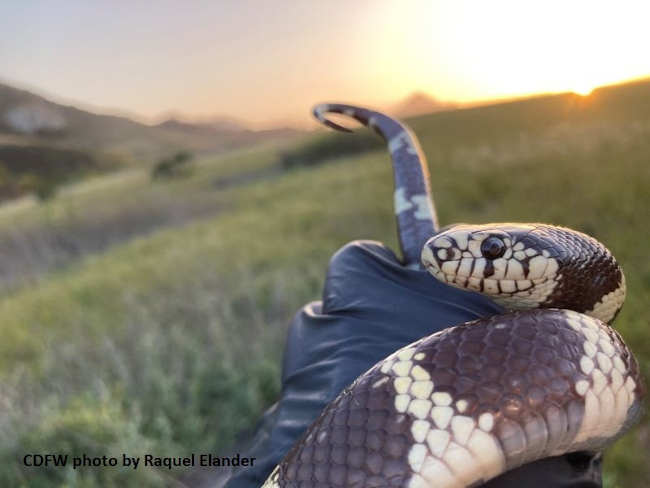
Is it legal to release kingsnakes into the wild for rattlesnake control?
Q: Someone posted on Facebook that they were seeking a kingsnake to breed and release into the wild for rattlesnake control. Wouldn’t that be illegal? Should I report the post to CDFW?
A: Yes, this would be illegal. Written authorization from the California Department of Fish and Wildlife (CDFW) is required to release animals into the wild. CDFW would not approve this release for two general reasons: (1) The risk of spreading pathogens and parasites and (2) The risk of introducing new genotypes into the environment which could impact the species or ecosystem.
California kingsnakes are ubiquitous and habitat generalists. If a property doesn’t already have California kingsnakes, then it’s probably not suitable habitat. It wouldn’t be a healthy environment for the snakes, and they probably wouldn’t persist for long.
You can report release of captive wildlife through CalTIP, which stands for Californians Turn in Poachers and Polluters. Reports can be submitted anonymously. We genuinely appreciate your help in protecting against those who illegally harm the state’s natural resources!
Kingsnake photo: Taken by CDFW Scientific Aid Raquel Elander while investigating snake fungal disease.
Patches
Q: I’m a patch collector. Can CDFW send me any departmental patches for my collection?
A: CDFW does not typically give out departmental patches to the general public. However, we do participate in the California Wildlife Officers Foundation’s (CalWOF) Pink Patch Project, a public awareness campaign supporting breast cancer awareness and research. Pink Patch Project CDFW patches are currently sold out, but when they are back in stock, they can be purchased through CalWOF’s website.
Air rifles
Q: Can I use a big-bore air rifle to hunt big game like wild pigs, deer and bears in California?
A: No, big-bore air rifles cannot be used for the take of big game species or migratory game birds. However, they can be used to take small game mammals and resident game birds.
The allowable “methods of take” for big game animals can be found in California Code of Regulations (CCR), Title 14, section 353. Air guns are not listed as an allowable method of take.
Note that air rifles are not considered “firearms” in California. Pre-charged pneumatics (PCP) big-bore air rifles use compressed air as a propellant to fire pellets.
Wildlife Violator Compact
Q: What is the Interstate Wildlife Violator Compact?
A: The Interstate Wildlife Violator Compact (IWVC) is an agreement between 47 states which allows for the reciprocal recognition of hunting and fishing license suspensions. If your license privileges have been suspended by another state, the suspension may be recognized here in California. For example, if your sport fishing or hunting privileges have been suspended in Colorado for five years, your privileges may also be suspended for five years in California or any of the states participating in the IWVC. The purchase of licenses or tags during the term of the suspension is a violation of the law and may result in prosecution. Licenses or tags purchased prior to or during a suspension are not refundable. Information on member states can be found on the National Association of Conservation Law Enforcement Chiefs website.
Over the years, CDFW has received occasional calls from hunters or anglers wondering why they were not allowed to purchase a hunting or fishing license at a California vendor. A common reason is that they have an unpaid citation in another state for something as simple as fishing without a license. That failure to take care of the fishing without a license citation would put them in the IWVC, which would prohibit them from purchasing a fishing license in California or any of the other participating 46 states until it is handled per the direction of the out-of-state court.
- Details
- Written by: Bureau of Land Management
The public must register to participate in the virtual public meeting. Registrants will then receive a link and phone numbers to join the meeting. Please contact the BLM for reasonable accommodations to participate.
“This public meeting will give off-highway vehicle users a chance to visit with BLM staff and discuss changes or improvements to enhance outdoor recreation,” said BLM Ukiah Field Manager Nicholas Lavrov. “The BLM will use public feedback to prepare grant applications to the California State Parks’ Off-Highway Motor Vehicle Recreation Division (Division) Grants and Cooperative Agreements Program for law enforcement, restoration, and ground operations and maintenance projects.”
The Division supports well-managed off-highway vehicle recreation in California by distributing more than $30 million annually collected from gas tax, entrance fees and OHV sticker registrations.
Cities, counties, districts, federal and state agencies, educational institutions, federally recognized Native American Tribes and nonprofit entities can apply for funds to develop, maintain and restore trails; provide law enforcement; and offer safety and training for riders.
Preliminary applications must be submitted to the Division no later than Mar. 6 and will be available on their website at www.ohv.parks.ca.gov for additional public review and comment from Mar. 7 through May 1.
The website will provide detailed instructions for accessing the preliminary applications and submitting comments.
Public comments must be submitted to both the Division and to the BLM Ukiah Field Office by May 1, 2023.
Comments may also be emailed to the BLM at
- Details
- Written by: Anderson Marsh State Historic Park
The walks begin at 8:30 a.m.
Parking is free for those attending. No pets are permitted on the park trails. The leisurely walks are led by volunteer State Parks docents on a 3-mile trail over mostly level terrain.
There is no charge for the guided nature walks and parking is free for those attending.
The next guided nature walk is scheduled for Saturday, Feb. 11. The February nature walk will be led by Henry Bornstein, a certified California Naturalist and volunteer State Parks docent.
Bring binoculars and meet in the parking lot at 8:15 a.m. for time to experience the early morning wildlife that can be found in the Ranch House and Barn complex yard. The walk will begin at 8:30 a.m.
Everyone is invited to take a walk in the park and experience the benefits of getting out into nature for some healthy exercise. Rain will cancel the walk.
Anderson Marsh State Historic Park is located on Highway 53, between Lower Lake and Clearlake.