 How to resolve AdBlock issue?
Recreation
- Details
- Written by: Editor
Kelseyville holds a commanding lead in the series, 7 to 3, while Clear Lake is looking to win its second Bass Bowl in a row.
The visiting Cardinals will enter the game with two wins and one loss and are averaging nearly 21 points per game while giving up just 12.
The home team Knights bring a 0-3 record, and have been struggling so far this season, getting routed in each of their first 3 games.
The Cardinals will be clear favorites to keep the Bass Bowl trophy in Lakeport in spite of playing on the Knights’ home turf.
But historically, all bets are off in this heated rivalry, as the Knights will not roll over to their rivals and likely play their best game of the year.
The Bass Bowl trophy will be brought to the game by the Cardinals, and it will go home with the winning team.
It has resided at Clear Lake High for the last two years, after the Cardinals won it in 2019 by beating Kelseyville 37-30.
There were no games played last year due to COVID-19.
The trophy sits on a totem pole that has the team mascots carved into it. The scores and victors of every Bass Bowl is plated onto the trophy itself.
The first ever Bass Bowl was played in 2010, with Kelseyville winning the inaugural game 34-20.
The next two Bass Bowls were won by Clear Lake, followed by Kelseyville winning the next six games in a row, a streak broken with the last game played in 2019.
The Bass Bowl was recognized in the book “The Dirty 30: America’s 30 Greatest High School Rivalries” by Tom Ward.
The section on the Bass Bowl is entitled “Kiss My Bass,” which the author acknowledges is one of the book's best chapters.
Local realty company Country Air Properties has sponsored the Bass Bowl every year since its inception, and this year they will be awarding the winning team $500 to help with equipment and travel expenses.
General admission is $5 and $3 for children. Tickets are still available, but it is advisable to get there early as it should be a full house.
Fans of both schools are encouraged to attend and wear their team colors: black and cardinal red for the Cardinals, and black and orange for the Knights.
- Details
- Written by: California Department of Fish and Wildlife
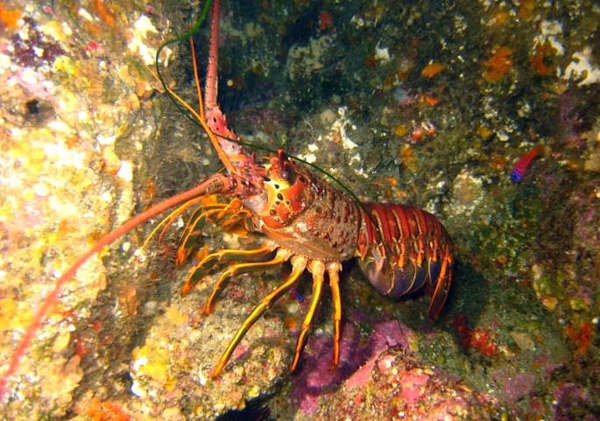
Spiny lobster season
Q: What are the dates of the upcoming recreational spiny lobster season? Can I purchase a lobster report card before the season starts?
A: Divers and hoop netters can now begin preparing for the 2021-22 recreational spiny lobster season by purchasing Spiny Lobster Report Cards.
The California Department of Fish and Wildlife, or CDFW, requires all lobster divers and hoop netters to record their catches on a Spiny Lobster Report Card. The cards can be purchased online for $10.54 at wildlife.ca.gov/Licensing/Online-Sales.
Spiny Lobster Report Cards are valid for the length of the recreational spiny lobster season, which runs from Oct. 2, 2021, through March 16, 2022. A $21.60 non-return fee will be charged when purchasing a Spiny Lobster Report Card if the previous year’s report card was not returned or reported online by the April 30, 2022 deadline. To avoid the fee, you may skip one lobster fishing season.
After skipping one season, you can purchase a Spiny Lobster Report Card the following season at no extra cost.
In addition to the Spiny Lobster Report Card, all divers and hoop netters 16 years of age or older must also purchase a California Sport Fishing License with a Sport Ocean Enhancement Validation, except for persons hoop netting from a public pier.
Deer tag validation
Q: I’m a Cal FIre firefighter, and I heard there were changes regarding which firefighters can validate deer tags. What are those changes and can I validate my hunting buddy’s deer if he gets a deer this season? Can I validate my own tag?
A: Good question and yes, there were some changes on this topic in 2019. We will answer the question as it relates to both deer and elk, since they are lumped together for regulation purposes.
Before we answer your question, let us thank you for your service to the state of California. We’re all aware and appreciate what you and your Cal Fire, U.S. Forest Service, and other municipal firefighter sisters and brothers are doing for us on a day-to-day basis during California’s fire season, which seems to grow longer every year.
A few years ago, the California Fish and Game Commission clarified which firefighters could countersign deer and elk tags. California Code of Regulations (CCR), Title 14, section 708.6 covers countersigning and transporting requirements. To start, CCR, Title 14, section 708.6(b) states that any person legally taking a deer in California shall have the deer license tag countersigned by a person authorized by the Fish and Game Commission before transporting such deer, except for the purpose of taking the deer to the nearest person authorized to countersign the license tag, on the route being followed from the point where the deer was taken (refer to Fish and Game Code, section 4341). Same goes for elk, as stated in CCR, Title 14, section 708.6(c). Finally, CCR, Title 14, section 708.6(d) lists personnel authorized to countersign deer and elk tags.
To answer your question directly: Yes, you may countersign your friend’s deer tag if they are successful this season. As a firefighter and a CAL FIRE employee, you are actually double-covered in the regulation. Most firefighters are limited to the authority to countersign deer and elk tags if they are employed full-time and the carcasses are brought into the station while they are on duty. CAL FIRE employees have the extended authority to countersign under the circumstances you describe, such as in the field if your friend is successful.
To answer your follow-up question: No, you cannot countersign your own tag.
GPS for MPAs
Q: How do I identify GPS coordinates for Marine Protected Areas (MPAs) when fishing for groundfish at the Farallon Islands off the coast of San Francisco?
A: Thanks for your interest in California fishing opportunities, and groundfish. CDFW has two great resources that should help. Our web-based Ocean Sport Fishing Interactive Map allows you to view any area of the state and see the various marine protected areas and other restrictions. If you click or tap on a specific location, more detailed information, including MPA coordinates, will be displayed. When used with a smartphone, the interactive map will show your current position in relation to the various boundaries. Note that this tool requires a cellular or internet connection, so you may need to access it in advance. CDFW is currently working on a truly mobile app that will replace this tool and work outside of cellular range.
Additionally, CDFW has produced printable maps that depict the coastal, island and offshore areas that are open (or closed) to groundfish fishing in 2021. These detailed Rockfish Conservation Area (RCA) Maps show California RCA waypoints and lines, as well as MPAs. Map #11 shows the Farallon Islands.
- Details
- Written by: Editor
It will take place on the old Kelsey Creek Trail located in the park, with access by campsite 48.
Enjoy a picnic in the park and read the story of “Gary the Grumpy Gray Squirrel” together on the StoryWalk trail.
Clear Lake State Park is located at 5300 Soda Bay Road, Kelseyville.
- Details
- Written by: California Department of Fish and Wildlife

Muzzleloading hunts
Q: Howdy. I won a muzzleloader in a drawing but have never shot one before or been acquainted with the regulations. Are there specific hunt season dates in California for muzzleloaders only, so we’re not competing with modern rifles and scopes?
A: For the 2021 deer season, CDFW offered 10 muzzleloading rifle hunts which can be found via the “Additional Hunts” link under the “Seasons” tab of our Deer Hunting webpage. You can also find them on page 33 of CDFW’s 2021 Big Game Hunting Digest.
The letter “M” designates a muzzleloading rifle hunt and “MA” designates a muzzleloading rifle/archery hunt. During both of these types of hunts, only open or “peep” type sights can be used. Scopes are not permitted. Season dates and number of tags available are listed.
Hunters must apply for a tag through CDFW’s annual Big Game Drawing before the June application deadline. Muzzleloading hunts are for limited areas and are usually scheduled late in the year, which make them desirable but harder to draw. For deer hunting, be familiar with the Methods Authorized for Taking Big Game regulation section.
You can also use your muzzleloading rifle during a general season that you have a tag for. You could even use a scope during a general season and you wouldn’t be restricted to only open or “peep” type sights. If you’re interested, there are other opportunities such as muzzleloading shotguns for resident small game. CDFW reminds hunters that nonlead ammunition is required when taking wildlife with any firearm in California, including muzzleloaders.
Delta blob
Q: I enjoy recreating in the Delta, and occasionally on my walks I see these gelatinous brown blobs in the water that look a little like jellyfish. They seem to appear in summer. What are those?
A: The critters you see on your walks are freshwater bryozoan. The scientific name is Pectinatella magnifica.
They were originally found on the east coast and made their way west. Scientists wrote in 2005 about discovering freshwater bryozoan in the Sacramento-San Joaquin Delta. However, it is likely that bryozoan arrived in the Delta years earlier.
Bryozoan are very common seasonally in the Delta and probably in all lower elevation freshwater reservoirs in California. We often hear them referred to as “blobs,” but really they are a colony of small individual animals in a gelatinous matrix.
As you mentioned, they are usually found in warmer waters from June through September. They are not poisonous and do not sting, but we’d suggest washing your hands if you come into contact with one. The U.S. Geological Survey has more information and links on its website.
Big game rifle
Q: Could you help me with information regarding the use of an AR 556/223 rifle for hunting? It’s a California compliant rifle with a 5-round magazine. Would this be a legal setup for hunting?
A: Yes, you can use the rifle you described as long as it is California compliant per the California Attorney General’s Office. California hunting regulations restrict the cartridge and bullet type for hunting big game, but not the firearm itself. In short, big game may only be taken by firearms using centerfire cartridges with soft nose or expanding projectiles, per California Code of Regulations (CCR), Title 14, section 353(c). Pay close attention to be sure your .223 bullets fit this description, as most .223 bullets are manufactured with full metal jackets, which would be unlawful to use.
Your other consideration is required use of nonlead ammunition for all hunting in California, which is usually a specialty ammunition type for the .223 or the similar 5.56. By your own evaluation, it sounds like you have determined your AR 556/223 is California compliant and you have nonlead ammunition.
Check that third box that the bullets are soft nose or expanding projectiles and you are good to go. Your 5-round magazine is also legal to use. See CCR, Title 14, section 353 for more details on authorized methods of take for big game. Good luck on your hunt!
Dove opener
Q: I am planning to hunt the dove opener in Imperial County on Sept. 1. I understand that CDFW produces maps that show the fields that were planted. Where would I find those? And do you have any forecast for how the season might look this year?
A: Yes! CDFW posts maps of the planted fields in Imperial County on its website. Wheat and sunflower were the primary crops planted, and some fields have additional Sudan, Bermuda and alfalfa.
It has been a hot, dry year and the drought has certainly affected agriculture, which in turn affects dove presence and movement.
We have had mixed reports across the state, with some areas experiencing high numbers of first year birds and some with very few.
As always, we hope for an exceptional hunting season and wish our hunters the best of luck in the field this year.