 How to resolve AdBlock issue?
Recreation
- Details
- Written by: California Department of Fish and Wildlife
Q: I have a few questions about the new trap regulations for recreational crabbing that took effect on Nov. 1. Why the new regulations? Where can I find information about the new requirements for marker buoys, main buoys and validations?
A: We appreciate your interest in keeping up to date on recreational crabbing regulations. The new regulations are spelled out in California Code of Regulations (CCR), Title 14, sections 29.80 and 29.85.
They were adopted to address entanglement risk in the recreational fishery and to minimize interaction potential with protected whales and sea turtles.
The regulations establish a validation stamp requirement, trap limit, trap service interval, new trap marking requirements, and new authority for the California Department of Fish and Wildlife to temporarily limit the use of crab traps in times of increased entanglement risk.
A full background report and rationale is available on the California Fish and Game Commission’s website. You can find answers to the most commonly asked questions about the new regulations on our crab fishery webpage.
Hunter education
Q: I was looking for information about hunting wild pigs in California and came across a YouTube video with wildlife officers providing just the information I needed! Are there other videos like this and if so, where can I find them?
A: It sounds like you watched a recording of CDFW’s Advanced Hunter Education (AHE) webinar titled “Wild Pig Hunting on Public Lands.”
This webinar is one in a series of CDFW Advanced Hunter Education webinars which launched about a year ago. Each webinar is about an hour long and focuses on a particular hunting related topic.
Some of the topics covered so far include turkey hunting 101, virtual scouting and Zone D11, D13 and D15 deer hunting opportunities.
You can sign up to participate in upcoming webinars at www.wildlife.ca.gov/Hunter-Education/Advanced. Additionally, you can view recordings of prior webinars by searching for “AHE” titled videos on CDFW’s YouTube channel.
CDFW’s R3 (which stands for recruit, retain and reactivate) program also offers a virtual seminar series called the R3 Harvest Huddle Hour (R3H3). R3H3 seminars are focused on people new to hunting, fishing, foraging and shooting sports.
You can register for these events by clicking on the calendar events listed on the R3 webpage. Past recordings can be found here. You may also find resources listed under the “hunting” tab useful too, like this older guide on hunting pigs in California.
Rattlesnakes
Q: I followed the news story about the Santa Rosa resident who found dozens of rattlesnakes under his home. Should I be worried about rattlesnakes under my house? Are rattlesnakes aggressive?
A: It’s perfectly natural, and perhaps even an innate human reaction, to feel worried when hearing a story about a California resident finding so many potentially dangerous snakes so close.
In general, rattlesnakes are not aggressive. They avoid conflict to the best of their ability because they don’t want to risk injury or death in a battle or to waste venom by biting something that isn’t prey.
The most familiar way rattlesnakes avoid conflict is signaling their presence by rattling and taking a defensive coiled posture when a potential threat gets too close for comfort. If left alone, they will move away from the threat, not toward it. A lot of bites occur when people are trying to kill or move rattlesnakes.
However, not all bites involve envenomation. They will sometimes “dry bite” as a warning.
Rattlesnakes are distributed broadly across the state but are typically found in open habitats like grasslands, savanna and desert, often in and around rock outcrops when available. When they are found in homes and yards, it’s usually along a wildland-urban interface. However, coming across a den under a house like the one in Santa Rosa is incredibly rare.
It’s important to recognize that rattlesnakes don’t seek out or prefer to live near people, but they will den under a home if there is an abundance of prey and if it’s the best available habitat in an area.
The Santa Rosa story is a good reminder that we should be mindful of our surroundings when we spend time outdoors and around our homes, especially during warmer weather.
Residents can make their yards rattlesnake safe by removing objects that attract them and their prey. This can include keeping vegetation away from fences, removing piles of boards or rocks around the home and preparing any holes in vents or other potential access points.
For more information on rattlesnakes in California, please visit www.wildlife.ca.gov/Keep-Me-Wild/Rattlesnakes.
- Details
- Written by: Clear Lake State Park
The free event will take place at the park’s visitor center.
Enjoy a book on the StoryWalk trail and stay for some crafts. The trail is less than a mile in length.
Clear Lake State Park is located at 5300 Soda Bay Road, Kelseyville.
For more information call 707-279-4293.
- Details
- Written by: Mendocino National Forest
The Thanksgiving holiday weekend is traditionally a popular time to visit the Mendocino National Forest.
National forests provide a great way to enjoy the outdoors, but it is important that everyone recreates safely.
Forest officials remind visitors to prepare for a trip to the forest by checking the weather forecast, having a full tank of gas and bringing extra food and water.
Visitors should carry emergency equipment and appropriate maps. Cellphone coverage is not reliable in many areas.
Weather and road conditions in the forest can change quickly. All visitors should be aware of the hazards of traveling through a burned area.
- Details
- Written by: California Department of Fish and Wildlife
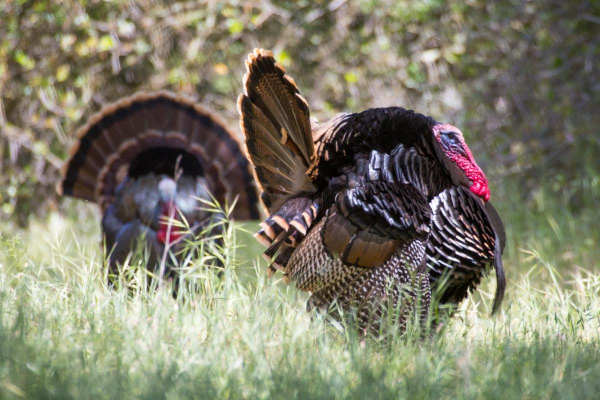
Turkey hunting season
With fall turkey season coming up, we’ve had a few questions related to method of take.
We here at the California Department of Fish and Wildlife, or CDFW, think there is no better Thanksgiving dinner than a freshly harvested California organically grown wild turkey!
Fall turkey season opens the second Saturday in November and extends for 30 consecutive days. The bag limit is one either-sex turkey per day, two per season.
Methods of take
Q: I have a 10-gauge shotgun I like to use for goose hunting. Can I use it for turkey hunting too?
A: Yes, California Code of Regulations (CCR), Title 14, section 311(a) authorizes use of a shotgun, 10-gauge or smaller, using shot shells only and incapable of holding more than three shells in the magazine and chamber combined.
If a plug is used to reduce the capacity of a magazine to fulfill the requirements of this section, the plug must be of one piece construction incapable of removal without disassembling the gun.
We don’t want to dissuade you from using your 10-gauge, but keep in mind, one of the most enjoyable elements of turkey hunting is coaxing the bird into your decoys, or your otherwise concealed position, to get a very close shot.
With some experience, practice and patience, you’ll manage to get the birds in where you can take it with something as simple as a .410.
Broadheads
Q: I’m going archery turkey hunting this fall. I’m interested in trying a guillotine-type broadhead for my arrows. Are they legal to use and is there a limit to how big a broadhead can be?
A: Yes, arrows with guillotine type broadheads, meaning broadheads with extended blades, are legal to use. When they work exactly as designed, by way of action like a guillotine, they are the quickest, most humane way of taking a wild turkey. The authorized size of a broadhead for take of resident small game is found in CCR, Title 14, section 311. It states: It shall be unlawful to take wild turkey by use of hunting arrows and crossbow bolts unless fitted with a broadhead-type blade which will not pass through a hole seven-eighths inch in diameter. Mechanical/retractable broadheads shall be measured in the open position.
Notice the regulation is designed to prohibit use of a broadhead that is too small, not too large. The requirement to use a broadhead with the designated minimum size is to be sure that hunters are using arrows with a broadhead lethal enough to affect a quick and humane kill on the turkey (or other game).
Be sure to practice extensively with arrows fitted with similarly weighted target tips because the guillotine broadheads are usually much heavier than traditional hunting broadheads. It’s important to know how they are going to fly once you release the arrow. Good luck on your turkey hunt!
Archery only season?
Q: Is there an archery only season for turkey during the fall?
A: No. Methods of take for fall turkey season includes all methods authorized by the CCR, Title 14, section 311, which include bows and arrows.
Occupied dwelling
Q: How far away from an occupied cabin do I have to be to legally hunt turkey with a bow?
A: If you have written permission from the cabin owner, you can hunt near the cabin, as long as you do so safely. However, hunting is prohibited within 150 yards of an occupied dwelling or outbuilding unless you have written permission, per California Fish and Game Code, section 3004 (a). The purpose of the statute is to create a safety zone around occupied dwellings such as cabins.
If the occupants of the cabin aren’t comfortable with hunting, or don’t know you’re hunting, the 150 yard zone helps ensure their safety. If you don’t have permission from the owner of the cabin, or any building where you’re hunting which you could reasonably expect to be occupied, you must be at least 150 yards away from the building to shoot your bow while hunting.
Additionally, if you do have written permission to hunt near a friend’s or neighbor’s dwelling, you should give them a heads up about what day and time you’ll be hunting as an added measure of safety.