How to resolve AdBlock issue?
Refresh this page
How to resolve AdBlock issue?
Refresh this page
Lake County News,California
  • Home
    • Registration Form
  • News
    • Community
      • Obituaries
      • Letters
      • Commentary
    • Education
    • Veterans
    • Police Logs
    • Business
    • Recreation
    • Health
    • Religion
    • Legals
    • Arts & Life
    • Regional
  • Calendar
  • Contact us
    • FAQs
    • Phones, E-Mail
    • Subscribe
  • Advertise Here
  • Login
How to resolve AdBlock issue?
Refresh this page
How to resolve AdBlock issue?
Refresh this page

News

State Senate approves Sen. Dodd’s Berryessa Snow Mountain expansion bill

The California Senate on Monday approved legislation from Sen. Bill Dodd, D-Napa, in partnership with Senate President pro Tem Mike McGuire, D-North Coast and Assembly Majority Leader Cecilia Aguiar-Curry, that would urge the White House to expand Berryessa Snow Mountain National Monument and to rename the new portion to reflect its cultural significance to the region’s Native American tribes.

“I am proud to have been on hand when President Obama finalized the original designation of Berryessa Snow Mountain, which is one of the most scenic and diverse landscapes in all of Northern California,” Sen. Dodd said. “Now, it makes sense to include this additional piece, which was home to native tribes for thousands of years. We can recognize the land’s cultural significance while protecting it for generations to come. I appreciate my Senate colleagues for giving this proposal their support.”

In 2015, Sen. Dodd authored Assembly Joint Resolution 4, the first time a state Legislature passed a measure asking the president to create a national monument.

Following the extensive campaign by state, local, tribal and federal representatives, President Barack Obama on July 10, 2015 designated 330,780 acres in the California Coastal Range in Colusa, Glenn, Lake, Mendocino, Napa, Solano and Yolo counties as Berryessa Snow Mountain National Monument.

The rugged land boasts abundant wildlife, plants and other natural resources, and is a haven for outdoor recreation. It is managed by the Mendocino National Forest and the Bureau of Land Management.

The designation comes at a time of vanishing wildlands around the world. Nationwide, natural land is declining at a rate of one football field every 30 seconds, threatening plant and animal species and contributing to climate change.

In response, both President Joe Biden and Gov. Gavin Newsom have championed the so-called 30X30 goal, which sets aside 30% of natural and coastal waters by 2030 to protect habitat, preserve history and maintain recreational opportunities.

The new measure, Senate Joint Resolution 10, helps fulfill state and federal goals by supporting proposals before Congress to expand Berryessa Snow Mountain Monument by 3,900 acres in Lake County.

It also supports renaming the area commonly known as Walker Ridge to Molok Luyuk, which means Condor Ridge in the Patwin language, reflecting the area’s cultural significance to many federally recognized tribes in the region.

By doing so, it would also provide opportunities for partnerships between the tribes, BLM and the U.S. Forest Service. The resolution also supports the legislative efforts of U.S. Sen. Alex Padilla and Congressmen John Garamendi and Mike Thompson.

SJR 10 passed the Senate floor Monday on a 35-0 vote. It heads next to the Assembly.

“The Berryessa Snow Mountain National Monument is home to rare plants and animals found nowhere else on earth,” said U.S. Rep. Mike Thompson, D-St. Helena. “Expanding this national monument to include Molok Luyuk is an important step to safeguard public lands that are sacred to the Yocha Dehe Wintun Nation and further conserve beautiful and diverse land. Thank you to Senator Dodd and the California Legislature for supporting our Congressional efforts to get the expansion signed into law and to ensure that this land is protected for generations to come.”

“I welcome state Sen. Dodd’s support for expanding the Berryessa Snow Mountain National Monument in Lake County for future generations to enjoy,” said U.S. Rep. John Garamendi, D-Walnut Grove, former deputy secretary of the Interior during the Clinton administration. “Conserving California’s special places has been a lifelong passion throughout my tenure in the state legislature, as deputy secretary of the Interior to President Clinton, and now as a member of Congress. Our proposed expansion supports President Biden and Gov. Newsom’s goal to conserve at least 30 percent of the lands and waters nationally and in California by 2030. Once again, California can lead the nation and the world.”

“The establishment of the Berryessa Snow Mountain National Monument was the result of a historic collaboration by the environmental, business and agricultural communities, recreational interests and tribal, local, and state government,” said Assembly Majority Leader Cecilia Aguiar-Curry, D-Winters. “Expanding the national monument to include the traditional tribal region known as Molok Luyuk in Lake and Colusa Counties will protect this incredibly valuable cultural and environmental resource and help our state reach our goal of protecting 30% of California’s lands by 2030. I was very proud to be a leader in winning the original federal designation and am excited to lend my support to this expansion effort. I thank my colleague, Sen. Dodd, for authoring this Resolution to add the support of the California Legislature to this campaign by Yocha Dehe Wintun Nation, Robinson Rancheria, and the Cachil Dehe Band of Wintun Indians.”

Dodd represents the Third Senate District, which includes all or portions of Napa, Yolo, Sonoma, Solano, Sacramento and Contra Costa counties.
Details
Written by: Lake County News reports
Published: 23 April 2024

States boost Earth Day impact with Climate Corps expansion


On Monday, Earth Day, the states of Illinois, New Mexico and Vermont each announced the creation of its own state-level Climate Corps in partnership with California Volunteers, Office of Gov. Gavin Newsom.

They join 10 states already providing volunteer and paid service opportunities to take climate action. With this announcement, state-level climate corps programs are now available in states representing a third of America’s population — a huge milestone for climate action.

These new states represent a powerful network of leaders committed to engaging more Americans in climate action. The state-level Climate Corps will engage people through a variety of activities and create job pathways for careers in sustainability.

Current states that have launched state-level Climate Corps include Arizona, California, Colorado, Maine, Maryland, Michigan, Minnesota, North Carolina, Utah and Washington. Many of these programs have already experienced early success, officials said.

Monday’s announcement comes as the Biden Administration announces thousands of new paid service positions now available through the American Climate Corps.

Positions range across a number of fields including energy-efficiency, disaster response and preparedness, and wildfire mitigation. Up to 20,000 people are expected to join in the program’s first year. To learn more and apply, visit www.climatecorps.gov.

While at an event last year in California, President Joe Biden expressed his optimism about Climate Corps. “When I think of climate, I think of jobs. When I think of climate, I think of innovation. When I think of climate, I think of turning peril into progress,” Biden said.

Fellows in state-based climate corps programs will earn a living stipend and, after completing a term of service, will be eligible for a scholarship to pay for college or to pay off student loans. Some participating fellows will earn up to $30,000 (prorated for those serving in a less than full-time capacity) by serving their communities. Each state will tailor the program to its specific needs and will determine additional climate activity priorities.

The state-level Climate Corps are supported through a public-private partnership between philanthropy and AmeriCorps. These states will work with the American Climate Corps as implementing partners to ensure participants gain new skills and earn money while serving their community.

“We can’t go it alone in tackling the climate crisis. With these three states launching their own Climate Corps, we’re making climate action a reality in communities representing millions of Americans. Together, we’re mobilizing and organizing citizen climate action at a scale never seen before — and now we’ll begin to see its impact across the nation,” said California Gov. Gavin Newsom.

“Climate change is a crisis that requires coordinated action," said Illinois Governor JB Pritzker. "California's Climate Corps network inspires a new generation of leaders to pursue volunteer and paid opportunities in sustainability. We deeply appreciate this partnership with Gov. Newsom, as our efforts are most powerful when we build coalitions."

“New Mexico is committed to doing its part to mitigate the climate crisis, and we’re proud to join in this growing, collective effort that will help protect our planet and produce new economic opportunities,” said New Mexico Governor Michelle Lujan Grisham. “I have no doubt that New Mexicans will enthusiastically participate in Climate Corps and help make this important new White House initiative a success.”

"Climate change is already having significant impacts on Vermont and states across the nation. It's critical we continue to do our parts to combat it," said Vermont Governor Phil Scott. "We are all better off when we do this work together and it's good to join with other states who are stepping up."

“Vermont’s American Climate Corps will mobilize young people who care deeply about the future of our planet and who are ready to take on the existential threat of climate change,” said Vermont Senator Bernie Sanders. “Addressing climate change isn’t just a moral imperative — it’s good economic policy that will create millions of good jobs and transform our communities toward sustainability and energy efficiency. It is good news that Vermont will be at the forefront of this important work.”
Details
Written by: Lake County News reports
Published: 23 April 2024

Wild turkey numbers are falling in some parts of the US – the main reason may be habitat loss


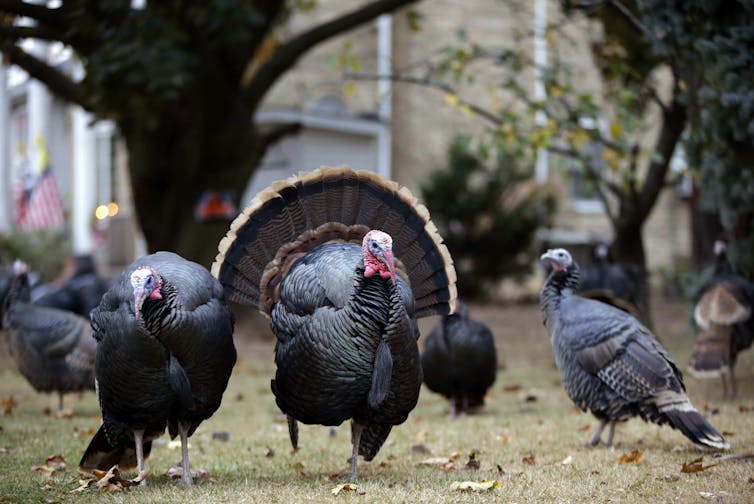
Wild turkeys in a yard on Staten Island, N.Y. AP Photo/Kathy Willens

Birdsong is a welcome sign of spring, but robins and cardinals aren’t the only birds showing off for breeding season. In many parts of North America, you’re likely to encounter male wild turkeys, puffed up like beach balls and with their tails fanned out, aggressively strutting through woods and parks or stopping traffic on your street.

Wild turkeys were abundant across North America when European settlers arrived. But people killed them indiscriminately year-round – sometimes for their meat and feathers, but settlers also took turkey eggs from nests and poisoned adult turkeys to keep them from damaging crops. Thanks to this unregulated killing and habitat loss, by 1900 wild turkeys had disappeared from much of their historical range.


Turkey populations gradually recovered over the 20th century, aided by regulation, conservation funding and state restoration programs. By the early 2000s, they could be found in Mexico, Canada and every U.S. state except Alaska.

Now, however, the trend appears to be reversing in some areas. In a 2021 study, eight out of 30 states surveyed reported that turkey populations declined from 2014 to 2019, with some of the sharpest decreases in Alabama, Arkansas, Georgia, Louisiana and Oklahoma.

Turkey numbers increased in 14 states, mainly in the Northeast and mid-Atlantic. But even in many of those states, populations were down from historic peaks in the early 2000s. Another study in 2023 reported that turkey populations in the eastern half of the U.S. were declining by about 9% yearly, based on data from the past 50 years.

We are wildlife ecologists working to determine why turkey populations are shrinking in portions of their range. This is a classic challenge in ecology: Many factors could be at play, and it takes careful analysis to untangle them and figure out whether each trend is a cause or symptom – or just irrelevant.

We created the Wild Turkey Science podcast to make peer-reviewed science accessible to the public and provide a platform for turkey researchers and biologists to discuss their work. So far, we have reviewed numerous studies and interviewed scientists from more than a dozen states. Here are some hypotheses that have emerged:

Fewer open spaces

While turkeys may appear at home in urban areas, their habitat is open forest – areas with sparse trees that allow near-full sunlight to reach herbaceous plants at ground level. Most uplands, or elevated areas, in the eastern U.S. historically were this type of dry-adapted woodland, savanna and grassland complex.

In 1792, naturalist William Bartram described the eastern U.S. as “Grande Savane,” or big savanna, a landscape with abundant wild turkeys. Traveling in Florida, Bartram wrote:

“I was awakened, in the morning early, by the cheering converse of the wild turkey cocks saluting each other from the sun-brightened tops of the lofty cypress and magnolia. They begin at early dawn, and continue till sunrise. The high forests ring with the noise of these social sentinels, the watchword being caught and repeated, from one to another, for hundreds of miles around, insomuch that the whole country is, for an hour or more, in an universal shout.”

Today, very little woodland or savanna remains in the U.S. Most of it has been cleared for development, farming or livestock grazing. The open spaces that are left often are not suitable for wild turkeys: They need a well-developed layer of vegetation at ground level that includes mainly wild flowers, native grasses and young shrubs and trees to provide cover for nesting and raising their young.


Very few of the remaining lands suitable for wild turkeys are managed using frequent, low-intensity prescribed fire, which creates and maintains a mosaic of open forest and grassland by continually setting back growth of trees, shrubs and vines. Suppressing fire in these forests across the eastern U.S. allows them to change from open forest dominated by fire-adapted grasses and wildflowers to closed forests with dense canopies, creating shady, moist conditions with minimal vegetation near ground level.

Turkeys can persist in these denser, shaded forests, but they don’t reproduce as successfully, and fewer of their young survive. The lack of ground vegetation makes it hard for hens to hide their nests, and it limits food supplies for young turkey poults.

This isn’t just a problem for wild turkeys. Over the past 50 years, populations of bird species that live in open forests and grasslands have fallen by more than 50%. Grasslands and savannas support hundreds of other wild species as well, many of which are declining.

The roles of food, predators and hunting

Scientists have proposed other explanations for turkey declines, but many of these hypotheses are at least partly habitat issues.

For example, blame is often placed on more abundant predators that eat turkey eggs, such as raccoons and opossums. But these predators probably are more abundant in part due to changes in turkey habitat.

For example, a 2024 study found that a range of mammals that eat turkey eggs were observed 70% of the time when prescribed burning was not used, but were observed less than 10% of the time in open forests where planned burns were conducted biannually. This suggests that prescribed fire across the wild turkey’s range creates an environment that’s more favorable for turkeys than for their predators.

Some observers have suggested that turkeys may be so abundant that the landscape can’t support their current population, so now they are declining to a more sustainable level. If turkey habitat remained stable, we would expect to see their numbers go up and down naturally, but their average abundance over time would remain the same. Instead, turkey numbers appear to be slowly but steadily falling in many areas – perhaps signaling that habitat availability is declining along with turkey populations.

What about food supplies? Young turkeys feed on insects, so insect declines may explain some observed changes in turkey populations. According to one calculation, land-dwelling bird species that depend on insects as food have declined by 2.9 billion individuals over the past 50 years, while those species that don’t have gained by 26.2 million individuals.

Insect losses could explain why fewer turkeys are surviving to adulthood, but insects depend on plants, so this shift is likely also linked to habitat changes. And where land is managed to promote native flowers and grasses, there also are abundant pollinators, ants, grasshoppers and spiders that turkeys relish.

Insect declines could explain some of the wild turkey declines.

Lastly, some observers have proposed that the timing of hunting could be affecting turkey reproduction. However, a recent study in Tennessee found that this was not the case. Another recent study showed that hunters in the Southeast were harvesting about the same share of male turkeys as when turkey populations were growing rapidly. If current turkey harvest rates are unsustainable, the explanation is likely that wild turkey productivity has declined for other reasons, such as habitat.

Creating space for turkeys

Land owners can help by managing for native grasses and wildflowers on their property, which will provide breeding habitat for turkeys. We have produced podcast episodes that discuss which plants are valuable to turkeys and other wildlife, and how to promote and maintain plants that are turkey-friendly.

People who don’t own land can support state and local efforts to restore wildlife, contribute to local wildlife conservation groups and buy hunting licenses, which help to fund wildlife management programs. With the right conditions, this iconic North American species could thrive yet again.The Conversation

Marcus Lashley, Associate Professor of Wildlife Ecology, University of Florida and William Gulsby, Associate Professor of Wildlife Management, Auburn University

This article is republished from The Conversation under a Creative Commons license. Read the original article.

Details
Written by: Marcus Lashley, University of Florida and William Gulsby, Auburn University
Published: 23 April 2024

Supervisors to consider appeal of cannabis project next to Kelsey Creek Schoolhouse

LAKE COUNTY, Calif. — The Board of Supervisors this week will be asked to consider overturning the Lake County Planning Commission’s decision to deny a major cannabis grow next to a historic site.

The‌ ‌board will meet beginning ‌at‌ ‌9‌ ‌a.m. Tuesday, April 23, in the board chambers on the first floor of the Lake County Courthouse, 255 N. Forbes St., Lakeport.

The‌ ‌meeting‌ ‌can‌ ‌be‌ ‌watched‌ ‌live‌ ‌on‌ ‌Channel‌ ‌8, ‌online‌ ‌at‌ ‌https://countyoflake.legistar.com/Calendar.aspx‌‌ and‌ ‌on‌ ‌the‌ ‌county’s‌ ‌Facebook‌ ‌page. Accompanying‌ ‌board‌ ‌documents, ‌the‌ ‌agenda‌ ‌and‌ ‌archived‌ ‌board‌ ‌meeting‌ ‌videos‌ ‌also‌ ‌are‌ ‌available‌ ‌at‌ ‌that‌ ‌link. ‌ ‌

To‌ ‌participate‌ ‌in‌ ‌real-time, ‌join‌ ‌the‌ ‌Zoom‌ ‌meeting‌ ‌by‌ ‌clicking‌ ‌this‌ ‌link‌. ‌ ‌

The‌ agenda gave this week’s ‌meeting‌ ‌ID‌ ‌is‌ 865 3354 4962, ‌pass code 726865. Those are the same passcodes as last week’s meeting and the board clerk clarified the supervisors are transitioning to a recurring passcode.

The meeting also can be accessed via one tap mobile at +16694449171,,86533544962#,,,,*726865#. The meeting can also be accessed via phone at 669 900 6833.

At 9:30 a.m., the board will hold a public hearing to consider the appeal by John Oliver of Higher Ground Farms of the Planning Commission’s denial of his major use permit and initial study for a cannabis grow at 3545 Finley East Road, Kelseyville, in an area of prime farmland and next door to the historic Kelsey Creek Schoolhouse.

The schoolhouse sits on property owned by the Kelseyville Unified School District, which has an agreement with the Lucerne Area Revitalization Association which is restoring the building. The association was founded by Lake County News publishers Elizabeth Larson and John Jensen.

Higher Ground Farms, whose owner and appellant are from Mendocino County, would include 22,000 square feet of cannabis canopy inside eight greenhouses.

The Planning Commission voted down the project in January, raising questions about its altering of the viewshed of the Big Valley area, deficiencies in planning, potential for harm to the neighboring historic site and the potential negative impact on the neighborhood, which has no other cannabis operations of this type.

In untimed items, the board will consider a resolution establishing position allocations for the new public defender’s office and also discuss job reclassification proposals from the county’s Classification, Compensation, Recruitment and Retention Committee.

The full agenda follows.

CONSENT AGENDA

5.1: Approve continuation of local emergency by the Lake County Sheriff/OES DDirector for the 2024 Late January, Early February Winter Storms.

5.2: Approve continuation of proclamation declaring a Clear Lake Hitch Emergency.

5.3: Approve continuation of proclamation of the existence of a local emergency due to pervasive tree mortality.

5.4: Approve continuation of emergency proclamation declaring a shelter crisis in the county of Lake.

5.5: Approve continuation of proclamation of the existence of a local emergency due to low elevation snow and extreme cold.

5.6: Approve Judicial Advocate General Grant #15PBJA-21-GG-02842-JAGX Decline Letter and authorize chair to sign.

5.7: Approve reissuance of property tax refund check from FY 14/15 in the amount of $363.42 issued to Catherine Orloff Trustee.

5.8: Adopt proclamation designating the month of April 2024 as Alcohol Awareness Month in Lake County.

5.9: Approve Amendment No.1 to the agreement between county of Lake and Health Management Associates Inc. for support services for consulting services for fiscal year 2023-24 and authorize the board chair to sign.

5.10: Approve Amendment No. 1 to the agreement between county of Lake and Hilltop Recovery Services for co-occurring services in the amount of $28,800.00 for fiscal year 2023-24 and authorize the board chair to sign.

5.11: Adopt resolution authorizing amendment to the standard agreement between the county of Lake and the Department of Health Care Services for the period of July 1, 2022 through June 30, 2025 and Authorize the Behavioral Health director to sign the amendment.

5.12: Sitting as the Board of Directors, Lake County Watershed Protection District, adopt amendment to Resolution 2022-116 authorizing the Lake County Watershed Protection District Board chair to execute a lease agreement between the Lake County Watershed Protection District and the Scotts Valley Energy Corp.

5.13: Approve by-laws of the Juvenile Justice Coordinating Council.

5.14: Approve the 2024-2025 Juvenile Justice Realignment Block Grant Plan.

5.15: Approve the qualified list from the request for qualifications for on-call architecture and engineering services.

5.16: A) Waive the competitive bidding process, pursuant to Lake County Code Section 2-38.2(3), based on the determination that competitive bidding would produce no economic benefit to the county, B) Authorize the Public Services Director / assistant purchasing agent to issue a purchase order not to exceed $120,000 to Mittry Construction Equipment Co. for a Caterpillar CT660 Heavy Duty Dump Truck.

5.17: a) Approve the general services agreement between the county of Lake and Optony Inc. for energy consulting services, and authorize the chair to sign the agreement; and b) approve supplemental services agreement number one for the Lake County Courthouse Campus Photovoltaic Array and Electric Vehicle Charging Station Project in an amount not to exceed $79,500, and authorize the chair to sign the agreement; and c) approve supplemental services agreement number two for photovoltaic system feasibility analysis, financial modeling, and procurement assistance for the Lakeport Library, Middletown Library, Redbud Library, and Probation Department in an amount not to exceed $30,000, and authorize the chair to sign the agreement.

5.18: Approve the supplemental services agreement number 5 between the county of Lake and Armstrong Consultants for engineering services related to Lampson Airfield and authorize the chair to sign the agreement.

5.19: a) Approve agreement for Federal Apportionment Exchange Program and State Match Program for California Department of Transportation - Non MPO County, Agreement No. X24-5914(134); and b) adopt resolution authorizing and directing the chair of the Board of Supervisors to execute the agreements for Federal Apportionment Exchange Program and State Match Program for California Department of Transportation – Non MPO County, Agreement No. X24-5914(134), and authorize the chair to sign the resolution and agreement.

5.20: Adopt resolution approving agreement with the state of California for Help America Vote Act (HAVA) Federal Funds in the Amount of $100,000, for activities to improve the administration of elections for Federal Office, including to enhance election technology and make election security improvements and authorizing the Registrar of Voters to execute the agreement with the state.

5.21: Approve contract between county of Lake and California Department of Social Services for Quality Assurance Case Review, in the amount of $108,695.00 from July 1, 2024 to June 30, 2029, and authorize the chair to sign.

TIMED ITEMS

6.2, 9:03 a.m.: Pet of the Week.

6.3, 9:04 a.m.: Presentation of Proclamation Designating the Month of April 2024 as Alcohol Awareness Month in Lake County.

6.4, 9:10 a.m.: Presentation of the North Coast Opportunities Building Up Individuals and Local Development, or BUILD, Program.

6.5, 9:30 a.m.: Public hearing, consideration of appeal (AB 24-01) of Planning Commission’s denial of major use permit (UP 20-40), Higher Ground Farms / John Oliver, applicant and appellant; location: 3545 Finley East Road, Kelseyville (APN: 008-026-07)(CONTINUED FROM MARCH 12, 2024).

6.6, 10:30 a.m.: Consideration of an agreement for professional communications and public relations services with Imprenta Communications Group Inc., in the not-to-exceed amount of $264,000 over three years.

6.7, 11:20 a.m.: Consideration of a resolution amending the master fee schedule for departmental services rendered by the county.

UNTIMED ITEMS

7.2: a) Annual Lake County PEG presentation; and b) discussion on continued PEG MAC support.

7.3: Consideration of draft ordinance repealing Urgency Ordinance 3113 Amending Ordinance 3110 prohibiting water hauling to unpermitted cannabis cultivation sites.

7.4: Consideration of rescission of Urgency Ordinance 3106 requiring land use applicants to provide enhanced water analysis during a declared drought emergency.

7.5: Consideration of resolution amending Scotts Valley Community Advisory Council boundary map.

7.6: Report to the board regarding Lake County Behavioral Health Services' revenue and expenditures and loan status.

7.7: Consideration of Amendment No. 1 to the agreement between county of Lake and BHC Heritage Oaks Hospital Inc. for acute inpatient psychiatric hospital services and professional services associated with acute inpatient psychiatric hospitalization in the amount of $175,000.00 for fiscal year 23-24 and authorize the board chair to sign.

7.8: Consideration of Amendment No. 3 to the agreement between the county of Lake and the Smithwaters Group in the amount of $210,000 for patient rights advocacy services for fiscal years 2022-23, 2023-24, and 2024-25.

7.9: Consideration and discussion of contract with HS Gov Tech Solutions Inc. for the license, configuration, support and hosting of the Lake County Environmental Health database management software for an amount not to exceed $400,093.21 and authorize chair to sign.

7.10: Consideration of resolution amending Resolution No. 2023-117 establishing position allocations for fiscal year 2023-2024, Budget Unit No. 2111 Public Defender.

7.11: Consideration of the Classification, Compensation, Recruitment, and Retention Committee 2023-2024 Reclassification Cycle Findings and Recommendations.

CLOSED SESSION

8.1, 3 p.m.: Public employee appointment pursuant to Gov. Code Section 54957(b) (1): Interviews for Special District administrator; appointment of Special District administrator.

8.2: Public employee appointment pursuant to Gov. Code Section 54957(b) (1): Interviews for Water Resources director; appointment of Water Resources director.

8.3: Public employee appointment pursuant to Gov. Code Section 54957(b) (1): Interviews for Social Services director; appointment of Social Services director.

Email Elizabeth Larson at This email address is being protected from spambots. You need JavaScript enabled to view it.. Follow her on Twitter, @ERLarson, or Lake County News, @LakeCoNews.
Details
Written by: Elizabeth Larson
Published: 22 April 2024
  1. Fires pose growing worldwide threat to wildland-urban interface areas
  2. Removing PFAS from public water systems will cost billions and take time – here are ways you can filter out harmful ‘forever chemicals’ at home
  3. April is Alcohol Awareness Month: Statewide program helps ABC licensees stay in compliance

Subcategories

Community

  • 698
  • 699
  • 700
  • 701
  • 702
  • 703
  • 704
  • 705
  • 706
  • 707
How to resolve AdBlock issue?
Refresh this page
Copyright © 2026 Lake County News,California. All Rights Reserved.