How to resolve AdBlock issue?
Refresh this page
How to resolve AdBlock issue?
Refresh this page
Lake County News,California
  • Home
    • Registration Form
  • News
    • Community
      • Obituaries
      • Letters
      • Commentary
    • Education
    • Veterans
    • Police Logs
    • Business
    • Recreation
    • Health
    • Religion
    • Legals
    • Arts & Life
    • Regional
  • Calendar
  • Contact us
    • FAQs
    • Phones, E-Mail
    • Subscribe
  • Advertise Here
  • Login
How to resolve AdBlock issue?
Refresh this page
How to resolve AdBlock issue?
Refresh this page

News

Thompson, Huffman address California insurance crisis


On Thursday, Reps. Mike Thompson (CA-04) and Jared Huffman (CA-02) were joined by Realtors, home builders, agriculture leaders, insurance leaders and fire survivors for a press conference at Santa Rosa’s Coffey Park in support of H.R. 7849, The Disaster Resiliency and Coverage Act of 2024, to help address California’s property insurance crisis.

“As insurers increasingly pull out of housing markets, California homeowners and business owners are struggling to find coverage,” said Thompson. “At the same time, the climate crisis is causing natural disasters to intensify, and families are increasingly relying on their insurers to help them rebuild. For example, those same families who relied on insurance to help rebuild their homes following the 2017 Tubbs Fire in Coffey Park are no longer able to get coverage. Were disaster to strike today, many families wouldn’t recover — and that’s unacceptable.

“I introduced the bipartisan ‘Disaster Resiliency and Coverage Act’ in March to help homeowners protect their property before disaster strikes, which is proven to encourage insurers to re-enter at-risk markets. Californians and Americans in disaster-prone regions across the country need both immediate support and a long-term solution to the insurance crisis,” Thompson said.

“For many folks in California, it feels like disaster hits just as we’re getting our feet back under ourselves from the last big storm or wildfire. Crisis after crisis like this has led to insurers either fleeing the area or jacking prices up that are unrealistic for the average homeowner,” said Rep. Huffman. “Our bill is a clever way to solve this problem: it incentivizes disaster resiliency, which will in turn bring insurers back to the marketplace. We are not going to let the folks we represent get boxed out of the property insurance they need to make staying in their homes possible.”

“Big ships don’t turn on a dime. The insurance crisis in California is a big ship. Congressman Thompson’s proposed legislation turns it around and points it in the right direction,” said City of Rohnert Park Mayor, Susan Hollingsworth-Adams.

“The Disaster Resiliency and Coverage Act goes beyond merely protecting buildings; it’s designed to secure and bolster the financial resilience of local economies by reducing insurance costs and thereby aiding in the retention of local workforce and protection of small businesses,” said Santa Rosa Councilmember Jeff Okrepkie.

“Our multigenerational wine and agricultural communities have been greatly impacted by the lack of access to affordable insurance. Many who once could afford one or two policies that provided complete coverage for their properties and businesses now face the challenge of needing four or five policies to provide only partial coverage at a 100% to 400% rate increase. The proposed legislation is a fantastic step in addressing this critical issue and supporting our wine and agricultural community as we continue our comprehensive wildfire mitigation work,” said Mike Haney of Sonoma County Vintners.

“Risk reduction will give insurance companies the confidence to supply homeowners insurance again,” said Anne Barbour of United Policy Holders.

“Congressman Thompson’s Disaster Resiliency and Coverage Act will provide meaningful assistance for our local homeowners and housing economy, particularly in our region where over half is designated as a high fire zone. The vast majority of local owners carry a mortgage, nearly 40% are spending over a third of their income on housing and are eager to receive help to fortify their properties. This bill would not only provide needed financing to harden homes and improve community resiliency, but also create a pathway to secure affordable insurance,” said Lisa Badenfort of North Bay Association of Realtors.

“The North Coast Builders Exchange is grateful to Congressman Thompson for this important legislation that will help remove another barrier to getting houses built in the North Coast. We are committed to build all kinds of housing for the community and to ensure a strong economy,” said Lisa Wittke Schaffner of North Coast Builders Exchange.

In March, Rep. Thompson and Rep. Doug LaMalfa (CA-01) introduced the bipartisan Disaster Resiliency and Coverage Act of 2024 (H.R. 7849). Rep. Huffman serves as a co-sponsor.

The legislation provides homeowners in disaster-prone regions with broad incentives to harden their properties against wildfires and other natural hazards to help address the ongoing insurance crisis in California and other states.

By incentivizing homeowners to mitigate disaster risks on their property, the legislation will help bring insurers back into the market and lower rates.

The legislation includes the establishment of a grant program, administered through State governments, through which certain individual households in designated disaster-prone regions are eligible for up to $10,000 for specified hazard mitigation work on their homes.

The legislation also provides a 30% tax credit for these mitigation activities conducted by individuals, farms and businesses. The credit complements the grant program by providing meaningful assistance to larger property owners for whom mitigation activity costs would far exceed $10,000.

In addition, the legislation establishes that payments from state-run disaster resiliency programs and payments from various federal emergency agricultural programs are not considered income for federal tax purposes. It also advises states to direct insurers to consider plan owners’ disaster mitigation efforts when setting premiums.
Details
Written by: Lake County News reports
Published: 26 April 2024

Yuba Community College District reports on completion rates

NORTHERN CALIFORNIA — This week the Yuba Community College District released information on the latest completion rates across its colleges.

The district includes Yuba College and Woodland Community College, the latter of which includes the Lake County Campus in Clearlake.

From 2017 to 2021, Yuba Community College District saw a 24% increase in students completing their associate degrees.

Woodland Community College had a 48% surge in associate degree completions, while Yuba College noted a 16% growth during the same period.

District officials said the latest numbers illustrated “remarkable increases in completion
rates across its colleges,” which it said reflects its commitment to student success.

“Our district and colleges are working hard to serve our students and our communities,” said Dr. Sonja Lolland, the district’s vice chancellor of education and planning. “The work we are doing to improve student support services, streamline processes and improve academic supports is paying off.”

She added that the completion rates significantly exceed the state average.

“These numbers tell a very good story of our faculty and staff’s commitment to our students’ success,” said district Chancellor Dr. Shouan Pan. “Importantly, this increase also indicates our students’ dedication to and belief in themselves. Deciding to attend and remain in college, especially during the pandemic, is not an easy choice. I’m very proud of each student who made the commitment to earn their associate’s and each employee who supported them along the way.”
Details
Written by: LAKE COUNTY NEWS REPORTS
Published: 26 April 2024

For millions of Americans, high-speed internet is unavailable or unaffordable − a telecommunications expert explains how to bring broadband to the places that need it the most


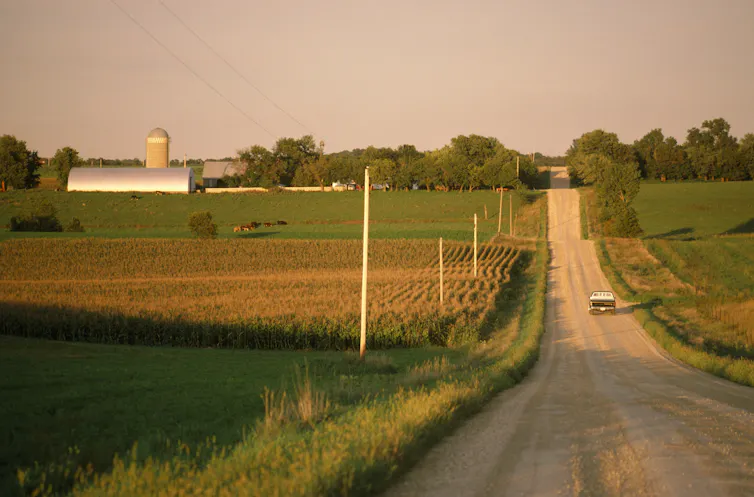
Broadband is noticeably missing in rural, remote or Indigenous areas. Grant Faint/The Image Bank via Getty Images

Millions of Americans still don’t have access to high-speed internet. Christopher Ali, a professor of telecommunications at Penn State University, discusses who lacks access to broadband and how the federal government – with a US$65 billion commitment – is trying to bring more people online.

Christopher Ali discusses the challenges in bringing high-speed internet to underserved America.

The Conversation has collaborated with SciLine to bring you highlights from the discussion that have been edited for brevity and clarity.

What is broadband internet?

Christopher Ali: Broadband internet, often just called broadband, is the technical term for high-speed internet connectivity.

The Federal Communications Commission, which is in charge of setting an official definition for broadband in the country, defines broadband as an always-on internet connection of 100 megabits-per-second download and 20 megabits-per-second upload.

But what high-speed internet fundamentally means to Americans is do we have the connectivity necessary to go about our digital lives. Can we stream Netflix? Can we go on Zoom? Can we file our taxes? Can we do our homework? Can we do our jobs? Can we game?

What can you tell us about disparities in broadband access?

Christopher Ali: One of the really frustrating things is, despite millions – tens of millions – of dollars spent on broadband mapping, we are still unsure of who is underconnected throughout the country.

Right now, the FCC reports that 7.2 million people lack access, but the commission numbers have been historically suspect. As a result, there are no doubt many more who are unserved and undercounted. In fact, the FCC repeatedly receives challenges to its broadband map.

Back in 2021, for instance, when the FCC reported that about 14 million people lacked internet access, an independent review found that 42 million people lacked access. That’s a huge discrepancy.

But one thing is certain: Broadband deserts are most often found in rural, remote and Indigenous areas.

It’s also clear that cost is part of the issue. Here in the U.S., we pay a tremendous amount of money – the most for internet access monthly than almost any other country in the developed world.

A program called the Affordable Connectivity Program subsidizes broadband for low-income families, and 50 million families across the country are eligible.

Without robust broadband access, communities risk being sidelined in the 21st century economy.

What benefits does broadband access provide?

Christopher Ali: Broadband access can aid with economic development. It can be a game changer when it comes to telehealth, especially for rural, remote and Indigenous communities, which often don’t have enough doctors and nurses. With telehealth, you can suddenly connect with a health care professional.

It aids in education. Some studies have found that access to broadband can impact grades and SAT scores, although there is disagreement about this. But the opportunities for students with broadband are undeniable – like applying online for college and student aid.

It contributes to civic engagement, allowing voters to contact local officials online. It impacts public safety, both in terms of our own safety as members of the public but also by allowing first responders to communicate online with their dispatch.

Broadband also helps sometimes with cultural enrichment, and we see this a lot with Indigenous communities, which can stream cultural and traditional events.

And it improves quality of life. Everyone enjoys being able to FaceTime with family and friends and go shopping online. These things were particularly essential during the COVID-19 pandemic.

The Broadband Equity, Access, and Deployment Program, passed as part of the 2023 infrastructure bill, allocates $42 billion in federal funds to expand broadband infrastructure. How can communities maximize its impact?

Christopher Ali: The money from the BEAD program is going to be managed by the states and not by the federal government. Each state receives a chunk of money, depending on the number of people who are unconnected. Texas, with more than 1 million unserved or underserved locations, will get $3.3 billion, the most of any state. Pennsylvania will get about $1.2 billion.

What states have done a particularly good job expanding broadband access?

Christopher Ali: Minnesota has done some amazing work over the past decade. As I discuss in my book “Farm Fresh Broadband: The Politics of Rural Connectivity,” Minnesota was one of the earliest states to create a broadband grant program – the Border-to-Border program – and has set really ambitious targets. Back in 2016, for instance, the state set up a goal of universal coverage at 100Mbps/20Mbps by 2026.

Another state is Virginia, which really got a wake-up call during the pandemic, and it mobilized a lot of the federal money that came down the pipes to empower counties, cooperatives and local ISPs.

Vermont has done something called communication union districts. They’ve allowed communities to come together to use public funding to deploy broadband networks.

Public networks are going to be a game changer because they empower communities to connect themselves and direct their own digital futures – either with municipally funded networks, or cooperatives, or some sort of public-private partnerships.

Watch the full interview to hear more.

SciLine is a free service based at the American Association for the Advancement of Science, a nonprofit that helps journalists include scientific evidence and experts in their news stories.The Conversation

Christopher Ali, Pioneers Chair in Telecommunications & Professor of Telecommunications, Penn State

This article is republished from The Conversation under a Creative Commons license. Read the original article.

Details
Written by: Christopher Ali, Penn State
Published: 26 April 2024

CHP seeks leads on October Highway 29 homicide

LAKE COUNTY, Calif. — The California Highway Patrol said it is investigating the October death of a Lake County man that investigators have ruled a homicide.

The CHP’s Clear Lake Area office identified the murder victim as Andrew Cleofaus-Paul Gurrola, 33, a father of three from Hidden Valley Lake.

At approximately 8:43 p.m. Oct. 17, the CHP received a report of a pedestrian on the side of Highway 29, north of Hofacker Lane near Lower Lake.

The agency had received reports that the pedestrian — later identified as Gurrola — appeared to have blood on his face and was attempting to flag down passing motorists.

The CHP, the Lake County Sheriff’s office and medical personnel responded, officials said.

The initial reports on the incident said Gurrola was found unresponsive, lying on the east shoulder of northbound Highway 29.

Gurrola was pronounced dead at the scene from what the CHP said were “apparent gunshot wounds.”

The CHP’s Northern Division Investigative Services Unit is leading the homicide investigation.

Anyone with information about Gurrola’s death is asked to call the CHP at 530-722-4300 or send an email to This email address is being protected from spambots. You need JavaScript enabled to view it..

Email Elizabeth Larson at This email address is being protected from spambots. You need JavaScript enabled to view it.. Follow her on Twitter, @ERLarson, or Lake County News, @LakeCoNews.
Details
Written by: Elizabeth Larson
Published: 25 April 2024
  1. Work crew finds body along road in Clearlake
  2. CDPH urges Californians to dispose of unneeded medications on Prescription Drug Take Back Day
  3. Cannabis legalization has led to a boom in potent forms of the drug that present new hazards for adolescents

Subcategories

Community

  • 695
  • 696
  • 697
  • 698
  • 699
  • 700
  • 701
  • 702
  • 703
  • 704
How to resolve AdBlock issue?
Refresh this page
Copyright © 2026 Lake County News,California. All Rights Reserved.