How to resolve AdBlock issue?
Refresh this page
How to resolve AdBlock issue?
Refresh this page
Lake County News,California
  • Home
    • Registration Form
  • News
    • Community
      • Obituaries
      • Letters
      • Commentary
    • Education
    • Veterans
    • Police Logs
    • Business
    • Recreation
    • Health
    • Religion
    • Legals
    • Arts & Life
    • Regional
  • Calendar
  • Contact us
    • FAQs
    • Phones, E-Mail
    • Subscribe
  • Advertise Here
  • Login
How to resolve AdBlock issue?
Refresh this page
How to resolve AdBlock issue?
Refresh this page

News

Habitat restoration project receives $2.5 million

LAKE COUNTY, Calif. — Federal officials said Tuesday that a habitat restoration project in Lake County has received a substantial financial grant.

The Department of the Interior announced more than $70 million from President Biden’s Investing in America agenda for 43 projects in 29 states that will improve fish passage around outdated or obsolete dams, culverts, levees and other barriers fragmenting the nation’s rivers and streams.

The projects announced Tuesday will address 134 barriers, reconnecting 6,072 stream miles and 861,604 acres of aquatic habitats across the nation.

Projects receiving funding showcase a diverse portfolio of aquatic conservation opportunities and are transformational in improving climate resilience, increasing recreational opportunities, and strengthening local economies.

In Lake County, the Tejeda Ranch Habitat Management Project was selected to receive $2.5 million.

Interior officials said the project will clear debris dams and plugged culverts and provide sustainable fish passage from Blue Lakes to Scotts Creek, benefitting species including Clear Lake hitch, Sacramento sucker, Clear Lake tule perch, foothill yellow-legged frog and California red-legged frog.

In addition to removing these barriers and controlling river flow, this project will also enhance community resilience to climate change by reducing flood risk and increasing aquifer recharge, officials said.

The project was proposed by the Robinson Rancheria of the Pomo Indians of California. Other partners include the Yurok Tribe's Design and Construction, Tribal Eco-Restoration Alliance, California Department of Fish and Wildlife, Caltrans and Lake County Watershed Protection District.

Officials said the U.S. Fish and Wildlife Service is looking forward to working with all of these partners on this important project.

“President Biden’s Investing in America agenda delivers a once-in-a-generation investment to restore our nation’s rivers and streams, safeguard endangered fish species, protect Indigenous subsistence practices and provide communities with increased opportunities for outdoor recreation and economic growth,” said Interior Secretary Deb Haaland. “When we remove outdated and obsolete barriers to fish migration, we revitalize the entire ecosystem these rivers support and invest in the surrounding community.”

This investment builds on the U.S. Fish and Wildlife Service’s 2022 and 2023 Bipartisan Infrastructure Law National Fish Passage Program investments of nearly $73 million in funding for 79 projects spanning the U.S. Across the country, millions of barriers are fragmenting rivers, blocking fish migration, and putting communities at higher risk for flooding. Improving fish passage and reconnecting aquatic systems is one of the most effective ways to help conserve vulnerable species, while building safer infrastructure for communities and improving climate resilience.

The Bipartisan Infrastructure Law delivers a five-year $200 million commitment for the Service to restore free-flowing waters, allowing for fish migration and protecting communities from flooding. The funding is also part of an over $3 billion investment across agencies in fish passage and aquatic connectivity projects under President Biden’s Investing in America agenda.

“This year’s $70 million investment from the President’s Investing in America agenda will have tremendous impacts, not only in restoring fragmented aquatic habitats but in revitalizing communities across the nation,” said U.S. Fish and Wildlife Service Director Martha Williams. “For every $1 million invested in 2022 and 2023 through the Bipartisan Infrastructure Law and partner funding for fish passage projects, an average of 13 jobs were supported and $1.5 million was contributed to the project area’s local economy through construction and implementation.”

The Service continues to collaborate with the 13 agencies that comprise the Interagency Fish Passage Task Force to deliver transformational impact for aquatic species, their habitats, and surrounding communities.

The 43 funded projects announced Tuesday were developed with local partners and selected through a collaborative process with an interdisciplinary panel of experts from multiple federal agencies, including the Service, the U.S. Forest Service, National Marine Fisheries Service, and Federal Highway Administration.

The projects leverage other investments in ecosystem restoration and aim to advance watershed-scale restoration. Additionally, almost half of these projects will be led by or have substantial involvement with Tribal partners, and many will help with conservation efforts for threatened or endangered species.

Projects will be funded in the following states: Alabama, Alaska, Arizona, Arkansas, California, Colorado, Connecticut, Georgia, Idaho, Illinois, Indiana, Maine, Massachusetts, Michigan, Minnesota, Missouri, Montana, New Mexico, New York, North Carolina, Ohio, Oregon, Pennsylvania, South Dakota, Texas, Vermont, Virginia, Washington and West Virginia.
Details
Written by: Lake County News reports
Published: 24 April 2024

Transporting hazardous materials across the country isn’t easy − that’s why there’s a host of regulations in place


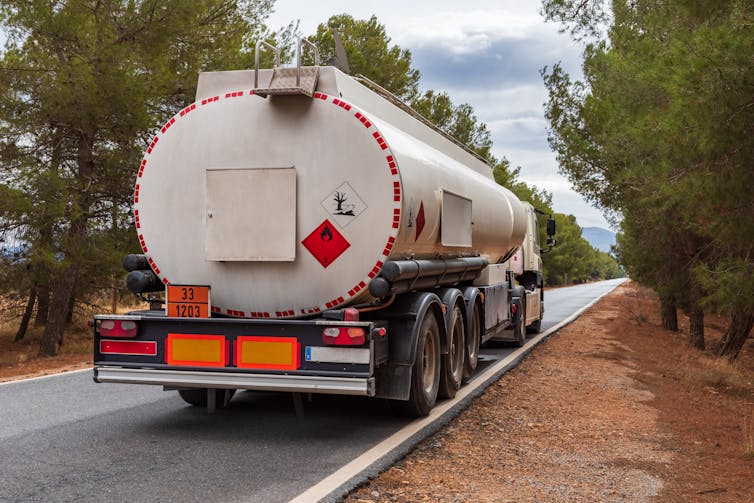
Hazardous materials regulations make sure that the vehicles carrying them have the right labels. Miguel Perfectti/iStock via Getty Images Plus

Ever wonder what those colorful signs with symbols and numbers on the backs of trucks mean? They’re just one visible part of a web of regulations that aim to keep workers and the environment safe while shipping hazardous waste.

Transporting hazardous materials such as dangerous gases, poisons, harmful chemicals, corrosives and radioactive material across the country is risky. But because approximately 3 billion pounds of hazardous material needs to go from place to place in the U.S. each year, it’s unavoidable.

With all the material that needs to cross the country, hazardous material spills from both truck and rail transportation are relatively unavoidable. But good regulations can keep these incidents to a minimum.

As an operations and logistics expert, I’ve studied hazardous materials transportation for years. Government agencies from the municipal to federal levels have rules governing the handling and transportation of these materials, though they can be a little complicated.

A hazardous material is anything that can cause a health or safety risk to people or the environment. Regulators put hazardous materials into nine categories and rate them based on the level of danger they pose during transport and handling.

These ratings help anyone associated with the shipment take precautions and figure out the right packaging and transportation methods for each type of hazardous material.

Who regulates hazardous material?

A number of agencies across the country closely scrutinize the entire hazardous materials supply chain from start to finish. The Occupational Safety and Health Administration regulates the proper handling of hazardous materials where they’re either manufactured or used. OSHA puts limits on how much hazardous material one person can be exposed to and for how long.

If the material spills, or if there’s any left over when they’re done being used, the U.S. Environmental Protection Agency, handles its disposal. Both EPA and OSHA regulations come into play during spills.

In between, the U.S. Department of Transportation regulates all of the movement of hazardous materials through four of its administrations.

The Pipeline and Hazardous Materials Safety Administration regulates the transportation of hazardous materials by truck, rail, pipeline and ship. The Federal Railroad Administration plays a role in regulating rail shipments, just as the Federal Highway Administration oversees movement over the road. In the air, the Federal Aviation Administration regulates hazardous materials.

Key regulations

Two essential regulations govern the handling and transportation of hazardous materials. In 1975, the EPA published the Hazardous Material Transportation Act, which protects people and property from hazardous material transportation risks.

This act gave the secretary of transportation more regulatory and enforcement authority than before. It gave the secretary power to designate materials as hazardous, add packaging requirements and come up with operating rules.

The Pipeline and Hazardous Materials Safety Administration oversees hazardous materials regulations that apply to everything from packaging and labeling to loading and unloading procedures. They also include training requirements for workers who have to handle hazardous materials and plans to make sure these materials stay secure.

Along with the Federal Highway Administration, the Pipeline and Hazardous Materials Safety Administration and the Federal Motor Carrier Safety Administration regulate hazardous material movement by road.

A white label reading
Hazardous material regulations require proper labeling of trucks carrying materials. BanksPhotos/E+ via Getty Images

Trucking companies transporting hazardous materials need to use specific vehicles and qualified drivers to comply with Federal Motor Carrier Safety Administration regulations. Drivers transporting hazardous materials must have specialized training and a hazardous materials endorsement on their commercial driver’s license.

The Pipeline and Hazardous Materials Safety Administration’s and the Federal Railroad Administration’s regulations for rail shipments require that rail cars fit physical and structural specifications. These specifications include having thick tanks and pressure release devices. Rail cars also have to undergo inspections and maintenance, per these rules.

The crew in charge of a hazardous materials train needs specialized training. And rail carriers need to have emergency response plans in case of a hazardous material spill.

Both truck and rail companies must follow regulations that require the proper classification, packaging and labeling of hazardous materials. The symbols on these labels let handlers and emergency responders know the potential risks the materials pose.

The Pipeline and Hazardous Materials Safety Administration’s security regulations prevent theft or sabotage of hazardous materials. They make sure that only authorized people can access the shipments. These regulations may require background checks for workers, secure storage facilities, and systems that track and monitor hazardous material.

Hazardous material shipments and incidents both have increased in the past 10 years. Anyone involved in the supply chain needs to understand hazardous material regulations.

Sticking to these rules helps get these materials from place to place safely. It also keeps safe those who handle them and minimizes the risk of accidents, injuries and environmental harm.The Conversation

Michael F. Gorman, Professor of Business Analytics and Operations Management, University of Dayton

This article is republished from The Conversation under a Creative Commons license. Read the original article.

Details
Written by: Michael F. Gorman, University of Dayton
Published: 24 April 2024

California Department of Water Resources updates allocation of State Water Project supplies for 2024

On Tuesday, the California Department of Water Resources announced a further increase in the State Water Project, or SWP, water supply allocation forecast for 2024.

The forecasted allocation has increased to 40%, up from 30% last month.

The State Water Project provides critical water supplies to 27 million Californians and farmers served by 29 public water agencies.

Tuesday’s increase would provide an additional 420,000 acre-feet of water, enough water to serve an estimated 1.5 million households for a year.

The allocation update is based on an 800,000 acre-foot increase in storage at Lake Oroville and the latest snow survey data from the all-important April 1 measurements. April 1 is typically when California sees peak snowpack and the start of the snowmelt season.

Statewide, the snowpack remains near average at 99 percent of average for this date. The spring forecast in the latest snow runoff report, known as Bulletin 120, also anticipates above average runoff this spring.

The State Water Project is working with the U.S. Army Corp of Engineers to manage flood releases and maximize the capture and storage of water from the winter storms and spring runoff in its reservoirs. Since Jan. 1, storage has increased by 917,000 acre-feet at Lake Oroville and by 178,125 acre-feet at San Luis Reservoir. Oroville is currently at 124 percent of average and 94 percent of capacity and is expected to reach capacity next month.

During the spring, the ability to move water supply south through the system will continue to be impacted by the presence of threatened and endangered fish species near the State Water Project pumping facility in the south Delta.

The presence of these fish species has triggered state and federal regulations that significantly reduce the pumping from the Delta into the California Aqueduct. This reduction in pumping has limited the ability to move and store water into San Luis Reservoir. This reduced pumping is expected to continue into late spring.

The State Water Project anticipates increasing its pumping significantly this summer as soon as the fishery conditions and our State and federal operating permits allow.

“This year highlights the challenges of moving water in wet periods with the current pumping infrastructure in the south Delta. We had both record low pumping for a wet year and high fish salvage at the pumps,” said DWR Director Karla Nemeth. “We need to be moving water when it’s wet so that we can ease conditions for people and fish when dry conditions return. It’s one more reason the Delta Conveyance Project, which would move water when the flows are high in a manner safer for fish, is a necessary climate adaptation project for California.”

Had the Delta Conveyance Project been in place this winter, the State Water Project would have been able to capture an additional 909,000 acre-feet of water since January 1. That’s enough water for 9.5 million people, or 3.1 million households, for a year.

The updated State Water Project allocation forecast announced Tuesday anticipates delivery of 40 percent of requested supplies to contractors south of the Delta, which accounts for the majority of contractors; 65 percent of requested supplies to contractors north of the Delta; and 100 percent allocation to Feather River Settlement Contractors.

Allocations are updated monthly as snowpack, rainfall, and runoff information is assessed, with a final allocation typically determined in May or June.

“While we are glad to see this modest allocation increase for public water agencies who rely on SWP supplies, it is still far below the amount of water we need,” said Jennifer Pierre, general manager of the State Water Contractors, a nonprofit association of 27 public agencies from Northern, Central and Southern California that purchase water under contract from the California State Water Project.

“Water deliveries should be far higher in a good water year like we've had — there is a lot of water in the system, California reservoirs are full, and runoff from snowpack melt is still to come. Today's modest allocation highlights just how difficult it is to operate within current regulatory constraints and with infrastructure in need of modernization. Even in a good water year, moving water effectively and efficiently under the current regime is difficult,” Pierre said.

Pierre said that, earlier this year, water operators reduced the amount of water they could divert from the Delta to protect endangered salmon and steelhead near the pumps. In a year with great hydrology, the unprecedented and significant export restrictions between January and March cost over a million acre-feet of water supply for the SWP, likely hampering our readiness for the next drought.

In addition, Pierre said that had the Delta Conveyance Project been operational this year, it could have captured and moved about 909,000 acre-feet of water between Jan. 1 and April 4 while keeping endangered species safe. That’s enough water to supply about 9.5 million people, or 3.1 million households — 35% of the SWP’s service population — for an entire year.

“While the presence of these fish hampered our ability to move and capture water for the entire winter and early spring season, it is important to note that water operators were able to protect many of them despite reports to the contrary. Most winter-run Chinook salmon and Central Valley steelhead categorized as captured or ‘taken’ at the pumps survive, are transported downstream, and then released to continue migrating to the Pacific Ocean,” Pierre said.

Pierre said scientific research indicates that salmon and steelhead salvaged at the pumps and released downstream are more likely to survive as they travel to the ocean than those that approach intake facilities but are not entrained. While there is a lot of evidence that salmonids this year experienced good survival conditions, there is no evidence that the significant salvage experienced this year had any meaningful effect on the salmonid population.

Protecting species is critically important, as is ensuring the 27 million people, 750,000 acres of farmland and countless businesses who rely on SWP supplies continue to receive affordable, high-quality water required to live and work, Pierre said.

“Infrastructure like the Delta Conveyance Project and updated regulatory rules like the Agreements to Support Healthy Rivers and Landscapes will allow us to better manage our water supplies for both people and fish. We must upgrade our decades-old infrastructure to keep pace with California’s rapidly changing climate and modify our regulations to reflect the best available science to ensure we can move excess flows efficiently with minimal impact on fish and capture precipitation when we get it for use when we don’t,” Pierre said.
Details
Written by: Lake County News reports
Published: 24 April 2024

Kelseyville Unified School District Board to discuss new version of Indigenous peoples proclamation

KELSEYVILLE, Calif. — The Kelseyville Unified School District Board of Trustees on Tuesday night will consider a proclamation that it says is meant to honor Indigenous peoples but which is being met with opposition by a group of citizens who are pushing back on a separate but simultaneous effort to change the town’s name.

The board will meet for a closed session at 6:30 p.m. Tuesday, April 23, before the public portion of the meeting begins at 7 p.m. in the Dr. Peter J. Quartarolo Board Room at the district office, located at 4410 Konocti Road. The meeting could move to the Tom Aiken Student Center at Kelseyville High School, 5480 Main St., if there is a large audience.

The full agenda can be found on the district’s website.

While the practice of offering proclamations is extremely common for all levels of local government, the proclamation being brought forward this week at Kelseyville Unified is viewed by opponents as a coordinated attack on the name of Kelseyville.

The proclamation comes as a group calling itself “Citizens for Healing” has a pending application before the U.S. Board of Geographic Names seeking that the name of Kelseyville be changed to “Konocti.” The district, however, has insisted that the two matters are not connected.

The minutes of the district’s March 19 regular board meeting show that the proclamation honoring Indigenous people and lands originally was proposed by Trustee Gilbert Rangel, who is the clerk of the board.

“Clerk Rangel discussed the idea to generate this proclamation stemmed from high school graduation and its public speakers, wanting to carry more depth and significance to represent the indigenous land and Native American demographics. He indicated it is not a political issue, not to cause a division with the populations, rather to unite. He made an open invitation to fulfill the proclamation by fellow KVUSD Board Members, the Superintendent, and the Public.”

Rangel’s presentation was followed by comments from seven individuals, some identifying as Native American, some not, who offered support for the idea, and emphasized they were not taking sides.

One of the speakers, Beniakem Cromwell, a former Kelseyville Unified Board member who now serves as tribal chair of the Robinson Rancheria Band of Pomo Indians, thanked Rangel and said, according to the minutes, that the proclamation “is not to fight, rather only to heal.”

Following the discussion and public input, board members said they felt the draft proclamation was “well written and thought out. The Board discussed to provide [sic] feedback regarding the Proclamation statements and individually report to Clerk Rangel with any statement recommendations,” the minutes said.

The belief that the proclamation and the name change are connected appears to have arisen because that initial version of the proclamation, discussed at the March meeting, has language that can be interpreted as suggesting that the district was supporting changing the town’s name.

In reference to the several tribes native to Lake County, that initial version of the proclamation stated in its next-to-last paragraph, “let it be recognized that this district will not be able to fully and truly honor the citizens of these nations and their ancestors who lived here for generations for as long as it bears a name that for those citizens and their ancestors represent a painful past.”

Additionally, that original proclamation ended by urging “positive action on this proclamation by residents, local businesses, educators, community and faith-based organizations, and district employees.”

Numerous community members, discussing the matter on the “Save Kelseyville” Facebook page, have posted emails they’ve sent to board members in the weeks since opposing the proclamation as it was originally worded and rallying community members to attend this week’s board meeting.

The controversy led the school district on April 17 to post a graphic that said “Correcting misinformation,” along with the following message on its Facebook page: “At its April meeting, the Kelseyville Unified School District board will discuss whether to adopt a resolution that recognizes, expresses appreciation for, and honors indigenous peoples who have an historic relationship with the lands of the district. The resolution also respectfully invites our community to join in this effort towards healing and reconciliation. The resolution does NOT address the issue of whether to change the name of our town. KVUSD does not take sides on political issues. We serve all Kelseyville students.”

Along with that post was an updated version of the proclamation that shows that the paragraph about the district not being able to “fully and truly honor” Indigenous peoples while the town bears a name that represents a painful past has been removed.

A new paragraph was inserted that says “this district acknowledges that its name represents a painful past for citizens of these nations and their ancestors who have lived here for generations.”

The new document, like the former version, commits the district to conducting a land acknowledgement “at every major event of importance including graduations.”

It also speaks about building awareness of Indigenous people and promoting the “continued unification of the community.”

The updated proclamation now ends by stating, “the Kelseyville Unified School District Governing Board invites our community to join in this effort towards healing and reconciliation.”

The full text of the updated resolution follows.


RESOLUTION 23/24-19
RESOLUTION OF THE BOARD OF TRUSTEES OF THE
KELSEYVILLE UNIFIED SCHOOL DISTRICT
FOR HEALING AND RECONCILIATION WITH INDIGENOUS PEOPLES AND LANDS


WHEREAS, the Kelseyville Unified School District’s jurisdiction as an educational institution along with its administrative and educational facilities sits on the land that is the ancestral and traditional territory of diverse indigenous nations and we strive to honor these peoples; and

WHEREAS, the Kelseyville Unified School District acknowledges the painful, tragic, and traumatic history of genocide and forced removal from this land, we honor the indigenous people still connected to this land where we live, work, and learn; and

WHEREAS, the Kelseyville Unified School District sits in the land of what was known to the indigenous people as the sacred mountain of Kno’Qoti, and this area Kelseyville Unified School District occupies, comprises in part the lands originally cared for by and home to the Elemi, Habematolel, Shigom, Wilokyomi, Xa-Ben-Na-Po, and Ye-Mah-Bax; and

WHEREAS, this district acknowledges that its name represents a painful past for citizens of these nations and their ancestors who have lived here for generations; and

WHEREAS, Kelseyville Unified School District extends our deepest respect to citizens of these nations who live here and elsewhere today and their ancestors who lived here for generations; and

WHEREAS, The Kelseyville Unified School District will announce a Land Acknowledgement at every major event of importance including graduations; and

WHEREAS, the Kelseyville Unified School District will seek to build the district’s cultural richness by fostering and promoting education and awareness of our indigenous peoples; and

WHEREAS, Kelseyville Unified School District recognizes that in the pursuit of honoring healing and reconciliation, we commit to promoting the continued unification of the community, together.

THEREFORE, BE IT RESOLVED, the Kelseyville Unified School District formally recognizes, expresses appreciation for, and honors indigenous peoples who have a historic relationship with the lands of the district; and

FURTHER, the Kelseyville Unified School District Governing Board respectfully invites our community to join in this effort towards healing and reconciliation.

Email Elizabeth Larson at This email address is being protected from spambots. You need JavaScript enabled to view it.. Follow her on Twitter, @ERLarson, or Lake County News, @LakeCoNews.
Details
Written by: Elizabeth Larson
Published: 23 April 2024
  1. State Senate approves Sen. Dodd’s Berryessa Snow Mountain expansion bill
  2. States boost Earth Day impact with Climate Corps expansion
  3. Wild turkey numbers are falling in some parts of the US – the main reason may be habitat loss

Subcategories

Community

  • 697
  • 698
  • 699
  • 700
  • 701
  • 702
  • 703
  • 704
  • 705
  • 706
How to resolve AdBlock issue?
Refresh this page
Copyright © 2026 Lake County News,California. All Rights Reserved.