How to resolve AdBlock issue?
Refresh this page
Lake County News,California
  • Home
    • Registration Form
  • News
    • Education
    • Veterans
    • Community
      • Obituaries
      • Letters
      • Commentary
    • Police Logs
    • Business
    • Recreation
    • Health
    • Religion
    • Legals
    • Arts & Life
    • Regional
  • Calendar
  • Contact us
    • FAQs
    • Phones, E-Mail
    • Subscribe
  • Advertise Here
  • Login
How to resolve AdBlock issue?
Refresh this page

News

Parents don’t need to try harder – to ease parenting stress, forget self-reliance and look for ways to share the care

Modern parents experience many demands, with little support. Abraham Gonzalez Fernandez/Moment via Getty Images

I wrap up my workday and head for home, making a quick stop to grab the supplies my sixth grader needs for a project due this week and some ingredients for a quick dinner.

Once home, I check the sixth grader’s school website and discover a missing assignment. Bringing this up sparks a minor meltdown. I summon the emotional energy to help her calm down and problem-solve. My husband arrives home with our high schooler, who’s discouraged by something that happened at soccer practice. We’ll have to process that later.

Around the dinner table, we realize that both kids have sports practices Thursday, on opposite ends of town, at the same time as a mandatory parent meeting at school. And now I’m ready for my own meltdown.

On this particular evening, my family wasn’t navigating anything unique or especially catastrophic. Scenes like this play out nightly in homes across the United States. In fact, my family’s circumstances offer the protections of multiple forms of privilege. Certainly others have more difficult circumstances.

Why is it still so hard?

For a long time, I felt ashamed for being overwhelmed by parenthood. How do others seem to have it all together? Of course, the highlight reel of social media only fueled this comparison game. I often felt that I was falling short, missing some hack that others had found for not feeling constantly exhausted.

The reality is I’m far from alone in experiencing what social scientists term parenting stress. Defined as the negative psychological reaction to a mismatch between the demands of parenting and the resources available, parenting stress has become increasingly prevalent over the past five decades. In the wake of the COVID-19 pandemic, nearly half of all parents in the U.S. said their stress was completely overwhelming on most days.

Stress like this has an impact: Parents who experience high levels of parenting stress have decreased mental health and feel less close with their children.

I began researching parental stress and well-being when, several years after becoming a parent, I left my job as a social worker and entered a Ph.D. program. Through this process, I learned something that changed my perspective entirely: Parents today experience such high levels of stress because people have never traditionally raised children in isolation. And yet, we are more isolated than ever.

It clicked: Parents don’t need to do more or try harder. We need connection. We don’t need more social media posts on the “top three ways to keep your family organized.” We need a paradigm shift.

small boy runs away from camera toward extended family at a party
In the age of the nuclear family, it’s common for multiple generations to come together only on special occasions. Maskot/DigitalVision via Getty Images

The myth of family self-reliance

Throughout human history, people primarily lived in multigenerational, multifamily arrangements. Out of necessity, our hunter-gatherer ancestors relied upon their clan-mates to help meet the needs of their families, including child-rearing. Research over time and across cultures suggests that parents are psychologically primed to raise children in community – not in isolated nuclear family units.

Anthropologists use the term alloparents – derived from the Greek “allo,” meaning “other” – to describe nonparent adults who provide care alongside that provided by parents.

Research suggests that alloparenting contributes to child well-being and even child survival in populations with high rates of child mortality. A 2021 study of a present-day foraging population in the Philippines found that alloparents provided an astounding three-quarters of the care for infants and an even greater proportion of the care for children ages 2 to 6.

In contrast, the ideal of the nuclear family is incredibly recent. It developed with industrialization, peaking in the 1950s and 1960s. Despite the significant changes in family structure – such as an increase in single-parent households – since that period, the paragon of the self-reliant nuclear family persists.

And yet, support from others is a key factor in family resilience. The familiar adage “It takes a village to raise a child” is, in fact, bolstered by social support research among parents in general, as well as those of children with special needs.

Parenting with collective care

Social support, while often viewed as a singular phenomenon, is actually a constellation of actions, each with its own unique function. Social scientists specify at least three types of support:

  • Tangible: Material or financial resources or assistance
  • Emotional: Expressions of care, empathy and love
  • Informational: Provision of information, advice or guidance

Different parenting challenges call for different types of support. When my husband and I realized we had three commitments in a single evening, we didn’t need advice on managing our family’s calendar; we needed someone to take our kid to practice – that’s tangible support. When my tween was blowing up over homework, I didn’t need someone to bring us dinner; I needed to remember what I learned from a book on parenting adolescent girls – that’s informational support.

To move away from the myth of family self-reliance and back toward an ideal of collective care would take a paradigm shift, requiring intervention at every level, from federal to state to family. A 2024 Surgeon General’s Advisory on parenting stress called it an urgent public health issue and provided recommendations for government leaders, service systems and communities. Systemic strategies like providing access to high-quality mental health care, expanding programs like Head Start that support parents and caregivers, and investing in social infrastructure like public libraries and parks could all help reduce parenting stress in the U.S.

three adults hold four toddlers on their laps outside
Finding other families at the same stage you’re in can be one way to fill out your village. VIJ/iStock via Getty Images Plus

Personal steps toward a paradigm shift

Parenting stress is not a problem that can be solved solely by the individuals experiencing it. But here are five ways you can start making the shift toward collective care in your own life:

  1. Take stock of your network. Assess not only in terms of the number of supporters, but what types of support they offer. Do you have plenty of people to talk to, but no one who would bring you a meal or give your kid a ride? Identify gaps and consider ways to round out your “village.”
  2. Start small. Introduce yourself to your retired neighbor. Sit next to another parent at your kid’s sporting event. Talk to the babysitter you regularly see at the playground. Supportive relationships don’t just happen; they are grown.
  3. Offer help to others. While it seems counterintuitive, people who give support to others experience greater well-being and even longevity compared with those who don’t. Helping others also creates the opportunity for reciprocity. Those you support may be more likely to return the favor in the future.
  4. Normalize asking for help and taking it when offered. For many people, asking for support is hard. It requires dropping the facade and letting people in on your struggles. However, people are often more willing to help than you might assume. Further, allowing others to help you gives them permission to voice their own needs in the future.
  5. Consider your caregiving expectations. The way others care for your children may not mirror your way entirely. Consider what are nonnegotiable practices for your family – such as limits on screen time – and what is worth loosening up on – like veggies at every meal – if it means you have more alloparents helping you out.

None of these suggestions are easy. They take time, vulnerability and courage. In our society of rugged individualism and nuclear family self-reliance, parenting through a lens of collective care is downright countercultural. But perhaps it’s closer to how we, as humans, have raised children throughout the millennia.The Conversation

Elizabeth Sharda, Associate Professor of Social Work, Hope College

This article is republished from The Conversation under a Creative Commons license. Read the original article.

Officials warn of Lake County residents’ information being given to Immigration and Customs Enforcement

LAKE COUNTY, Calif. — Access to the private information of millions of Californians and tens of thousands of Lake County residents who have used Medi-Cal and CalFresh has been given to the Department of Homeland Security’s Immigration and Customs Enforcement, or ICE, an action that also is affecting millions of other Americans.

On July 1, California Attorney General Rob Bonta led a multistate coalition to sue the Trump Administration over the transfer of the data.

“The Trump Administration has upended longstanding privacy protections with its decision to illegally share sensitive, personal health data with ICE. In doing so, it has created a culture of fear that will lead to fewer people seeking vital emergency medical care,” said Attorney General Bonta.

Bonta said California and 19 other states were headed to court “to prevent any further sharing of Medicaid data — and to ensure any of the data that’s already been shared is not used for immigration enforcement purposes.”

State and county officials said the data for the Medicaid program, created in 1965, has been strictly protected up until this point.

“In the seven decades since Congress enacted the Medicaid Act to provide medical assistance to vulnerable populations, federal law, policy, and practice has been clear: the personal healthcare data collected about beneficiaries of the program is confidential, to be shared only in certain narrow circumstances that benefit public health and the integrity of the Medicaid program itself,” Bonta’s office said in a July 1 statement.

As of January, 78.4 million people were enrolled in Medicaid and the Children’s Health Insurance Program nationwide, Bonta’s office reported.

In a statement on the situation, Lake County Social Services explained that, to receive federal funding, California has always been required to share data gathered from the local county welfare department with the federal government.

Medi-Cal data must be shared with the federal Center for Medicaid and Medicare Services, or CMS, and CalFresh data must be shared with the federal United States Department of Agriculture, Food and Nutrition Services, Social Services reported.

Social Services said this data has traditionally been treated with strict confidentiality, used only for program administration.

However, on June 13, CMS released Medicaid data to the Department of Homeland Security’s Immigration and Customs Enforcement, or ICE.

The data CMS released to ICE included the names, Social Security numbers and home addresses of Medi-Cal recipients.  

The federal government claims it gave this data to DHS “to ensure that Medicaid benefits are reserved for individuals who are lawfully entitled to receive them.” But Bonta’s office said it is Congress that extended coverage and federal funds for emergency Medicaid to all individuals residing in the United States, regardless of immigration status.

Bonta’s office said that on June 13, California and other states learned through news reports that Health and Human Services has transferred en masse their state’s Medicaid data files, containing personal health records representing millions of individuals, to DHS. 

“Reports indicate that the federal government plans to create a sweeping database for ‘mass deportations’ and other large-scale immigration enforcement purposes,” the Attorney General’s Office reported.

Medicaid is known as Medi-Cal in California. California’s Medi-Cal program provides health care coverage for one out of every three Californians, including more than two million noncitizens, the Attorney General’s Office reported.

Non-citizens include green card holders, refugees, individuals who hold temporary protected status, Deferred Action for Childhood Arrival recipients, and others. 

Not all noncitizens are eligible for federally funded Medi-Cal services, and so California uses state-only funds to provide a version of the Medi-Cal program to all eligible state residents, regardless of their immigration status, the Attorney General’s Office reported.

The lawsuit didn’t stop the Trump administration from continuing to move forward, with a July 17 Associated Press report stating that CMS signed an agreement with Homeland Security to allow ICE continued access to all Medicaid recipient’s data, nationwide.  

On the same day as the Associated Press report was published, Bonta came out with a statement, noting his alarm that the data sharing agreement came out after the lawsuit he is leading against the government.

“I’m deeply disturbed by the Trump Administration’s reckless and unprecedented weaponization of the private, sensitive data of Medicaid recipients,” said Bonta. “It is devastating to think that individuals may not seek essential medical care because they are afraid that if they do so, they may be targeted by this Administration. We sued President Trump and his lackeys after we received initial reports of this illegal data sharing earlier this month. Despite this, the Trump Administration appears to have entered into a new illegal data sharing agreement with ICE. We are moving quickly to secure a court order blocking the sharing of this data for immigration enforcement. The President’s efforts to pull personal, private, and unrelated health data to create a mass deportation machine cannot be allowed to continue.”

A hearing on the motion for a preliminary injunction filed against the Trump administration by California and the multistate coalition is scheduled for Aug. 7. 

The coalition is asking that the court find the Trump Administration’s actions arbitrary and capricious and rulemaking without proper procedure in violation of the Administrative Procedure Act, contrary to the Social Security Act, Health Insurance Portability and Accountability Act, or HIPAA, the Federal Information Security Modernization Act and Privacy Act, and in violation of the Spending Clause. 

They’re also asking the court to enjoin Health and Human Services from transferring personally identifiable Medicaid data to Homeland Security or any other federal agency and Homeland Security from using this data to conduct immigration enforcement.  

The impacts in Lake County

In Lake County, Medi-Cal is known as the Partnership Health Plan, said Social Services Director Rachael Dillman Parsons.

Dillman Parsons told Lake County News that as of June, 30,490 individuals were enrolled in Medi-Cal in Lake County. That’s roughly 45% of the Lake County population, which as of Jan. 1, the California Department of Finance reported that Lake County had a population of 67,254 residents.

She said that the specific information regarding how many or whose data was released by CMS to ICE was not available to her.

In Social Services’ statement on the situation, it noted, “Individuals will need to weigh their risk in continuing to receive, or applying for, needed benefits. Lake County Social Services cannot delete case records or prevent federal data sharing. We can no longer assure people that the information we gather will be used solely for program administration.”

Social Services said it encourages trusted partners to help individuals, especially immigrants, assess their personal risks and benefits of accessing human services programs in this environment.

The California Department of Social Services funds community organizations to provide certain resources for immigrants. A list can be found here.

“Experts anticipate that the chilling effect from this federal data sharing will create further strain on already limited food distribution resources and medical care, the impact of which will be felt community wide,” Social Services said.

“These are concerning times,” Dillman Parsons told Lake County News.

Other lawsuits push back on information usage

In May, the US Department of Agriculture’s Food and Nutrition Services, or FNS, released a notice about a new National Supplemental Nutrition Assistance Program, or SNAP, Information Database, which referenced a March executive order by President Trump called “Stopping Waste, Fraud, and Abuse by Eliminating Information Silos.”

The agency planned to use the data on SNAP applicants, recipients, and former recipients for a wide variety of purposes.  

“FNS will use the data it receives from processors to ensure program integrity, including by verifying the eligibility of benefit recipients. This is consistent with FNS’s statutory authority and the President’s Executive Order and will ensure Americans in need receive assistance, while at the same time safeguarding taxpayer dollars from abuse,” the agency said.

SNAP is known as CalFresh in California and is sometimes referred to as “EBT” since the benefits are loaded onto an Electronic Benefit Transfer, or EBT, card to be spent at grocery stores on food.  

Groups including Protect Democracy, Student Defense, the National Center for Law and Economic Justice and the Electronic Privacy Information Center on behalf of students, SNAP recipients, MAZON: A Jewish Response to Hunger and EPIC filed a lawsuit against the Trump administration over the plan.

As a result, by the start of June, the Trump administration backed off the plan, with senior U.S. Department of Agriculture official Shiela Corley giving a sworn declaration “that the agency has not collected any of the SNAP recipient data in question and will not proceed with its plan to do so without following laws intended to protect privacy and data security,” according to a Protect Democracy statement on the suit.

Email Elizabeth Larson at This email address is being protected from spambots. You need JavaScript enabled to view it.. Follow her on Twitter, @ERLarson, and on Bluesky, @erlarson.bsky.social. Find Lake County News on the following platforms: Facebook, @LakeCoNews; X, @LakeCoNews; Threads, @lakeconews, and on Bluesky, @lakeconews.bsky.social. 

Russian earthquake triggers tsunami concerns along West Coast

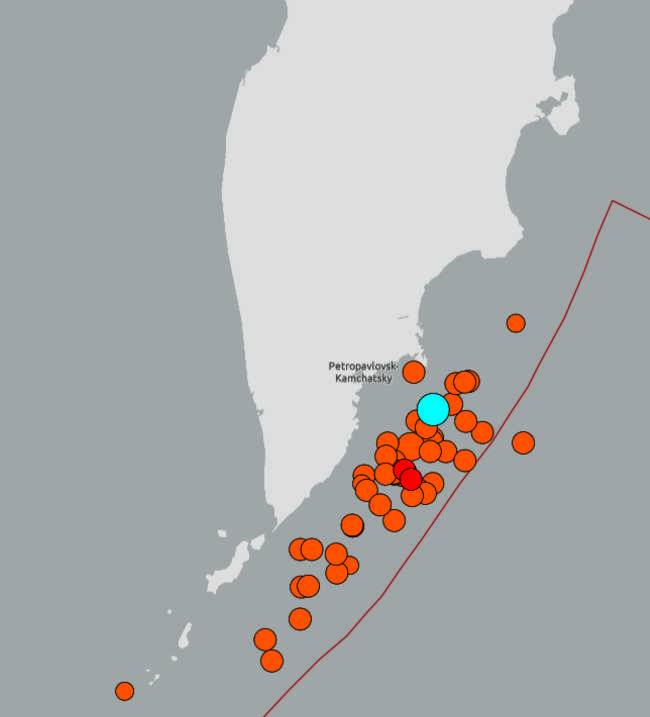
The 8.8 earthquake that happened off the eastern coast of Russia on Tuesday, July 29, 2025, shown in blue, followed by a cluster of other smaller, but still significant, earthquakes. Image courtesy of the United States Geological Survey.


NORTHERN CALIFORNIA — A Tuesday afternoon earthquake off the Russian coast triggered a tsunami advisory for much of the West Coast, and a warning for the Hawaii Islands and a portion of the North Coast of California.

The United States Geological Survey said the 8.8-magnitude earthquake occurred just before 4:30 p.m. Pacific Time off the Kamchatka Peninsula on the eastern coast of Russia.

That initial quake was followed by dozens of quakes in the same area, some as large at 6.5 magnitude.

The quake’s 8.8-magnitude earned it a tie for the sixth-largest recorded earthquake, according to seismic historical records.

The National Tsunami Warning Center began issuing updates on the potential for a tsunami shortly after it occurred.

At around 10 p.m. Tuesday night, “a tsunami is occurring in the Pacific Ocean tonight,” the center posted on its Facebook page.

“This is the most significant event we've seen in some time. It is _not_ the same thing as recent alerts near California in December, or Alaska a few weeks ago,” the center said in its post.

At that time, a tsunami warning was in effect for the Western Aleutians and Pribilof Islands in the Bering Sea, which later was downgraded to an advisory.

A warning was in effect for the Hawaiian Islands, and a stretch of the Northern California coast that included northern Humboldt County and southern Del Norte County. A tsunami advisory was in place for the rest of the West Coast.  

Late Tuesday, the Sonoma County Sheriff’s Office said the Sonoma coast was under a tsunami warning until 3:30 a.m. 

The public was urged to stay out of coastal waters, off the beach, harbor docks and piers as strong currents and dangerous waves were expected. 

Tsunami start times for the North Coast were:

• Fort Bragg: 11:50 p.m. July 29.
• Crescent City: 11:50 p.m. July 29.
• Monterey: 12:15 a.m. July 30.
• San Francisco: 12:40 a.m. July 30.

The Sonoma County Sheriff’s office said tsunamis often arrive as a series of waves or surges which could be dangerous for many hours after the first wave arrives. The first tsunami wave or surge may not be the highest in the series. 

The forecast peak tsunami wave heights along much of the North Coast were expected to be less than one foot high.

The Del Norte Office of Emergency Services said late Tuesday that tsunami waves from 2.7 to 5 feet would begin to arrive shortly before midnight and may last for approximately 30 hours. 

In a late Tuesday night video, Eric Wier, Crescent City’s city manager, said the tsunami would not be like that of 1964. 

He said some city residents in an inundation area had been asked to evacuate. A temporary evacuation point was set up at the Veteran's Memorial Building in Crescent City.

Ryan Aylward of the National Weather Service said that when high tide arrives around 3 a.m., there could be waves that are higher than the normal high tide, with the surge into the 5 foot range. There is the possibility of some minor flooding close to the bay.

State Sen. Mike McGuire, who was on the video with Del Norte officials, noted that the worst case scenario could have been much worse.

Email Elizabeth Larson at This email address is being protected from spambots. You need JavaScript enabled to view it.. Follow her on Twitter, @ERLarson, and on Bluesky, @erlarson.bsky.social. Find Lake County News on the following platforms: Facebook, @LakeCoNews; X, @LakeCoNews; Threads, @lakeconews, and on Bluesky, @lakeconews.bsky.social. 

Clearlake churches partner for school backpack giveaway

CLEARLAKE, Calif. — Praises of Zion Baptist Church and the Church of the Nazarene in Clearlake are partnering to present a community backpack giveaway for all local children attending schools in the area.

The churches’ inaugural backpack giveaway will take place from 11 a.m. to 2 p.m. Saturday, Aug. 2, at the Church of the Nazarene, 15917 Olympic Drive.  

The two churches are distributing 150 backpacks filled with school supplies.

The children — from kindergarten through high school — must be present to receive a backpack, while supplies last.

In addition to the backpacks, there will be agencies present to provide health and safety information for parents and children as the children prepare to go back to school starting in August.  

For more information, call the Church of the Nazarene at 707-994-4008.

Revoking EPA’s endangerment finding – the keystone of US climate policies – isn’t simple and could have unintended consequences

Several U.S. climate regulations aim to reduce burning of fossil fuels, a driver of climate change. Visions of America/Joseph Sohm/Universal Images Group via Getty Images

Most of the United States’ major climate regulations are underpinned by one important document: It’s called the endangerment finding, and it concludes that greenhouse gas emissions are a threat to human health and welfare.

The Trump administration is trying to eliminate it.

Environmental Protection Agency Administrator Lee Zeldin announced on July 29, 2025, that the EPA would soon publish a rule to rescind the endangerment finding and allow 45 days for public comment.

A draft released by the EPA of the proposal argues that the agency didn’t have the authority to issue the endangerment finding in 2009 or regulations based on it. The draft also argues that U.S. vehicle emissions are not significant in terms of global emissions of greenhouse gases and that the costs to consumers outweigh the benefits.

These are dubious factual and legal propositions that will require deeper analysis once the proposal is officially published in the Federal Register.

Revoking the endangerment finding isn’t a simple task. If the rule is finalized, it will also trigger an onslaught of lawsuits. And revoking the finding could have unintended consequences for the very industries President Donald Trump is trying to help.

EPA Administrator Lee Zeldin announces plans in March 2025 to reconsider more than 30 climate regulations.

As a law professor, I have tracked federal climate regulations and the lawsuits and court rulings that have followed them over the past 25 years. To understand the challenges, let’s look at the endangerment finding’s origins and Zeldin’s options.

Origin and limits of the endangerment finding

In 2007, the U.S. Supreme Court ruled in Massachusetts v. EPA that six greenhouse gases are pollutants under the Clean Air Act and that the EPA has a duty under the same law to determine whether they pose a danger to public health or welfare.

The court also ruled that once the EPA made an endangerment finding, the agency would have a mandatory duty under the Clean Air Act to regulate all sources that contribute to the danger.

The court emphasized that the endangerment finding was a scientific determination and rejected a laundry list of policy arguments made by the George W. Bush administration for why the government preferred to use nonregulatory approaches to reduce emissions. The court said the only question was whether sufficient scientific evidence exists to determine whether greenhouse gases are harmful.

The endangerment finding was the EPA’s response.

The finding was challenged and upheld in 2012 by the U.S. Court of Appeals for the D.C. Circuit. In that case, Coalition for Responsible Regulation v. EPA, the court found that the “body of scientific evidence marshaled by the EPA in support of the endangerment finding is substantial.” The Supreme Court declined to review the decision. The endangerment finding was updated and confirmed by the EPA in 2015 and 2016.

Challenging the endangerment finding

The scientific basis for the endangerment finding is stronger today than it was in 2009.

The Intergovernmental Panel on Climate Change’s latest assessment report, involving hundreds of scientists and thousands of studies from around the world, concluded that the scientific evidence for warming of the climate system is “unequivocal” and that greenhouse gases from human activities are causing it.

According to the National Climate Assessment released in 2023, the effects of human-caused climate change are already “far-reaching and worsening across every region of the United States.”

Maps show most of the US, especially the West, getting hotter, and the West getting drier.
Summer temperatures have climbed in much of the U.S. and the world as greenhouse gas emissions have risen. Fifth National Climate Assessment

During Trump’s first term, then-EPA Administrator Scott Pruitt considered repealing the endangerment finding but ultimately decided against it. In fact, he relied on it in proposing the Affordable Clean Energy Rule to replace President Barack Obama’s Clean Power Plan for regulating emissions for coal-fired power plants.

Zeldin’s cost argument

Zeldin had previewed some of his arguments for rescinding the endangerment finding in a news release on March 12.

His first argument then was that the 2009 endangerment finding did not consider costs. However, that argument was rejected by the District of Columbia Circuit Court in Coalition for Responsible Regulation v. EPA in 2012. Cost becomes relevant once the EPA considers new regulations – after the endangerment finding.

Moreover, in a unanimous 2001 decision, the Supreme Court in Whitman v. American Trucking Associations held that the EPA cannot consider cost in setting air quality standards.

What happens if the EPA revokes the endangerment finding?

Even if Zeldin is able to revoke the endangerment finding, that does not automatically repeal all the rules that rely on it. Each of those rules must go through separate rulemaking processes that will also take months. The agency will also face lawsuits.

Zeldin could simply refuse to enforce the rules on the books.

However, a blanket policy abdicating any enforcement responsibility could be challenged in lawsuits as arbitrary and capricious. Further, the regulated industries would be taking a chance if they delay complying with regulations, only to find the endangerment finding and climate laws still in place.

A repeal could backfire

Repealing the endangerment finding could also backfire on the fossil fuel industry.

States and cities have filed dozens of lawsuits against the major oil companies. The industry’s strongest argument has been that these cases are preempted by federal law. In AEP v. Connecticut in 2011, the Supreme Court ruled that the Clean Air Act “displaced” federal common law, barring state claims for remedies related to damages from climate change.

However, if the endangerment finding is repealed, then there is arguably no basis for federal preemption, and these state lawsuits would have legal grounds. Prominent industry lawyers have warned the EPA about this and urged it to focus instead on changing individual regulations. The industry is concerned enough that it may try to get Congress to grant it immunity from climate lawsuits.

To the extent that Zeldin is counting on the conservative Supreme Court to back him up, he may be disappointed.

In 2024, the court overturned the Chevron doctrine, which required courts to defer to agencies’ reasonable interpretations when laws were ambiguous. That means Zeldin’s reinterpretation of the statute is not entitled to deference. Nor can he count on the court overturning its Massachusetts v. EPA ruling to free him to disregard science for policy reasons.

This article, originally published March 19, 2025, has been updated with the EPA’s announcement to rescind the endangerment finding.The Conversation

Patrick Parenteau, Professor of Law Emeritus, Vermont Law & Graduate School

This article is republished from The Conversation under a Creative Commons license. Read the original article.

Unemployment in Lake County and across the state rises in June

LAKE COUNTY, Calif. — The state’s latest report on the jobless rate showed a one-point jump for Lake County’s unemployment, while the state rate also edged up.

The California Employment Development Department’s report said Lake County’s rate rose from 6.3% in May to 7.3% in June. The June 2024 rate was 6.6%.

California’s June unemployment rate changed slightly, rising to 5.4% from 5.3% in May. The state’s June 2024 rate was 5.3%.

The federal Bureau of Labor Statistics said the nationwide unemployment rate was 4.1% in June, down from 4.2 percent in May. The June 2024 jobless rate also was 4.1%.

The report said that the number of Californians employed in June was 18,770,800, an increase of 21,700 persons from May’s total of 18,749,100 and up 153,100 from the employment total in June 2024.

At the same time, the number of unemployed Californians was 1,070,000 in June, an increase of 11,700 over the month and up 28,800 in comparison to June 2024.

California payroll jobs fell from 18,017,200 in May 2025 to 18,011,100 in June 2025. On a year-to-year basis, payroll jobs increased to 18,011,100 from 17,910,000, according to the report.

California has gained 3,091,300 jobs since April 2020, an average of 49,860 per month, the report said. Although the State did post a month-over loss of 6,100 jobs for June 2025, California has a net gain of 101,100 nonfarm jobs since June 2024.

Four of California's 11 industry sectors gained jobs in June, with private education and health services (+9,900) posting a gain for the 41st consecutive month, according to the report.

The largest gains were in health care and social assistance (+2,700). This includes jobs in continuing care retirement communities and assisted living facilities, and nursing and residential care facilities, partly attributed to California’s aging population.

Leisure and hospitality (+4,300) also posted a month-over job gain as the arrival of the summer season spurs growth in California’s recreation-focused businesses such as arts and entertainment, spectator sports, and amusement parks.

Professional and business services (-9,900) posted the state’s largest month-over loss as jobs declined in administrative and support services and temporary employment services. Losses also occurred in accounting, tax preparation, bookkeeping and payroll services, and computer systems design.

In Lake County, the transportation, warehousing and utilities sector grew by 12.3%; federal government, 6.7%; the total farm category, 4.5%; and manufacturing, 3%.

Categories showing losses included professional and business services, down 6.6%; goods producing, down 2.2%; and service producing, down -0.7%.

In the July report, Lake County’s jobless rate ranked it 46 out of California’s 58 countries. Lake’s neighboring county jobless rates and ranks last month were: Colusa, 12.2%, No. 57; Glenn, 7.8%, No. 48; Mendocino, 5.8%, No. 27; Napa, 4.2%, No. 3; Sonoma, 4.6%, No. 8; and Yolo, 6.1%, No. 32.

In related data that figures into the state’s unemployment rate, there were 387,555 people certifying for Unemployment Insurance benefits during the June 2025 sample week. 

The Employment Development Department said that this compares to 384,749 people in May and 381,123 people in June 2024. 

Concurrently, 46,629 initial claims were processed in the June 2025 sample week, which was a month-over increase of 5,393 claims from May, but a year-over increase of 1,467 claims from June 2024.

Email Elizabeth Larson at This email address is being protected from spambots. You need JavaScript enabled to view it.. Follow her on Twitter, @ERLarson, and on Bluesky, @erlarson.bsky.social. Find Lake County News on the following platforms: Facebook, @LakeCoNews; X, @LakeCoNews; Threads, @lakeconews, and on Bluesky, @lakeconews.bsky.social. 

  • 181
  • 182
  • 183
  • 184
  • 185
  • 186
  • 187
  • 188
  • 189
  • 190

Community

  • Sheriff’s Activities League and Clearlake Bassmasters offer youth fishing clinic

  • City Nature Challenge takes place April 24 to 27

Public Safety

  • Lakeport Police logs: Wednesday, Feb. 11

  • Lakeport Police logs: Tuesday, Feb. 10

Education

  • Ramos measure requiring school officer training in use of anti-opioid drug moves forward

  • Lake County Chapter of CWA announces annual scholarships 

Health

  • California ranks 24th in America’s Health Rankings Annual Report from United Health Foundation

  • Healthy blood donors especially vital during active flu season

Business

  • Employment law summit takes place March 9

  • Two Lake County Mediacom employees earn company’s top service awards

Obituaries

  • Terry Knight

  • Ellen Thomas

Opinion & Letters

  • Who should pay for AI’s power? Not California ratepayers

  • Crandell: Supporting nephew for reelection in supervisorial race

Veterans

  • State honors fallen chief warrant officer killed in conflict in Iran

  • CalVet and CSU Long Beach team up to improve data collection related to veteran suicides

Recreation

  • April Audubon program will show how volunteers can help monitor local osprey nests

  • First guided nature walk of spring at Anderson Marsh State Historic Park April 11

  • Second Saturday guided nature walks continue at Anderson Marsh State Historic Park

  • Wet weather trail closure in effect on Upper Lake Ranger District

Religion

  • Kelseyville Presbyterian Church plans Easter service

  • Easter ‘Sonrise’ Service returns to Xabatin Community Park

Arts & Life

  • ‘CIA’ delves into the shadowy world of an espionage thriller

  • ‘War Machine’ shifts the battlefield into uncharted territory

Government & Politics

  • Lake County Democratic Central Committee endorses Falkenberg

  • Crandell launches reelection campaign plans March 15 event

Legals

  • April 23 hearing on Lake Coco Farms Major Use Permit

  • NOTICE OF 30-DAY PUBLIC COMMENT PERIOD & NOTICE OF PUBLIC HEARING

How to resolve AdBlock issue?
Refresh this page