How to resolve AdBlock issue?
Refresh this page
Lake County News,California
  • Home
    • Registration Form
  • News
    • Education
    • Veterans
    • Community
      • Obituaries
      • Letters
      • Commentary
    • Police Logs
    • Business
    • Recreation
    • Health
    • Religion
    • Legals
    • Arts & Life
    • Regional
  • Calendar
  • Contact us
    • FAQs
    • Phones, E-Mail
    • Subscribe
  • Advertise Here
  • Login
How to resolve AdBlock issue?
Refresh this page

News

New sewer spill incident command team reports on plans, progress

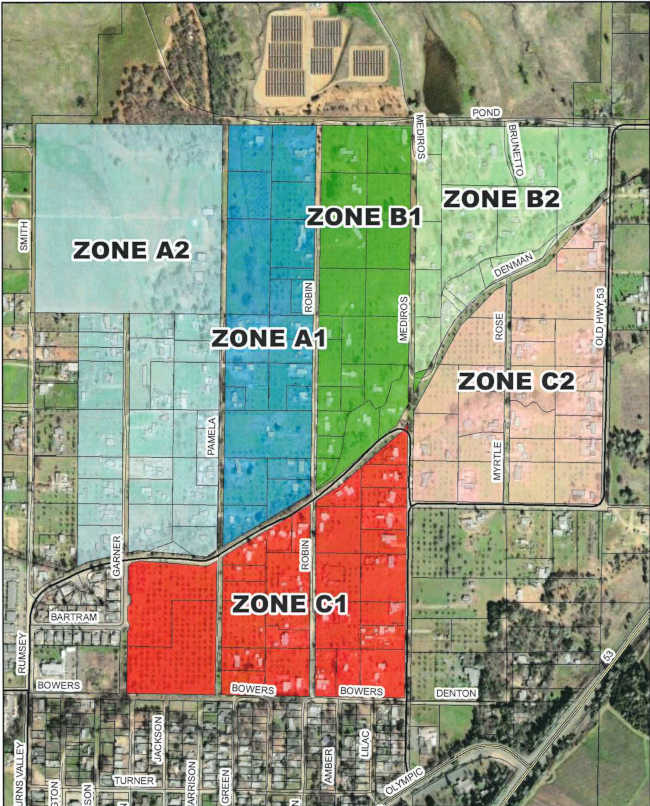
A map of the 2026 Robin Lane Sewer Spill area divided into zones. The map was released at the third sewer spill town hall on Wednesday, Jan. 28, 2026. 


CLEARLAKE, Calif. – County and city of Clearlake officials on Wednesday held a town hall at Clearlake City Hall to update residents on recovery progress and next steps following the Robin Lane sewage spill two and a half weeks ago.

The two-hour meeting was the third weekly town hall-style session with officials and residents since Jan. 11, when a force main on Robin Lane ruptured.

The failure released an estimated 2.9 million gallons of raw sewage from a sewer system owned and operated by the Lake County Sanitation District, which is overseen by Lake County Special Districts.

More than 200 properties relying on private water wells across an area of about 297 acres have been impacted and remain under a public health advisory not to use well water.

Wednesday marked the 18th day residents had been without clean running water.

The immediate response to the spill was led by Lake County Special Districts. Command was transferred Monday to a joint command between the city of Clearlake and the Lake County Office of Emergency Services. 

County officials including Environmental Health Director Craig Wetherbee, Special Districts Administrator Robin Borre, Health Services Director Anthony Arton, Public Health Officer Dr. Bob Bernstein and Social Services Director Rachael Dillman Parson were in attendance.

Also on hand were city staff and officials, including City Council members Dirk Slooten, Mary Wilson and Russ Cremer. Cremer lives in the spill area and whose well has been impacted.

City-led assessments at affected properties began Tuesday.

Officials at the meeting say they are actively collecting information from impacted residents and will make “data-driven” decisions regarding resources and solutions toward recovery.

“It’s continuing to take way longer than I want it to and I can only imagine what you guys are feeling,” said District 2 Supervisor Bruno Sabatier.

Undersheriff Corey Paulich, who also is the deputy director for the Office of Emergency Services, said the city and his agency established the incident command team on Monday and began making plans.

“Our role is recovery,” and trying to get everyone back to their homes,” Paulich said.

Beginning on Monday, the incident command sent out assessment teams working across the spill area, which has been mapped out in six zones.

The area directly impacted by the sewage flow was mapped out as “Zone A1” which encompasses south of Pond Road, north of Rumsey, west of Robin Lane and east of Pamela Lane.

Within that area, everyone who “needed a tank will have a tank,” said Paulich.

Paulich said the assessment teams were able to test the majority of houses in every zone with the exception of a couple, which will be done on Thursday. The test results will take about 24 hours.

The estimated cost of that testing is $300 per well per day, costs that are expected to be covered by a $750,000 appropriation approved by the Board of Supervisors last week. Those funds also will cover water tanks meant to be a temporary solution for the residents needing a backup water source.

City Manager Alan Flora said they wouldn’t be able to do the work without the new team in place.

He said the goal for this incident command team is very simple – to get people back in their homes as quickly as possible. 

The assessment teams covered 60 to 70 percent of the parcels on Tuesday; the remainder should have been contacted on Wednesday. Those spill area residents who didn’t receive outreach are asked to contact the city.

Flora said the team hopes to start reducing the incident’s scope and they expect to move to an updated advisory for water use as soon as Thursday. 

Well sanitization has been ongoing in the spill area. When a well is tested and gets two negative tests in a row – 24 hours apart – for E. coli and coliform, the property owner will get a notification with test results and information on how to treat their wells going forward, Flora said.

After two clean tests, residents will get the all clear to use their wells, he said.

Flora also reported that a hydrologist has been hired to assist with studying the aquifer and helping to understand the spill’s impact on it.

Community members seek answers

The nearly 100 people in attendance spent about an hour and a half asking questions about numerous topics – in particular, who will get the backup water tanks, soil testing and safety, how the money approved by the Board of Supervisors will be spent, how much longer it might take to solve the water quality program and why some properties where wells are testing positive for contaminants aren’t on the map.

Cassandra Hulbert, who lives in the spill area, is immunocompromised and has two disabled children. Her well continues to have “hot” tests showing high levels of E. coli and coliform, but she said she’s yet to get a water tank, while she’s watched them go in at nearby properties.

In response to questions about tank distribution and prioritization, Sgt. Ben Moore said it was location based, and the new data and test results will help guide where tanks go.

Stephanie Piseno, who along with husband Juan runs a day care at their home on Robin Lane, said she made claims on her homeowners and day care insurance and is going to lose them as a result. She’s also losing children who previously attended her day care, and she is concerned about her children being able to play outside.

“I don’t even know what to do,” she said, adding that she’s never going to feel comfortable or safe on her property.

Flora said they are working on possible long-term plans and outside funding sources to connect to public water and the sewer system itself.

When asked by a spill area resident about who is going to oversee Lake County Special Districts to ensure they are doing property maintenance, Flora said the Board of Supervisors and the State Water Board have oversight. 

He added that there have been issues in the sewer system “for a significant period of time.” The Clearlake City Council is very concerned about the situation, and they want to have a role in the governance of Special Districts. 

Asked about when residents could expect a return to normalcy, Paulich responded, “I don’t know that we can give you a date.”

The incident team isn’t yet committing to another town hall, however, daily communication to the community about the incident will resume on Thursday, Flora said.

Flora said the city of Clearlake’s website will be the main source of information, with a webpage dedicated to the incident. 

“All of the resources that we have available will be posted there,” he said.

Additional information requests about the incident can be directed to Administrative Services Director/City Clerk Melissa Swanson, who also is acting as the incident’s public information officer, at 707-994-8201, Extension 106.

Staff reporter Lingzi Chen contributed to this report. She is a 2024-2026 California Local News Fellow. Email her at This email address is being protected from spambots. You need JavaScript enabled to view it.. 

Email Elizabeth Larson at This email address is being protected from spambots. You need JavaScript enabled to view it.. Follow her on Twitter, @ERLarson, and on Bluesky, @erlarson.bsky.social. Find Lake County News on the following platforms: Facebook, @LakeCoNews; X, @LakeCoNews; Threads, @lakeconews, and on Bluesky, @lakeconews.bsky.social. 

Thompson, Masui call for Noem impeachment, ICE funding cuts after Minneapolis killings

Congressman Mike Thompson and Congresswoman Doris Matsui are calling for urgent oversight, transparency and accountability of the Department of Homeland Security and Immigration and Customs Enforcement in the wake of two killings in Minneapolis this month.

Thompson (CA-04) and Matsui (CA-07) on Tuesday held a press conference outside the John E. Moss Federal Building, which houses ICE personnel in Sacramento, warning that unchecked federal enforcement is putting lives at risk in California and across the country.

Following the killings of Renee Good and Alex Pretti in Minneapolis, Thompson, Matsui and their Democratic colleagues are demanding a stop to ICE funding and DHS Secretary Kristi Noem’s removal from office.

They said the chaos in Minneapolis is the latest escalation in Americans’ concerns about federal agencies operating without sufficient oversight.

“Like so many Americans, I am sickened by ICE’s killings of Renee Good and Alex Pretti in Minneapolis,” said Congressman Thompson. “This is just the latest in ICE’s abuses across our country, including in Sacramento. Enough is enough. There is nothing legal, moral, ethical, nor humane with what’s going on in Minnesota and our Republican colleagues in Congress need to grow some courage and join us to impeach Kristi Noem, cut ICE funding, and stop the chaos.”

“From Sacramento to Minneapolis, we are seeing the same dangerous pattern: more force, less transparency, and no accountability from DHS and ICE,” said Congresswoman Matsui. “This is the fifth time I have stood outside this building demanding answers from a rogue agency. The fact that we are here again shows how persistent and unchecked this abuse of power has become. Secretary Kristi Noem must be held accountable, ICE needs to get out of our communities, and Congress must stop funding abuse disguised as enforcement. We will not stop fighting until there is real and independent accountability.” 

“NorCal Resist affirms our commitment to our immigrant community and to defending fundamental democratic and human rights values this administration seeks to ignore through immigration enforcement,” said Giselle Garcia, program director, NorCal Resist. “May all representatives in Congress oust each transgressor and hold them accountable for their crimes against humanity. May the people continue to resist in the face of repression and fight for the world we deserve.” 

Congressman Thompson and Congresswoman Matsui were among the first members of Congress to co-sponsor articles of impeachment against Noem, citing systemic failures in leadership and oversight. 

Last week, Thompson and Matsui also voted no on legislation to provide funding to DHS, arguing that Congress must not continue to expand the power and resources of agencies that have demonstrated a pattern of terrorizing communities and trampling constitutional rights.

In addition to voting against funding for ICE last week, Congressman Thompson has introduced legislation to require ICE agents to wear body cameras and prohibit them from wearing masks or police insignia. 

Thompson also has hosted numerous “Know Your Rights” workshops for local businesses and community members to help people learn their rights when interacting with federal agents.

The legislative fight for DHS funding now moves to the U.S. Senate, where lawmakers face a critical decision: approve DHS funding or hold the line. 

With lives at stake, Congressman Thompson and Congresswoman Matsui reiterated that Congress cannot continue to fund DHS.

Thompson represents California’s Fourth Congressional District, which includes all or part of Lake, Napa, Solano, Sonoma and Yolo counties. 

Little Hoover Commission holds hearing on California’s developmental disabilities system

SACRAMENTO — California families that rely on the state’s system for developmental disabilities continue to struggle with barriers to service, lengthy delays, and inconsistent implementation across regions, according to testimony received by the Little Hoover Commission.

Witnesses described long waits for critical services and the heavy burden placed on families to navigate gaps in the system. 

The Jan. 22 hearing reviewed implementation of the commission’s past recommendations for reforms to the system.

Michelle Del Rosario said that even when her son’s needs were formally identified, services were not implemented. 

“Services exist, but there is no consistent process to ensure they are implemented,” she told commissioners. 

Her son, William Del Rosario, underscored the impact of those delays, noting he has waited six years for communication-trained support staff. “Six years is far too long to wait for access to education, employment, and community life.”

Judy Mark, co-founder and president of Disability Voices United, told commissioners that access to services still depends too heavily on a family’s ability to fight the system. 

“We have spent decades building supports that should be there by default,” she said, warning that uneven implementation continues to leave many families behind.

Pete Cervinka, who became director of the California Department of Developmental Services slightly more than a year ago, said the department has issued new guidance and oversight measures aimed at improving consistency across regional centers, while acknowledging that translating policy changes into timely, on-the-ground results remains an ongoing challenge.

Amy Westling, executive director of the Association of Regional Center Agencies, testified that regional centers have worked to reduce disparities in spending levels for Latino and non-Latino clients, though she was pressed by commissioners about the need for greater consistency, greater independence of regional center boards, and more use of the state's self-determination program.

The hearing was part of the commission’s review of its recommendations from its past report “A System in Distress: Caring for Californians with Developmental Disabilities.”

The commission anticipates releasing a report later this year regarding the implementation of that report's recommendations.

Eating less ultraprocessed food supports healthier aging, new research shows

Studies have linked ultraprocessed foods to poor health outcomes, but such foods make up about half the calories of a typical American diet. Kobus Louw/E+ via Getty Images

Older adults can dramatically reduce the amount of ultraprocessed foods they eat while keeping a familiar, balanced diet – and this shift leads to improvements across several key markers related to how the body regulates appetite and metabolism. That’s the main finding of a new study my colleagues and I published in the journal Clinical Nutrition.

Ultraprocessed foods are made using industrial techniques and ingredients that aren’t typically used in home cooking. They often contain additives such as emulsifiers, flavorings, colors and preservatives. Common examples include packaged snacks, ready-to-eat meals and some processed meats. Studies have linked diets high in ultraprocessed foods to poorer health outcomes.

My team and I enrolled Americans ages 65 and older in our study, many of whom were overweight or had metabolic risk factors such as insulin resistance or high cholesterol. Participants followed two diets low in ultraprocessed foods for eight weeks each. One included lean red meat (pork); the other was vegetarian with milk and eggs. For two weeks in between, participants returned to their usual diets.

A total of 43 people began the dietary intervention, and 36 completed the full study.

In both diets, ultraprocessed foods made up less than 15% of the total calories – a significant reduction from the typical American diet, where more than 50% of total calories comes from ultraprocessed foods. The diets were designed to be realistic for everyday eating, and participants were not instructed to restrict calories, lose weight or change their physical activity.

Older couple shopping in a supermarket
Maintaining metabolic health promotes healthy aging. Giselleflissak/E+ via Getty Images

We prepared, portioned and provided all meals and snacks for the study. Both diets emphasized minimally processed ingredients and aligned with the 2020-2025 Dietary Guidelines for Americans, the U.S. government’s nutrient-based recommendations for healthy eating, while providing similar calories and amounts of key nutrients.

The 2025-2030 Dietary Guidelines for Americans, released on Jan. 7, 2026, explicitly recommend eating less ultraprocessed food, but the previous versions of the guidelines did not specifically address food processing. Our feeding study design allowed us, for the first time, to examine the health effects of reducing ultraprocessed foods while keeping nutrient levels consistent with recommended targets.

We compared how participants fared while eating their habitual diets with how they responded to the two diets that were low in ultraprocessed foods. During the periods when participants ate fewer ultraprocessed foods, they naturally consumed fewer calories and lost weight, including total and abdominal body fat. Beyond weight loss, they also showed meaningful improvements in insulin sensitivity, healthier cholesterol levels, fewer signs of inflammation and favorable changes in hormones that help regulate appetite and metabolism.

These improvements were similar whether participants followed the meat-based or the vegetarian diet.

Why it matters

Ultraprocessed foods make up more than half the calories consumed by most U.S. adults. Although these foods are convenient and widely available, studies that track people’s diets over time increasingly link them with obesity and age-related chronic diseases such as Type 2 diabetes and heart disease. With older adults making up a growing share of the global population, strategies that preserve metabolic health could support healthy aging.

Most previous feeding studies testing how ultraprocessed foods affect people’s health haven’t reflected real-world eating, especially among Americans. For example, some studies have compared diets made up almost entirely of ultraprocessed foods with diets that contain little to none at all.

Our study aimed to more closely approximate people’s experience while still closely tracking the foods they consumed. It is the first to show that for older adults a realistic reduction in ultraprocessed foods, outside the lab, has measurable health benefits beyond just losing weight. For older adults especially, maintaining metabolic health helps preserve mobility, independence and quality of life.

What’s still unknown

Our study was small, reflecting the complexity of studies in which researchers tightly control what participants eat. It was not designed to show whether the metabolic improvements we observed can prevent or delay diseases such as diabetes or heart disease over time. Larger, longer studies will be needed to answer that.

On the practical side, it’s still unclear whether people can cut back on ultraprocessed foods in their daily lives without structured support, and what strategies would make it easier to do so. It’s also not fully understood which aspects of processing – for example, additives, emulsifiers or extrusion – matter more for health.

Answering these questions could help manufacturers produce foods that are healthier but still convenient – and make it easier for people to choose healthier food options.

The Research Brief is a short take on interesting academic work.The Conversation

Moul Dey, Professor of Nutrition Science, South Dakota State University

This article is republished from The Conversation under a Creative Commons license. Read the original article.


Warm winter skies: Majestic birds of prey take center stage at Clear Lake

American bald eagle at Lucerne Harbor Park. Photo by Craig Nelson.

LAKE COUNTY, Calif. — With temperatures climbing into the high 60s, Clear Lake has become a bustling theater for some of nature’s most impressive aviators. 

While many anglers are firing up their boats in search of bass and crappie, the real action lately has been happening in the sky and on the shorelines.

The "majestic" American bald eagle is the star of the show this season. 

American bald eagle on Long Tule Point. Photo courtesy of Jace Garger.


These iconic birds migrate to our shores between December and March to fish and perch among the lakeside trees. 

Recently, a mating pair was spotted scouting territory at Long Tule Point before relocating to Rodman Island later in the afternoon. 

Catching a glimpse of these hunters in action is an exhilarating experience that is truly breathtaking.

A great blue heron. Photo courtesy of Jace Garger.


It isn’t just the eagles making waves. Clear Lake remains a premier habitat for several other massive species.

The great blue heron stands 4 feet tall with a staggering 7-foot wingspan, these are North America’s largest herons. These birds are frequently seen stalking fish and small mammals along the shoreline. One was recently observed successfully snagging a bluegill for lunch near Lands End. 

Another bird of prey recently observed is the American white pelicans. These winter regulars are hard to miss, boasting wingspans of up to 9.5 feet. Look for them gathering in large groups to fish the shallow waters near Lucerne Harbor Park, where they work together to corral schools of fish.

White pelicans in Lucerne, California. Photo courtesy of Rudy Brown.

For those who prefer the action below the surface, the Best Bass Tournament Golden Mussel Division is the next big event on the calendar, starting this weekend.

Hosted by Clear Lake Outdoors, the team-format event features a 100% payback. 

Whether you’re holding a fishing rod or a pair of binoculars, the warm winter weather makes this a perfect week to explore Clear Lake.

Craig Nelson is a former professional golfer who fell in love with tournament bass fishing 20 years ago. He found Lake County after fishing an FLW Stren Series event and never left. He’s the back-to-back winner of the Konocti Classic and runner up in the inaugural WON Bass Clear Lake Open.


Best Bass Tournament Golden Mussel Division Clear Lake, California, tournament flyer provided by Clear Lake Outdoors.

Third sewage spill town hall planned for Wednesday; assessment teams contact impacted residents

LAKE COUNTY, Calif. — County and city officials are planning to update community members on the latest developments regarding the Robin Lane sewer spill at the third in a series of town hall meetings.

The meeting will take place at 6 p.m. Wednesday, Jan. 28, at Clearlake City Hall, 14050 Olympic Drive.

Officials have been holding the town hall meetings on Wednesday evenings since the spill occurred on Sunday, Jan. 11.

The spill was the result of the rupture of a 16-inch force main operated by the Lake County Sanitation District, overseen by Lake County Special Districts.

Officials said an estimated 2.9 million gallons of raw sewage spilled out into neighborhoods in the northern part of the city of Clearlake, ultimately impacting 200 properties on roughly 300 acres east of Smith Lane, west of Old Highway 53, south of Pond north of Bowers Avenue.

On Monday, officials announced that the city of Clearlake and the Lake County Office of Emergency Services were taking over joint command of the sewer spill’s ongoing recovery.

On Tuesday, city-led assessments teams began contacting residents on the affected properties. 

Lake County News spoke to three residents on Robin Lane — the epicenter of the incident — who said the visits from the city-led assessment teams on Tuesday were the first time officials had come to their properties to ask for information.

Impacted property owners who need more information are urged to call Clearlake City Hall at 707-994-8201.

Staff reporter Lingzi Chen contributed to this report.

Email Elizabeth Larson at This email address is being protected from spambots. You need JavaScript enabled to view it.. Follow her on Twitter, @ERLarson, and on Bluesky, @erlarson.bsky.social. Find Lake County News on the following platforms: Facebook, @LakeCoNews; X, @LakeCoNews; Threads, @lakeconews, and on Bluesky, @lakeconews.bsky.social. 

  • 53
  • 54
  • 55
  • 56
  • 57
  • 58
  • 59
  • 60
  • 61
  • 62

Community

  • Sheriff’s Activities League and Clearlake Bassmasters offer youth fishing clinic

  • City Nature Challenge takes place April 24 to 27

Public Safety

  • Lakeport Police logs: Wednesday, Feb. 11

  • Lakeport Police logs: Tuesday, Feb. 10

Education

  • Ramos measure requiring school officer training in use of anti-opioid drug moves forward

  • Lake County Chapter of CWA announces annual scholarships 

Health

  • California ranks 24th in America’s Health Rankings Annual Report from United Health Foundation

  • Healthy blood donors especially vital during active flu season

Business

  • Employment law summit takes place March 9

  • Two Lake County Mediacom employees earn company’s top service awards

Obituaries

  • Terry Knight

  • Ellen Thomas

Opinion & Letters

  • Who should pay for AI’s power? Not California ratepayers

  • Crandell: Supporting nephew for reelection in supervisorial race

Veterans

  • State honors fallen chief warrant officer killed in conflict in Iran

  • CalVet and CSU Long Beach team up to improve data collection related to veteran suicides

Recreation

  • April Audubon program will show how volunteers can help monitor local osprey nests

  • First guided nature walk of spring at Anderson Marsh State Historic Park April 11

  • Second Saturday guided nature walks continue at Anderson Marsh State Historic Park

  • Wet weather trail closure in effect on Upper Lake Ranger District

Religion

  • Kelseyville Presbyterian Church plans Easter service

  • Easter ‘Sonrise’ Service returns to Xabatin Community Park

Arts & Life

  • ‘CIA’ delves into the shadowy world of an espionage thriller

  • ‘War Machine’ shifts the battlefield into uncharted territory

Government & Politics

  • Lake County Democratic Central Committee endorses Falkenberg

  • Crandell launches reelection campaign plans March 15 event

Legals

  • April 23 hearing on Lake Coco Farms Major Use Permit

  • NOTICE OF 30-DAY PUBLIC COMMENT PERIOD & NOTICE OF PUBLIC HEARING

How to resolve AdBlock issue?
Refresh this page